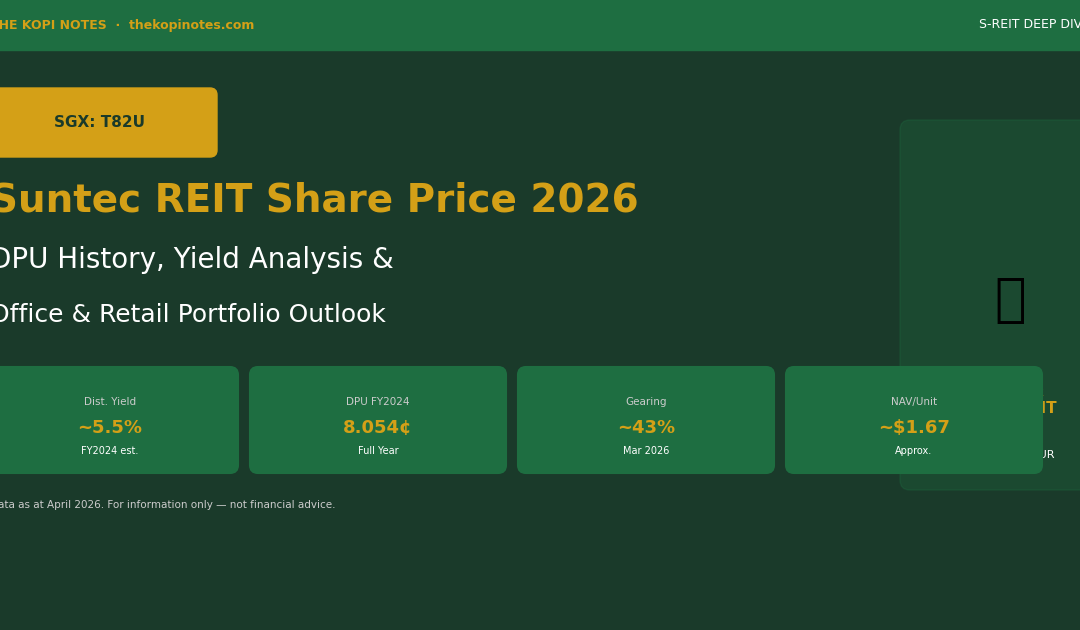
Suntec REIT Share Price 2026 (SGX: T82U): DPU History, Yield Analysis & Office/Retail Portfolio Deep-Dive
Suntec REIT (SGX: T82U) is one of Singapore’s oldest and most recognised diversified REITs, owning landmark office and retail assets including Suntec City, One Raffles Quay, and a growing international portfolio in Australia and Europe. This guide covers the 2026 share price outlook, DPU history, distribution yield, gearing, and how Suntec stacks up against its S-REIT peers — for Singapore investors doing their due diligence.
Data as at April 2026. This is not financial advice. Always conduct your own research before investing.
Table of Contents
Contents — Click to expand
- Suntec REIT Overview & SGX Listing
- Share Price Performance 2024–2026
- DPU History: FY2019–FY2024
- Distribution Yield Analysis
- Portfolio: Singapore, Australia & Europe
- Key Financials: Gearing, Interest Cover & NAV
- Peer Comparison: Office & Retail REITs
- 2026 Outlook & Risks
- How to Invest in Suntec REIT
- Frequently Asked Questions
Suntec REIT Overview & SGX Listing
Suntec REIT (SGX ticker: T82U) was listed on the Singapore Exchange in December 2004, making it one of Singapore’s pioneer listed REITs. Managed by ARA Trust Management (Suntec) Limited, the REIT holds interests in premier integrated commercial developments across Singapore, Australia, and the United Kingdom.
Its flagship Singapore asset — Suntec City — is a landmark integrated development in the heart of Marina Bay, comprising over 1.6 million square feet of Grade A office space and one of Singapore’s most visited retail malls. The REIT also holds interests in One Raffles Quay, MBFC Towers, and 21 Harris Street in Sydney among others.
| Key Fact | Details |
|---|---|
| SGX Ticker | T82U |
| REIT Type | Office & Retail (Diversified Commercial) |
| Listing Date | 9 December 2004 |
| Manager | ARA Trust Management (Suntec) Limited |
| Market Cap (approx.) | ~S$3.8 billion (April 2026) |
| Distribution Frequency | Semi-annual (H1 & H2 each year) |
| CPF-investible | Yes (CPF Investment Scheme — OA approved) |
| SRS-eligible | Yes |
Share Price Performance 2024–2026
Suntec REIT’s share price has faced headwinds over 2024–2025, largely reflecting the broader S-REIT market’s sensitivity to global interest rate movements. After the aggressive US Federal Reserve rate-hiking cycle pushed REIT valuations down from their 2022 peaks, Suntec found itself trading at a meaningful discount to its net asset value (NAV).
As of April 2026, Suntec REIT’s share price trades in the approximate range of S$1.40–S$1.55 per unit, reflecting a price-to-book ratio below 1.0x its NAV of approximately S$1.67 per unit. This discount has attracted income investors who believe the REIT’s core Singapore assets remain fundamentally strong despite near-term distribution pressure.
Key share price drivers to watch in 2026 include: the pace of US Federal Reserve rate cuts (which would lower Suntec’s borrowing costs and lift valuations), Singapore office demand from financial services and tech tenants, and the performance of the Australian and European assets in a softening commercial property environment.
Suntec REIT’s 52-week trading range (as at April 2026) has been approximately S$1.20 (low) to S$1.60 (high), underscoring the volatility that income investors must be prepared for in a rate-sensitive environment.
DPU History: FY2019–FY2024
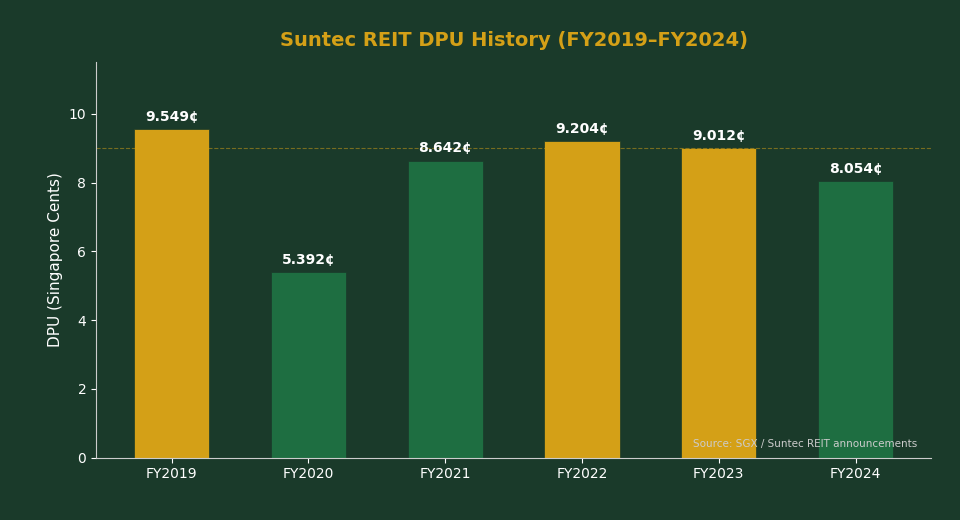
Understanding Suntec REIT’s Distribution Per Unit (DPU) history is critical for income investors. DPU is the actual cash distribution you receive per unit held — and tracking it over multiple years reveals the sustainability and growth trajectory of the REIT’s income stream.
| Financial Year | DPU (Singapore Cents) | YoY Change | Key Notes |
|---|---|---|---|
| FY2019 | 9.549¢ | — | Pre-COVID baseline; strong Singapore office market |
| FY2020 | 5.392¢ | –43.5% | COVID-19 rental rebates & retail mall closures |
| FY2021 | 8.642¢ | +60.3% | Recovery; reopening boost for Suntec City Mall |
| FY2022 | 9.204¢ | +6.5% | Full operational recovery; Singapore office demand strong |
| FY2023 | 9.012¢ | –2.1% | Higher interest costs; overseas asset softness |
| FY2024 | 8.054¢ | –10.6% | Higher borrowing costs; cautious distribution |
The FY2024 DPU of 8.054 Singapore cents represents a decline from peak levels, primarily driven by elevated interest expenses on Suntec’s floating-rate debt and softer contributions from its Australian and UK assets amid weaker overseas office markets. Singapore-based investors relying on the REIT for retirement income should monitor whether management can stabilise the DPU as global interest rates ease.
For CPF-OA investors, Suntec REIT’s history of semi-annual distributions makes it a viable income vehicle — though the recent DPU compression is a reminder that REIT distributions are never guaranteed. Learn how to optimise your CPF investment strategy in our CPF investment guide.
Distribution Yield Analysis
At the current share price of approximately S$1.45–S$1.55, Suntec REIT’s distribution yield based on FY2024’s declared DPU of 8.054 cents works out to approximately 5.2%–5.6%. This positions it as a mid-yield S-REIT in the commercial segment — higher than the CPF OA rate of 2.5%, but below higher-yield industrial and hospitality REITs.
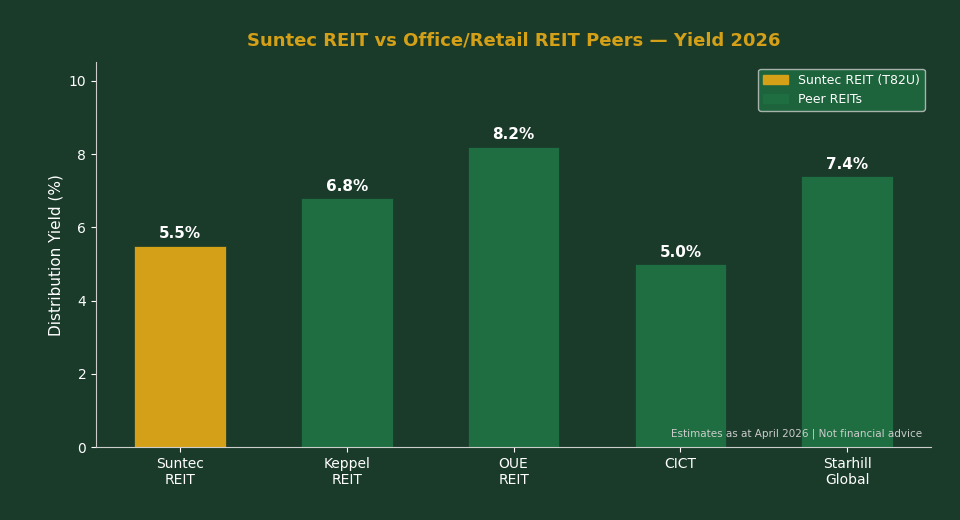
Compared to its office and retail REIT peers, Suntec REIT’s yield is broadly in line with CapitaLand Integrated Commercial Trust (CICT) — Singapore’s largest commercial REIT — but lower than more niche plays like OUE REIT (which trades at a steeper discount to NAV and carries more risk). Starhill Global REIT also offers a higher yield but with a smaller, more concentrated portfolio.
Investors should note that the gross distribution yield is not the same as total return. Suntec’s unit price appreciation (or depreciation) can significantly affect your total returns. At current prices, the discount-to-NAV provides a potential capital upside if rates normalise — but carries risk if the discount persists.
Use our S-REIT Dividend Yield Calculator to model your exact income based on current prices, and compare against our S-REIT Yield vs SGS Bond Spread Calculator to assess whether the current risk premium over risk-free rates justifies an allocation.
Portfolio: Singapore, Australia & Europe
Suntec REIT’s portfolio spans three geographies — Singapore (dominant), Australia, and the United Kingdom — making it one of the more internationally diversified S-REITs. Here’s a breakdown of its major assets as at April 2026:
| Asset | Location | Type | Suntec Stake |
|---|---|---|---|
| Suntec City Office Towers | Singapore | Grade A Office | 100% |
| Suntec City Mall | Singapore | Retail Mall | 100% |
| One Raffles Quay | Singapore | Grade A Office | 33.3% |
| MBFC Tower 1 & 2 | Singapore | Grade A Office | 33.3% |
| 21 Harris Street | Sydney, AUS | Office | 50% |
| Nova Properties | London, UK | Office | 50% |
| Olderfleet, 477 Collins Street | Melbourne, AUS | Office | 50% |
The Singapore assets remain the earnings engine of the REIT, with Suntec City’s office and retail components reporting consistently high occupancy rates above 95%. The Convention Centre, a unique non-REIT asset under the Suntec entity, adds footfall to the retail mall but doesn’t directly contribute to REIT distributions.
The overseas portfolio has been a drag on performance in recent years. The London Nova Properties experienced softer demand in the hybrid-work era, while Australian office markets in Sydney and Melbourne saw rising vacancy rates amid subdued demand from financial and professional services tenants. These headwinds are expected to ease gradually as return-to-office mandates strengthen globally.
Key Financials: Gearing, Interest Cover & NAV
Before investing in any S-REIT, Singapore investors should review three critical financial metrics: aggregate leverage (gearing), interest coverage ratio (ICR), and net asset value (NAV) per unit. The Monetary Authority of Singapore (MAS) mandates that S-REITs maintain a gearing cap of 50% (or 45% without a minimum ICR of 2.5x).
| Metric | As at Mar 2026 (est.) | Comment |
|---|---|---|
| Aggregate Leverage (Gearing) | ~43% | Above sector median; limits debt headroom |
| Interest Coverage Ratio (ICR) | ~2.4x | Sufficient; near MAS threshold for 50% cap |
| NAV Per Unit | ~S$1.67 | Trading at ~13–15% discount to NAV |
| Weighted Avg Debt Maturity | ~3.2 years | Manageable; refinancing risk moderate |
| % Fixed Rate Debt | ~60–65% | Partially hedged; still exposed to rate moves |
| Total Assets (approx.) | ~S$10.5 billion | One of Singapore’s larger diversified REITs |
Suntec’s gearing of around 43% is elevated relative to the S-REIT sector average of ~35–38%. This limits the manager’s ability to pursue acquisitions without equity fundraising and makes the DPU more sensitive to interest rate movements. However, with approximately 60–65% of its debt fixed at pre-2022 rates, some protection has been built in — the full impact of rate hikes is still filtering through as fixed-rate loans expire and are refinanced.
Use our S-REIT Gearing Ratio & ICR Calculator to stress-test how different interest rate scenarios affect Suntec’s distribution capacity.
Peer Comparison: Office & Retail REITs
Suntec REIT sits in the commercial REIT space alongside several other Singapore-listed office and retail REITs. Understanding how it compares helps investors make informed allocation decisions across the S-REIT universe.
| REIT | SGX Ticker | Yield (est.) | Gearing | Key Differentiator |
|---|---|---|---|---|
| Suntec REIT | T82U | ~5.5% | ~43% | Marina Bay + retail mall; overseas exposure |
| CICT | C38U | ~5.0% | ~38% | Largest commercial REIT; blue-chip, lower yield |
| Keppel REIT | K71U | ~6.8% | ~40% | Pure Grade A office; AUS + SG concentrated |
| OUE REIT | TS0U | ~8.2% | ~41% | Higher yield; smaller, more concentrated assets |
| Starhill Global REIT | P40U | ~7.4% | ~35% | Orchard retail + office; lower gearing |
Suntec REIT sits at a mid-point in the risk-yield spectrum: more diversified and liquid than OUE REIT or Starhill Global, but with a lower yield than peers and higher gearing. Investors who prioritise liquidity, asset quality, and exposure to Marina Bay’s premium office corridor may still find Suntec compelling at a discount-to-NAV — especially as rate cuts materialise and overseas asset valuations recover.
For a broader S-REIT comparison, see our Best S-REITs Singapore 2026 guide which ranks the top S-REITs by yield, gearing and portfolio quality.
2026 Outlook & Risks
Suntec REIT’s 2026 outlook is cautiously optimistic, contingent on several macro and REIT-specific factors coming together.
Tailwinds: The Fed’s rate-cutting cycle, which began in late 2024, is expected to continue into 2026. Each 25bps rate cut reduces Suntec’s floating-rate debt costs and could trigger a re-rating of the unit price toward NAV. Singapore’s Grade A office market remains fundamentally supported by demand from financial institutions, professional services firms, and tech companies that prefer premium, centrally-located space. Suntec City Mall continues to benefit from strong tourism recovery with Singapore reclaiming its status as a top MICE destination.
Headwinds: The overseas portfolio (Australia and UK) remains a drag. Hybrid work adoption has reduced demand for suburban and secondary-grade office space, though Suntec’s assets are generally well-located. Currency risk on AUD and GBP distributions adds volatility to DPU. Gearing near 43% limits the manager’s growth options and makes equity fundraising (which dilutes existing unitholders) more likely if an acquisition opportunity arises.
DPU trajectory: Analysts broadly expect Suntec’s DPU to stabilise at 8–8.5 cents for FY2025 before modestly recovering toward 9 cents by FY2026–2027 as rate costs ease. This would imply a forward yield of approximately 5.5–6% at current prices — a reasonable risk premium over Singapore’s 3-month T-bills and SGS bonds.
If you’re comparing whether S-REIT yields justify the risk over risk-free Singapore government bonds, use our T-Bill, SSB & Fixed Deposit Comparison Calculator.
How to Invest in Suntec REIT in Singapore
Singaporean investors can invest in Suntec REIT (T82U) through the following channels:
SGX trading platforms: Suntec REIT is listed on the Singapore Exchange and can be purchased through any SGX-connected brokerage. Popular options for Singapore retail investors include FSMOne, Interactive Brokers, Tiger Brokers, Moomoo, and DBS Vickers. Look for T82U when placing your buy order.
CPF OA: Suntec REIT is CPF Investment Scheme (CPFIS-OA) approved, meaning you can use your CPF Ordinary Account funds to invest in T82U. Remember that CPFIS investments must meet strict conditions — and the CPF OA interest rate of 2.5% is a guaranteed baseline you’re giving up.
SRS: Suntec REIT can also be purchased using your Supplementary Retirement Scheme (SRS) funds, making it useful for tax-efficient retirement income planning. Use our SRS Tax Savings Calculator to estimate your tax benefit from SRS contributions.
REIT ETFs: If you prefer broader S-REIT exposure without single-REIT concentration risk, consider Singapore REIT ETFs such as the Lion-Phillip S-REIT ETF (CLR) or the NikkoAM-StraitsTrading Asia ex Japan REIT ETF (CFA).
For DIY investors who want to maximise cashback or referral bonuses when opening a brokerage or investment account to buy S-REITs, check out our curated referral code pages:
Frequently Asked Questions — Suntec REIT
What is Suntec REIT's current distribution yield?
Is Suntec REIT a good investment in 2026?
What is Suntec REIT's share price today?
Can I buy Suntec REIT using CPF?
What is Suntec REIT's DPU history?
What is Suntec REIT's gearing ratio?
How does Suntec REIT compare to CICT?
Disclaimer: All information on this page is for educational and informational purposes only. The Kopi Notes is not a licensed financial adviser. Figures used in this article (DPU, yield, gearing, NAV) are estimates based on publicly available SGX announcements and management reports as at April 2026 — they may not reflect the most current data. Past performance is not indicative of future results. Always read the full prospectus and consult a qualified financial adviser before making any investment decision.
This article was researched with the help of AI. While we strive to keep all information accurate and up to date, there may be errors. If you notice any discrepancies, please contact us.