Syfe vs IBKR Singapore 2026: Which Wins for Long-Term Investors?
Managed robo-advisor fees vs self-directed broker costs, CPF/SRS access, and who actually comes out ahead on a typical Singapore portfolio.
Syfe is a managed robo-advisor charging a tiered annual fee (0.65% down to 0.25% of assets) for diversified, auto-rebalanced portfolios, while IBKR (Interactive Brokers) is a self-directed broker with no account minimum and near-zero per-trade commissions but zero advice or rebalancing. For most Singapore investors with smaller, simpler portfolios who want a hands-off approach, Syfe is more convenient; for larger, cost-conscious investors comfortable picking their own global stocks and ETFs, IBKR is usually cheaper long-term.
Not financial advice. All figures are for educational reference only. Data as at November 2026 unless noted.
Table of Contents
Quick Answer: Syfe vs IBKR
Syfe and Interactive Brokers (IBKR) sit on opposite ends of the investing spectrum. Syfe builds and manages a diversified portfolio for you — picking the underlying ETFs, rebalancing automatically, and handling dividend reinvestment — in exchange for an annual fee of 0.65% at the entry Blue tier, stepping down to 0.25% at the Diamond tier (S$5 million and above net invested). IBKR charges no annual asset-based fee at all. Instead, Singapore investors pay a small commission per trade — roughly 0.08% of trade value for SGX stocks (minimum S$2.50) and as little as US$0.005 per share for US stocks — but they must choose, size, and rebalance every position themselves.
For a Singapore investor who wants to “set and forget” a portfolio without researching individual stocks, Syfe’s managed approach is worth the fee. For someone comfortable building their own global equity allocation and who trades infrequently, IBKR’s near-zero cost structure wins on pure fees over a multi-year horizon — the gap widens as portfolio size grows, because Syfe’s fee is charged on the whole balance every year while IBKR’s commission is only charged when you actually trade.
Key Differences at a Glance
| Feature | Syfe | IBKR (Interactive Brokers) |
|---|---|---|
| Investment style | Managed, auto-rebalanced portfolios | Fully self-directed |
| Core fee | 0.65% (Blue) down to 0.25% p.a. (Diamond, S$5M+) | No annual account or AUM fee |
| Trading cost | Included in managed portfolios; Syfe Trade brokerage separately at 0.06%–0.04% SGX (min S$1.98) | ~0.08% SGX stocks (min S$2.50); from US$0.005/share US stocks |
| Account minimum | S$0 to open; fee tiers scale with balance | S$0 — no minimum balance or inactivity fee |
| Rebalancing | Automatic, included in the fee | Manual — you place every trade |
| Product range | Curated managed portfolios + limited self-trade list | 150+ global markets — stocks, ETFs, bonds, options, futures, FX |
| CPF OA investing | Not supported | Not CPFIS-approved |
| SRS investing | Supported on select portfolios | Only via indirect cash transfer from an SRS operator (DBS/OCBC/UOB) |
| Best for | Hands-off investors, beginners, cash management | Cost-conscious, self-directed, larger portfolios |
Fee & Tax-Efficiency Comparison
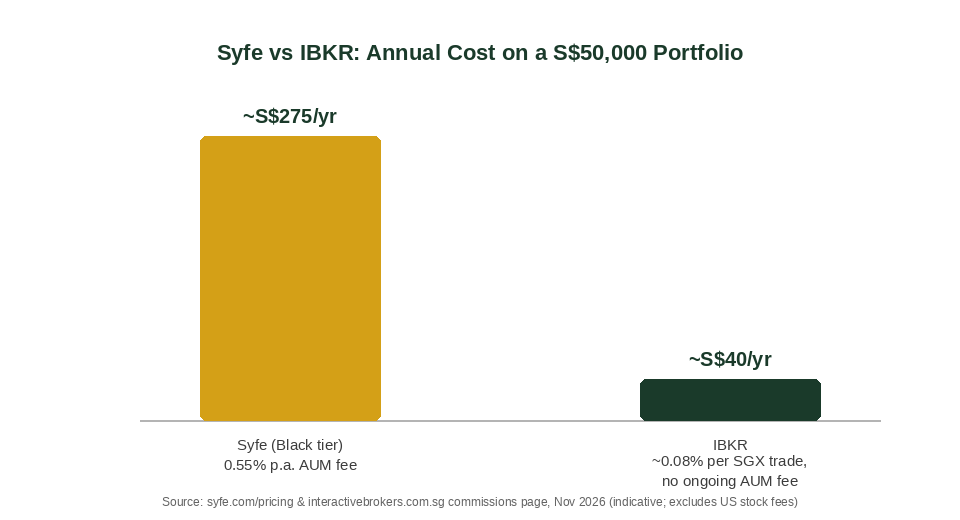
The single biggest driver of long-term returns between these two platforms is the fee structure, not the underlying investments — both platforms give Singapore investors access to the same global index ETFs if they choose to hold them. Syfe’s managed portfolios charge an asset-based fee that applies every year regardless of how often the portfolio trades: a S$50,000 portfolio on the Black tier (0.55% p.a., for balances above S$50,000) costs roughly S$275 a year, rising in absolute terms as the portfolio grows even though the percentage steps down at higher tiers.
IBKR flips this: there is no annual fee on the account itself. Cost is incurred only when you trade. A buy-and-hold Singapore investor who rebalances a handful of times a year on IBKR might pay under S$50 a year in total commissions on the same S$50,000 portfolio — a fraction of Syfe’s managed fee — but that investor is also doing all the fund selection, currency conversion, and rebalancing work themselves, with no professional allocation decisions baked in. Neither platform’s quoted “fee” captures the full tax picture: dividend withholding tax on US-domiciled ETFs is identical regardless of which platform you use to hold them, so the fee comparison below is the more decision-relevant number for most SG investors.
CPF and SRS Access
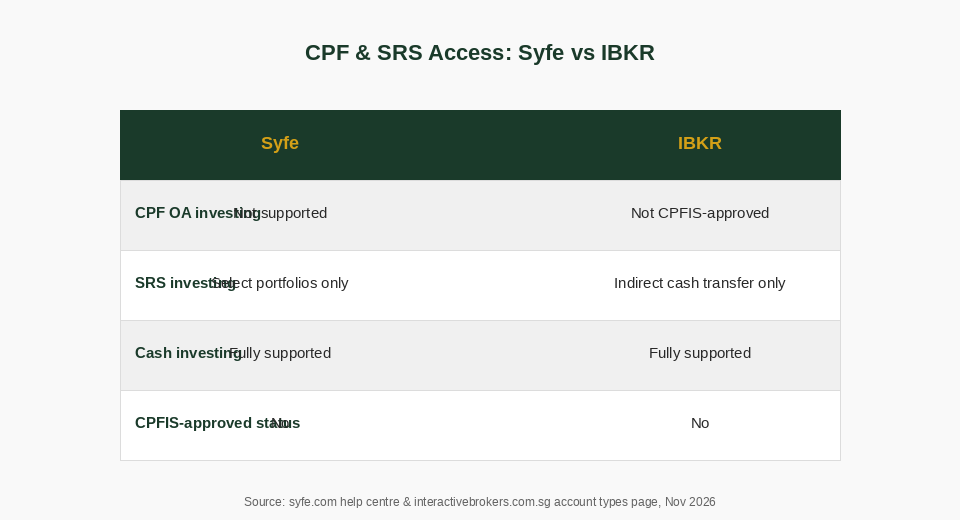
Neither Syfe nor IBKR is CPFIS-approved, so neither platform accepts CPF Ordinary Account (OA) funds directly — investors who want to deploy CPF-OA money into ETFs or unit trusts need a CPFIS-approved platform such as Endowus or FSMOne instead. Our CPF investment strategy guide covers which platforms are CPFIS-approved and how to think about the 2.5% CPF-OA floor rate as your hurdle return.
SRS is where the two platforms diverge slightly. Syfe accepts SRS funding directly on select managed portfolios, letting SRS contributors invest their tax-relief savings without leaving the platform. IBKR has no direct SRS integration at all — an investor would need to withdraw SRS funds as cash through their SRS operator bank (DBS, OCBC or UOB) first, which is a clumsy, indirect path and not how SRS is typically meant to be used for market investing. If SRS deployment matters to you, Syfe is the more practical choice between these two; if you specifically want to invest SRS funds through a broker, FSMOne or Endowus (both CPFIS- and SRS-friendly) are usually a better fit than either platform reviewed here.
| Funding Source | Syfe | IBKR |
|---|---|---|
| Cash | Supported | Supported |
| CPF Ordinary Account | Not supported | Not supported |
| SRS | Select portfolios | Indirect only |
Source: syfe.com help centre and interactivebrokers.com.sg account types page, November 2026.
Total Cost of Ownership: A Worked Example
Take a Singapore investor with a S$50,000 portfolio who rebalances roughly four times a year. On Syfe’s Black tier (0.55% p.a., which applies once the account crosses S$50,000 in net invested value), the annual managed fee works out to approximately S$275 a year, charged automatically regardless of trading activity. On IBKR, assuming four SGX trades of about S$12,500 each at 0.08% of trade value (above the S$2.50 minimum per trade), total commissions come to roughly S$40 a year — plus any separate cost for US-listed holdings, which IBKR prices from US$0.005 per share.
That gap — S$275 versus roughly S$40 — looks dramatic, but it omits the value of what Syfe’s fee buys: professional asset allocation, systematic rebalancing, and no research time required from the investor. An IBKR investor who mis-times rebalancing or picks a concentrated, poorly diversified set of holdings can easily underperform by more than the fee difference. The honest comparison is only valid if the IBKR investor actually replicates a reasonably diversified, low-cost ETF allocation and rebalances with similar discipline to Syfe’s automated system.
Who Should Pick Which?
Syfe is likely the better fit if: you want a diversified portfolio without picking individual stocks or ETFs yourself; you value automatic rebalancing and dividend reinvestment handled for you; your portfolio is still growing from a smaller base and you’d rather pay a percentage fee than spend time managing allocations; or you want to invest SRS funds without an indirect cash-transfer workaround.
IBKR is likely the better fit if: you’re comfortable researching and selecting your own global stocks, ETFs, bonds or other instruments; your portfolio is large enough that an asset-based fee would cost meaningfully more than a handful of trade commissions each year; you want access to markets, order types, or asset classes (options, futures, bonds, 150+ exchanges) beyond what a managed robo-advisor portfolio offers; or you plan to trade infrequently and hold for the long term.
Many Singapore investors use both: Syfe for a core, hands-off diversified sleeve (and for SRS funds, where Syfe’s direct support is more convenient), and IBKR for a self-directed satellite sleeve where they want more control or access to specific global instruments. For a side-by-side look at how a similar managed-vs-self-directed trade-off plays out with a CPFIS-approved platform instead, see our Endowus vs IBKR Singapore 2026 comparison, and for the managed-vs-broker question against a third self-directed app, our Endowus vs moomoo Singapore 2026 guide covers similar ground.
Whichever platform — or combination — you choose, a clear retirement number helps decide how much of your portfolio needs to be in a low-cost, self-directed structure versus a managed one. Our Singapore retirement calculator and passive income Singapore guide are good starting points for sizing that split, and our CPF investment strategy guide covers the CPFIS-approved alternatives if CPF-OA deployment is part of your plan.
Not financial advice. All figures are for educational reference only and may change — always verify current fee schedules on syfe.com and interactivebrokers.com.sg before investing. Data as at November 2026.
Frequently Asked Questions
What is the main difference between Syfe and IBKR?
Syfe is a managed robo-advisor that builds and automatically rebalances a diversified portfolio for you, charging an annual fee of 0.65% down to 0.25% of assets depending on your balance tier. IBKR (Interactive Brokers) is a self-directed broker with no annual account fee — you choose and trade every position yourself, paying only a small commission per trade.
Which has lower fees, Syfe or IBKR?
IBKR is cheaper on pure fees for most portfolio sizes, since it charges no ongoing asset-based fee — only small per-trade commissions (around 0.08% for SGX stocks, minimum S$2.50). Syfe’s fee is a percentage of your whole portfolio every year, which can be more expensive in absolute terms as your balance grows, but it includes professional portfolio management that IBKR does not provide.
Can I invest my CPF or SRS funds through Syfe or IBKR?
Neither platform is CPFIS-approved, so CPF Ordinary Account funds cannot be invested directly through either one. For SRS, Syfe supports direct funding on select managed portfolios, while IBKR has no direct SRS integration — SRS funds would need to be withdrawn as cash first, which is not a practical way to invest SRS money.
Is Syfe better for beginners than IBKR?
Generally yes. Syfe’s managed portfolios require no stock-picking or rebalancing decisions, making it more approachable for beginners who don’t want to research individual holdings. IBKR’s self-directed interface and global market access can be overwhelming for a first-time investor, though its fee structure rewards investors who are willing to learn and manage their own allocation.
Can I use both Syfe and IBKR at the same time?
Yes. Many Singapore investors run a “core-satellite” approach — using Syfe for a hands-off, diversified core portfolio (and for SRS funds) while using IBKR for a self-directed satellite portfolio where they want more control over specific stocks, ETFs, or other global instruments.
Which is better for a long-term retirement portfolio, Syfe or IBKR?
It depends on your involvement level and portfolio size. For a smaller, growing portfolio where you want hands-off management, Syfe’s fee is a reasonable trade-off for convenience. For a larger, long-term portfolio where you’re comfortable picking a simple set of global index ETFs and rebalancing occasionally yourself, IBKR’s near-zero ongoing cost typically compounds to a meaningfully larger balance over 15-20+ years.
Ready to Open an Account?
Whether you want a managed portfolio or full self-directed control, use our referral links for sign-up bonuses on both platforms.
This article was researched with the help of AI. While we strive to keep all information accurate and up to date, there may be errors. If you notice any discrepancies, please contact us.