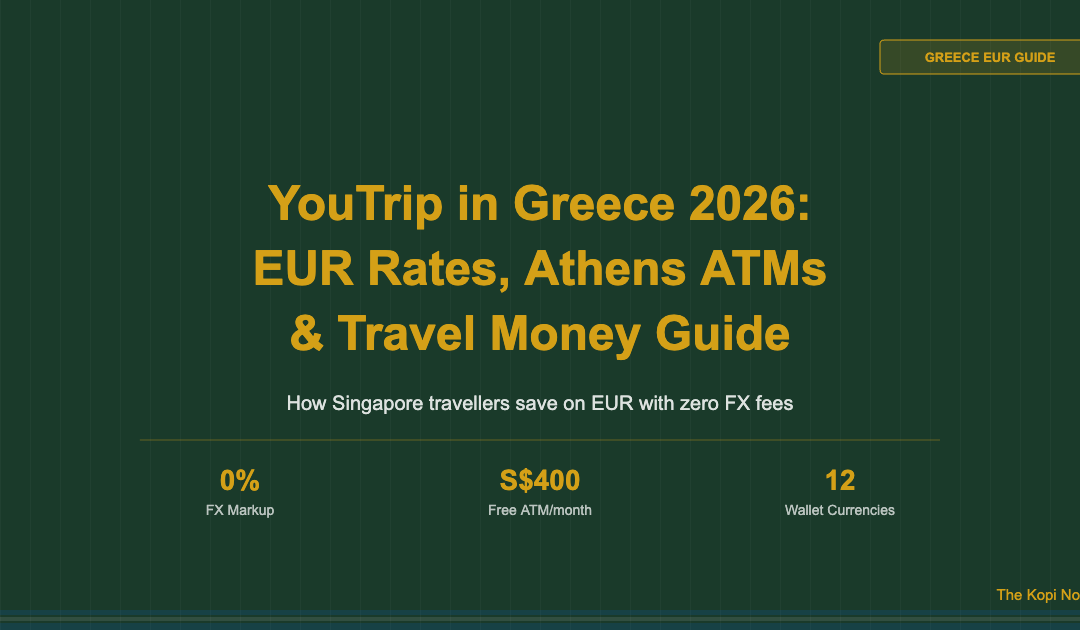
YouTrip in Greece 2026: EUR Rates, Athens ATMs & Travel Money Guide
How Singapore travellers save on EUR with zero FX fees in Athens, Santorini & beyond
Quick Answer: Best Card for Greece
YouTrip is the best travel money card for Singapore visitors to Greece. It charges 0% foreign exchange fees on EUR transactions using the wholesale Mastercard rate, giving you approximately €690 per S$1,000 — versus €671 or less with a standard Singapore bank card charging 2.8–3.25% FX markup. Your first S$400/month in overseas ATM withdrawals is free, with a 2% fee beyond that limit.
Not financial advice. All figures are for educational reference only. Data verified as at October 2026 unless noted.
Greece is one of the most popular European holiday destinations for Singapore travellers — with direct flights to Athens on Singapore Airlines and connecting routes via Middle Eastern hubs, the country is more accessible than ever. Whether you are island-hopping across Santorini and Mykonos, exploring the Acropolis in Athens, or driving the olive groves of Crete, understanding the best way to manage your travel money can save you S$50–S$120 on a typical two-week trip.
This guide covers the optimal SGD to EUR rate, how to navigate Greek ATMs, Dynamic Currency Conversion (DCC) pitfalls, cash requirements on the islands, and a full card comparison. If you haven’t got your YouTrip yet, use our YouTrip referral code for a free card and S$5 in travel credits.
SGD to EUR Exchange Rate 2026
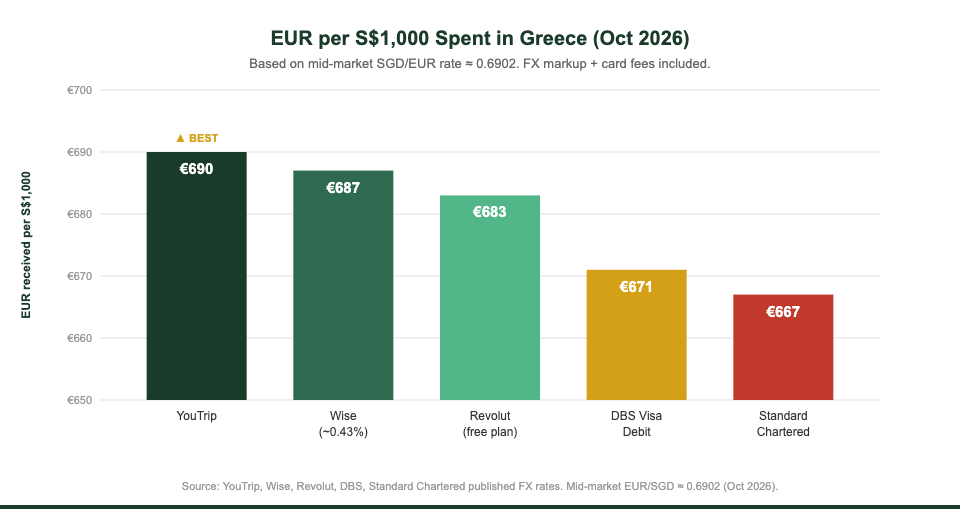
The mid-market SGD to EUR rate as of late October 2026 was approximately 0.6902 — meaning S$1,000 buys roughly €690 at the interbank rate. YouTrip passes this wholesale Mastercard rate directly to cardholders with zero markup.
Standard Singapore bank credit and debit cards typically add a 2.8–3.25% FX conversion fee on top of this rate. For a Singapore traveller spending S$3,000 across a Greece holiday — hotels, restaurants, island activities, shopping — that FX markup alone adds up to S$84–S$97 in unnecessary fees.
| Card | FX Markup | EUR per S$1,000 | Overseas ATM Fee |
|---|---|---|---|
| YouTrip | 0% | €690 | First S$400/month free, then 2% |
| Wise | ~0.43% | ~€687 | First S$350 free (SGD card), then 1.75% |
| Revolut (free plan) | 0%* (weekdays) | ~€683 | S$350 free/month limit, then 2% |
| DBS Visa Debit | 2.8% | ~€671 | S$5 per transaction |
| Standard Chartered | 3.25% | ~€668 | S$5–S$8 per transaction |
Source: YouTrip, Wise, Revolut, DBS, Standard Chartered published FX rates. Mid-market EUR/SGD ≈ 0.6902 (Oct 2026). *Revolut free plan applies a markup on weekends.
Greece ATM Guide: Which Banks to Use
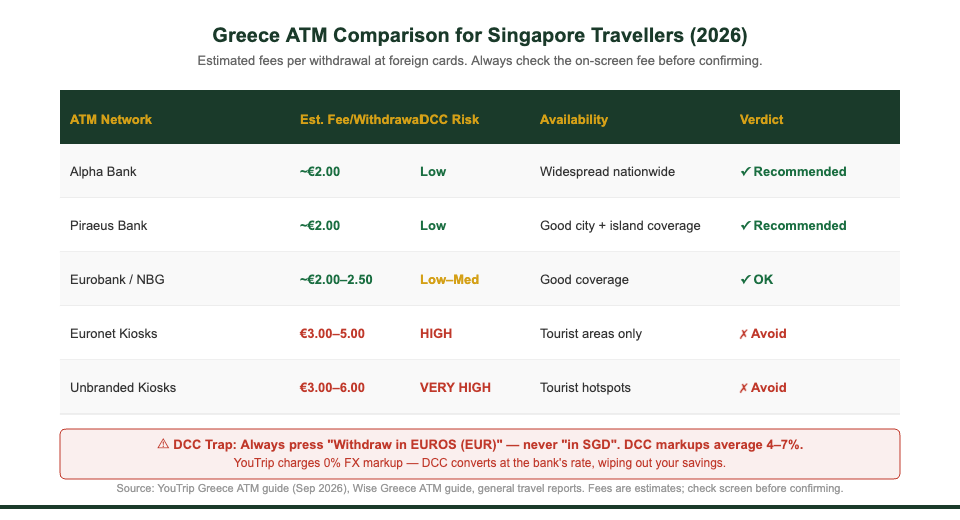
Greece has a well-developed ATM network in cities, towns, and popular tourist islands. However, not all ATMs are equal — the network you choose can determine whether you pay a reasonable fixed fee or an inflated charge plus a currency conversion trap.
Recommended: Major Greek Bank ATMs
Stick to ATMs operated by Greece’s major licensed banks. These machines comply with Bank of Greece fee transparency requirements and typically present the withdrawal fee on screen before you confirm:
- Alpha Bank — the largest ATM network in Greece, present nationwide including on islands such as Santorini, Mykonos, and Crete. Generally charges €1.50–€2.50 for foreign card withdrawals (shown on screen before confirmation).
- Piraeus Bank — second-largest network, strong presence in Athens and major tourist regions. Similar fee structure to Alpha Bank.
- Eurobank — good coverage across mainland Greece and popular islands. Some Eurobank terminals in tourist areas offer DCC — always decline.
- National Bank of Greece (Ethniki) — widespread in smaller towns and villages, useful if you’re travelling off the beaten path. Fee usually displayed on screen.
Avoid: Standalone Kiosks and Euronet ATMs
Standalone ATM kiosks — including those operated by Euronet, a pan-European operator common in tourist hotspots like Monastiraki Square in Athens and the port areas in Mykonos — are notorious for two issues: higher flat fees (often €3.00–€5.00 per withdrawal) and aggressive DCC offers that can add a further 4–7% markup to your transaction. The golden rule: if you see an unfamiliar ATM brand in a tourist area, walk to the nearest bank branch ATM instead.
On the islands, particularly smaller ones like Paros, Naxos, or Milos, ATM supply is more limited. Withdraw sufficient cash before boarding your ferry rather than relying on finding a preferred ATM at your destination.
DCC Warning: Always Choose EUR at Greek ATMs
Dynamic Currency Conversion (DCC) is the single biggest avoidable money trap in Greece for Singapore travellers. Here’s how it works: when you insert a foreign card at a Greek ATM or pay at a restaurant terminal, the machine detects your card’s home currency (SGD) and offers to convert the transaction into SGD at an “on-the-spot” rate.
This sounds convenient, but the DCC rate typically includes a markup of 4–7% on top of the mid-market rate — wiping out every advantage your YouTrip card offers. A 2019 European Commission study found DCC markups averaged around 5% across EU ATMs, with some reaching 12%.
⚠ The Rule: At every ATM screen and every card payment terminal in Greece, when asked “Would you like to pay in SGD or EUR?”, always select EUR. Always. Even if the SGD amount looks convenient, you will always pay more.
At ATMs: after entering your PIN, select Savings as your account type, then enter your withdrawal amount. If a DCC screen appears, look for a button labelled “Withdraw in the local currency”, “Pay in EUR”, or “Continue without conversion” — and press it. If you cannot find this option, cancel the transaction and use a different machine.
Cash vs Card in Greece: What You Need to Know
Greece is significantly more cash-reliant than Northern European countries like the Netherlands or Germany. While card acceptance has improved markedly in Athens and major resort areas since 2020, cash remains essential — especially on the islands and in rural areas.
Where You Can Pay by Card
- Hotels (all categories in cities and resorts)
- Larger restaurants and tavernas in Athens, Thessaloniki, Santorini, Mykonos
- Supermarkets (Sklavenitis, AB Vassilopoulos, Lidl, Masoutis)
- Petrol stations on main roads
- Tourist attractions and museum entry
- Organised tour operators and larger ferry companies
Where You Must Use Cash
- Small family tavernas on islands (especially non-resort villages)
- Street food vendors and market stalls
- Local buses and taxis on smaller islands
- Ferry tickets from local island-to-island operators
- Restaurant tips — cash is strongly preferred and culturally important in Greece
- Parking and toll roads in rural areas
How Much Cash to Carry
A practical approach for a Greece trip: withdraw €150–€250 on arrival in Athens or at the airport, using your YouTrip at a major bank ATM (Alpha Bank operates at Athens International Airport). Island-hop with €100–€150 per island in your wallet, topping up as needed at ATMs in the main ports (Fira in Santorini, Mykonos Town, Heraklion in Crete). Never arrive on a small island with less than €50 cash.
For a two-week Greece itinerary covering Athens and three islands, budget approximately €500–€700 in cash across the trip. If you hold EUR in your YouTrip wallet, the rate is locked in — useful if you converted when SGD/EUR was favourable. For comparison between YouTrip and its closest competitor, see our Revolut vs YouTrip comparison.
YouTrip vs Other Singapore Travel Cards for Greece
Here is how the main Singapore travel money options stack up for a Greece holiday. The right card depends on your spending patterns — high-card-payment destinations favour zero-FX-markup cards; high-cash destinations require you to also consider ATM fee structures.
| Feature | YouTrip | Wise | Revolut | DBS/OCBC | Trust Bank |
|---|---|---|---|---|---|
| FX Markup (EUR) | 0% | ~0.43% | 0%* | 2.8–3.25% | 0%† |
| Free ATM (monthly) | S$400 | S$350 | S$350 (free plan) | S$0 (flat fee per ATM) | Limited |
| EUR Wallet (pre-convert) | ✓ Yes | ✓ Yes | ✓ Yes | ✗ No | ✗ No |
| Annual / Card Fee | S$0 | S$0 (physical card delivery fee applies) | S$0 (free plan) | S$0–S$192 | S$0 |
| Best For Greece | Overall | Also transfers | Light users | Emergency only | Trust customers |
Source: Published card terms, Oct 2026. *Revolut free plan applies a 0.5–2% markup on weekends and above monthly spending limits. †Trust Bank FX fee waiver subject to their terms and conditions.
For a deep dive on fees, see our best travel credit card Singapore guide, or if you’re comparing specifically with our YouTrip Netherlands EUR guide to understand consistent EUR handling across Europe.
One key advantage of YouTrip over standard bank debit cards: you can pre-load EUR at a rate you choose, locking in favourable rates before you fly. The YouTrip annual fee is S$0 — there is no subscription cost, making it genuinely free to hold alongside your regular bank cards.
How to Use YouTrip in Greece (Step-by-Step)
Before you fly:
- Download the YouTrip app and complete identity verification (MyInfo via Singpass is fastest). Apply at least 3–5 working days before departure for card delivery.
- Top up your YouTrip wallet via PayNow, PayLah!, or bank transfer (instant). A minimum S$20 top-up is required to activate the card.
- Convert SGD to EUR in the app if you want to lock in a rate. Alternatively, leave funds in SGD and let YouTrip convert at the live wholesale rate each time you spend — both approaches give you the interbank rate with 0% markup.
- Enable transaction notifications in the YouTrip app so you can monitor every spend in real time.
At ATMs in Greece:
- Locate an Alpha Bank, Piraeus Bank, or National Bank of Greece ATM (avoid Euronet kiosks).
- Insert your YouTrip card, enter your 4-digit YouTrip PIN (set in the app).
- Select Savings as your account type when prompted.
- Enter your withdrawal amount in EUR (up to your card’s daily limit of S$5,000 equivalent).
- If prompted to convert to SGD, decline and choose EUR. This is the DCC trap — always select local currency.
- Collect your cash and keep your receipt to cross-check with the YouTrip app notification.
For card payments:
Simply tap or insert your YouTrip card at the payment terminal. If the terminal offers DCC (“Pay in SGD?”), select EUR. YouTrip converts at the wholesale rate and the SGD amount is deducted from your wallet instantly.
Worried about card loss overseas? You can immediately freeze your YouTrip card in the app — the card management features are full-featured and accessible 24/7 from Singapore. For broader travel financial planning, our Singapore retirement calculator can help you understand how travel spending fits into your long-term savings picture.
Tip for island travellers: Greece’s inter-island ferries (operated by companies like Hellenic Seaways, Blue Star, and Minoan) increasingly accept cards for online bookings, but local water taxis and smaller operators on islands like Hydra, Spetses, and Folegandros remain cash-only. Always carry some EUR notes when island-hopping.
Disclaimer: Always carry an emergency backup card (a credit card with sufficient limit). While YouTrip is very reliable, no single payment method is infallible overseas. Data as at October 2026.
Frequently Asked Questions
Can I use YouTrip in Greece?
Yes. YouTrip works in Greece at any ATM or payment terminal displaying the Mastercard logo. Greece is in the Eurozone (EUR), and EUR is one of YouTrip’s 12 supported wallet currencies. Card payments are widely accepted in hotels, larger restaurants, and supermarkets — but carry some EUR cash for smaller island establishments, local tavernas, and ferries.
What is the YouTrip EUR exchange rate for Greece?
YouTrip uses the Mastercard wholesale interbank rate with 0% FX markup. As of late October 2026, the mid-market SGD/EUR rate was approximately 0.6902, meaning S$1,000 converted to roughly €690. The live rate fluctuates daily — check the YouTrip app before converting. This compares favourably to standard Singapore bank cards which add 2.8–3.25% on top of the interbank rate.
Are there ATM fees when using YouTrip in Greece?
YouTrip offers free overseas ATM withdrawals up to S$400 per calendar month. Beyond that, a 2% fee applies on the excess amount. Separately, Greek ATMs may charge their own flat fee per withdrawal (typically €1.50–€2.50 at major bank ATMs, and €3.00–€5.00 at standalone kiosks like Euronet). This fee is displayed on screen before you confirm — if it looks high, cancel and find a major bank ATM instead.
Do I need cash in Greece, or can I pay by card everywhere?
Cash is more important in Greece than in Northern Europe. While hotels, larger restaurants, and supermarkets in Athens and major resort areas accept cards, many island tavernas, local ferries, markets, and smaller shops prefer or require cash. Budget approximately €150–€250 for your arrival and top up at major bank ATMs (Alpha Bank, Piraeus Bank) at ports before island hopping. Never arrive on a small island with less than €50 in cash.
Which ATMs are best in Greece for YouTrip?
Use ATMs from Alpha Bank, Piraeus Bank, Eurobank, or the National Bank of Greece (Ethniki). These are widespread across the mainland and major islands, display fees transparently before confirmation, and are less likely to push DCC. Avoid Euronet kiosks and unbranded standalone machines in tourist areas — they charge higher fees and aggressively offer Dynamic Currency Conversion (DCC), which can cost you 4–7% extra.
Is YouTrip better than Wise for Greece?
For most Singapore travellers visiting Greece, YouTrip and Wise are both excellent options — both offer near-zero FX fees. YouTrip has a slight edge for simplicity: 0% markup (vs ~0.43% for Wise on SGD-to-EUR conversions), and a S$400 free ATM allowance (vs S$350 for Wise). Wise is better if you also need to make international bank transfers while travelling. Carrying both cards provides an ideal combination of FX savings and versatility.
Can I use YouTrip to pay for ferries in Greece?
Major Greek ferry operators (Blue Star Ferries, Hellenic Seaways, Minoan Lines) accept card payments for advance bookings online. At ports, larger ticket offices also accept cards. However, smaller island-to-island operators, water taxis, and local boat services are often cash-only. Always carry EUR cash when island-hopping, and consider booking larger ferries online before departure to avoid cash-only queues at busy ports.
Ready to Use YouTrip in Greece?
Get your YouTrip card before you fly — use our referral link for a S$5 sign-up bonus. Zero annual fees, 0% FX markup, and EUR pre-loading available.
This article was researched with the help of AI. While we strive to keep all information accurate and up to date, there may be errors. If you notice any discrepancies, please contact us.