Critical Illness Insurance Singapore: What Does It Cover? (2026 Guide)
37 LIA Conditions, Exclusions, Claims Process & Top Plans
Critical illness insurance in Singapore covers a lump-sum cash payout if you are diagnosed with one of 37 standard conditions defined by the Life Insurance Association (LIA). These include major cancers, heart attack, stroke, end-stage kidney failure, and 33 other severe illnesses. The LIA Version 2024 definitions (effective 1 October 2025) govern all Singapore CI policies. Coverage typically pays the full sum assured upon diagnosis of a qualifying severe-stage condition — giving you cash to cover lost income, medical bills, and lifestyle adjustments.
Not financial advice. All figures are for educational reference only. Data verified as at October 2026 unless noted.
Table of Contents
Jump to a Section
- What Is Critical Illness Insurance?
- The 37 LIA Standard Critical Illnesses
- Early Stage vs Late Stage CI Coverage
- What Critical Illness Insurance Does NOT Cover
- How a CI Insurance Claim Works
- Top CI Insurance Plans in Singapore 2026
- How Much CI Coverage Do You Need?
- CI Insurance vs MediShield Life / IP
- Frequently Asked Questions
What Is Critical Illness Insurance?
Critical illness (CI) insurance pays you a one-time lump sum if you are diagnosed with a covered severe illness. Unlike MediShield Life or your Integrated Shield Plan (IP), which reimburse hospital bills, a CI payout goes directly to you in cash — no receipts required.
This cash payout can be used for anything: replacing lost income while you recover, paying off your mortgage, funding experimental treatments not covered by your IP, or simply giving your family financial breathing room during a difficult time.
In Singapore, all CI policies sold by LIA-member insurers must cover the same 37 standard critical illness conditions, using definitions standardised by the Life Insurance Association (LIA). The current definitions are from the LIA Version 2024 framework, which took effect on 1 October 2025, incorporating updated medical terminology and revised severity thresholds.
There are three main types of CI coverage in Singapore:
| Type | What It Covers | Typical Payout |
|---|---|---|
| Traditional (Late Stage) CI | Severe-stage only (e.g. major cancer, not early cancer) | 100% of sum assured |
| Early Stage CI | Early, intermediate and severe stages | Varies: 25–100% depending on stage |
| Multi-Pay CI | Multiple claims across different conditions | Up to 3–5 separate payouts |
Source: LIA Singapore, insurer product disclosures (Oct 2026)
Most Singaporeans hold CI coverage as a standalone CI plan or as a rider attached to a whole life or term life policy. Both deliver the same 37 LIA conditions; the difference lies in flexibility, cost structure, and what happens to coverage after a claim.
The 37 Standard Critical Illnesses Covered in Singapore
Under the LIA Version 2024 framework, all Singapore CI policies must cover the following 37 conditions at the severe stage. Note that the definitions specify minimum severity — your insurer may offer broader coverage beyond this list.
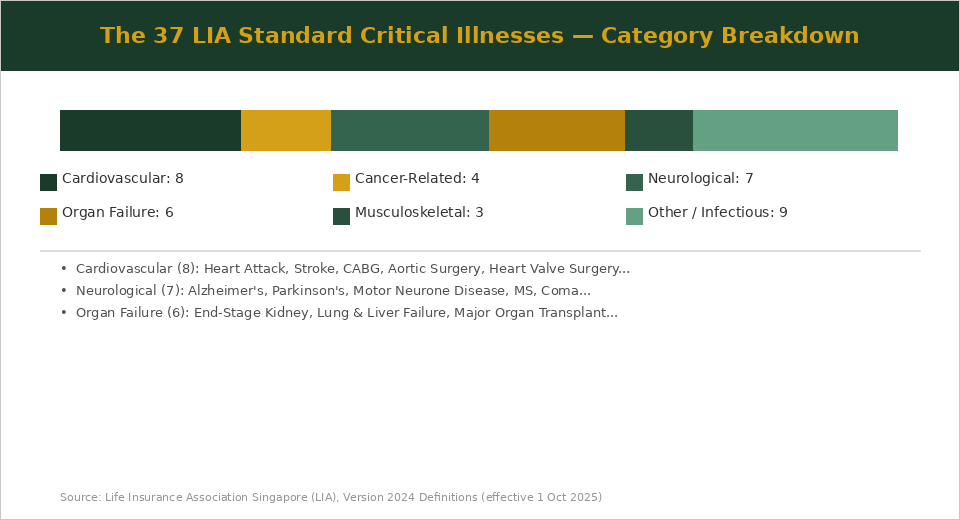
Source: Life Insurance Association Singapore (LIA), Version 2024 Definitions (effective 1 Oct 2025)
| # | Critical Illness | # | Critical Illness |
|---|---|---|---|
| 1 | Major Cancers | 20 | Muscular Dystrophy |
| 2 | Heart Attack of Specified Severity | 21 | Primary Pulmonary Arterial Hypertension |
| 3 | Stroke with Permanent Neurological Deficit | 22 | Loss of Independent Existence |
| 4 | Coronary Artery By-pass Surgery | 23 | Parkinson’s Disease |
| 5 | End Stage Kidney Failure | 24 | HIV Due to Blood Transfusion |
| 6 | Coma | 25 | Fulminant Viral Hepatitis |
| 7 | Deafness / Loss of Hearing | 26 | Bacterial Meningitis |
| 8 | Heart Valve Surgery | 27 | Benign Brain Tumour |
| 9 | Loss of Speech | 28 | Encephalitis |
| 10 | Major Burns | 29 | Poliomyelitis |
| 11 | Major Head Trauma | 30 | Alzheimer’s Disease / Severe Dementia |
| 12 | Blindness / Loss of Sight | 31 | Other Serious Coronary Artery Disease |
| 13 | Major Organ / Bone Marrow Transplant | 32 | Aortic Surgery |
| 14 | Aplastic Anaemia | 33 | Progressive Bulbar Palsy |
| 15 | Terminal Illness | 34 | End Stage Lung Disease |
| 16 | Loss of Limbs | 35 | End Stage Liver Failure |
| 17 | Progressive Scleroderma | 36 | Systemic Lupus Erythematosus with Lupus Nephritis |
| 18 | Medullary Cystic Disease | 37 | Terminal Illness (late-stage, life expectancy ≤12 months) |
| 19 | Motor Neurone Disease |
Source: Life Insurance Association Singapore (LIA), Version 2024 Definitions (effective 1 Oct 2025)
Important caveat: A few insurers do not cover all 37. For example, some term life + CI riders cover 35 of the 37 LIA conditions. Always check the policy schedule before buying.
Early Stage vs Late Stage Critical Illness Coverage
The most common source of confusion about CI insurance in Singapore is the difference between early-stage and late-stage (traditional) coverage.
Traditional (Late Stage) CI
Standard CI policies pay out only when you reach the severe stage of a condition. For cancer, this means an advanced invasive malignancy — early or in-situ cancers do not trigger a payout. This covers around 95% of diagnosed cases by severity, but you may have fought the illness for months before qualifying.
Early Critical Illness (ECI) Plans
Early CI plans cover early, intermediate, and severe stages — including early-stage cancers (e.g. carcinoma in situ), early heart conditions, and even pre-serious conditions depending on the insurer. Payouts are smaller at early stages (typically 25–50% of sum assured) and 100% at severe stage.
Multi-Pay CI Plans
Multi-pay plans let you claim multiple times across different covered conditions, up to a policy maximum (commonly 3–5 claims or 300–500% of the original sum assured). This is the most comprehensive — and most expensive — CI option.
| Feature | Traditional CI | Early CI | Multi-Pay CI |
|---|---|---|---|
| Stages Covered | Severe only | Early → Severe | Early → Severe |
| No. of Claims | 1 | 1 per progression | Up to 3–5 |
| Relative Premium | Lowest | Medium | Highest |
| Best For | Budget-conscious; basic protection | Comprehensive; early detection | Maximum protection; multiple risks |
Source: Insurer product disclosures, LIA Singapore (Oct 2026)
The LIA recommends that Singaporeans hold approximately 4 times their annual income in critical illness coverage. For someone earning S$60,000 a year, that means S$240,000 in CI cover — enough to replace 4 years of income while recovering and managing medical bills not covered by their IP.
What Critical Illness Insurance Does NOT Cover
Understanding the exclusions is just as important as knowing what is covered. Most CI policies in Singapore do not pay out in the following situations:
1. Pre-Existing Conditions
If you had a condition before the policy started and did not disclose it, your claim can be rejected. Any condition known or diagnosed before the policy start date may be excluded permanently or for a specified period.
2. Waiting Period (90 Days)
Most CI policies have a 90-day waiting period from the policy start date. If you are diagnosed with a covered illness within this period, the claim is not payable. The policy remains active; you simply cannot claim for conditions diagnosed in the first 90 days.
3. Severity Threshold Not Met
For traditional CI policies, if your cancer is diagnosed at an early or intermediate stage, or your heart attack does not meet the LIA’s specified severity criteria, you will not receive a payout. This is the biggest source of claim disputes in Singapore’s CI market.
4. Self-Inflicted Conditions
CI policies exclude conditions arising from self-harm, substance abuse, or participation in illegal activities.
5. Specific Exclusions Unique to Each Policy
Beyond the universal LIA exclusions, each insurer may add its own exclusions based on your medical underwriting. Common individual exclusions include: certain types of cancer if you have a family history, cardiovascular conditions if you have pre-existing hypertension, or mental health-related conditions.
Action step: Always read the policy’s exclusion clause in full before signing. Ask for a personalised illustration and have your financial adviser confirm what is and isn’t covered for your specific health profile.
How a Critical Illness Insurance Claim Works in Singapore
The CI claim process in Singapore is relatively straightforward, but timing and documentation matter. Here is a step-by-step overview:
- Get a formal diagnosis. Your doctor must provide a written diagnosis specifying the illness name and stage. For conditions like cancer, this typically requires a biopsy report or pathology result.
- Notify your insurer. Most insurers require you to notify them within 30 days of diagnosis. Contact your financial adviser or the insurer’s claims hotline directly.
- Submit the claims form and supporting documents. Typical documents include: the completed CI claim form, your doctor’s medical report confirming diagnosis and severity, hospital discharge summaries, and pathology or lab reports. For surgical conditions (e.g. CABG), the surgeon’s operative report is required.
- Insurer reviews the claim. The insurer’s medical team will review your documents against the LIA definitions to confirm your condition meets the severity threshold. Straightforward cases are typically resolved in 14–30 business days.
- Payout is made. If approved, the lump sum is paid directly to you (or your nominee if you are incapacitated). There is no requirement to show how you spend it.
Common Reasons CI Claims Are Rejected
- Condition diagnosed within the 90-day waiting period
- Severity threshold not met (e.g. early-stage cancer on a traditional CI policy)
- Undisclosed pre-existing condition at the time of application
- Documentation incomplete or medical report language does not use LIA definition terminology
If your claim is rejected and you believe it is unjustified, you can escalate to the Financial Industry Disputes Resolution Centre (FIDReC) in Singapore for independent adjudication.
Top CI Insurance Plans in Singapore 2026
All major insurers in Singapore offer CI coverage. Here is an overview of the main providers and their flagship CI products as of October 2026. Premiums below are indicative for a 35-year-old, non-smoker, S$200,000 sum assured:
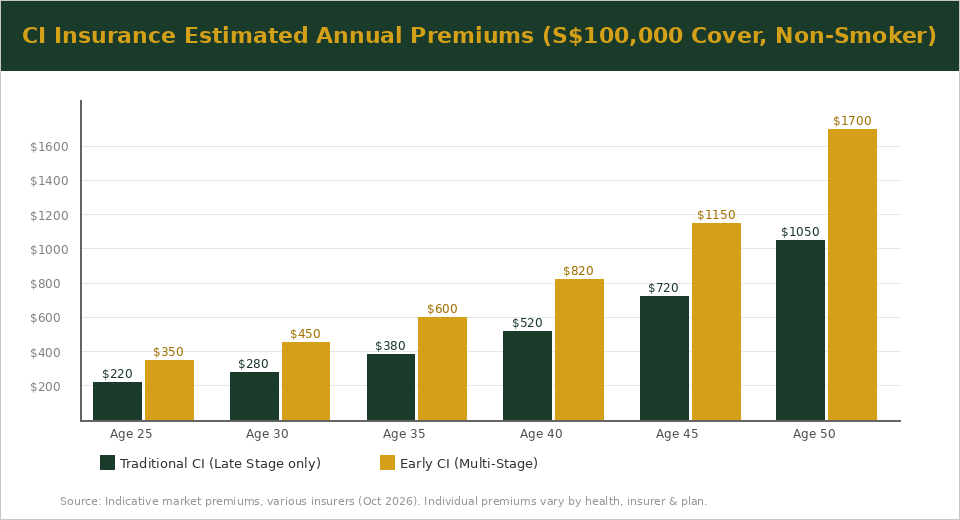
Source: Indicative market premiums, various Singapore insurers (Oct 2026). Actual premiums vary by health status, insurer and plan.
| Insurer | Flagship CI Plan | Coverage Type | Conditions |
|---|---|---|---|
| AIA | AIA Power Critical Cover | Multi-pay, early + late | 100+ conditions |
| Prudential | PRUActive Term / PRUSaver CI | Late stage (standalone) | 37 LIA standard |
| Great Eastern | GREAT CriticalCare | Early + late stage | 100+ conditions |
| Income / Singlife | Singlife MultiPay CI | Multi-pay, early + late | 100+ conditions |
| Manulife | ManuProtect Critical | Late stage (standalone) | 37 LIA standard |
| FWD | FWD CI Term | Late stage (term rider) | 35 conditions |
Source: Insurer product pages, LIA Singapore (Oct 2026). Always refer to the product summary for the definitive list of covered conditions.
For the most competitive pricing, consider using a fee-transparent platform like Endowus (referral code: 2V343) or working with an independent financial adviser who can compare plans across multiple insurers. Fee-based platforms typically don’t earn commissions, reducing conflict of interest in recommendations.
How Much Critical Illness Coverage Do You Need?
The LIA recommends 4 times your annual income in CI coverage. Here’s why that figure makes sense and how to personalise it:
The 4x Rule — Why It Works
A critical illness diagnosis often means an extended recovery period. Statistics from Singapore’s major hospitals suggest that recovery from a major cancer diagnosis averages 2–4 years before patients return to full work capacity — if they do at all. The 4x rule gives you roughly 4 years of income replacement, covering:
- Loss of income during treatment and recovery
- Out-of-pocket medical costs not covered by your Integrated Shield Plan
- Home modifications or caregiver costs
- Mortgage payments during the recovery period
Worked Example
| Annual Income | LIA Recommended Cover (4×) | Est. Annual Premium (Age 35, Non-Smoker) |
|---|---|---|
| S$50,000 | S$200,000 | ~S$750–S$1,200/yr (traditional CI) |
| S$80,000 | S$320,000 | ~S$1,200–S$2,000/yr |
| S$120,000 | S$480,000 | ~S$1,800–S$3,000/yr |
Source: Indicative premiums based on market data (Oct 2026). Early CI and multi-pay premiums will be higher.
If you already hold CI coverage through your employer’s group insurance or an existing whole life policy rider, calculate your current CI coverage gap before buying additional standalone cover.
You can also use our retirement planning calculator to model how a critical illness event would impact your long-term financial plan — including CPF drawdown timing and investment portfolio sustainability.
Critical Illness Insurance vs MediShield Life / Integrated Shield Plan
A common question is: “If I have an Integrated Shield Plan (IP), do I still need CI insurance?” The short answer is yes — they serve fundamentally different purposes.
| Feature | Critical Illness Insurance | MediShield Life / IP |
|---|---|---|
| What it pays | Lump sum cash (no receipts needed) | Reimburses hospital & surgical bills |
| Trigger | Diagnosis of covered condition | Hospitalisation or approved procedures |
| Covers lost income? | Yes (spend as you wish) | No |
| Experimental treatment? | Yes (cash can be used for anything) | No (must be MOH-approved) |
| Overseas treatment | Yes (no restriction) | Limited or not covered |
Source: CPF Board, LIA Singapore (Oct 2026)
In practice, your IP covers the hospital stay and surgeon fees, while CI insurance provides the income replacement and lifestyle buffer that your IP cannot. Most Singapore financial planners recommend having both: a good IP (ideally Class B1 or above) and adequate CI coverage of at least 4× your annual income.
For retirement planning purposes, consider how your CI coverage fits into your broader retirement income strategy and your CPF investment approach. A CI event can dramatically accelerate CPF drawdown and may affect your ability to hit the Full Retirement Sum.
Frequently Asked Questions
What are the 37 critical illnesses covered in Singapore?
Does critical illness insurance cover early-stage cancer in Singapore?
How much critical illness insurance do I need in Singapore?
Can I use SRS or CPF to pay for critical illness insurance premiums?
What is the waiting period for critical illness insurance in Singapore?
What is the difference between critical illness insurance and term life insurance?
Are mental health conditions covered by critical illness insurance in Singapore?
Get Free Insurance Advice
Speak with a licensed insurance advisor. No obligation, no cost.
By submitting this form, you agree to our Privacy Policy.
This article was researched with the help of AI. While we strive to keep all information accurate and up to date, there may be errors. If you notice any discrepancies, please contact us.