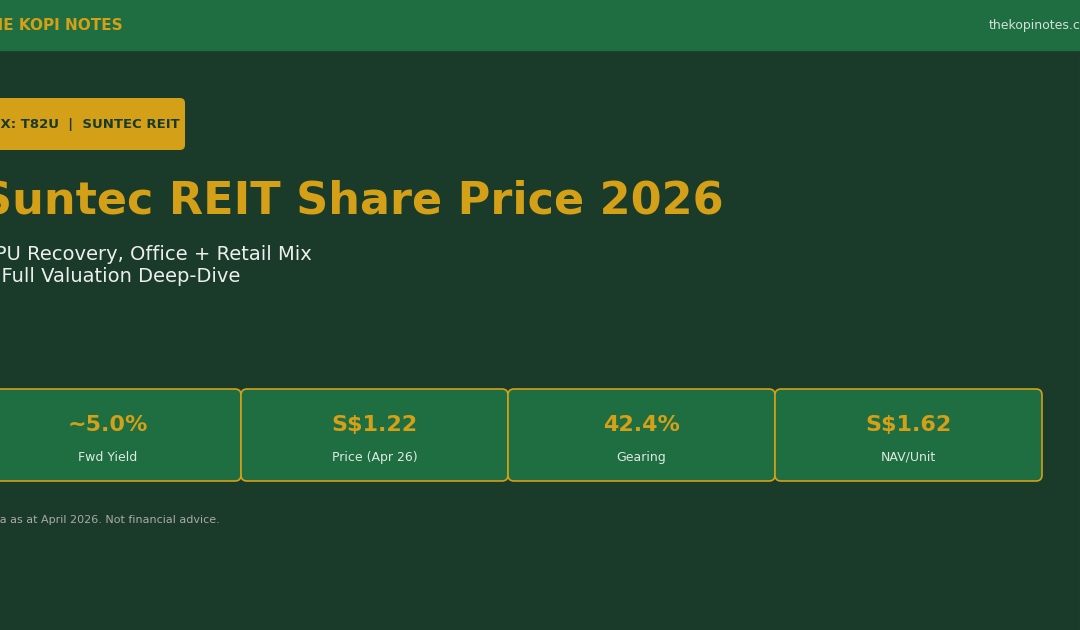
Suntec REIT Share Price 2026: DPU Recovery, 5% Yield & Full Deep-Dive (SGX: T82U)
Suntec REIT (SGX: T82U) is Singapore’s largest integrated commercial REIT — combining prime office towers and retail malls under one roof. After a tough 2020–2021 pandemic dip, its DPU has been recovering steadily. With a forward yield near 5%, a diversified Singapore and Australian portfolio, and one of the lowest P/NAV ratios among commercial S-REITs, many investors are asking: is now the right time to buy? This deep-dive covers Suntec REIT’s current share price, DPU history, portfolio breakdown, gearing health, and how it stacks up against peers as of April 2026. This is not financial advice.
Table of Contents
Contents — Click to expand
- Suntec REIT at a Glance: April 2026 Snapshot
- What’s Driving Suntec REIT’s Share Price in 2026
- DPU History: FY2019–FY2025E
- Portfolio Overview: Office, Retail & Convention
- Financial Health: Gearing, ICR & Debt Maturity
- Peer Yield Comparison: Suntec vs S-REIT Office/Commercial Sector
- Valuation: P/NAV, Yield Spread & Entry Points
- Key Risks for 2026
- How to Buy Suntec REIT in Singapore
- FAQ
Suntec REIT at a Glance: April 2026 Snapshot
Suntec REIT (SGX: T82U) is managed by ARA Asset Management and listed on the Singapore Exchange since 2004. It is one of Singapore’s largest commercial REITs by market cap, owning a blend of Grade-A office, prime retail, and the Suntec Singapore Convention & Exhibition Centre.
| Metric | Value (Apr 2026) |
|---|---|
| SGX Ticker | T82U |
| Share Price (approx.) | S$1.22 |
| NAV Per Unit | S$1.62 |
| P/NAV | ~0.75× |
| FY2025E DPU (est.) | ~9.80¢ |
| Forward Yield (est.) | ~5.0% |
| Gearing | 42.4% |
| ICR | ~2.4× |
| Market Cap | ~S$4.4B |
| Distribution Frequency | Semi-annual |
| Portfolio Properties | 11 (SG + AU) |
| Total AUM | ~S$10.3B |
Note: Share price and DPU estimates are approximate as at April 2026. Always verify the latest data via SGX or Suntec REIT’s investor relations page before making any investment decision.
What’s Driving Suntec REIT’s Share Price in 2026
Suntec REIT’s share price in 2026 is being shaped by a confluence of macro and property-specific factors:
1. SORA Rate Decline: SORA has fallen to approximately 0.80–1.10% in early 2026, significantly down from its 3.03% peak. Suntec REIT carries S$3.5B+ in borrowings, a large portion of which is on floating-rate terms. Every 100bps decline in SORA reduces Suntec’s interest costs by an estimated S$20–35M annually, directly supporting DPU recovery. See our S-REIT DPU Recovery 2026 analysis for the macro context.
2. Singapore Office Market Resilience: CBD Grade-A office vacancy remains tight at under 5% in Q4 2025. Rental reversions at Suntec City Offices and One Raffles Quay have been positive, averaging +6–9% above preceding rents. This supports stable NPI (Net Property Income) growth.
3. Retail Recovery at Suntec City Mall: Foot traffic at Suntec City Mall has normalised post-COVID, with the AEI (Asset Enhancement Initiative) completed in late 2022 improving tenant mix toward F&B and experiential retail. Occupancy remains above 96%.
4. Australian Office Headwinds: Suntec’s Australian office assets (177 Pacific Highway, Southgate Complex, 21 Harris Street) face ongoing office-to-hybrid work pressures in Sydney and Melbourne. Occupancy in Australia has been softer, providing a drag on overall NPI. This remains a key watch item for 2026.
5. Iran Oil Shock & Macro Uncertainty: As of April 2026, the global macro backdrop includes elevated crude oil prices (~US$90–95/bbl) following Middle East tensions. MAS tightened the S$NEER slope on 14 April 2026, which could put upward pressure on SORA in H2 2026. Read our Iran oil shock S-REIT analysis for the full picture.
DPU History: FY2019–FY2025E
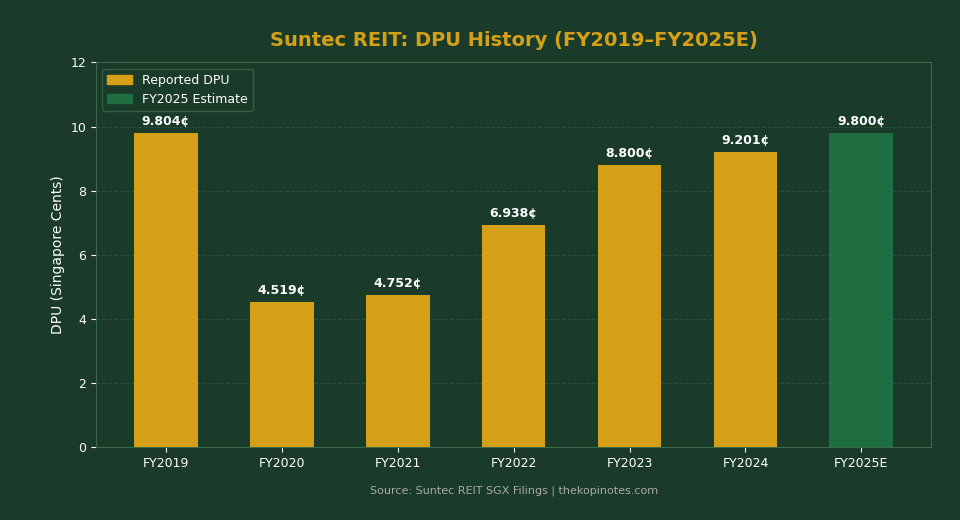
Suntec REIT’s DPU tells the story of a REIT hit hard by COVID-19, the forced shift to remote work, and then a gradual but meaningful recovery as Singapore’s commercial sector normalised:
| Financial Year | DPU (¢) | YoY Change | Key Driver |
|---|---|---|---|
| FY2019 | 9.804¢ | — | Pre-COVID baseline; healthy office + retail |
| FY2020 | 4.519¢ | −53.9% | COVID lockdowns; rental reliefs; convention closed |
| FY2021 | 4.752¢ | +5.2% | Partial reopening; continued rent relief |
| FY2022 | 6.938¢ | +46.0% | Full reopening; convention resumed; rising rents |
| FY2023 | 8.800¢ | +26.9% | Strong recovery; MICE events recovered |
| FY2024 | 9.201¢ | +4.6% | Resilient office demand; SORA drag easing |
| FY2025E | ~9.80¢ | ~+6.5% | SORA decline benefit; positive rental reversions; AU stabilising |
The DPU recovery trajectory is clear, but Suntec REIT has not yet returned to its FY2019 pre-COVID peak of 9.804¢. FY2025E consensus suggests a modest beat is possible if SORA continues its decline and Australian occupancy stabilises. For a deeper look at the sector-wide DPU recovery thesis, see our S-REIT DPU Recovery 2026 article.
Portfolio Overview: Office, Retail & Convention
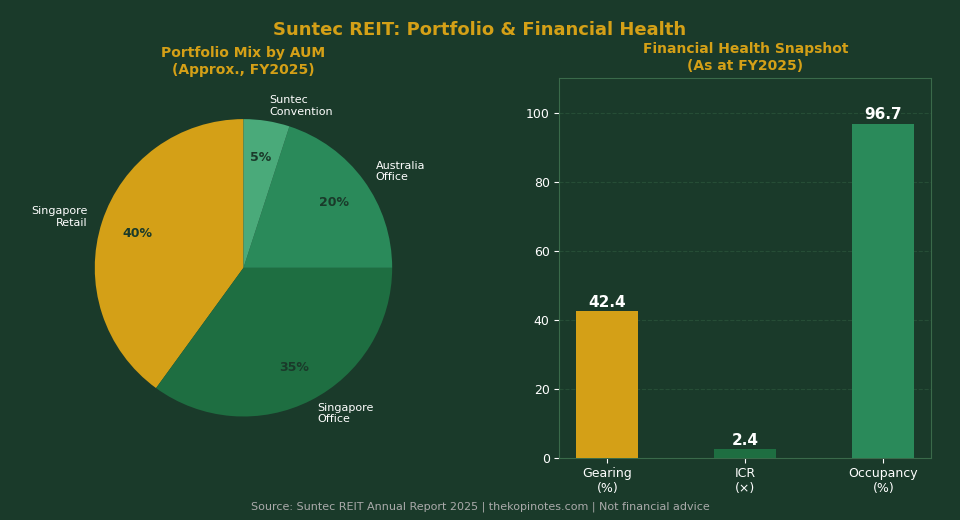
Suntec REIT’s AUM is approximately S$10.3B spread across 11 properties in Singapore and Australia. The portfolio is distinctive among S-REITs for its integrated commercial model — retail, office, and a convention centre under one roof at the Suntec City complex.
Singapore Assets (approx. 80% of NPI):
The Singapore portfolio includes Suntec City Offices (comprising 5 office towers), Suntec City Mall, One Raffles Quay (with HSBC and others as anchor tenants, 33.33% interest), MBFC (Marina Bay Financial Centre — 30.0% interest), and the Suntec Singapore International Convention & Exhibition Centre. Singapore office occupancy has been robust at above 96%, benefiting from the return-to-office trend and tight CBD supply.
Australian Assets (approx. 20% of NPI):
The Australian portfolio comprises 177 Pacific Highway (North Sydney), Southgate Complex (Melbourne), and 21 Harris Street (Sydney). Australian assets have faced headwinds from flexible work arrangements, with occupancy somewhat softer than Singapore. Management has been proactive in lease renewals and AEI to attract tenants.
Suntec Singapore Convention Centre: This is a unique income stream — MICE (Meetings, Incentives, Conferences, Exhibitions) revenues were severely impacted during COVID but have recovered strongly with Singapore re-establishing itself as a top global MICE destination. The convention centre contributes meaningfully to NPI and provides revenue diversification.
For investors comparing Singapore commercial REITs, see our analysis of CICT Dividend 2026 and the Best S-REITs Singapore 2026 comparison table.
Financial Health: Gearing, ICR & Debt Maturity
Suntec REIT’s gearing of approximately 42.4% is above the sector median (~38%) but within MAS’s regulatory cap of 50% (or 60% with ICR ≥ 2.5×). This elevated gearing partly reflects the REIT’s large asset base and its acquisition history. The ICR of approximately 2.4× sits just above the 2.0× MAS safety threshold, which means any significant uptick in SORA or decline in NPI could squeeze this metric. This is a key risk to monitor.
On the positive side, Suntec REIT has been actively managing its debt maturity profile. As at FY2024, management had spread maturities across FY2025–FY2030 to avoid refinancing concentration risk. A meaningful proportion (~55–60%) of borrowings are on fixed-rate terms, providing DPU visibility even as floating-rate borrowings benefit from lower SORA.
Key financial metrics summary:
| Metric | Suntec REIT | Sector Benchmark | Assessment |
|---|---|---|---|
| Gearing | 42.4% | ~38% | Elevated but manageable |
| ICR | ~2.4× | >2.5× preferred | Adequate; watch closely |
| Fixed-rate debt % | ~55–60% | 50%+ preferred | Good hedge against rate volatility |
| Avg cost of debt | ~3.3% | ~2.8–3.5% | In line with peers |
| WALE (office) | ~3.0 years | 3–5 years typical | Moderate; office renewal risk in 2026–2027 |
To compare gearing across the S-REIT sector, use our free S-REIT Gearing & ICR Calculator.
Peer Yield Comparison: Suntec vs S-REIT Office/Commercial Sector
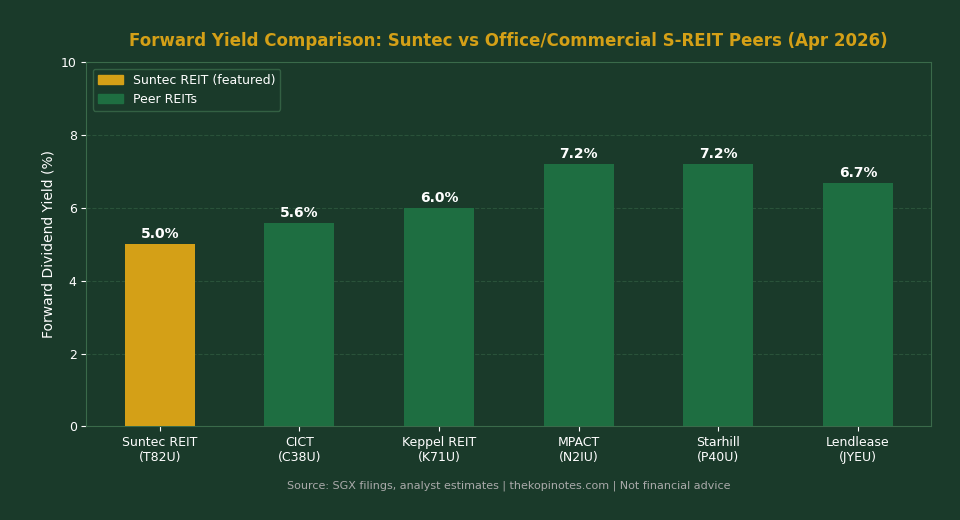
How does Suntec REIT’s yield stack up against other Singapore commercial and office S-REITs? The chart and table below provide an April 2026 snapshot:
| REIT | Ticker | Fwd Yield | Gearing | P/NAV |
|---|---|---|---|---|
| Suntec REIT | T82U | ~5.0% | 42.4% | ~0.75× |
| CICT | C38U | ~5.6% | 40.2% | ~0.93× |
| Keppel REIT | K71U | ~6.0% | 41.2% | ~0.82× |
| MPACT | N2IU | ~7.2% | 40.5% | ~0.71× |
| Starhill Global | P40U | ~7.2% | 36.2% | ~0.80× |
| Lendlease REIT | JYEU | ~6.7% | 38.4% | ~0.74× |
Source: SGX filings, analyst estimates, April 2026. Data approximate — verify before trading.
Suntec REIT offers a lower forward yield (~5%) compared to peers like MPACT (~7.2%) or Keppel REIT (~6%). However, Suntec’s scale, integrated commercial model, and convention centre income stream make it a unique asset in the S-REIT universe. Its P/NAV of ~0.75× represents a meaningful discount to book value.
To calculate and compare yields dynamically, use our S-REIT Dividend Yield Calculator and the Yield vs SGS Bond Spread Calculator.
Valuation: P/NAV, Yield Spread & Entry Points
Suntec REIT’s valuation in April 2026 can be framed along three key metrics:
P/NAV (~0.75×): At S$1.22 against NAV of ~S$1.62, Suntec trades at a 25% discount to book value. This is a historically wide discount for a blue-chip Singapore commercial REIT. During pre-COVID norms, Suntec typically traded between 0.85–1.10× NAV. The current discount reflects macro uncertainty, elevated gearing anxiety, and Australian asset concerns — but it also means you’re buying S$1.62 of assets for S$1.22.
Yield Spread over SGS 10Y (~2.8%): With a forward yield of ~5.0% and the SGS 10-year bond at ~2.22% (April 2026), Suntec offers a yield spread of ~2.78 percentage points. This is above the historical long-run average spread of ~2.0–2.5%, suggesting valuation support at current levels. MAS’s April 14, 2026 tightening creates some near-term SORA pressure, but the yield spread remains attractive for income investors.
Implied Cap Rate: At current NPI levels and market cap, Suntec’s implied capitalisation rate is approximately 4.5–5.0% — in line with prime Singapore CBD office cap rates of 3.8–4.5% and retail cap rates of 4.5–5.5%. The Australian assets may compress this slightly depending on valuation revisions.
For context on the S-REIT sector valuation backdrop, see our S-REIT Index Buying Window 2026 article. You can also run your own retirement projection using our Retirement Planning Calculator to see how a position in Suntec REIT fits your passive income goals.
Key Risks for Suntec REIT in 2026
No investment is without risk. Suntec REIT investors should be aware of the following key risks in 2026:
1. Australian Office Softness: Work-from-home adoption in Sydney and Melbourne remains structurally higher than in Singapore. If Australian occupancy falls further, NPI contribution from this segment could disappoint. Management’s ability to execute lease-ups will be critical.
2. MAS Tightening & SORA Reversal: MAS tightened the S$NEER on 14 April 2026 in response to the Iran oil shock and inflationary pressures. If SORA drifts up from its current ~0.80–1.10% trough toward 1.3–1.5% in H2 2026, Suntec’s interest costs will rise on floating-rate borrowings, potentially compressing DPU growth.
3. Elevated Gearing Headroom: At 42.4% gearing and ~7.6 percentage points of headroom to the 50% MAS cap, Suntec has less buffer than peers like Far East Hospitality Trust (gearing ~32%) or AIMS APAC REIT (gearing ~29%). Any downward revaluation of assets (particularly Australian properties) could push gearing higher.
4. Office WALE Renewals: With office WALE of approximately 3 years, Suntec will face meaningful lease renewal cycles in 2026–2027. While Singapore Grade-A office rents are currently firm, any unexpected demand softness could affect renewal rates.
5. Macro/Tariff Uncertainty: The Trump 90-day tariff pause (until ~8 July 2026) and ongoing US-China trade tensions create uncertainty for global MICE and corporate travel demand — which directly affects Suntec Singapore Convention Centre revenues.
How to Buy Suntec REIT in Singapore
Suntec REIT (SGX: T82U) trades on the Singapore Exchange in board lots of 100 units. At S$1.22 per unit, a single board lot costs approximately S$122 — making it highly accessible for retail investors.
To buy Suntec REIT, you’ll need a CDP (Central Depository) account and a brokerage account. Here’s a quick comparison of popular brokerages:
| Broker | SGX Commission | SRS Compatible | CPF OA (CPFIS) |
|---|---|---|---|
| FSMOne | 0.08%, min S$8.80 | ✅ | ✅ |
| DBS Vickers | 0.12–0.18%, min S$18–25 | ✅ | ✅ |
| moomoo | 0.06%, min S$0.99 | ✅ | ❌ |
| Tiger Brokers | 0.06%, min S$1.99 | ✅ | ✅ (via Cash Boost) |
If you want to use SRS funds to invest in S-REITs like Suntec REIT, all brokers above are compatible. Read our SRS Account Singapore Guide to maximise your tax savings. Prefer robo-advisor exposure? Syfe REIT+ and Endowus offer S-REIT fund exposure with professional management.
Frequently Asked Questions
What is Suntec REIT's current share price and yield?
As at April 2026, Suntec REIT (SGX: T82U) trades at approximately S$1.22 per unit with a forward dividend yield of around 5.0%, based on an estimated FY2025 DPU of ~9.80 Singapore cents. Always check the latest price on SGX or your broker before investing.
Is Suntec REIT a good buy in 2026?
Suntec REIT trades at an attractive P/NAV of ~0.75× and offers a ~2.8 percentage point yield spread over the SGS 10-year bond — both historically supportive levels. However, its elevated gearing (42.4%), softer Australian assets, and lower yield relative to peers are valid concerns. Investors with a medium-to-long-term horizon and preference for a diversified integrated commercial REIT may find value; those seeking the highest yield-per-risk may prefer peers like MPACT or Keppel REIT. This is not financial advice.
Can I buy Suntec REIT using CPF OA?
Yes. Suntec REIT (T82U) is approved under CPFIS-OA (CPF Investment Scheme — Ordinary Account), meaning you can purchase it using your CPF OA funds via FSMOne or DBS Vickers. Note that CPFIS has rules around the types and amounts you can invest — read our CPF Investment Strategy guide for the full details.
What are the main risks of investing in Suntec REIT?
The key risks include: (1) elevated gearing at 42.4%, leaving limited headroom to the MAS 50% cap; (2) softer Australian office performance due to hybrid work trends; (3) potential SORA increase in H2 2026 following MAS tightening in April 2026; (4) office WALE of ~3 years means meaningful lease renewals upcoming in 2026–2027; and (5) macro sensitivity from US-China trade tensions affecting MICE convention revenues.
How does Suntec REIT compare to CICT?
Both are Singapore’s largest commercial REITs. CICT (CapitaLand Integrated Commercial Trust, C38U) is larger, better diversified with more retail assets, offers a slightly higher yield (~5.6% vs ~5.0%), and trades at a higher P/NAV (~0.93× vs ~0.75×). CICT typically commands a premium for its larger scale, stronger sponsor (CapitaLand), and lower gearing footprint. Suntec REIT is distinctive for its convention centre exposure and deeper NAV discount. Read our CICT Dividend 2026 deep-dive for a full comparison.
Does Suntec REIT pay dividends quarterly or semi-annually?
Suntec REIT distributes on a semi-annual basis — typically for the H1 (January–June) and H2 (July–December) periods. Distributions are usually announced within 2–3 months after the period end. This is different from some S-REITs like AIMS APAC REIT which pay quarterly.
What is Suntec REIT's NAV and P/NAV ratio?
As at FY2024, Suntec REIT’s NAV per unit was approximately S$1.62. At a share price of ~S$1.22, this implies a P/NAV of approximately 0.75× — meaning you’re buying the portfolio at a 25% discount to its book valuation. Historically, Suntec REIT traded at closer to 0.85–1.10× NAV in the pre-COVID era, making the current discount look historically wide.
Where can I find Suntec REIT's investor relations materials?
Suntec REIT’s investor relations page can be found on suntecreit.com and all SGX filings are available on the SGX website. Annual reports, financial results, and distribution announcements are published there. For a historical DPU and NAV comparison across all S-REITs, our Best S-REITs Singapore 2026 guide is a good starting point.
Disclaimer: This article is for informational purposes only and does not constitute financial advice. S-REIT prices, DPU, and yields change frequently. Always verify data from official SGX filings and consult a licensed financial adviser before making investment decisions. All data referenced as at April 2026.
This article was researched with the help of AI. While we strive to keep all information accurate and up to date, there may be errors. If you notice any discrepancies, please contact us.