CPF Interest Rates Q2 2026: OA, SA, MA & CPF LIFE Monthly Payout Guide
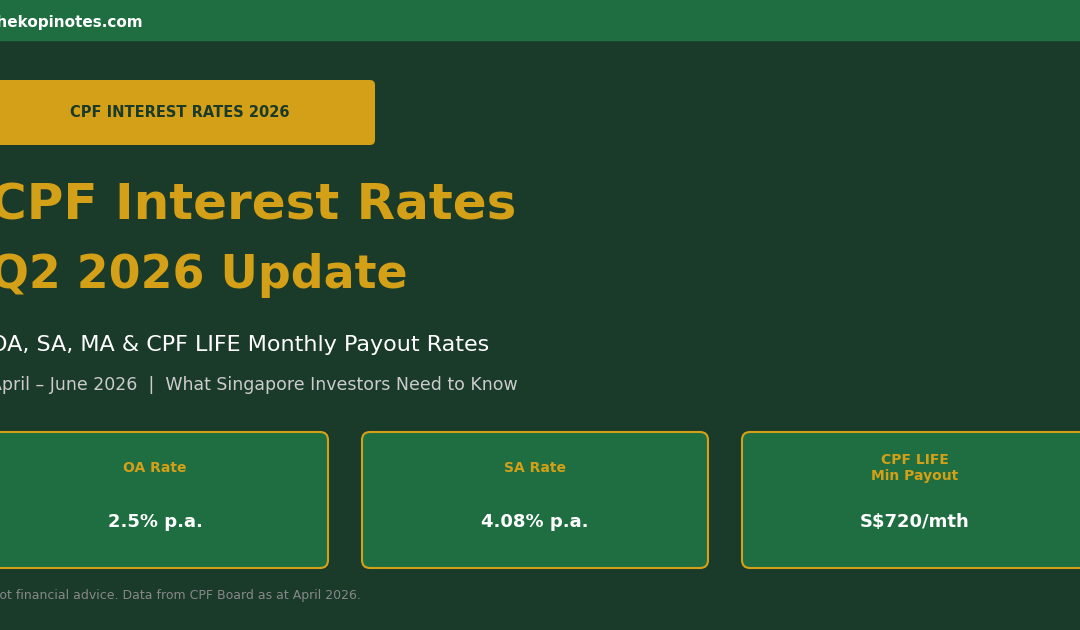
The CPF Board has confirmed interest rates for Q2 2026 (April – June 2026). Whether you are planning your retirement, topping up your CPF accounts, or reviewing your CPF LIFE payout projections, understanding the current rates helps you make smarter financial decisions. Here is everything Singapore investors need to know — in plain English, with real numbers.
Not financial advice. All data sourced from the CPF Board as at April 2026. Rates and payout figures are subject to CPF Board review quarterly.
Table of Contents
Contents — Click to expand
- CPF Account Interest Rates Q2 2026 (OA, SA, MA, RA)
- Extra Interest on First S$40,000
- CPF LIFE Monthly Payout Estimates 2026
- CPF LIFE Plans: Standard vs Basic vs Escalating
- Retirement Sums for 2026
- How to Maximise Your CPF Interest Returns
- CPF Top-Up Strategy: SA vs SRS vs CPFIS
- Frequently Asked Questions
1. CPF Account Interest Rates Q2 2026 (OA, SA, MA, RA)
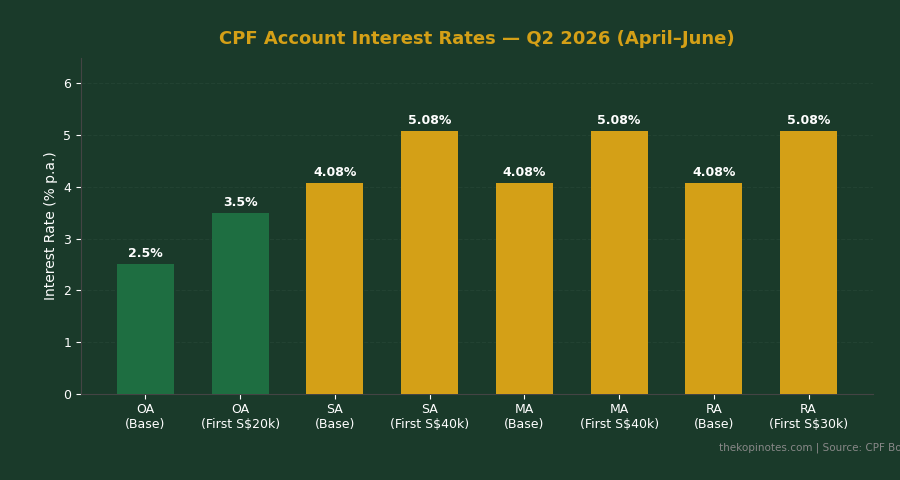
The CPF Board sets interest rates quarterly for the four CPF accounts. For Q2 2026 (April to June 2026), the confirmed rates are:
| CPF Account | Base Rate (p.a.) | Extra 1% on First S$20k OA / S$40k SA/MA/RA | Effective Rate (with extra interest) |
|---|---|---|---|
| Ordinary Account (OA) | 2.50% | +1% on first S$20,000 | Up to 3.50% |
| Special Account (SA) | 4.08% | +1% on first S$40,000 | Up to 5.08% |
| MediSave Account (MA) | 4.08% | +1% on first S$40,000 | Up to 5.08% |
| Retirement Account (RA) | 4.08% | +2% on first S$30,000 (age 55+) | Up to 6.08% |
Key takeaway: The SA, MA, and RA all earn a minimum of 4.08% p.a. — significantly higher than most bank savings accounts or Singapore Savings Bonds (2.14% for May 2026). Your OA earns 2.50% base, rising to 3.50% on the first S$20,000.
Note: The SA rate of 4.08% is the floor; it is pegged to the 12-month average yield of 10-year Singapore Government Securities (10YSGS) plus 1%, subject to a floor of 4%. For Q2 2026, the 10YSGS average was approximately 3.08%, hence the rate remains at the 4% floor + 0.08% = 4.08%.
2. Extra Interest on First S$40,000 — What It Means in Dollars
The CPF “extra interest” rules are where the real magic happens. Here is how it works in practice:
- Under age 55: An extra 1% p.a. is paid on the first S$20,000 in your OA and the first S$40,000 combined across your SA and MA. The OA portion is capped at S$20,000 — amounts above this in your OA earn only the base 2.50%.
- Age 55 and above: An extra 2% p.a. is paid on the first S$30,000 in your Retirement Account (RA), and an additional 1% on the next S$30,000. This means the effective rate on the first S$30,000 in your RA can reach 6.08% p.a.
Worked example (under 55): If you have S$20,000 in your OA and S$40,000 in your SA, your annual CPF interest works out to: (S$20,000 × 3.5%) + (S$40,000 × 5.08%) = S$700 + S$2,032 = S$2,732 per year in risk-free CPF interest — tax-free and compounding.
This is why topping up your SA (for those below 55) or RA (for those above 55) makes sense as part of your CPF investment strategy. At 5.08% with zero credit risk, it is hard to beat for the risk-adjusted portion of your retirement portfolio.
For a detailed breakdown of top-up tax relief on SA/RA contributions, see our guide on CPF Cash Top-Up Tax Relief 2026.
3. CPF LIFE Monthly Payout Estimates 2026
CPF LIFE (Lifelong Income For the Elderly) is Singapore’s national annuity scheme. Once you turn 65, CPF LIFE pays you a monthly income for life — the amount depends on how much you have in your Retirement Account at age 65 and which plan you chose.
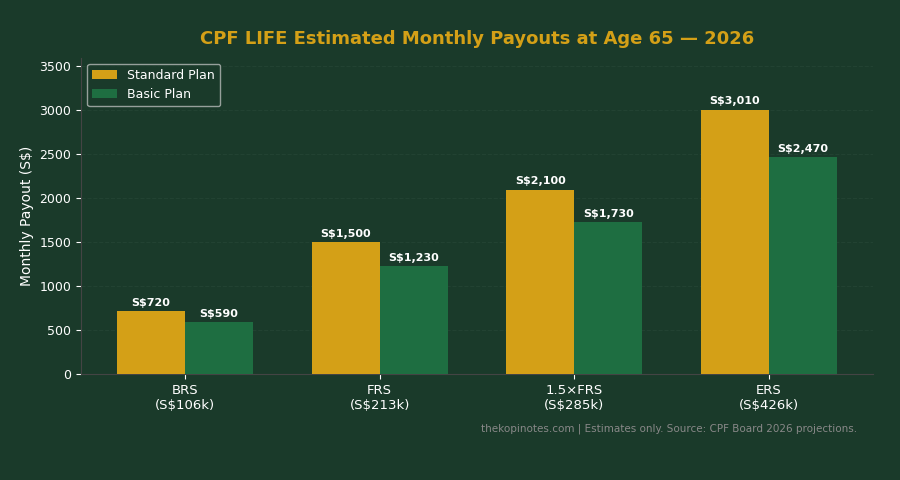
Below are the estimated monthly payouts for members turning 65 in 2026, based on the Standard Plan and Basic Plan:
| RA Balance at Age 65 | Standard Plan (S$/mth) | Basic Plan (S$/mth) | Escalating Plan (S$/mth est.) |
|---|---|---|---|
| BRS — S$106,500 | ~S$720 – S$790 | ~S$590 – S$650 | ~S$640 – S$710 (with 2% p.a. escalation) |
| FRS — S$213,000 | ~S$1,500 – S$1,600 | ~S$1,230 – S$1,310 | ~S$1,330 – S$1,430 |
| 1.5× FRS — S$319,500 | ~S$2,100 – S$2,250 | ~S$1,730 – S$1,860 | ~S$1,880 – S$2,020 |
| ERS — S$426,000 | ~S$3,010 – S$3,200 | ~S$2,470 – S$2,620 | ~S$2,680 – S$2,860 |
Note: These are projections based on CPF Board estimates. Actual payouts depend on your exact RA balance, age at which CPF LIFE starts, and prevailing interest rates. Use the official CPF LIFE Payout Estimator or our CPF LIFE Payout Calculator for a personalised estimate.
The retirement sums above reflect 2026 figures: BRS S$106,500, FRS S$213,000, ERS S$426,000. These increase annually by approximately 3.5% to account for inflation and rising living costs.
4. CPF LIFE Plans: Standard vs Basic vs Escalating
CPF LIFE offers three plans. You can choose (or change your plan) any time before your monthly payouts start, typically from age 65:
- Standard Plan — Highest monthly payout, with the full RA balance used. No bequest component; most of the premium is pooled. Best for members who want to maximise monthly income and have few dependants relying on a CPF bequest.
- Basic Plan — Lower monthly payout (~18–20% less than Standard), but a larger bequest to beneficiaries when you pass away. Suitable if you want to leave something behind.
- Escalating Plan — Starts at a lower payout (about 10–15% less than Standard) but increases by 2% each year, protecting against inflation. Best for those worried about purchasing power erosion over a 20–30 year retirement horizon.
Most financial planners recommend the Standard Plan for most Singaporeans — the pooling mechanism means you receive guaranteed income for as long as you live, regardless of how long that is. If you outlive your premium (which many do), you continue to receive the full payout funded by the CPF LIFE pool. For Singapore couples, it is common for each spouse to separately optimise their CPF LIFE to cover base living expenses, then supplement with S-REIT dividends or robo-advisor returns.
To understand how CPF LIFE fits into a full passive income strategy, visit our guide on best ways to earn passive income in Singapore.
5. CPF Retirement Sums for 2026
The CPF retirement sums determine how much you need in your RA when you turn 55 (set aside) and what CPF LIFE payout tier you fall under. For members turning 55 in 2026:
| Retirement Sum | Amount (2026) | What It Means |
|---|---|---|
| Basic Retirement Sum (BRS) | S$106,500 | Minimum set-aside if you own property with sufficient remaining lease. Supports CPF LIFE Basic Plan at minimum payout. |
| Full Retirement Sum (FRS) | S$213,000 | Standard set-aside for members without pledged property. Enables Standard Plan payout of ~S$1,500–S$1,600/mth. |
| Enhanced Retirement Sum (ERS) | S$426,000 | 2× FRS — maximum you can set aside in RA for the highest CPF LIFE payout (~S$3,000+/mth on Standard Plan). |
Important change from July 2026: The retirement age increases from 63 to 64. The re-employment age rises from 68 to 69. This means employer CPF contributions continue for an additional year, and members have one extra year to accumulate CPF savings before drawing on CPF LIFE.
The sums above are for members reaching 55 in 2026. If you turned 55 before 2026, your cohort-specific sums apply — check your CPF statement or use our CPF Retirement Sum Calculator.
6. How to Maximise Your CPF Interest Returns
CPF interest compounds annually — meaning the interest earned each year is credited at the end of the year and earns interest in subsequent years. Here are five practical strategies to make your CPF work harder:
- Top up SA early (if under 55): SA earns 4.08%–5.08%. Cash top-ups (under the Retirement Sum Topping-Up Scheme) also qualify for up to S$8,000 tax relief per year. The earlier you top up, the longer compounding works in your favour.
- Keep S$20,000 in OA for the extra 1%: The extra 1% on the first S$20,000 OA is applied to OA before SA/MA. Ensure you maintain at least S$20,000 in your OA to capture this benefit, even if you are also investing via CPF Investment Scheme (CPFIS).
- Transfer OA to SA before age 55: OA-to-SA transfers are one-way and irreversible, but earn 4.08% instead of 2.5%. Once SA hits the Full Retirement Sum (S$213,000 in 2026), no further transfers are allowed.
- Delay CPF LIFE start age if healthy: You can defer CPF LIFE payouts until age 70. Every year of deferral increases your monthly payout by approximately 6–7%. A member in good health may receive significantly higher lifetime income by deferring to 70.
- Combine CPF with S-REITs and robo advisors: CPF handles the risk-free, guaranteed base of your retirement income. For higher yield exposure, layer in S-REITs (currently yielding 5.5–7%) and robo-advisor platforms like Endowus (CPF-compatible) or Syfe for SRS investing. Use our Retirement Planning Calculator to see how the combination works.
7. CPF Top-Up Strategy: SA vs SRS vs CPFIS
Singapore investors have three main vehicles for retirement savings beyond mandatory CPF contributions. Knowing when to use each maximises your after-tax retirement income:
| Vehicle | Annual Limit | Tax Relief | Return Potential | Liquidity |
|---|---|---|---|---|
| SA Top-Up (RSTU) | S$8,000 self + S$8,000 family = S$16,000 | Up to S$16,000/yr | 4.08%–5.08% guaranteed | Locked until 55/RA withdrawal rules |
| SRS | S$15,300 (SC/PR), S$35,700 (foreigner) | Full contribution amount | Variable (stocks, ETFs, funds, robo) | Penalty before statutory retirement age |
| CPFIS (OA) | OA balance above S$20,000 | None (uses CPF funds) | Dependent on investment (must beat 2.5%) | Returns credited back to OA |
For most Singaporeans: Maximise SA top-up first (guaranteed 4%+ + tax relief), then use SRS for additional tax savings and equity/ETF exposure. CPFIS is only worth using if you can consistently beat 2.5% after fees — for many retail investors, just leaving OA funds in CPF to compound at 2.5%–3.5% is the better choice.
For SRS investing options, see our SRS Account Singapore Guide. For CPF-compatible robo platforms, Endowus is the only robo advisor with full CPF OA, SA, and SRS access.
Start Planning Your CPF Retirement Income Today
Use our free retirement planning tools to model your CPF LIFE payouts, SRS tax savings, and overall retirement income. No sign-up required.
8. Frequently Asked Questions
What is the CPF OA interest rate for Q2 2026?
What is the CPF SA interest rate for Q2 2026?
How much CPF LIFE monthly payout will I get?
Can I increase my CPF LIFE payout?
Is CPF interest taxable in Singapore?
What is the difference between CPF LIFE Standard and Basic Plan?
What are the CPF Retirement Sums for 2026?
How does CPF interact with the SRS for retirement planning?
This article was researched with the help of AI. While we strive to keep all information accurate and up to date, there may be errors. If you notice any discrepancies, please contact us.