Biotech ETF Singapore: How to Invest in the GLP-1 and Biotech Boom (2026)
A pure-play guide to BTEC (iShares Nasdaq US Biotechnology UCITS ETF) — why biotech is rallying on GLP-1 weight-loss drugs and record M&A, how to buy it in Singapore, and the risks to size correctly.
BTEC (iShares Nasdaq US Biotechnology UCITS ETF) is the most accessible way for Singapore investors to buy a basket of 250 Nasdaq-listed biotech stocks on the London Stock Exchange. It tracks companies like Amgen, Vertex Pharmaceuticals, and Gilead Sciences that are driving the GLP-1 weight-loss drug boom and a record wave of biotech M&A in 2026. Ireland domicile means 15% US dividend withholding tax (not 30%) and no US estate tax exposure — but biotech is a volatile, concentrated sector best held as a small tactical slice of a diversified portfolio.
Not financial advice. All figures are for educational reference only. Data verified as at September 2026 unless otherwise noted.
- BTEC tracks the Nasdaq Biotechnology Index — 250 holdings, 0.35% TER, Ireland-domiciled, accumulating
- GLP-1 drugs (weight-loss and diabetes) and AI-assisted drug discovery are fuelling a biotech re-rating and the strongest M&A year since 2019
- Biotech is high-volatility and binary-outcome driven (FDA trial results) — treat it as a 5–10% tactical allocation, not a core holding
Table of Contents
Contents — Click to expand
What Is a Biotech ETF?
A biotech ETF is a basket of stocks in companies that research, develop, and commercialise drugs, gene therapies, and diagnostic tools — distinct from a broader healthcare ETF, which also includes large pharmaceutical manufacturers, medical device makers, and health insurers. Biotech-specific funds are concentrated in small and mid-cap biotechnology and pharmaceutical names, which means more binary, event-driven returns (a single FDA approval or trial failure can move the whole fund) but also a bigger upside when a sector-wide catalyst — like the current GLP-1 boom — hits.
For Singapore investors, the simplest way in is BTEC (iShares Nasdaq US Biotechnology UCITS ETF), which tracks the Nasdaq Biotechnology Index on the London Stock Exchange. It is UCITS-regulated and Ireland-domiciled, meaning it meets European investor protection standards and avoids the 30% US dividend withholding tax and US estate tax exposure that apply to US-listed biotech ETFs like iShares’ own NASDAQ-listed IBB.
If you want a steadier, more diversified way to play the same healthcare theme, our Healthcare ETF Singapore guide compares broader global health funds (IUHC vs HEAL) that mix in pharma giants, device makers, and insurers — lower volatility, but also lower torque to a pure biotech re-rating.
Why Biotech Is Trending in 2026: GLP-1 and the M&A Wave
Biotech has re-rated sharply through 2026 for two connected reasons. First, the GLP-1 drug class — originally developed for type 2 diabetes and now the backbone of the weight-loss drug boom (Novo Nordisk’s Wegovy, Eli Lilly’s Zepbound/Mounjaro, and a fast-growing pipeline of oral and next-generation competitors) — has become one of the largest addressable markets in pharma history. Industry estimates put the global GLP-1 receptor agonist market at over USD 100 billion in 2026, with the weight-loss segment alone forecast to keep compounding at double-digit rates through the end of the decade.
Second, large pharmaceutical companies facing patent cliffs on legacy blockbuster drugs are racing to acquire smaller biotech firms with promising GLP-1, RNA, antibody-drug conjugate (ADC), and gene-editing pipelines. Biotech and pharma dealmaking hit roughly USD 106 billion in the first half of 2026 alone, putting the sector on track for its strongest M&A year since the pre-pandemic peak in 2019. This matters directly for BTEC holders: several of the fund’s largest constituents — Amgen, Vertex Pharmaceuticals, Gilead Sciences, and Regeneron — are both active acquirers and plausible acquisition targets, which has supported re-rating across the index.
For a Singapore investor, this creates a window: a structural, multi-year demand story (chronic disease management, obesity as a treatable condition) combined with a near-term M&A premium across the sector — but also a reminder that biotech remains cyclical and news-driven.
Best Biotech ETFs for Singapore Investors
BTEC is the largest and cheapest LSE-listed option tracking the Nasdaq Biotechnology Index, but it is worth knowing the alternatives before you commit capital.
| ETF | Listing | TER | AUM | Structure | 1Y Return |
|---|---|---|---|---|---|
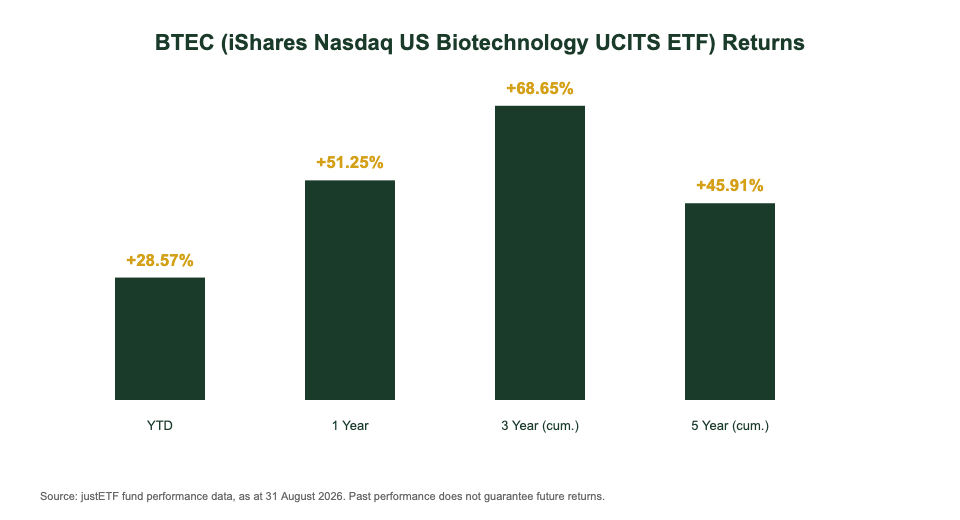
| BTEC — iShares Nasdaq US Biotechnology UCITS ETF | LSE (USD) | 0.35% | ~EUR 1.02bn | Accumulating | +51.25% |
| BTEK (same fund, GBP share class) | LSE (GBP) | 0.35% | ~EUR 1.02bn | Accumulating | +51.25%* |
| Invesco Nasdaq Biotech UCITS ETF | LSE/Xetra | 0.40% | ~EUR 439m | Accumulating (swap-based) | Tracks same index |
| iShares Nasdaq US Biotechnology UCITS ETF USD (Dist) | LSE | 0.35% | ~EUR 72m | Distributing | Tracks same index |
*GBP share class return in local currency terms differs slightly from USD once FX is accounted for. Source: iShares and Invesco fund factsheets (justETF, as at 31 August 2026 / 9 September 2026).
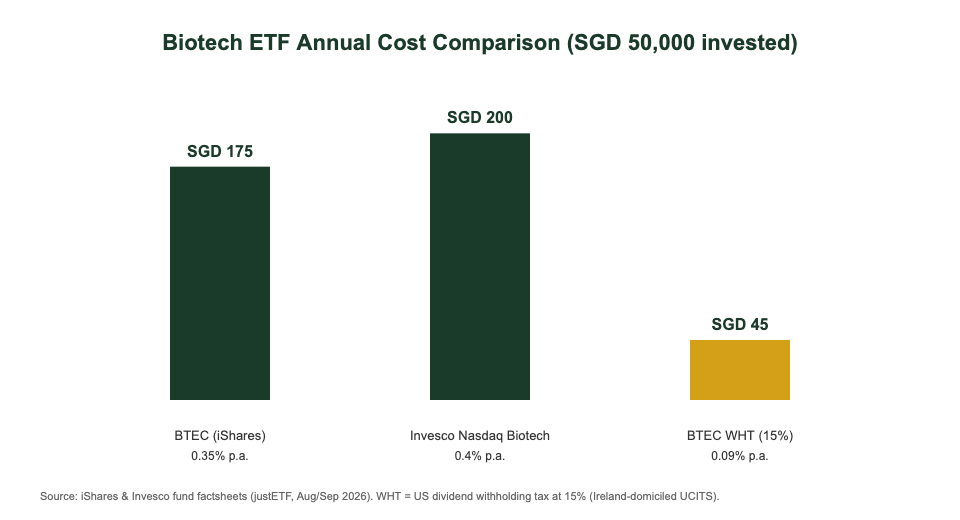
Costs and Tax: BTEC vs US-Listed Alternatives
BTEC’s 0.35% TER is roughly in line with sector peers — the Nasdaq Biotechnology Index itself is not available cheaper on the LSE. The bigger decision for Singapore investors is domicile. A US-listed biotech ETF like iShares’ Nasdaq Biotechnology ETF (IBB) on the Nasdaq has a lower headline TER (around 0.45% is typical for US-listed biotech funds, though this varies by provider) but exposes you to 30% US dividend withholding tax and US estate tax on holdings above USD 60,000 — a risk that does not apply to BTEC as an Ireland-domiciled UCITS fund.
| ETF Type | Domicile | US Dividend WHT | US Estate Tax Risk |
|---|---|---|---|
| BTEC (LSE) | Ireland | 15% | None |
| US-listed biotech ETF (e.g. IBB, NASDAQ) | USA | 30% | Yes (above USD 60k) |
Source: TKN calculations based on standard Ireland-US and US domestic withholding tax treatment; see our US estate tax guide for Singapore investors for the full breakdown.
Most of BTEC’s holdings pay little or no dividend — biotech companies typically reinvest cash into R&D rather than distribute income — so the WHT advantage is smaller in dollar terms than it would be for a dividend-heavy ETF. The estate tax point is the more material one: a Singapore investor building a sizeable biotech position over several years is better protected holding it via an Ireland-domiciled fund like BTEC than a US-listed equivalent.
For a SGD 20,000 position in BTEC, the annual TER cost works out to approximately SGD 70 per year (0.35% × SGD 20,000) — modest compared to the sector’s historical volatility, which is the more important variable to manage.
How to Buy BTEC in Singapore (Step-by-Step)
Step 1: Choose a broker with LSE access. You need a platform that lists LSE-traded securities. Syfe referral code offers zero-commission access with automated rebalancing, which suits investors who want a hands-off tactical allocation. FSMOne referral code is a lower-cost option for larger lump-sum trades, and Interactive Brokers (IBKR) offers the lowest global commissions for investors comfortable with a more technical platform.
Step 2: Search for the ticker BTEC (or the full name, iShares Nasdaq US Biotechnology UCITS ETF). Confirm you are selecting the USD-denominated, accumulating share class listed on the London Stock Exchange — not the GBP share class (BTEK) unless you have a specific reason to hold GBP exposure.
Step 3: Place your order during London market hours (8am–4:30pm GMT, i.e. 4pm–12:30am Singapore time). Biotech stocks and ETFs can have wider bid-ask spreads than broad-market funds during volatile periods — for amounts under SGD 5,000, consider a limit order rather than a market order to control your entry price.
Step 4: Size the position deliberately and hold with a long horizon. Given the sector’s volatility, most of BTEC’s return has historically come in sharp multi-month rallies (like the one underway in 2026) rather than steady appreciation — plan to hold for at least 3–5 years and avoid trying to time entries around individual FDA decisions.
Risks to Consider
Binary, event-driven volatility. A single FDA rejection, clinical trial failure, or patent ruling can move an individual biotech stock 20–50% in a day — and because BTEC’s top 10 holdings make up over 44% of the fund, a bad outcome for one or two major constituents can meaningfully drag down the whole ETF. BTEC’s 1-year volatility of 20.96% (versus roughly 10–11% for a broad world equity ETF) reflects this.
Policy and pricing risk. US drug pricing reform, changes to Medicare negotiation rules, or shifts in FDA approval timelines are recurring political risks for the sector. Any administration’s stance on drug pricing can swing biotech sentiment broadly, regardless of individual company fundamentals.
Concentration risk. BTEC is 88% exposed to the United States and almost entirely to healthcare (99.7% of the portfolio), with no diversification into other sectors or geographies. This is a deliberate, concentrated bet — not a core portfolio holding.
Valuation and drawdown risk. After a sharp 2026 rally (+28.57% year-to-date as at end-August 2026), biotech valuations are no longer cheap. The fund’s maximum drawdown over 3 years was -25.56% — a reminder that sector re-ratings can reverse quickly if M&A activity slows or GLP-1 competition compresses margins for the current leaders.
Who Should Buy BTEC?
BTEC is a reasonable fit if: you already hold a diversified core portfolio (such as a broad global or healthcare ETF) and want a small, high-conviction tactical tilt toward the GLP-1 and biotech M&A theme; you have a 5+ year horizon and can tolerate 20%+ drawdowns without needing to sell; and you are using spare cash capital rather than money earmarked for near-term goals.
Consider alternatives if: you want healthcare exposure without the volatility — the diversified healthcare funds covered earlier are a steadier fit; or if you are investing via CPF or SRS, since BTEC is not on the CPF-approved investment list and LSE-listed ETFs generally are not SRS-compatible through most SRS-linked brokers. For broader retirement planning around CPF, our passive income Singapore guide and retirement calculator are better starting points than a single-sector biotech bet.
Frequently Asked Questions
What is BTEC and why are Singapore investors buying it in 2026?
BTEC (iShares Nasdaq US Biotechnology UCITS ETF) is an LSE-listed fund tracking 250 Nasdaq biotechnology stocks, including Amgen, Vertex Pharmaceuticals, and Gilead Sciences. Singapore investors are buying it in 2026 to gain exposure to the GLP-1 weight-loss drug boom and the strongest biotech M&A wave since 2019, without needing a US brokerage account or taking on 30% US withholding tax and US estate tax exposure.
Is BTEC the same as a general healthcare ETF?
No. BTEC is a pure-play biotech fund — concentrated in small and mid-cap drug developers with binary, trial-driven outcomes. A general healthcare ETF (such as the IUHC or HEAL funds covered in our Healthcare ETF Singapore guide) spreads exposure across large pharma, medical devices, and health insurers, which is lower-volatility but less directly leveraged to a biotech re-rating.
Can I buy BTEC using my CPF or SRS funds?
No. BTEC is not on the CPF Board’s approved investment list, so you cannot use CPF Ordinary Account funds to buy it. LSE-listed ETFs are also generally not accessible through most SRS-linked brokerage accounts in Singapore. BTEC can only be bought with cash held in a standard brokerage account such as Syfe, FSMOne, or Interactive Brokers.
How much of my portfolio should I put into a biotech ETF like BTEC?
Most financial planners would frame BTEC as a tactical, sector-specific allocation rather than a core holding — typically 5–10% of a portfolio at most. Biotech’s volatility (around 21% annualised, roughly double that of a broad world equity ETF) and its history of sharp drawdowns (-25.56% over 3 years) mean an outsized position can meaningfully destabilise your overall portfolio if the sector corrects.
What are the biggest risks of investing in BTEC?
The main risks are binary clinical trial and FDA approval outcomes (which can swing individual holdings sharply), US drug pricing policy changes, heavy concentration in US healthcare stocks (88% US, 99.7% healthcare), and valuation risk after a strong 2026 rally. BTEC should be held with a multi-year horizon and sized so a 20–30% drawdown would not derail your financial plan.
Which broker is best for buying BTEC in Singapore?
Syfe is the simplest option for most investors — zero commission and automatic portfolio rebalancing. FSMOne offers lower costs on larger trades, and Interactive Brokers (IBKR) has the lowest global commissions for investors comfortable with a more technical trading platform. All three support LSE-listed ETFs like BTEC.
The Bottom Line
BTEC gives Singapore investors tax-efficient, UCITS-regulated access to the GLP-1 and biotech M&A boom — but it belongs as a small tactical slice next to a diversified core, not a replacement for one. Not financial advice. Data verified as at September 2026.
This article was researched with the help of AI. While we strive to keep all information accurate and up to date, there may be errors. If you notice any discrepancies, please contact us.