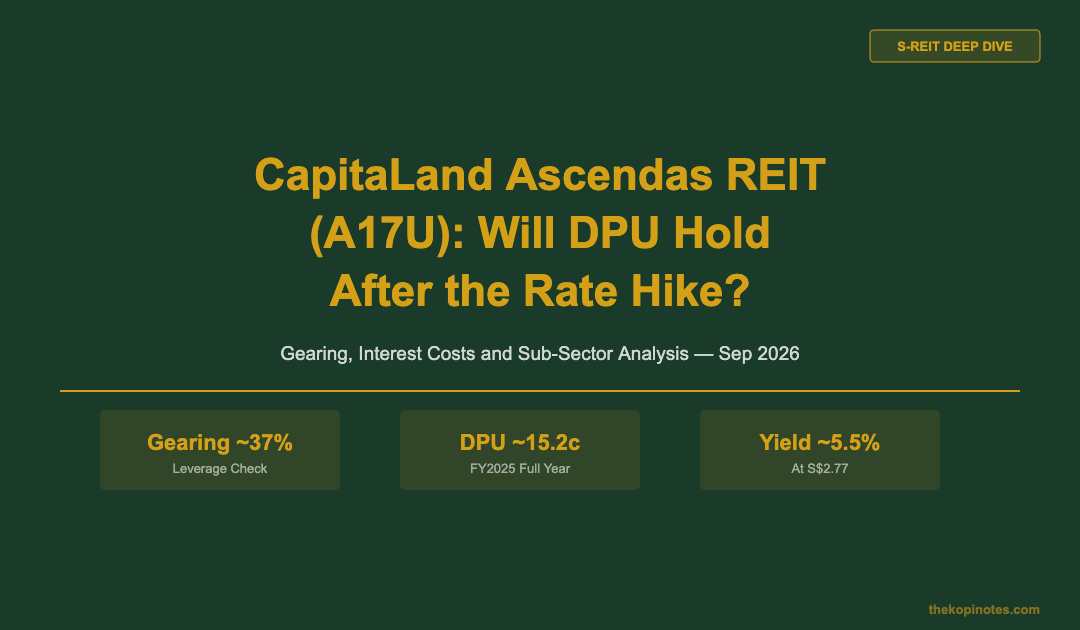
CapitaLand Ascendas REIT (A17U): Will DPU Hold After the Rate Hike?
Gearing, interest costs and sub-sector analysis | September 2026
CapitaLand Ascendas REIT (SGX: A17U) is Singapore’s largest industrial REIT, holding data centres, business parks, logistics hubs and high-specs industrial properties. After the Fed’s September 2026 rate hike, investors are asking whether CLAR’s DPU can hold. The answer is yes — but the margin depends on data centre rental reversion and how quickly floating-rate debt is refinanced.
Not financial advice. All figures are for educational reference only. Data as at September 2026 unless noted.
- CLAR’s gearing of ~37.2% is below the S-REIT average and well below the 50% regulatory cap — it has room to absorb higher costs
- 79% of debt is hedged to fixed rates, limiting the immediate DPU hit from the September 2026 rate hike
- Data centre rental reversion of 12%–18% is the key offset — and Singapore’s supply moratorium keeps this tailwind intact
CLAR at a Glance: Key Metrics
Before getting into the rate hike impact, here is where CLAR stands heading into Q4 2026.
| Metric | Value | Notes |
|---|---|---|
| SGX Code | A17U | CapitaLand Ascendas REIT |
| Share Price (Sep 2026) | ~S$2.77 | Post rate-hike level |
| Market Cap | ~S$13.8B | Largest Singapore industrial REIT |
| FY2025 DPU (full year) | ~15.17 cents | 1H + 2H FY2025 combined |
| Distribution Yield | ~5.5% | At S$2.77 share price |
| Gearing Ratio | ~37.2% | Below sector avg of 38.5% |
| Avg Cost of Debt | ~3.8% | Post rate-hike estimate |
| Hedged Debt % | ~79% | Key buffer against further hikes |
Source: CapitaLand Ascendas REIT SGX filings and investor presentations. Educational reference only. As at Sep 2026.
DPU History and Yield Analysis
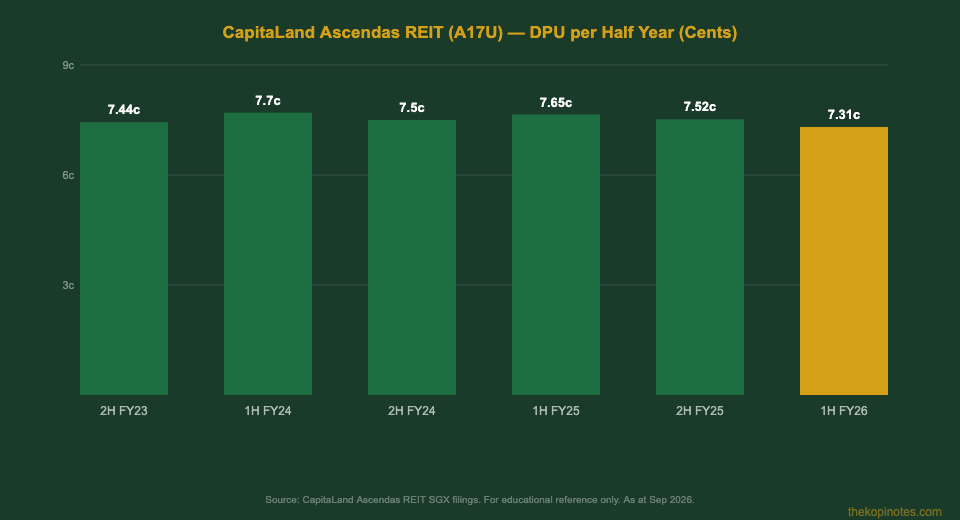
CLAR pays distributions twice a year. Here is how DPU has trended across the last three full financial years and into 1H FY2026.
| Period | DPU (cents) | YoY Change |
|---|---|---|
| 2H FY2023 (Oct–Mar) | 7.44c | — |
| 1H FY2024 (Apr–Sep) | 7.70c | +3.5% vs prior 1H |
| 2H FY2024 (Oct–Mar) | 7.50c | +0.8% vs prior 2H |
| 1H FY2025 (Apr–Sep) | 7.65c | -0.6% vs prior 1H |
| 2H FY2025 (Oct–Mar) | 7.52c | +0.3% vs prior 2H |
| 1H FY2026 (Apr–Sep) | 7.31c | -4.4% vs prior 1H |
Source: CapitaLand Ascendas REIT SGX announcement filings. Educational reference only. As at Sep 2026.
The 4.4% dip in 1H FY2026 DPU reflects two pressures. Higher borrowing costs cut into net distributable income. And CLAR completed a large equity fundraising earlier in 2026, diluting DPU across a bigger unit base. Management guidance points to stabilisation in 2H FY2026, driven by newly completed assets contributing full-period income and data centre leases rolling over at higher rates.
For context on how CLAR compares with other large S-REITs, see our guide to the best S-REITs in Singapore 2026.
Gearing and Interest Cost Analysis
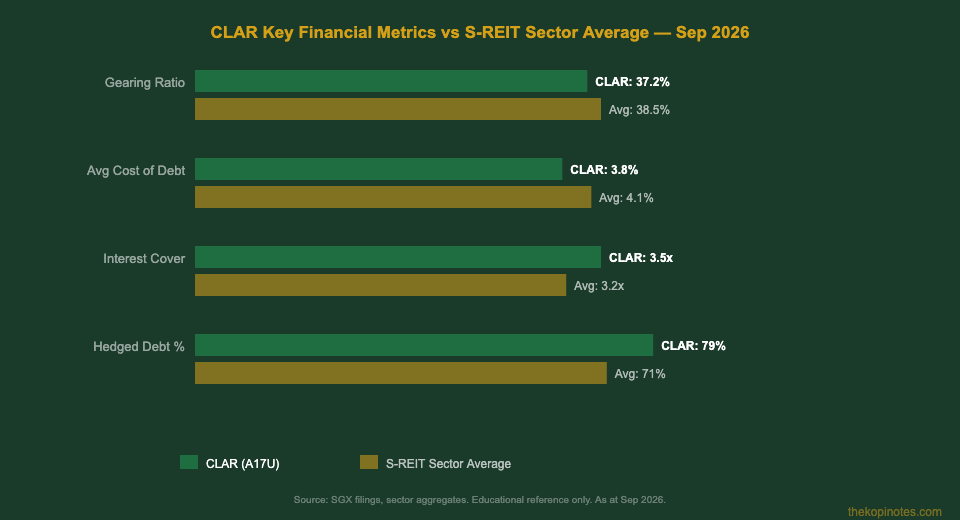
Gearing is the most important number to watch when rates rise. It tells you what share of CLAR’s assets are funded by debt. Higher gearing means more interest expense — and less income left for DPU.
CLAR’s gearing sits at approximately 37.2% as at September 2026. That is below the sector average of 38.5% and well below the MAS regulatory ceiling of 50%. You have a meaningful buffer here.
With 79% of debt locked in at fixed rates, only the remaining 21% is exposed to the September 2026 hike. On a debt base of roughly S$8.3 billion, that floating exposure is about S$1.74 billion. A 25-basis-point increase adds approximately S$4.4 million in annual interest costs — or around 0.13 cents per unit in DPU terms. That is manageable in isolation.
The bigger risk is debt refinancing. As fixed-rate loans mature over the next 18 months, CLAR will roll them over at higher prevailing rates. Management has staggered maturities so no single year accounts for more than 15% of total debt — which limits cliff-risk but does not eliminate the gradual cost creep.
The interest coverage ratio of approximately 3.5x is above the sector average of 3.2x. That gives CLAR more room before lenders get nervous. To put this in Singapore investor context — you can explore how S-REIT income fits a retirement income plan via our Singapore retirement calculator.
Sub-Sector Breakdown: Data Centres vs Industrial
CLAR’s portfolio spans four distinct sub-sectors. Each has different demand drivers, and knowing which are outperforming matters when you are assessing DPU sustainability.
| Sub-Sector | Portfolio % | Rental Reversion | Outlook |
|---|---|---|---|
| Data Centres | ~20% | +12% to +18% | Strong — SG supply moratorium limits new builds |
| High-Specs Industrial | ~35% | +6% to +10% | Stable — semiconductor and biomedical tenants |
| Business Parks | ~20% | +2% to +5% | Moderate — hybrid work weighing on occupancy |
| Logistics / General Industrial | ~25% | +3% to +6% | Steady — port activity and regional trade resilient |
Source: CLAR investor presentations, management guidance. Estimates for educational reference only. As at Sep 2026.
Data centres are the headline story. Singapore’s government has maintained a moratorium on new data centre approvals since 2019, lifting only selectively for green, efficient facilities. This means supply is extremely tight. When CLAR’s existing data centre leases expire, they roll over at 12% to 18% higher rates. That sub-sector is effectively a natural hedge against the rate hike.
High-specs industrial is the second key driver. Singapore’s ambition to grow semiconductor, precision engineering and biomedical manufacturing keeps demand for clean-room and controlled-environment space elevated. Tenants in this segment tend to have long lease terms and low move-out risk.
For a broader view of how to generate passive income in Singapore via S-REITs, see our dedicated guide.
What the Rate Hike Means for DPU in Practical Terms
Here is a simple worked example. CLAR has approximately S$8.3 billion in total debt. The floating-rate portion — around 21% — is the part exposed to the September 2026 hike. That is about S$1.74 billion at risk of repricing.
If the floating rate rises by 25 basis points: S$1.74B x 0.25% = S$4.35 million in additional annual interest cost. With approximately 3.5 billion units outstanding, that works out to roughly 0.12 cents per unit in reduced DPU capacity per year. By itself, that is a modest dent.
But here is the more important picture. As fixed-rate debt rolls over at higher market rates over the next 12 to 18 months, the total interest cost drag could reach 0.4 to 0.6 cents per unit annually. That is where the real pressure builds. Whether data centre and high-specs industrial rental reversion can offset this drag is the core question for 2H FY2026 and FY2027.
Management guidance suggests that S$1.2 billion worth of leases due for renewal in 2H FY2026 include a significant data centre component. At 12% reversion on even half of that, the income uplift would likely exceed the rate hike cost drag — which is why analysts have been cautiously constructive on CLAR post-hike.
If you held CLAR at current prices and received a yield of around 5.5%, you are already beating the 4-year fixed deposit rate at most Singapore banks. For a comparison of fixed-income alternatives, see our article on how to access moomoo Singapore for low-cost S-REIT investing. You can also review platforms like Endowus for fee-efficient REIT fund exposure (referral code 2V343).
Should You Hold CLAR After the Rate Hike?
This is not a buy or sell recommendation — you should make your own decision based on your financial situation. What we can do is lay out the key factors.
| Factor | Bull Case | Bear Case |
|---|---|---|
| DPU sustainability | Data centre reversion offsets cost drag | Refinancing drag builds through FY2027 |
| Share price re-rating | Fed signals hold or cut — REITs re-rate up | Further hike in Q4 2026 keeps discount wide |
| Yield vs alternatives | ~5.5% yield still attractive vs 6M T-bill at ~3.8% | T-bills rise further and close the gap |
| NAV discount | Current price below NAV — margin of safety | NAV may compress if cap rates rise |
Educational analysis only. Not investment advice. As at Sep 2026.
CLAR is Singapore’s largest industrial REIT for a reason. Its portfolio diversification, dominant market position in Singapore data centres, and conservative gearing give it more resilience than most. But no S-REIT is immune to higher rates — the question is how long rates stay elevated.
If you are building a Singapore passive income portfolio, CLAR at current yields remains worth considering as a core holding. Pair this research with data from our best S-REITs in Singapore 2026 comparison and a brokerage with low trading fees. Syfe Trade offers no-commission S-REIT trading for retail investors (referral code SRPRFFFCD). Alternatively, FSMOne (referral code P0544985) offers a regular savings plan for buying CLAR on autopilot each month.
Frequently Asked Questions
Will CLAR DPU fall further after the September 2026 rate hike?
What is CapitaLand Ascendas REIT's current gearing ratio?
Why does CLAR's share price fall when interest rates rise?
How is CLAR different from a pure data centre REIT?
Where can I invest in CLAR in Singapore with low fees?
This article was researched with the help of AI. While we strive to keep all information accurate and up to date, there may be errors. If you notice any discrepancies, please contact us.