Singapore Insurance Savings Plan 2026: Types, Returns and How to Choose
A Singapore insurance savings plan is a hybrid financial product that combines life insurance cover with a structured savings component. You pay regular or single premiums, build a guaranteed cash value over time, and receive a maturity payout at the end of the policy term. Participating (par) plans may add non-guaranteed bonuses from the insurer’s par fund on top. All plans are regulated by MAS and covered by SDIC up to S$100,000 in guaranteed benefits. Data verified as at 10 September 2026.
Not financial advice. All figures are for educational reference only. Always read the product summary and policy documents before committing.
- Insurance savings plans lock in capital-guaranteed returns and add life cover — unlike a bank savings account, your money is committed for the full policy term.
- Non-participating plans fix your return from day one. Participating plans can earn more through par fund bonuses, but those bonuses are never guaranteed.
- SDIC covers up to S$100,000 in guaranteed benefits per policy owner per insurer — your guaranteed principal is protected even if the insurer fails.
What Is a Singapore Insurance Savings Plan?
An insurance savings plan is a life insurance policy with a savings element built in. You pay premiums over a set period, and in return you receive a guaranteed payout when the policy matures. If you pass away during the term, your beneficiaries get a death benefit instead.
This is different from a standalone term life policy, which gives you pure protection with no savings return. And it is different from a pure savings account, which gives you no life cover.
Insurance savings plans sit in the middle — they offer both. The trade-off is commitment. Once you sign up, your money is locked in for the full policy term. Early surrender typically means getting back less than you put in, especially in the first few years.
The plans are issued by MAS-licensed insurers and fall under the Policy Owners Protection (PPF) Scheme administered by SDIC. Your guaranteed benefits — not the full maturity value, just the guaranteed component — are protected up to S$100,000 per insurer if that insurer fails.
Who typically buys an insurance savings plan?
These plans suit Singaporeans who want a forced savings habit, need life cover alongside their savings, and are comfortable locking up money for two to ten years in exchange for a guaranteed return. They are especially popular with parents saving for a child’s education, or individuals building a retirement pot alongside their CPF investment strategy.
Participating vs Non-Participating Plans: Key Differences
Every insurance savings plan in Singapore is either participating (par) or non-participating (non-par). This is the single most important thing to understand before you compare any two plans.
Non-participating plans are simpler. The insurer calculates your exact guaranteed payout at the start, and that number does not change. What you see in the policy document is exactly what you get at maturity — no more, no less. Returns tend to be modest, but you know precisely what you are signing up for.
Participating plans offer a guaranteed cash value plus the potential for additional non-guaranteed bonuses. These bonuses come from the insurer’s participating fund, which invests in a mix of equities, bonds, and other assets. If the fund does well, you may receive more than the illustrated amount. If it does poorly, bonuses may be lower than illustrated — or declared as zero in a bad year.
| Feature | Non-Participating | Participating |
|---|---|---|
| Returns | Fully guaranteed | Guaranteed + non-guaranteed bonuses |
| Predictability | High — exact payout known upfront | Lower — bonus depends on par fund performance |
| Return potential | Lower ceiling | Higher ceiling if fund performs well |
| Typical term | 2 to 5 years | 3 to 20+ years |
| Best for | Short-term, capital certainty | Long-term wealth building with upside |
Source: MAS, LIA Singapore, insurer product disclosures, Sep 2026.
How Par Fund Returns Work in Singapore
When you buy a participating plan, your premiums go into the insurer’s participating fund. The fund invests primarily in bonds, equities, and real estate. Each year, the insurer declares a bonus based on the fund’s performance.
There are two main types of bonuses you need to understand:
Reversionary bonus — declared each year and added to your policy’s accumulated value once vested. Once it is declared and vested, it cannot be taken back, even if the fund performs poorly in future years. Think of it as a ratchet — it only moves up.
Terminal bonus — paid out as a lump sum when your policy matures or when you surrender it. This bonus is purely at the insurer’s discretion and is not guaranteed at all. It can vary significantly depending on when you exit the policy.
Understanding LIA Illustration Rates
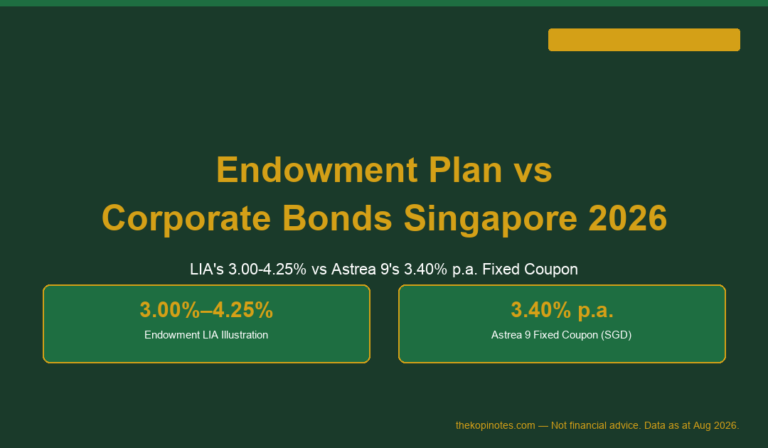
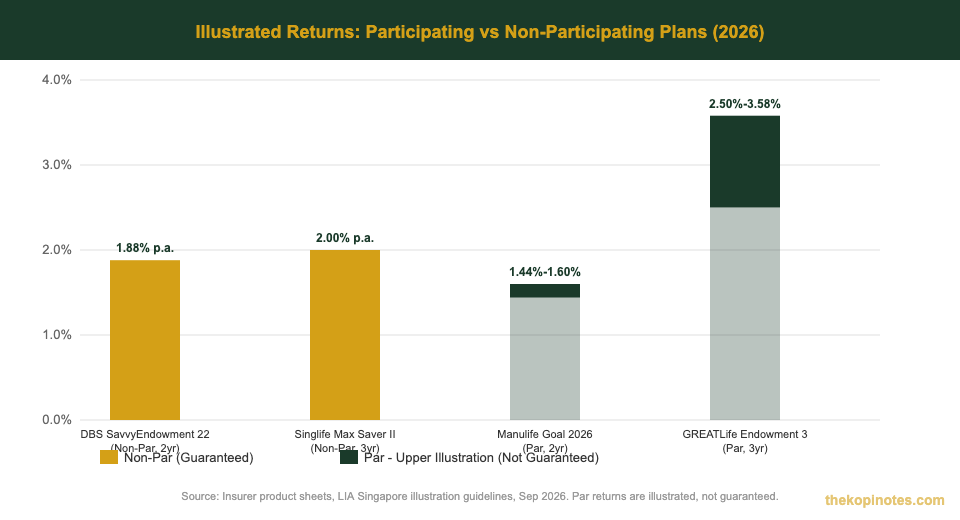
When an insurer shows you an illustrated return for a par plan, it is based on two scenarios set by the Life Insurance Association (LIA) Singapore. The upper illustration assumes the par fund earns 4.25% per year. The lower illustration assumes 3.00% per year.
These are not promises. They are projections to help you compare plans on an equal footing. Your actual return could be higher or lower. The GREATLife Endowment Insurance 3, for example, illustrates a return of up to 3.58% p.a. at the 4.25% upper rate — but your actual payout depends on how the Great Eastern par fund performs over your policy term.
Before signing any participating plan, always look at both the upper and lower illustrated values. The gap between them tells you how much uncertainty you are taking on. A plan where the two scenarios produce very different payouts carries more variability than one where they are close together.
Key Singapore Providers and Plan Examples (2026)
Here is a snapshot of plans available in September 2026. For a deeper look at single premium endowment plan Singapore options, we have a dedicated guide covering the full range.
| Plan | Insurer | Type | Term | Illustrated Return |
|---|---|---|---|---|
| SavvyEndowment 22 | DBS / Manulife | Non-par | 2 years | Up to 1.88% p.a. (guaranteed) |
| Max Saver II | Singlife | Non-par | 3 years | 2.00% p.a. (guaranteed) |
| Manulife Goal 2026 | Manulife | Par | 2 years | Up to 1.60% p.a. illustrated |
| GREATLife Endowment 3 | Great Eastern | Par | 3 years | Up to 3.58% p.a. illustrated |
Source: Insurer product sheets and factsheets, Sep 2026. Par plan returns are illustrated at LIA upper rate of 4.25% — not guaranteed. Verify current rates directly with each insurer before applying.
Other major Singapore providers of insurance savings plans include Prudential, AIA, NTUC Income, and Tokio Marine. Each insurer manages its own par fund with a different asset allocation and historical bonus track record.
If you want to compare surrender values and what happens if you exit early, our insurance surrender value Singapore guide explains the mechanics.
How to Compare Singapore Insurance Savings Plans
Not all plans are created equal. Here are the five things to check before you commit:
1. Guaranteed vs total illustrated return — Look at the guaranteed cash value at maturity, not just the total illustrated value. The difference is what depends on bonus performance. A plan with a high illustrated return but a low guaranteed component carries more risk.
2. Policy term and liquidity needs — A 2-year non-par plan suits someone who can park money for a fixed short window. A 10-year par plan suits someone building long-term wealth who will not need to touch the money. Surrendering early on most plans means a loss — check the surrender schedule in the policy document.
3. Par fund track record — For participating plans, the insurer’s par fund bonus history matters. Ask your financial adviser for the last five years of bonus declarations. A consistent track record does not guarantee future performance, but it signals a well-managed fund.
4. Death benefit — Most savings plans include a death benefit of 101% or 105% of premiums paid. This is basic cover. If you need substantial life cover, you should hold a separate term policy alongside your savings plan. See our breakdown of savings plans in Singapore 2026 ranked by returns and risk.
5. Total premiums vs payout — Use the Singapore retirement calculator to model whether the guaranteed maturity value justifies the total premiums you will pay. For short plans, the effective annual return is easy to calculate. For longer par plans, compare the lower illustrated scenario against alternatives like Singapore Savings Bonds before deciding.
ISP vs Other Savings Options in Singapore
How does an insurance savings plan stack up against the other options available to Singapore savers? Here is a quick comparison. Use this alongside professional advice for your specific situation.
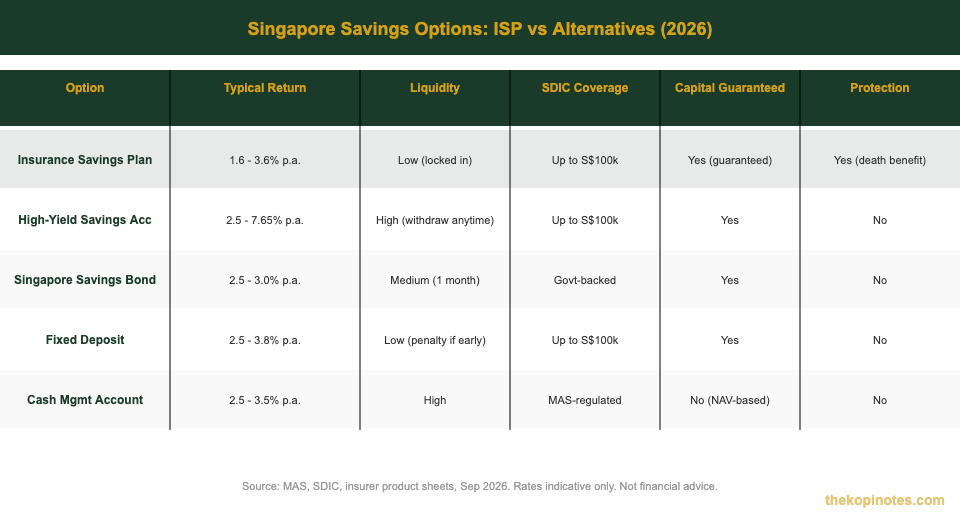
High-yield savings accounts (like MariBank Save or Trust Bank) offer higher headline rates — some up to 7.65% p.a. — but these bonus rates come with spending, salary credit, and insurance purchase conditions. The base rate without conditions is much lower. An ISP gives you a clean guaranteed rate with no hoops to jump through.
Singapore Savings Bonds offer government-backed capital safety and monthly liquidity (one month notice to redeem). Current rates in September 2026 are around 2.5% to 3.0% p.a. — competitive with short non-par endowments. The trade-off: no life cover.
Fixed deposits at Singapore banks currently range from 2.5% to 3.8% p.a. depending on tenure and amount. They are highly liquid compared to insurance savings plans — most allow early withdrawal with an interest penalty rather than a capital loss. However, they provide no life protection.
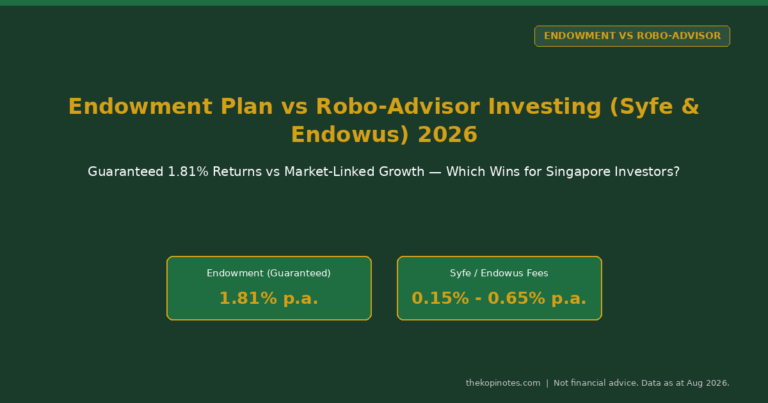
Cash management accounts offered by platforms like Endowus, Syfe, and FSMOne invest in money market and short-duration bond funds. Returns are currently around 2.5% to 3.5% p.a. but are not capital-guaranteed — your return depends on the underlying fund’s NAV. If you are using one of these platforms, check whether you qualify for an Endowus referral code for a fee rebate on your first investment.
The bottom line: insurance savings plans are not the highest-return option in isolation. Their edge is the combination of capital guarantee, life cover, and discipline. If you struggle to keep money in a savings account without dipping into it, the commitment structure of an ISP can work in your favour.
Frequently Asked Questions
Is a Singapore insurance savings plan the same as an endowment plan?
Are insurance savings plans covered by SDIC?
What happens if I surrender my insurance savings plan early?
Do I need to pay tax on insurance savings plan payouts in Singapore?
What is the minimum premium for a Singapore insurance savings plan?
Should I choose a participating or non-participating plan?
Get Free Insurance Advice
Speak with a licensed insurance advisor. No obligation, no cost.
By submitting this form, you agree to our Privacy Policy.
This article was researched with the help of AI. While we strive to keep all information accurate and up to date, there may be errors. If you notice any discrepancies, please contact us.