MediSave Top-Up Tax Relief 2026: How to Claim Up to S$8,000
MediSave top-up tax relief lets you claim up to S$8,000 off your taxable income each year by making voluntary cash contributions to your MediSave account. A separate S$8,000 relief is also available for topping up eligible family members’ accounts — bringing the combined maximum to S$16,000. All you need is a CPF account and spare cash; the government does the rest through your Notice of Assessment.
Not financial advice. All figures are for educational reference only. Data verified as at 8 September 2026. Consult IRAS or a licensed financial adviser for personalised guidance.
- Top up your MediSave with cash → deduct up to S$8,000 from your taxable income per year
- The relief is shared with SA/RA top-ups — plan your CPF top-up strategy holistically
- If you’re aged 55–70, stack the Matched MediSave Scheme (MMSS) on top for an extra S$1,000 government grant (2026–2030)
What Is MediSave Top-Up Tax Relief?
Your CPF MediSave account is the part of your CPF that pays for hospital bills, approved outpatient treatments, and Integrated Shield Plan premiums. Unlike the Ordinary Account, you can’t invest your MediSave — but you can voluntarily top it up with cash, and IRAS rewards you for doing so.
When you make a voluntary cash top-up to your MediSave account, that amount is deductible from your chargeable income for that Year of Assessment (YA). In plain English: you pay less income tax.
This relief falls under the broader CPF Cash Top-Up Relief scheme, which also covers voluntary top-ups to your Special Account (SA) and Retirement Account (RA). The key point — and where many people trip up — is that the S$8,000 cap covers all three accounts combined, not just MediSave alone.
| Account | Top-Up Type | Tax Relief? | Max Annual Relief |
|---|---|---|---|
| MediSave Account (MA) | Voluntary cash top-up | ✅ Yes | S$8,000 (shared) |
| Special Account (SA) | Voluntary cash top-up | ✅ Yes | S$8,000 (shared) |
| Retirement Account (RA) | Voluntary cash top-up | ✅ Yes | S$8,000 (shared) |
| Family member accounts (MA/SA/RA) | Cash top-up on their behalf | ✅ Yes | Additional S$8,000 |
Source: IRAS Singapore, CPF Cash Top-Up Relief guidelines. YA2026.
How Much Tax Can You Save?
The actual savings depend on your marginal tax rate. Singapore uses a progressive income tax system, so the higher your income, the more you save from every dollar of relief you claim.
For example, if you earn enough to fall in the 19% bracket, topping up S$8,000 to your MediSave saves you S$1,520 in taxes — in one year. That’s a guaranteed, risk-free “return” of 19% on S$8,000 the moment you file your taxes.
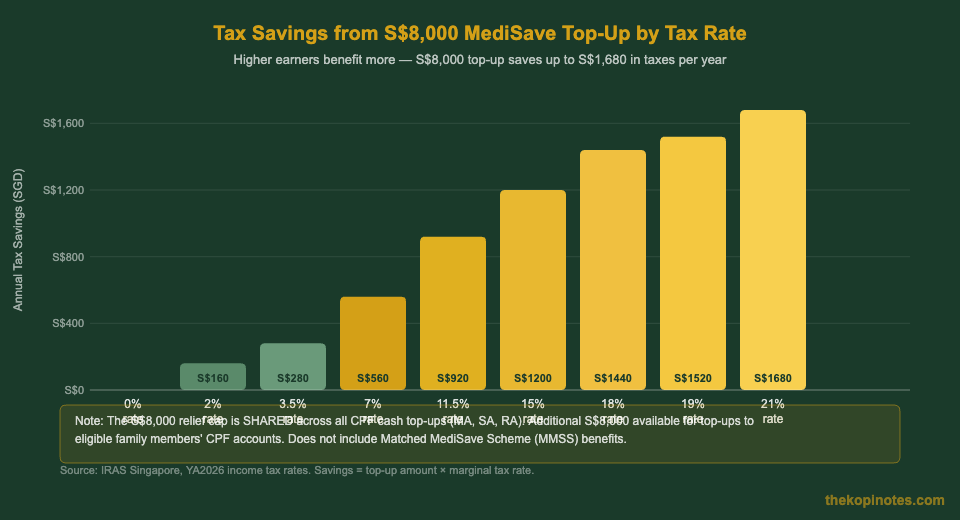
Even at the lower 7% bracket, a S$8,000 top-up saves you S$560 in taxes — and the money stays in your MediSave earning a guaranteed 4% MediSave interest rate per year. You’d be hard-pressed to find a safer combination of tax savings and guaranteed return.
Important caveat: If you’re also topping up your SA or RA, remember the S$8,000 cap is shared. Topping up S$5,000 to your SA leaves only S$3,000 of tax relief available for your MediSave top-up.
Who Qualifies for MediSave Top-Up Tax Relief?
Most working Singaporeans qualify. To be eligible, you must meet all three conditions:
- You are a Singapore Citizen or Permanent Resident — foreigners without CPF accounts are not eligible
- Your MediSave balance is below the Basic Healthcare Sum (BHS) — the BHS for 2026 is S$79,000. You cannot top up beyond this limit
- You make a voluntary cash top-up — not employer contributions or mandatory CPF contributions. Only voluntary cash top-ups qualify for tax relief
For Family Member Top-Ups
You can claim an additional S$8,000 in tax relief for topping up CPF accounts belonging to eligible family members. To qualify, the recipient must be your:
- Parent, parent-in-law, grandparent, or grandparent-in-law
- Spouse or sibling
Crucially, the recipient’s assessable income in the preceding year must not exceed S$4,000 — unless they are 55 years old or older. This catches most retired parents who no longer earn a salary.
| Eligible Recipient | Income Condition | Max Extra Relief |
|---|---|---|
| Parents / Parents-in-law | Income ≤ S$4,000 OR aged ≥ 55 | S$8,000 |
| Grandparents / Grandparents-in-law | Income ≤ S$4,000 OR aged ≥ 55 | S$8,000 |
| Spouse / Siblings | Income ≤ S$4,000 | S$8,000 |
Source: IRAS Singapore. The S$8,000 family relief cap is shared across all family members’ accounts combined — not S$8,000 per person.
How to Top Up Your MediSave Account
Topping up your MediSave is straightforward. You can do it online in minutes. Here are the three main methods:
Method 1: CPF Online Portal
Log in to CPF Board’s online portal with your Singpass. Go to My Requests → Building Up Your CPF Savings → Contribute to My Account. Choose MediSave as the destination and enter your top-up amount.
Method 2: PayNow
Transfer funds via PayNow to CPF Board’s UEN. This is the fastest method — your balance updates within a few hours. Use the reference code format specified on the CPF site to ensure it’s credited correctly.
Method 3: GIRO
Set up a recurring GIRO deduction for disciplined, automated top-ups each month. Good for those who want to hit the S$8,000 annual limit systematically without thinking about it.
There’s no partial-year pro-rating. A S$1 top-up on 31 December counts for the same tax year as a S$8,000 top-up on 1 January. But you can only claim relief up to the S$8,000 cap — any excess earns 4% interest but no additional tax deduction for that year.
Once your MediSave balance hits the BHS (S$79,000 in 2026), any further contributions to your CPF Ordinary Account or SA will overflow into MediSave until it’s full. These mandatory overflow contributions do not qualify for the tax relief — only deliberate voluntary cash top-ups do. For a full breakdown of how the BHS works, see our guide on the MediSave cap and withdrawal limits.
Matched MediSave Scheme (MMSS) — Extra S$1,000 Bonus
Since 2026, the CPF Board introduced the Matched MediSave Scheme (MMSS) as part of the Healthier SG initiative. Under MMSS, the government matches your voluntary MediSave top-ups dollar-for-dollar, up to S$1,000 per year.
This means if you top up S$1,000 to your MediSave in a calendar year, the government adds another S$1,000. That’s effectively a 100% return on that portion before you even count the tax savings.
MMSS Eligibility
MMSS is available to Singapore Citizens and Permanent Residents who are:
- Enrolled in Healthier SG with a chosen family doctor
- Aged 40 and above (those under 40 are not yet eligible for MMSS as of 2026)
- Making voluntary MediSave cash top-ups during the calendar year
The S$1,000 MMSS bonus is separate from your tax relief limit. You can still claim the full S$8,000 in tax relief on your self-top-up even if you also receive the MMSS matching grant.
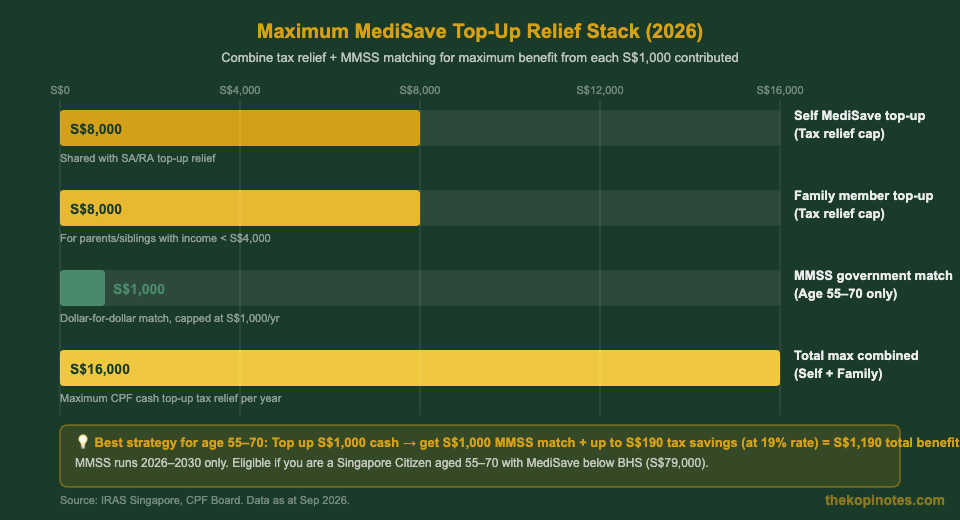
Combined tax savings + MMSS bonus for a S$1,000 top-up, by marginal tax rate
How MMSS and Tax Relief Stack
Consider a 45-year-old Singaporean with a chargeable income of S$200,000 (marginal tax rate: 19.5%). She tops up S$1,000 to MediSave in January 2026:
- MMSS bonus: S$1,000 (government matches her S$1,000 top-up)
- Tax saved: S$1,000 × 19.5% = S$195
- MediSave 4% interest on S$2,000: ~S$80/year
- Total benefit on a S$1,000 outlay: S$1,275 in Year 1
This makes the S$1,000 MMSS-eligible tranche the single most efficient CPF strategy for eligible Singaporeans — higher net return than a Singapore Savings Bond, T-bills, or most fixed deposits.
Key Rules and Limits to Know
| Rule | Detail |
|---|---|
| Self top-up relief cap | S$8,000 per Year of Assessment |
| Family top-up relief cap | S$8,000 per YA (shared across all family accounts) |
| Combined CPF top-up relief cap | S$16,000 per YA (self + family combined) |
| MediSave ceiling (BHS) | S$79,000 for 2026 — top-ups beyond this are rejected |
| MMSS matching cap | S$1,000/year for eligible members aged 40+ |
| Eligible top-up type | Voluntary cash only — mandatory CPF contributions don’t qualify |
| Withdrawal | MediSave can only be used for approved medical expenses and premiums — not freely withdrawable |
| Tax relief claim | Automatically reflected in IRAS after CPF Board processes top-up; no manual claim needed |
Related Tools for Singaporean Investors
Building your healthcare financial buffer is just one piece of Singapore’s personal finance puzzle. Here are some tools our readers use:
- Endowus — Invest your CPF and SRS savings. Use referral code 2V343 for S$10,000 fee-free for 6 months
- Syfe — Automated investment portfolios. Use referral code SRPRFFFCD for fee-free investing for 3 months
- Trust Bank — High-yield savings and cashback. Use referral code HTWYQP95 to get started
- MariBank — Digital bank savings account. Use referral code 2DCT80WQ for sign-up bonus
Frequently Asked Questions
Can I claim MediSave top-up tax relief every year?
Yes. The S$8,000 self top-up relief and S$8,000 family top-up relief reset each Year of Assessment. You can claim the full amount annually, as long as your MediSave balance is below the Basic Healthcare Sum (BHS) of S$79,000 in 2026 and you make qualifying voluntary cash top-ups before 31 December each year.
Does MediSave top-up tax relief reduce both income tax and CPF contributions?
MediSave top-up relief reduces your chargeable income for income tax purposes only. It does not affect your CPF contribution rate or the amount of CPF contributions deducted from your salary. Those are calculated separately based on your wage ceiling.
What is the difference between MediSave top-up relief and CPF SA top-up relief?
Both fall under the broader CPF Cash Top-up Relief umbrella, sharing the combined S$16,000 annual cap. MediSave top-up relief applies to voluntary cash contributions to your MediSave Account (for healthcare spending). SA top-up relief applies to voluntary cash top-ups to your Special Account or Retirement Account (for retirement). You can split your top-ups between both accounts, but the total tax relief is capped at S$16,000 (S$8,000 self + S$8,000 family).
Is there a minimum amount I need to top up to qualify?
No minimum top-up amount is required. Even a S$1 voluntary cash top-up technically qualifies for tax relief. However, to maximise the benefit — especially for the MMSS matching grant — you should aim for at least S$1,000 to trigger the full matching bonus.
Does the MMSS bonus count toward the BHS ceiling?
Yes. The S$1,000 MMSS government match is credited to your MediSave Account and counts toward the Basic Healthcare Sum ceiling of S$79,000. If your current MediSave balance is already close to S$79,000, you may not receive the full MMSS match. Check your CPF balance before planning your top-up.
Can foreigners on Employment Pass claim MediSave top-up tax relief?
No. MediSave top-up tax relief is only available to Singapore Citizens and Permanent Residents with CPF accounts. Employment Pass holders are not in the CPF system and cannot make MediSave top-ups or claim this relief.
Will I get the tax relief automatically or do I need to declare it?
Once CPF Board processes your voluntary top-up, the relief is automatically passed to IRAS. You do not need to manually declare it in your tax filing. However, it’s good practice to check your Notice of Assessment each year to confirm the relief has been applied correctly.
Bottom Line
MediSave top-up tax relief is one of Singapore’s most underused tax breaks. If you’re not topping up to the S$8,000 annual limit — especially if you’re in a higher tax bracket — you’re leaving real money on the table. Layer in the MMSS matching grant if you’re 40+ and enrolled in Healthier SG, and the case becomes even stronger. The funds stay in your MediSave for future healthcare needs, earning a guaranteed 4% interest while you wait.
Start with S$1,000 to capture the MMSS match, then top up to S$8,000 before 31 December for the full tax relief.
Get Free Insurance Advice
Speak with a licensed insurance advisor. No obligation, no cost.
By submitting this form, you agree to our Privacy Policy.
This article was researched with the help of AI. While we strive to keep all information accurate and up to date, there may be errors. If you notice any discrepancies, please contact us.