CPF Calculator 2026: How to Calculate Your CPF Contributions in Singapore
Updated rates for all age groups — with step-by-step formulas and worked examples for Singapore employees.
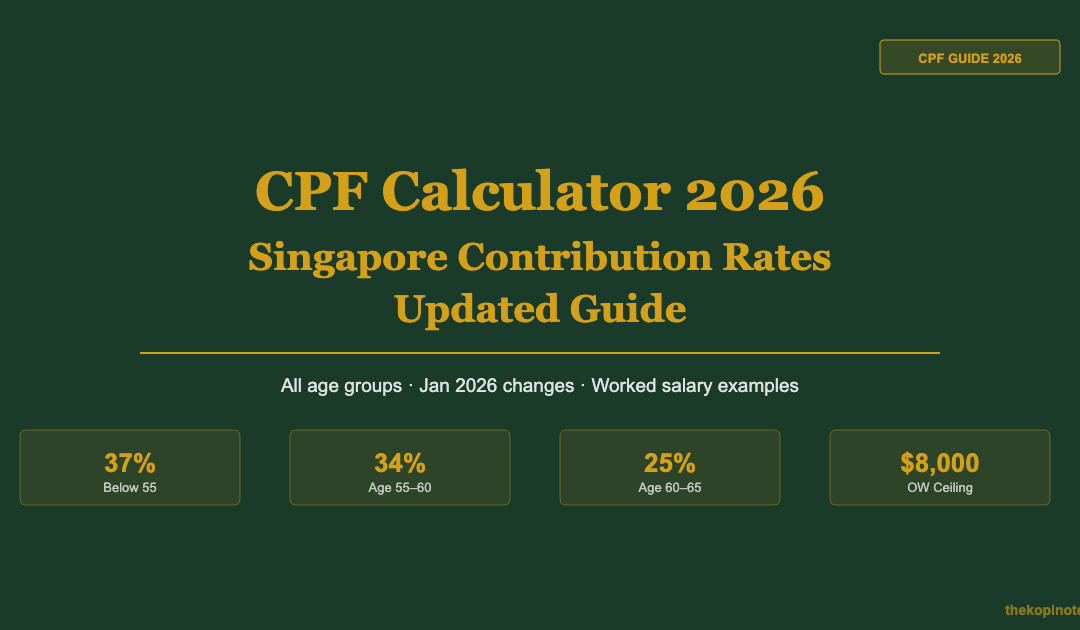
The CPF calculator 2026 helps Singapore employees and employers work out the exact Central Provident Fund contributions due each month. From 1 January 2026, the Ordinary Wage ceiling rose to $8,000 per month and contribution rates increased for workers aged 55 to 65. For employees aged 55 and below, the total rate stays at 37%: 20% from the employee, 17% from the employer. Rates vary by age group and wages.
Not financial advice. All figures are for educational reference only. Data sourced from CPF Board as at January 2026.
- For employees aged 55 and below: total CPF rate is 37% (employee 20%, employer 17%)
- The CPF Ordinary Wage ceiling increased to $8,000/month from January 2026 — contributions are capped here
- Senior workers aged 55–65 saw rates rise by 1.5 percentage points from January 2026
Table of Contents
Contents — Click to expand
- What Is the CPF Contribution Calculator?
- CPF Contribution Rates 2026: All Age Groups
- What Changed in January 2026?
- How to Calculate Your CPF Contributions (Step-by-Step)
- CPF Ordinary Wage Ceiling 2026
- Worked Examples at Different Salary Levels
- Where Does Your CPF Go?
- How to Use the Online CPF Calculator
- Frequently Asked Questions
What Is the CPF Contribution Calculator?
CPF (Central Provident Fund) is Singapore’s compulsory savings scheme. Every working Singapore Citizen and Permanent Resident contributes a portion of their monthly salary to CPF. Their employer tops that up with an additional employer contribution.
The CPF calculator 2026 helps you answer three questions. First, how much does your employer deduct from your gross salary? Second, how much extra does your employer add on top? Third, how much do you actually take home each month?
The answers depend on two things: your age group and your monthly wage. The CPF Board sets different rates for different ages — younger workers contribute more, while older workers contribute less (with rates slowly increasing over time).
Understanding the formula also helps you plan for retirement. The more you know about your CPF contributions, the better you can use your CPF investment strategy Singapore to grow your savings over time.
CPF Contribution Rates 2026: All Age Groups
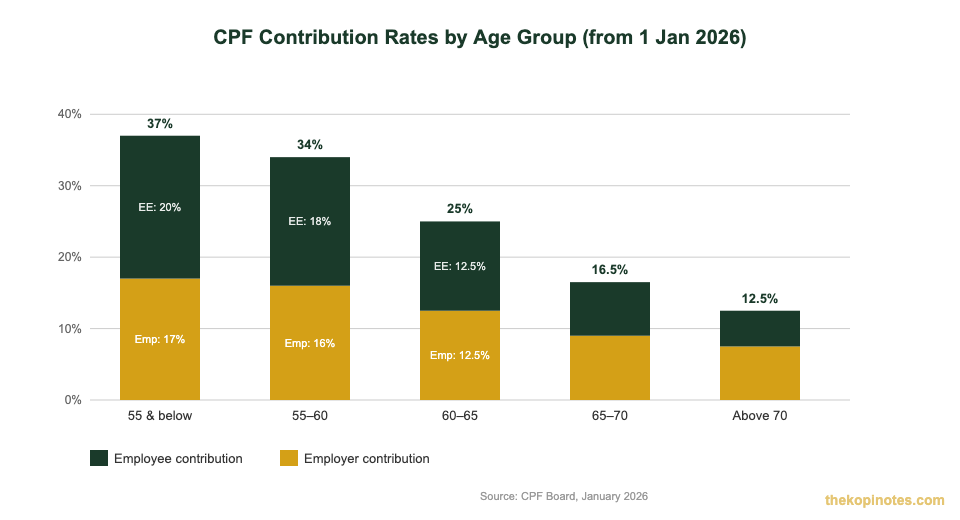
These are the official CPF contribution rates from 1 January 2026, for employees earning more than $750 per month.
| Employee Age | Employee Rate | Employer Rate | Total Rate | Change vs 2025 |
|---|---|---|---|---|
| 55 and below | 20% | 17% | 37% | No change |
| Above 55 to 60 | 18% | 16% | 34% | +1.5% |
| Above 60 to 65 | 12.5% | 12.5% | 25% | +1.5% |
| Above 65 to 70 | 7.5% | 9% | 16.5% | No change |
| Above 70 | 5% | 7.5% | 12.5% | No change |
Source: CPF Board — CPF Contribution Rates, January 2026. Applies to employees earning more than $750/month.
What Changed in January 2026?
Two major changes took effect from 1 January 2026. Both affect senior workers and higher-income earners.
1. Senior Worker Rates Increased
Workers aged 55 to 60 now contribute 34% of wages in total — up from 32.5% in 2025. The employee contribution rose 1 percentage point (from 17% to 18%), and the employer contribution rose 0.5 percentage points (from 15.5% to 16%).
Workers aged 60 to 65 now contribute 25% in total — up from 23.5% in 2025. The increase is split 1% from the employee and 0.5% from the employer.
These extra contributions go directly into the Retirement Account (RA), up to the Full Retirement Sum. If you’ve already hit the FRS, the contributions go to your Ordinary Account instead.
2. Ordinary Wage Ceiling Reached $8,000
The CPF Ordinary Wage (OW) ceiling hit its final planned level of $8,000 per month in January 2026. This is the maximum monthly wage subject to CPF contributions. Any salary above $8,000 is not subject to CPF for that month.
This ceiling was raised in four steps since September 2023: from $6,000 to $6,300, then $6,800, then $7,400, and finally $8,000. If your salary is $8,000 or below, 100% of your wages attract CPF. Above that, only the first $8,000 does.
How to Calculate Your CPF Contributions (Step-by-Step)
The CPF contribution formula is straightforward once you know your age group and the wage ceiling rules. Here is how to do it.
Step 1: Identify Your Age Group
Your CPF rate depends on your age as at your last birthday. Use the table above to find your row. For most working Singaporeans below 55, the rate is 20% (employee) + 17% (employer) = 37% total.
Step 2: Calculate Your Ordinary Wages
Ordinary Wages (OW) is your regular monthly salary — excluding bonuses, AWS, and overtime. If your monthly salary is $8,000 or below, use the full amount. If it exceeds $8,000, cap it at $8,000 for CPF purposes.
Step 3: Apply the Formula
The calculation is:
- Employee CPF = Ordinary Wages × Employee Rate (round down to nearest dollar)
- Employer CPF = Ordinary Wages × Employer Rate (round up where applicable)
- Total CPF = Employee CPF + Employer CPF
- Take-Home Pay = Gross Salary − Employee CPF
For example, if you earn $6,000 per month and you are 40 years old:
- Employee CPF = $6,000 × 20% = $1,200
- Employer CPF = $6,000 × 17% = $1,020
- Total CPF = $2,220 (of which $2,220 goes to your CPF accounts)
- Take-home pay = $6,000 − $1,200 = $4,800
Your employer pays you $4,800 in your bank and sends $2,220 to CPF (your $1,200 + their $1,020).
CPF Ordinary Wage Ceiling 2026
The OW ceiling is one of the most misunderstood parts of the CPF calculation. Here is what you need to know.
Only your Ordinary Wages are subject to the $8,000 monthly cap. Additional Wages (AW) — bonuses, AWS, incentives — have a separate Annual Wage Ceiling. In 2026, that AW ceiling is $102,000 minus the total OW already contributed for the year.
So if your monthly salary is $10,000 and you earn a $20,000 bonus, here is how the CPF caps apply:
- Monthly OW for CPF purposes = $8,000 (not $10,000)
- Annual OW contributed = $8,000 × 12 = $96,000
- AW ceiling = $102,000 − $96,000 = $6,000 (only $6,000 of your $20,000 bonus attracts CPF)
This is important for your overall tax and retirement planning. You can use our Singapore retirement calculator to model how your CPF accumulation affects your retirement income.
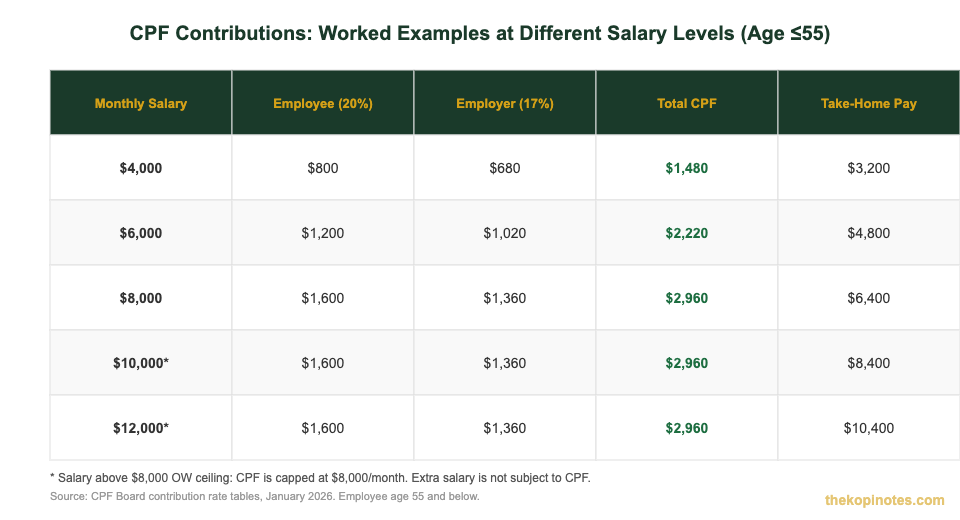
Worked Examples at Different Salary Levels (Age 55 and Below)
Use this table to quickly estimate your CPF contributions. All figures assume the employee is aged 55 and below, with monthly salary as the only Ordinary Wage component.
| Monthly Salary | Employee CPF (20%) | Employer CPF (17%) | Total CPF | Take-Home Pay |
|---|---|---|---|---|
| $3,000 | $600 | $510 | $1,110 | $2,400 |
| $5,000 | $1,000 | $850 | $1,850 | $4,000 |
| $6,000 | $1,200 | $1,020 | $2,220 | $4,800 |
| $8,000 (ceiling) | $1,600 | $1,360 | $2,960 | $6,400 |
| $10,000* | $1,600 | $1,360 | $2,960 | $8,400 |
* Salary above $8,000: CPF is capped at $8,000/month. Extra salary is not subject to CPF. Source: CPF Board contribution rate tables, January 2026.
Notice that for salaries above $8,000, the CPF contribution stays the same. But your take-home pay keeps rising. This means high earners have a larger proportion of their salary as disposable income — which also makes investing outside CPF more important for them. Generating passive income Singapore through REITs or ETFs becomes more relevant once your salary exceeds the ceiling.
Where Does Your CPF Go? The Three Accounts
Your CPF contributions are split across different accounts based on your age. Each account serves a specific purpose.
The Ordinary Account (OA) is the most flexible. You can use OA funds to buy property, pay for education, or invest through the CPF Investment Scheme (CPFIS). It earns a floor interest rate of 2.5% per year.
The MediSave Account (MA) is reserved for healthcare costs — hospitalisation, insurance premiums (including Integrated Shield Plan premiums), and approved medical expenses. It earns 4% per year, capped at the Basic Healthcare Sum (BHS). The BHS for 2026 is $75,500.
For members aged 55 and above, a Retirement Account (RA) is created. Your OA and any remaining SA funds are swept into the RA up to the Full Retirement Sum. The RA funds your CPF LIFE payouts in retirement.
Note: The Special Account (SA) was closed for members below age 55 from 1 January 2025. Funds previously in the SA were transferred to the RA (up to the FRS) or back to the OA. For those above 55, the SA continues to exist. For more on how to build long-term wealth with CPF, see our guide on Singapore Savings Bonds and best S-REITs in Singapore 2026 as complementary strategies.
How to Use the Online CPF Contribution Calculator
The CPF Board offers a free official calculator at cpf.gov.sg — CPF Contribution Calculator. It handles all the rounding rules and special cases automatically.
To use it, you need three things: the employee’s age, their monthly Ordinary Wage, and any Additional Wages for the month. The calculator outputs the employee CPF deduction, the employer CPF addition, and the total CPF payable.
For retirement planning, pair the CPF calculator with our Singapore retirement calculator to see how your monthly CPF builds up over a 20- or 30-year career. Small increases in salary or contributions early in your career compound significantly.
If you want to invest your OA funds for potentially higher returns, platforms like Endowus let you invest CPF OA savings in funds — a strategy worth exploring once you understand your contribution baseline.
Frequently Asked Questions
What is the CPF contribution rate in 2026 for employees below 55?
What is the CPF Ordinary Wage ceiling for 2026?
Did CPF contribution rates change for senior workers in 2026?
How is take-home pay calculated after CPF deduction?
Can I calculate CPF contributions on bonuses and AWS?
Where can I find the official CPF contribution calculator?
This article is for informational and educational purposes only. It is not financial advice. CPF contribution rates are set by the CPF Board and may change. Always verify figures at cpf.gov.sg before making payroll or planning decisions. Data as at January 2026.
This article was researched with the help of AI. While we strive to keep all information accurate and up to date, there may be errors. If you notice any discrepancies, please contact us.