CFA REIT ETF Guide: Best Asia Ex-Japan REIT ETFs for Singapore Investors (2026)
CFA, BYJ and IASP compared on fees, yield and liquidity — so you can diversify beyond S-REITs with your eyes open.
CFA is the SGX ticker for the Amova-StraitsTrading Asia ex Japan REIT Index ETF, the largest Singapore-listed fund giving you diversified exposure to REITs across Hong Kong, Australia and other Asian markets outside Japan. It charges roughly 0.59% a year and yields about 5.4%. Two alternatives — Phillip’s BYJ and iShares’ London-listed IASP — offer different cost, yield and liquidity trade-offs worth understanding first.
Not financial advice. All figures are for educational reference only. Data verified as at 5 September 2026.
- CFA (SGX) is the largest and most liquid Asia ex-Japan REIT ETF for Singapore investors — about 0.59% in fees a year with a ~5.4% yield
- BYJ (SGX) charges a lower 0.30% fee, but its ~S$7.7 million fund size means thin trading volume is a real risk
- IASP (LSE) includes Japan and is Ireland-domiciled — useful if you want broader Developed Asia property exposure rather than a strict ex-Japan basket
Table of Contents
What Is an Asia Ex-Japan REIT ETF?
An Asia ex-Japan REIT ETF is a fund that buys a basket of Real Estate Investment Trusts (REITs) across Asia — but leaves Japan out on purpose.
Here’s why that matters. Japan’s REIT market (called J-REITs) is enormous. If you bought a plain “Asia REIT” fund, Japan could easily make up 40–60% of it. That dilutes your exposure to higher-yielding markets like Hong Kong, Singapore and Australia, where REITs typically pay out more of their income as distributions.
Stripping Japan out gives you a basket tilted toward higher current yield. For a Singapore investor already holding S-REITs or a Singapore REIT ETF, an Asia ex-Japan fund adds regional diversification without diluting the yield you’re after.
Three products currently serve this niche for Singapore-based investors: the Amova-StraitsTrading Asia ex Japan REIT Index ETF (ticker CFA), the Phillip SGX APAC Dividend Leaders REIT ETF (ticker BYJ), and the iShares Asia Property Yield UCITS ETF (ticker IASP, which actually includes Japan — more on that below).
Why Look Beyond S-REITs in 2026?
If you’re a Singapore investor, there’s a good chance most of your property income exposure already comes from S-REITs — names like CapitaLand Integrated Commercial Trust or Mapletree Logistics Trust. That’s a reasonable starting point. See our roundup of the best S-REITs in Singapore 2026 if you haven’t already.
But concentrating all your REIT exposure in one country carries a specific risk: Singapore-specific shocks — a change in property cooling measures, a shift in SGX liquidity, or a single large-cap REIT stumbling — hit your entire property income sleeve at once.
REITs across the region are also sensitive to interest rates. When rate-cut expectations firm up, REIT valuations across Hong Kong, Australia and Singapore tend to move together — but not identically. Holding a regional basket smooths out some of that single-market noise while keeping you in the same asset class you already understand. It also complements a broader passive income Singapore strategy that isn’t dependent on any single market’s dividend cycle.
Best Asia Ex-Japan REIT ETFs for Singapore Investors
Here’s how the three real options stack up, based on the latest available factsheet and exchange data as at September 2026.
| Fund | Ticker / Exchange | Domicile | Scope | TER | AUM | Yield |
|---|---|---|---|---|---|---|
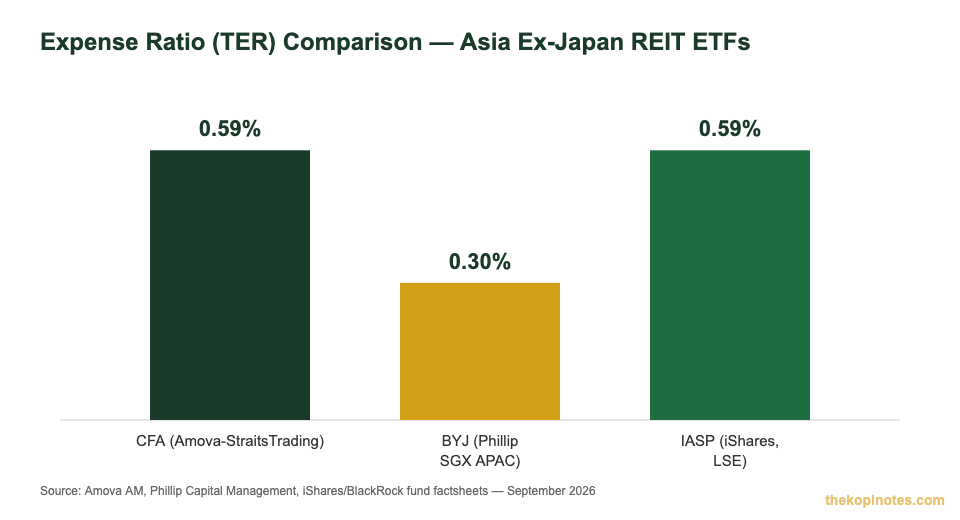
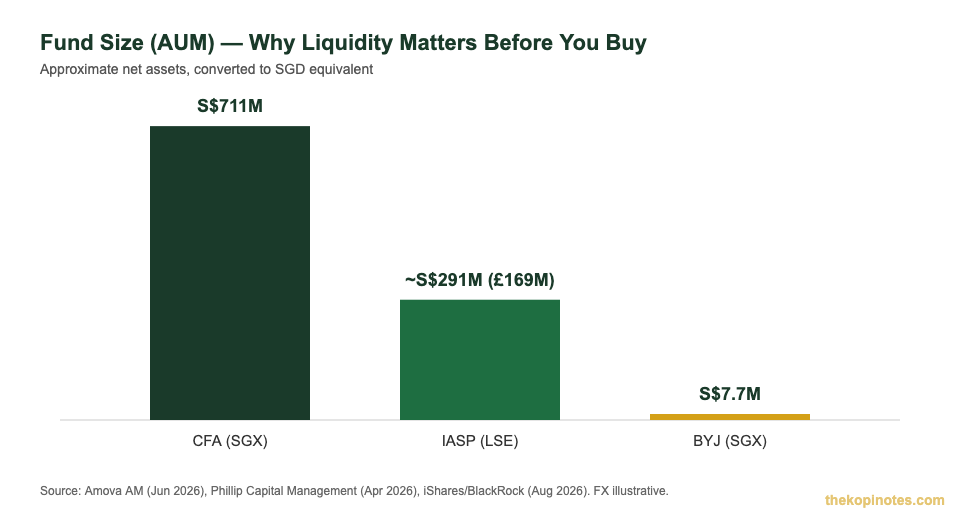
| Amova-StraitsTrading Asia ex Japan REIT Index ETF | CFA (SGX, SGD) | Singapore | Asia ex-Japan REITs | ~0.58–0.60% | ~S$710.7M | ~5.3–5.5% |
| Phillip SGX APAC Dividend Leaders REIT ETF | BYJ / BYI (SGX) | Singapore | Asia Pacific ex-Japan REIT dividend leaders | 0.30% | ~S$7.7M | Not consistently published |
| iShares Asia Property Yield UCITS ETF | IASP (LSE, USD/GBP) | Ireland (UCITS) | Developed Asia REITs (includes Japan) | 0.59% | ~£169M | ~3.6% (12-mo trailing) |
Source: Amova Asset Management fund page (Jun 2026), Phillip Capital Management factsheet (Apr 2026), iShares/BlackRock product page (Aug 2026).
CFA tracks the FTSE EPRA/NAREIT Asia ex Japan REITs 10% Capped Index. As the biggest and most established of the three, with roughly S$710.7 million in assets as at June 2026, it’s the option with the deepest trading volume — meaning tighter bid-ask spreads when you buy or sell. It distributes quarterly, and its trailing yield of roughly 5.3–5.5% (as at July 2026) sits well above what most S-REITs pay individually.
BYJ targets the same broad geography — Asia Pacific ex-Japan — but weights toward dividend-paying REITs specifically. Its 0.30% expense ratio is the cheapest of the three. The catch: at only about S$7.7 million in assets (as at April 2026), it’s thinly traded. A small fund size usually means wider spreads and the risk that market makers pull back, which can cost you more in trading friction than the lower TER saves you.
IASP is a different animal. It’s Ireland-domiciled, UCITS-compliant, and listed on the London Stock Exchange rather than SGX. Crucially, it tracks the FTSE EPRA/NAREIT Developed Asia Dividend+ Index — which includes Japan. Its top holdings include Japanese names like Mitsui Fudosan alongside Hong Kong’s Sun Hung Kai Properties. If you specifically want an ex-Japan basket, IASP isn’t a pure fit. If you’re comfortable with Japan exposure and want the tax treatment that comes with a UCITS structure, it’s worth a look.
CFA vs BYJ vs IASP: Which Should You Pick?
Start with what you’re optimising for. If it’s liquidity and a track record, CFA wins easily — it’s roughly 92 times the size of BYJ. If it’s the lowest headline fee and you’re comfortable with a small, thinly traded fund, BYJ’s 0.30% TER is genuinely cheaper, but you should size your position modestly and use limit orders, never market orders.
If you want exposure to Japan’s property market alongside the rest of developed Asia, and you’re already investing on the London Stock Exchange for other UCITS-domiciled ETFs, IASP consolidates that into one trade. Just remember its distribution yield (around 3.6% trailing) is meaningfully lower than CFA’s — you’re trading yield for diversification into a market (Japan) with structurally lower REIT payout ratios.
| Priority | Best Fit | Why |
|---|---|---|
| Liquidity & track record | CFA | Largest fund, deepest trading volume on SGX |
| Lowest fee | BYJ | 0.30% TER, but weigh against thin liquidity |
| Broader Developed Asia incl. Japan | IASP | UCITS structure, London-listed, includes Japan |
How to Buy These REIT ETFs in Singapore
CFA and BYJ are both SGX-listed, so buying them is no different from buying any local blue-chip stock.
Step 1: Fund your brokerage account. Any Singapore broker that offers SGX trading works — Syfe’s brokerage arm is one option built for beginners, with fractional trading and no minimum funding.
Step 2: Search the ticker. Type “CFA” or “BYJ” into your broker’s search bar and confirm the listing is on SGX before placing an order — ticker collisions with US-listed stocks do happen on some platforms.
Step 3: Use a limit order. This matters more for BYJ given its thin volume. A limit order caps the price you’re willing to pay, protecting you from a wide bid-ask spread eating into your entry price.
Step 4: For IASP, you’ll need a broker with London Stock Exchange access. Interactive Brokers and Saxo Markets both offer this. FSMOne also provides access to a range of UCITS-domiciled funds if you’d rather go through a Singapore-regulated platform.
Whichever fund you choose, dollar-cost averaging in monthly rather than deploying a lump sum reduces your exposure to any single entry-price shock — particularly relevant for a small-cap fund like BYJ where a single large trade can visibly move the price.
Risks to Consider
These funds are not a risk-free alternative to cash or bonds. A few things to weigh before you buy:
Concentration in one sector. All three funds hold only REITs. If property valuations fall broadly across Asia — from higher-for-longer rates or a regional economic slowdown — all three funds fall together. They don’t diversify you away from real estate as an asset class.
Liquidity risk (BYJ specifically). At roughly S$7.7 million in assets, BYJ can see days with very little trading. That can mean a wider gap between the price you want and the price you get.
Currency risk (IASP). IASP trades in GBP or USD share classes on the LSE. A weaker pound or a stronger Singapore dollar can erode returns even if the underlying REITs perform well in local currency terms.
Distributions are not guaranteed. REIT ETF payouts move with the underlying REITs’ rental income and payout policy. A 5.4% trailing yield on CFA reflects the past twelve months, not a promised future rate.
Tax, CPF and SRS Notes for Singapore Investors
Singapore does not levy capital gains tax on individual investors, which applies to gains on all three funds. For SGX-listed CFA and BYJ, Supplementary Retirement Scheme (SRS) funds can generally be used to buy SGX-listed securities including ETFs through SRS-linked brokerage accounts — check with your broker to confirm SRS eligibility for the specific counter.
CPF Ordinary Account (CPFIS) inclusion is fund-specific and can change. Don’t assume a REIT ETF is CPFIS-approved just because it’s SGX-listed — verify directly on the CPF Board’s website or with your broker before committing CPF funds. For a broader view of how ETFs fit into your CPF strategy, see our CPF investment strategy guide, and if you’re mapping this into a longer retirement plan, our Singapore retirement calculator can help you see how regional REIT income fits your broader numbers.
This is general information, not personalised tax or investment advice. Speak to a licensed financial adviser about your specific situation.
Frequently Asked Questions
What does the CFA ticker on SGX stand for?
CFA is the SGX ticker for the Amova-StraitsTrading Asia ex Japan REIT Index ETF (formerly branded NikkoAM-StraitsTrading, renamed in September 2025 after Nikko Asset Management’s rebrand to Amova). It’s not related to the Chartered Financial Analyst designation, which shares the same three letters coincidentally.
Is CFA REIT ETF the same as a Singapore REIT ETF?
No. A Singapore REIT ETF like the Lion-Phillip S-REIT ETF or CSOP iEdge S-REIT Leaders Index ETF holds only Singapore-listed REITs. CFA holds REITs across Asia excluding Japan — including Hong Kong, Singapore, Australia and other regional markets — giving you broader geographic diversification than a Singapore-only fund.
Which is better for Singapore investors — CFA or BYJ?
CFA is the more practical choice for most investors because of its size (~S$710.7 million versus BYJ’s ~S$7.7 million) and deeper trading liquidity. BYJ’s 0.30% expense ratio is lower than CFA’s ~0.59%, but its thin trading volume can offset that fee advantage through wider bid-ask spreads, especially for larger trade sizes.
Can I buy CFA or BYJ using my CPF or SRS funds?
SRS funds can generally be used to buy SGX-listed securities, including ETFs like CFA and BYJ, through an SRS-linked brokerage account. CPF Ordinary Account (CPFIS) eligibility is fund-specific and can change over time, so confirm directly with the CPF Board or your broker before using CPF funds for either counter.
Does IASP include Singapore REITs?
Yes. IASP tracks the FTSE EPRA/NAREIT Developed Asia Dividend+ Index, which spans developed Asian property markets including Singapore, Hong Kong, Australia and Japan. Unlike CFA and BYJ, it does not exclude Japan, so Japanese names such as Mitsui Fudosan appear among its top holdings.
What is the minimum investment for these REIT ETFs?
There’s no fund-imposed minimum. For SGX-listed CFA and BYJ, most Singapore brokers now support fractional or odd-lot trading, so you can start with as little as one share. IASP on the London Stock Exchange typically trades in whole units too, and pricing depends on the GBP or USD share class you select.
Ready to Diversify Beyond S-REITs?
Open a brokerage account and add regional REIT exposure alongside your existing Singapore holdings.
This article was researched with the help of AI. While we strive to keep all information accurate and up to date, there may be errors. If you notice any discrepancies, please contact us.