
TDSR & MSR Calculator Singapore 2026
Check whether your home loan fits MAS’s 55% Total Debt Servicing Ratio and 30% Mortgage Servicing Ratio caps — free calculator with real-time results in SGD.
Your Income & Debts
Proposed Home Loan
Estimates only, based on MAS's published TDSR/MSR formulas and the 4% p.a. medium-term interest rate floor MAS requires banks to use for residential property loans (as opposed to your actual quoted rate). Actual bank approval depends on credit bureau records, other MAS/bank-specific adjustments, and each bank's internal credit policy. Not financial advice.
Understanding TDSR and MSR for Singapore Homebuyers
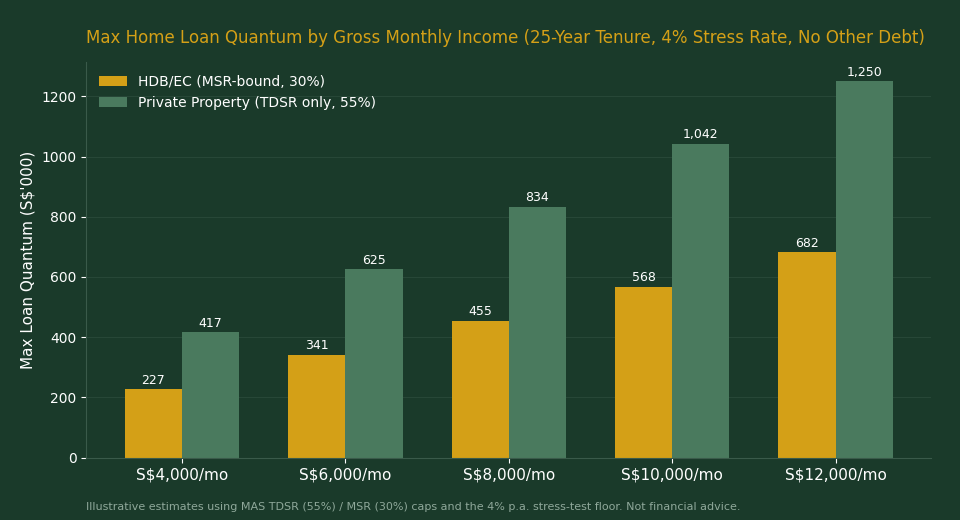
The Total Debt Servicing Ratio (TDSR) is a framework the Monetary Authority of Singapore (MAS) introduced in June 2013 to keep household borrowing sustainable. It caps how much of your gross monthly income can go toward all your debt obligations — home loan, car loan, personal loan, credit card minimum payments, and any other property loans — at 55%. The Mortgage Servicing Ratio (MSR) is an older, narrower rule that applies only to HDB flats and new Executive Condominiums (ECs): it caps your housing loan instalment alone at 30% of gross monthly income, regardless of your other debts.
Not financial advice. All figures are estimates based on MAS’s published TDSR/MSR framework and the medium-term interest rate floor. Data as at Q3 2026. Your actual bank approval depends on credit bureau checks and each lender’s internal policies.
Why Banks Stress-Test at 4%, Not Your Actual Rate
Even if your bank quotes you 2.8% or 3.2% today, MAS requires financial institutions to compute your TDSR and MSR using a medium-term interest rate floor of 4% p.a. for residential property loans — last raised from 3.5% in September 2022. The logic: rates fluctuate over a 25–30 year loan, so your eligibility is tested against a higher, more conservative rate to make sure you can still service the loan if rates rise. This is exactly the methodology our calculator above uses.
TDSR vs MSR: Two Different Caps, Two Different Loan Types
TDSR applies to every property loan taken from a bank or finance company in Singapore — HDB, EC, or private. MSR only kicks in for HDB flats and new ECs, and only when the loan comes from a bank (not HDB itself — more on that below). When both apply, you must clear both hurdles: MSR is usually the tighter constraint since 30% is a lower ceiling than 55%.
How to Use This TDSR & MSR Calculator
- Enter your income: Your gross monthly income, plus your co-borrower’s if you’re buying jointly. Tick the variable-income box if you’re self-employed or commission-based — MAS applies a 70% haircut to non-fixed income.
- List your other debts: Car loan, personal loan, credit card minimum payments, and any other property loan instalments.
- Pick your property type: HDB/new EC (both MSR and TDSR apply) or private property/resale EC (TDSR only).
- Set your loan amount, tenure, and actual quoted rate: The calculator instantly stress-tests the instalment at MAS’s 4% floor to compute your TDSR, MSR (if applicable), and the maximum loan quantum you likely qualify for.
Pro tip: Once you know your maximum loan quantum, run it through our Mortgage Repayment Calculator to see the full month-by-month instalment schedule at your actual quoted rate.
Contents — Click to Expand
What Is TDSR and What Is MSR?
TDSR (Total Debt Servicing Ratio) is MAS’s framework limiting your total monthly debt repayments — the proposed home loan instalment plus every other loan you’re servicing — to 55% of your gross monthly income. It applies to every bank-financed property loan in Singapore, HDB, EC, or private, and was introduced specifically to prevent households from over-leveraging across multiple loans at once. MSR (Mortgage Servicing Ratio) is narrower and older: it caps only the housing loan instalment, on its own, at 30% of gross monthly income, and applies exclusively to HDB flats and new ECs. Use our Home Loan Affordability Calculator alongside this tool if you want to work from a target monthly budget instead of a fixed loan amount.
How TDSR and MSR Are Calculated: The Maths
Both ratios use the same underlying mortgage formula: Monthly Instalment = P × r × (1+r)ⁿ ÷ [(1+r)ⁿ − 1], where P is your loan amount, r is the monthly interest rate, and n is the number of monthly instalments. The twist is which rate goes into r. For TDSR/MSR eligibility, banks must use the higher of your actual quoted rate or MAS’s 4% p.a. medium-term floor — almost always the 4% floor, since most quoted rates in 2026 sit around 2.5–3.5%. On a S$800,000 loan over 25 years, that’s the difference between a real-world instalment of roughly S$3,794 at 3.0% and a stress-tested instalment of roughly S$4,223 at 4.0% — the higher figure is what your bank actually uses to size up your TDSR and MSR.
HDB Loan vs Bank Loan: Which Ratio Applies to You?
This is the part most calculators skip. If you take a concessionary loan directly from HDB, TDSR does not apply — HDB isn’t a MAS-regulated “financial institution” under the TDSR notice, so only its own MSR-style 30% cap applies. If you finance the same HDB flat with a bank loan instead, you must clear both hurdles: MSR (30%) and TDSR (55%). In practice this means an HDB loan can sometimes approve a slightly higher quantum than a bank loan for the same buyer, though bank loans usually carry lower interest rates. Compare both paths properly with our HDB Loan vs Bank Loan Calculator before committing.
How to Improve Your TDSR/MSR Before You Apply
Since MSR only counts the housing instalment, the fastest lever for an HDB purchase is usually a longer tenure or a smaller loan quantum — both reduce the stress-tested instalment directly. For TDSR, the highest-leverage move is usually clearing smaller debts first: a S$300/month car loan or personal loan instalment eats directly into your 55% ceiling. Run your existing debts through our Debt Payoff Calculator to see how quickly a Snowball or Avalanche approach could free up headroom before you apply for a mortgage. Adding a co-borrower with stable income also widens both ratios immediately, since MAS assesses TDSR/MSR on combined household income.
MAS’s 4% Stress Test and Other Singapore-Specific Rules
Two rules trip up first-time buyers most often. First, variable income — commission, freelance, or self-employed net trade income — is haircut to 70% of its face value before it counts toward TDSR/MSR, a rule MAS applies because variable income is inherently less predictable than a fixed salary. Second, existing property loans (including an overseas mortgage) count fully against your TDSR even if the property itself generates rental income, unless you can document that income to your bank’s satisfaction. CPF Ordinary Account savings used for your downpayment don’t change your TDSR/MSR calculation at all — the ratios are purely about your income versus your monthly repayment obligations, not your savings or CPF balance.
Why TDSR/MSR Discipline Matters for Your Long-Term Retirement Plan
A home loan that consumes 50–55% of your income today is a home loan that will still be running when you’re trying to ramp up retirement savings in your 40s and 50s. Buyers who deliberately borrow well under their maximum TDSR/MSR ceiling — rather than stretching to the limit — free up meaningful monthly cash flow for CPF top-ups, SRS contributions, and dividend-focused investing later. Model how a smaller, more conservative loan quantum today changes your retirement trajectory using our Retirement Planning Calculator, and see our Passive Income Singapore guide for how S-REITs and dividend portfolios can fill that gap once your mortgage headroom is freed up.
Frequently Asked Questions
What is a good TDSR for a home loan in Singapore?
Anything comfortably under the 55% MAS ceiling gives you a buffer. Many mortgage brokers suggest targeting 40–45% at the stress-tested rate, since your actual instalment (at your real quoted rate, not the 4% floor) will be noticeably lower — leaving room for other financial goals.
Is it possible to get a bank loan if I exceed the 55% TDSR cap?
Generally no — TDSR is a hard regulatory cap for financial institutions, not a guideline. Some narrow exceptions exist (for example, downsizing or mortgage equity withdrawal loans under specific MAS provisions), but for a standard new home loan, exceeding 55% means reducing your loan quantum, extending tenure, or clearing other debts first.
How much home loan can I get with an S$8,000 monthly income?
With S$8,000 gross income, S$500 in existing monthly debts, and a 25-year tenure at the 4% stress rate, you’d likely qualify for around S$454,700 on an HDB flat (MSR-bound at 30%) versus around S$738,900 on a private property (TDSR-bound at 55%, no MSR cap). Run your own numbers in the calculator above — the gap between HDB and private eligibility is almost always driven by MSR being the tighter constraint.
What is the difference between TDSR and MSR in Singapore?
TDSR caps all your debt obligations (home loan plus car loan, personal loan, credit cards, etc.) at 55% of gross income and applies to every bank-financed property type. MSR caps only the housing loan instalment at 30% of gross income and applies exclusively to HDB flats and new ECs.
Should I use CPF to lower my monthly instalment and improve my TDSR?
Using CPF-OA to pay part of your instalment reduces your cash outlay but does not change your TDSR/MSR calculation — MAS assesses the ratio against your gross income and the full instalment amount, regardless of whether you pay it in cash or CPF. A larger CPF-funded downpayment can still help by reducing your loan quantum, which does lower TDSR/MSR.
Which Singapore bank has the most lenient TDSR/MSR assessment?
TDSR (55%) and MSR (30%) are MAS-mandated caps that every bank must follow identically — no bank can approve above these ceilings. What varies between banks is how they treat edge cases like rental income documentation, bonus/variable income verification, and outstanding credit card limits, so it’s worth comparing more than one lender or using a mortgage broker if you’re near the cap.
Can I include my CPF Ordinary Account savings in the TDSR calculation?
No. TDSR and MSR are calculated purely from your monthly gross income against your monthly debt obligations. CPF-OA savings affect how much cash downpayment or CPF you can draw on to fund the purchase, but they don’t enter the TDSR/MSR formula itself.
What interest rate does MAS use to stress-test my home loan?
MAS requires banks to use the higher of your actual quoted rate or a medium-term interest rate floor of 4% p.a. for residential property loans (raised from 3.5% in September 2022). In practice, since most quoted mortgage rates in 2026 sit below 4%, the 4% floor is almost always the rate used for TDSR/MSR eligibility.
How does TDSR/MSR affect my retirement planning in Singapore?
Borrowing right up to your TDSR/MSR ceiling locks up a large share of your income in mortgage repayments for 20–30 years, leaving less room for CPF top-ups, SRS contributions, and dividend investing during your prime saving years. Buyers who borrow conservatively below the cap typically reach their retirement number faster because more income compounds earlier.
Plan Your Next Move With Confidence
Know your loan eligibility, then map the rest of your financial plan. Use our free tools and referral bonuses to put your knowledge into action.