
Self-Employed MediSave Contribution Calculator Singapore 2026
Estimate your mandatory CPF MediSave bill as a freelancer or self-employed person — free calculator using official CPF Board 2026 rates, results in SGD.
Your Details
Understanding MediSave Contributions for Self-Employed Singaporeans
About 1 in 8 working Singaporeans is self-employed, according to the Ministry of Manpower’s Labour Force Report — freelancers, hawkers, private-hire drivers, tuition teachers, real estate agents, and sole proprietors among them. Unlike salaried employees, self-employed persons (SEPs) don’t have an employer contributing CPF on their behalf. Instead, the CPF Board requires SEPs to make a single mandatory contribution: to their MediSave Account (MA). IRAS assesses your net trade income when you file your annual income tax return, then issues a Notice of Computation (NOC) stating exactly how much MediSave you owe — you have 30 days from that notice to pay.
Not financial advice. All figures are for educational reference only and based on CPF Board’s official MediSave Contribution Rates for Self-Employed Persons, applicable for work year 2026 (Table 1 and Table 2).
Who Counts as a Self-Employed Person (SEP)?
You’re an SEP for CPF purposes if you earn income from a trade, business, profession, or vocation — this includes sole proprietors, partners in a partnership, freelancers, commission-based agents, and gig workers. From 2025, platform workers (private-hire drivers, delivery riders) began receiving CPF contributions directly from their platform operators under a separate scheme, so their platform earnings are excluded from the net trade income used in this calculator — see the FAQ below for details.
Why the Rate Isn’t a Flat Percentage
Unlike employee CPF, where a fixed 20% deduction applies below the salary ceiling, the SEP MediSave rate scales in three tiers based on net trade income: a flat lower rate from S$6,000 to S$12,000, a phased-in formula from S$12,000 to S$18,000 that gradually lifts you from the lower rate to the higher rate, and a flat higher rate (capped at a maximum dollar amount) above S$18,000. The calculator above runs the exact CPF Board formula for your income and age band automatically.
How to Use This MediSave Contribution Calculator
- Enter your Net Trade Income: This is your income after allowable business expenses, as assessed by IRAS on your Notice of Assessment — not your gross revenue or gross commission.
- Set your age: Use the slider for your age as at 1 January of the work year the income relates to (e.g. for 2025 income, use your age as at 1 Jan 2026).
- Tick the pensioner box if applicable: This only applies to a small group of SEPs receiving a CPF pensioner benefit — most users can leave this unticked.
- Read your results: The calculator shows your effective contribution rate, the annual MediSave amount payable, the monthly equivalent for budgeting, and the maximum annual cap for your age band.
The calculator instantly recalculates as you adjust the inputs — no need to click a “calculate” button.
Pro tip: If you’re deciding whether to also make Voluntary Contributions to your CPF Ordinary and Special Accounts, try our CPF OA/SA Allocation Calculator to see how a top-up would be split.
Contents — Click to Expand
- What Is the Self-Employed MediSave Contribution?
- How the CPF Board Calculates Your Rate: The 2026 Formula
- The Three Net Trade Income Brackets Explained
- Paying Your Bill and Claiming Tax Relief
- Platform Workers vs Traditional Self-Employed in 2026
- Beyond MediSave: Voluntary CPF and Retirement Planning
- Frequently Asked Questions
What Is the Self-Employed MediSave Contribution?
MediSave is the healthcare savings component of CPF, used to pay for hospitalisation, approved outpatient treatments, and health insurance premiums such as MediShield Life and Integrated Shield Plan add-ons. Salaried employees build up MediSave automatically as part of their monthly CPF contribution — 8% to 10.5% of wages, split across OA, SA, and MA depending on age. Self-employed persons don’t have this automatic deduction, so the CPF Act makes MediSave contributions mandatory once net trade income exceeds S$6,000 in a year. Unlike employees, SEPs are not required to contribute to their Ordinary Account (OA) or Special Account (SA) — MediSave is the only compulsory account, though voluntary top-ups to OA/SA are allowed and encouraged for long-term retirement planning.
How the CPF Board Calculates Your Rate: The 2026 Formula
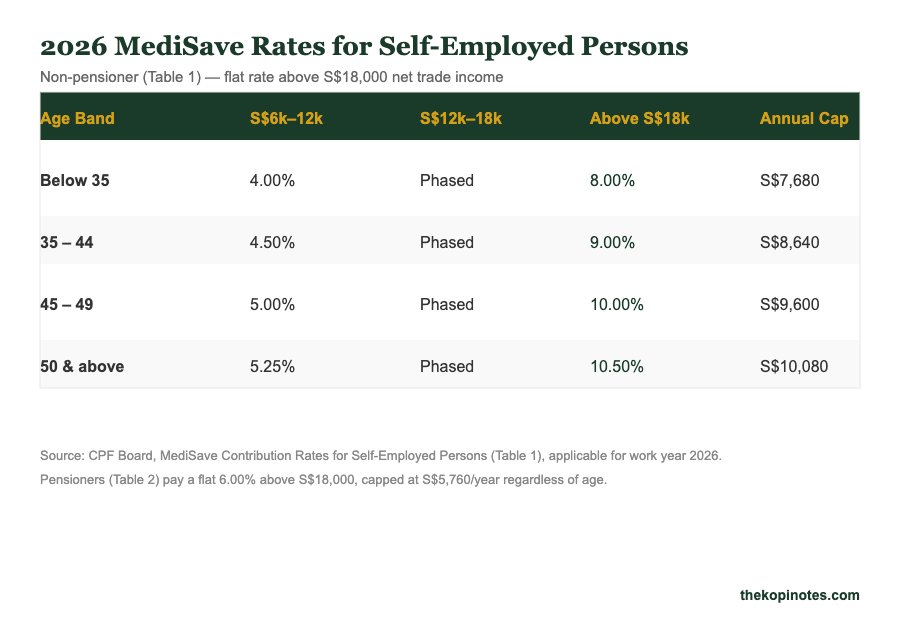
The CPF Board publishes updated MediSave Contribution Rate tables every year. For work year 2026, non-pensioner SEPs fall into four age bands — below 35, 35 to below 45, 45 to below 50, and 50 and above — each with its own flat rate for income up to S$12,000 (4.00% to 5.25%) and a higher flat rate above S$18,000 (8.00% to 10.50%, each capped at a maximum dollar amount ranging from S$7,680 to S$10,080 per year). Between S$12,000 and S$18,000, the rate is “phased in” using a formula such as [480 + 0.16 × (NTI − 12,000)] × 100 / NTI for the below-35 band, so the effective percentage climbs smoothly from the lower tier to the higher tier rather than jumping abruptly. This calculator runs the exact formula so you don’t need to do the algebra yourself.
The Three Net Trade Income Brackets Explained
Take a 40-year-old SEP (35–44 age band, rate range 4.5% to 9.0%). At S$10,000 net trade income, they fall in the lower flat-rate band: 4.5% × S$10,000 = S$450/year. At S$15,000, they’re in the phased band: [540 + 0.18 × (15,000 − 12,000)] = S$1,080, an effective rate of 7.2%. At S$60,000, they’re well into the upper flat-rate band: 9.0% × S$60,000 = S$5,400/year, still under the S$8,640 cap for their age band. Only very high earners — roughly above S$96,000 net trade income for the below-35 band — actually hit the dollar cap, at which point the contribution stops rising even as income grows further.
Paying Your Bill and Claiming Tax Relief
After filing your income tax return, IRAS shares your assessed net trade income with the CPF Board, which then issues a Notice of Computation (NOC) — you have 30 days to pay via GIRO instalment, PayNow, eNETS, or CashCard. If you can’t pay in full, CPF Board will generally work with genuine cases of financial hardship on an instalment plan; failure to pay without arrangement can result in penalties and, in persistent cases, a fine of up to S$2,500 for a first offence. On the upside, in 2026 the MediSave relief ceiling was removed, meaning SEPs can claim full income tax relief on all mandatory MediSave contributions, up to the Basic Healthcare Sum (S$71,500 for 2026) — check current limits on the IRAS CPF relief page. Our CPF Contribution Rate for Self-Employed Singapore guide covers the voluntary contribution side of this in more depth.
Platform Workers vs Traditional Self-Employed in 2026
From 2025, Singapore rolled out CPF contributions for platform workers (private-hire drivers, delivery riders on recognised platforms) — their platform operators now make both an “employer” and “employee” style contribution directly, covering OA and SA as well as MediSave, similar to salaried staff. Net earnings from platform work declared by the platform operator to the CPF Board are excluded from the net trade income used in this calculator’s formula. If you’re a platform worker with a side hustle outside the platform (e.g. freelance design work alongside private-hire driving), only the non-platform portion of your income is assessed under the SEP MediSave rules covered here.
Beyond MediSave: Voluntary CPF and Retirement Planning
Because SEPs don’t receive an employer CPF contribution — which can be worth up to 17% of wages for salaried staff — many self-employed Singaporeans fall behind on retirement savings unless they proactively top up. Voluntary Contributions (VC) to all three CPF accounts are capped at the CPF Annual Limit (S$37,740 for 2026, inclusive of mandatory MediSave), and the portion going to OA/SA earns the same guaranteed 2.5%/4% p.a. as employees receive, plus an extra 1% on the first S$60,000 of combined balances. If retirement adequacy is a concern, run your numbers through our Retirement Planning Calculator and consider a Supplementary Retirement Scheme (SRS) top-up as a second tax-advantaged savings channel alongside your mandatory MediSave. For a broader view of building passive income as a freelancer, see our passive income guide for Singapore investors.
Frequently Asked Questions
Do self-employed persons need to pay CPF in Singapore?
Yes, but only to MediSave, not to the Ordinary or Special Account. Self-employed persons (SEPs) with net trade income above S$6,000 a year must make mandatory MediSave contributions, assessed by IRAS after you file your annual tax return. Contributions to OA and SA remain voluntary for SEPs.
How much MediSave do I need to contribute as a self-employed person in 2026?
It depends on your age and net trade income. For 2026, rates range from 4.00% (below age 35, lower income band) up to 10.50% (age 50 and above, higher income band), with annual caps between S$7,680 and S$10,080 depending on your age. Use the calculator above to get your exact figure.
What happens if my net trade income is between S$12,000 and S$18,000?
This is the CPF Board’s “phased-in” bracket — your effective rate rises gradually from the lower flat rate to the higher flat rate as your income increases within this range, using an official formula rather than a single fixed percentage. The calculator above applies this formula automatically.
Is there a maximum MediSave contribution I need to pay as an SEP?
Yes. Each age band has an annual dollar cap: S$7,680 (below 35), S$8,640 (35–44), S$9,600 (45–49), and S$10,080 (50 and above) for non-pensioners in 2026. Once your calculated contribution reaches this cap, it doesn’t rise further even if your net trade income keeps increasing.
What is the difference between Table 1 and Table 2 MediSave rates?
Table 1 applies to most self-employed persons (non-pensioners). Table 2 applies to a smaller group of CPF pensioners, who pay a flat 6.00% above S$18,000 net trade income with a lower cap of S$5,760/year, regardless of age band. Tick the pensioner checkbox in the calculator if this applies to you.
Can platform workers use this calculator?
Platform workers (private-hire drivers, delivery riders) on recognised platforms have had CPF contributions — including MediSave — made directly by their platform operator since 2025, so that income is excluded from this calculator’s net trade income input. If you also earn separate freelance income outside a recognised platform, use this calculator for that non-platform portion only.
Can I use my CPF Ordinary Account to pay my MediSave bill?
No — mandatory MediSave contributions must be paid in cash (via GIRO, PayNow, eNETS, or CashCard), not offset against your existing OA or SA balances. Your CPF accounts only grow when the new contribution is credited in; you cannot transfer between accounts to settle the bill.
What happens if I don't pay my MediSave contributions on time?
You have 30 days from the Notice of Computation to pay. If you don’t and haven’t arranged an instalment plan with CPF Board for genuine financial hardship, you risk late payment penalties and, in persistent non-payment cases, prosecution with fines of up to S$2,500 for a first offence. Non-payment can also affect renewal of certain business licences.
How does my self-employed MediSave contribution affect my income tax in Singapore?
As of 2026, the MediSave relief ceiling was removed — SEPs can claim full income tax relief on all mandatory MediSave contributions made in the year, up to the Basic Healthcare Sum (S$71,500 for 2026). This reduces your chargeable income and, in turn, your income tax payable. Check the current limits on IRAS’s website before filing.
Plan Beyond Your Mandatory MediSave Contribution
As a self-employed person, your retirement savings are entirely in your own hands. Use our free tools to see the full picture.