
Scrip Dividend Calculator Singapore 2026
Work out exactly how many shares you’d receive under a scrip dividend scheme, the discount you capture, and how it compares to cash — free calculator with real-time results in SGD.
Your Dividend Details
If you elect scrip and the share price falls more than your breakeven tolerance before you sell, your discount advantage is wiped out. Cash dividend value: S$0.
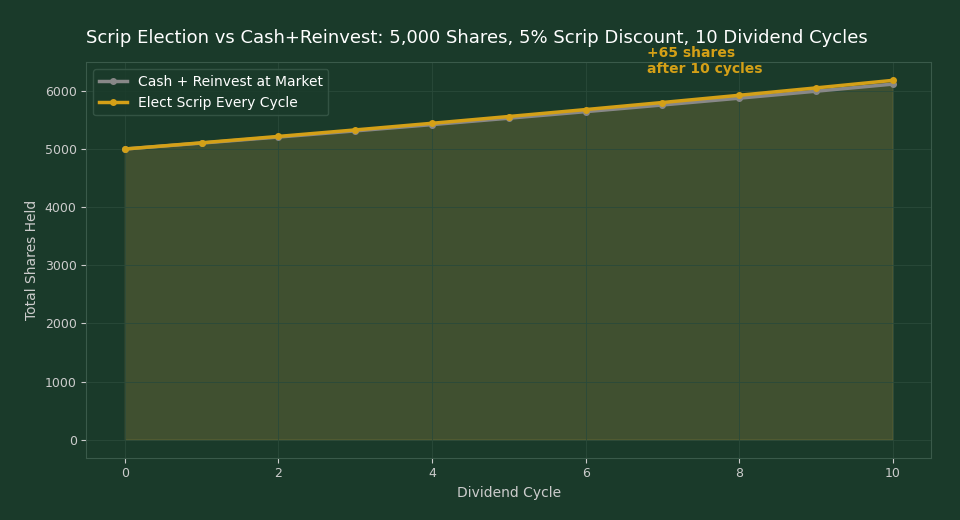
Scrip vs Cash+Reinvest: Share Count After 10 Cycles
Illustrative only — assumes the same dividend per share and VWAP repeat every cycle, ignores brokerage fees on cash reinvestment (which favours scrip further) and share price changes.
Understanding Scrip Dividends for Singapore Investors
A scrip dividend scheme lets a listed company — including many S-REITs and Singapore banks — pay shareholders in new shares instead of cash, usually at a discount to the prevailing market price. The mechanics are governed by SGX Rulebook Part IX, which caps the discount at 10% and requires the issue price to be based on a Volume-Weighted Average Price (VWAP) taken over a defined Price Determination Period. This calculator applies the same mechanics companies like DBS use for their own scrip dividend scheme so you can see exactly how many shares you'd receive, in SGD, before you make your election.
Not financial advice. All figures are for educational reference only. Data as at Q3 2026 unless noted.
Why Companies Offer Scrip Dividends
Scrip dividends let a company conserve cash while still rewarding shareholders — useful for S-REITs funding acquisitions or asset enhancement works, or banks retaining capital for regulatory buffers. For you as an investor, the discount is effectively a bonus: shares that would cost S$7.81 on the open market might be issued to you at S$7.42, an instant paper gain if the price holds.
Who This Calculator Is For
If you hold shares in a company that has announced a scrip dividend option — common among S-REITs and Singapore banks during capital-intensive periods — this tool helps you compare the shares-and-discount outcome against simply taking the cash, so you can make an informed election before the deadline.
How to Use This Scrip Dividend Calculator
- Shares Held: Enter the number of shares or units you currently hold that are eligible for the scrip dividend.
- Cash Dividend per Share: Enter the cash dividend rate announced by the company (in SGD per share).
- Reference Share Price / VWAP: Enter the Volume-Weighted Average Price used to set the scrip issue price — this is usually published in the company's scrip dividend circular.
- Scrip Discount: Adjust the slider to the discount rate the company has set (SGX caps this at 10%).
- Dividend Cycles: Use this slider to see how repeatedly electing scrip vs cash+reinvesting compounds your share count over time.
The calculator instantly shows your new scrip shares, the discount value captured, any leftover fractional entitlement paid in cash, and your breakeven price-drop tolerance.
Pro tip: Compare this against manually reinvesting cash dividends on the open market with our Dividend Reinvestment (DRIP) Calculator — scrip avoids brokerage fees entirely.
Contents — Click to Expand
- What Is a Scrip Dividend?
- How the Scrip Dividend Calculation Works
- Scrip Dividend vs Dividend Reinvestment (DRIP) in Singapore
- How to Elect Scrip Dividends in Singapore
- Tax Treatment of Scrip Dividends in Singapore
- Scrip Dividends as a Passive Income & Compounding Strategy
- Frequently Asked Questions
What Is a Scrip Dividend?
A scrip dividend is a dividend paid in new shares instead of cash — distinct from both a bonus issue (free shares proportional to your holding, no dividend involved) and a stock split (dividing existing shares, no new capital raised). Under a scrip dividend scheme, the company announces a cash dividend as usual, then gives shareholders the option to receive some or all of it as newly issued shares, typically priced at a discount of 5–10% to a VWAP calculated over a set Price Determination Period. Many SGX-listed S-REITs and the three local banks have run scrip dividend schemes at various points, most actively used when the issuer wants to retain cash for acquisitions, asset enhancement, or balance sheet strength without launching a separate rights issue or private placement.
How the Scrip Dividend Calculation Works: The Maths Behind It
The core formula has two steps. First, the scrip issue price: Scrip Issue Price = VWAP × (1 − Discount%). If the VWAP is S$7.81 and the discount is 5%, your scrip issue price is S$7.4195. Second, your new shares: New Shares = FLOOR(Cash Dividend Value ÷ Scrip Issue Price), rounded down to a whole share (or board lot, depending on the company). For example, with 5,000 shares held and a S$0.159 per share cash dividend, your cash dividend value is S$795. Divided by a S$7.4195 scrip issue price, that's 107 new shares, with roughly S$1.11 left over paid to you in cash as a fractional entitlement. The "discount value captured" — 107 shares × (S$7.81 − S$7.4195) = around S$41.78 — is the instant paper gain from taking scrip over cash, assuming the market price holds at VWAP.
Scrip Dividend vs Dividend Reinvestment Plan (DRIP) in Singapore
These two mechanisms are often confused but work differently. A scrip dividend is issued directly by the company at a set discount, with no brokerage fee — the shares come straight from the issuer. A DRIP (or manually reinvesting a cash dividend) means buying additional shares on the open market through your broker at full market price, plus a brokerage commission. The table below summarises the difference:
| Feature | Scrip Dividend | DRIP / Manual Reinvestment |
|---|---|---|
| Share source | Newly issued by the company | Bought on the open market |
| Price paid | Discounted VWAP (5–10% off) | Full market price |
| Brokerage fee | None | Yes, per trade |
| Availability | Only when the company offers it | Any time you hold cash dividends |
Because scrip avoids both the discount-free market price and the brokerage fee, it's structurally the cheaper way to build your position — provided you're comfortable holding more shares in that one counter, which brings a concentration trade-off worth weighing against diversification.
How to Elect Scrip Dividends in Singapore
If your shares are held via CDP (Central Depository), you'll typically receive a physical or electronic election form ahead of the deadline stated in the company's circular — no action means you default to cash in most schemes, so check the fine print. If you hold through a custodial broker instead, the process runs through your platform: Endowus and Syfe account holders should check their platform's corporate actions notice, while FSMOne and other custodial brokers usually notify eligible clients directly and collect elections through their app or portal ahead of the books-closure date. Election windows are typically short — often 2–3 weeks — so it pays to check your notifications around ex-dividend dates for counters you know run scrip schemes.
Tax Treatment of Scrip Dividends in Singapore
Singapore runs a one-tier corporate tax system, meaning dividends — cash or scrip — are generally tax-exempt in the hands of individual shareholders, with no further personal income tax due regardless of which option you choose. This is a meaningful difference from markets like the US, where scrip or DRIP dividends can still trigger a taxable event even though no cash changes hands. For CPF Investment Scheme (CPFIS) or SRS-held shares, scrip elections are usually processed by your CPFIS agent bank or SRS operator on your behalf under their standard corporate action procedures — check with your bank or broker directly, as not every CPFIS/SRS platform supports every scrip scheme.
Scrip Dividends as a Passive Income & Compounding Strategy for Retirement
For income investors building a retirement pool, consistently electing scrip over cash — when the discount and fundamentals justify it — compounds your share count faster than cash-plus-manual-reinvestment, as the chart on this page illustrates. But there's a real trade-off worth flagging for REIT investors specifically: new scrip shares dilute existing unitholders' proportional claim on the trust's income and assets, which can pressure per-unit metrics like DPU (distribution per unit) if the new capital isn't deployed into equally accretive assets. Before electing scrip repeatedly, check whether the REIT's growth pipeline justifies the added units — our Gearing Ratio & ICR Calculator is a useful companion check on balance sheet health. To see how scrip dividends fit into your broader retirement number, run your details through our Retirement Planning Calculator, and read our Passive Income Guide for how dividend compounding strategies fit a Singapore retirement plan.
Frequently Asked Questions
What is a good scrip dividend discount to look for in Singapore?
SGX Rulebook Part IX caps the scrip discount at 10%, and most Singapore schemes fall in the 5–10% range. A discount at or near the 10% cap gives you the largest instant paper gain, but always weigh it against the dilution effect on the company or REIT's per-share metrics before electing.
Is electing scrip dividend a good strategy in Singapore?
It can be, if you're already comfortable holding more of that counter and the discount is meaningful. Scrip avoids brokerage fees and buys shares below market price, but it also concentrates your portfolio further and can dilute per-unit metrics for REITs — it isn't automatically better than taking cash and reinvesting elsewhere.
How many shares will I get if I elect scrip on 5,000 shares with a 5% discount?
Using this calculator's default example — 5,000 shares, a S$0.159 per share cash dividend, a S$7.81 VWAP, and a 5% discount — you'd receive 107 new shares, with about S$1.11 paid out in cash as a fractional entitlement, capturing roughly S$41.78 in discount value.
What is the difference between a scrip dividend and a bonus issue in Singapore?
A bonus issue gives all shareholders free shares proportional to their holding and isn't tied to a dividend payment at all. A scrip dividend is an alternative way of receiving an already-declared cash dividend — you're choosing shares (usually at a discount) instead of cash, not receiving something extra on top.
How much of my dividend should I take as scrip vs cash in Singapore?
Many schemes let you elect scrip for only part of your holding. A reasonable approach is to take scrip on the portion of your position you're happy to grow further, and cash for the portion you'd rather keep liquid or redeploy elsewhere — this calculator can be run at different share-count inputs to compare scenarios.
Which Singapore brokers support scrip dividend elections?
Custodial brokers including Endowus, Syfe, and FSMOne generally notify clients of scrip dividend elections through their platform when a held counter offers one; if you hold shares directly via CDP, elections are handled through the company's registrar instead.
Can I elect scrip dividends for shares held in my CPF or SRS account?
It depends on your CPFIS agent bank or SRS operator's process for handling corporate actions — some support scrip elections on CPFIS/SRS-held counters and some default to cash automatically. Always confirm directly with your bank or broker ahead of the election deadline.
What discount rate and VWAP should I use in this calculator?
Use the exact figures published in the company's scrip dividend circular or corporate action notice — the discount percentage and the VWAP/Price Determination Period are always stated explicitly, since SGX rules require full disclosure of both under Rulebook Part IX.
Does taking scrip dividends dilute my ownership in a REIT?
Yes — new scrip units increase the total units outstanding, which slightly dilutes every unitholder's proportional claim on income and assets unless the additional capital raised is deployed into equally accretive investments. This is worth monitoring alongside a REIT's gearing ratio and DPU trend over successive scrip cycles.
Plan Your Full Passive Income Picture
See how dividend and scrip income fit into your retirement number. Use our free tools and referral bonuses to put your knowledge into action.