
Credit Card Cashback Calculator Singapore 2026
Calculate your monthly cashback earnings, net annual savings after fees, and effective return rate in SGD — free tool for Singapore cardholders.
Your Monthly Spending Profile
Understanding Credit Card Cashback for Singapore Investors
Credit card cashback in Singapore is one of the simplest and most reliable financial optimisations available to everyday consumers. Unlike miles programmes that require active management and redemption windows, cashback is credited directly to your card statement — reducing your next bill automatically. As at Q1 2026, the Monetary Authority of Singapore (MAS) reports over 9.5 million credit cards in circulation across a resident population of roughly 4 million, a testament to how deeply cashback and rewards cards have penetrated the local market. Banks including DBS, OCBC, UOB, Standard Chartered, Citibank, and American Express compete aggressively with cashback structures, pushing effective rates in high-spend categories — groceries, petrol, dining, online shopping — well above 5% for cardholders who meet monthly spend thresholds.
This calculator lets you model your actual cashback earnings using your real spending profile: total monthly outlay, how much falls in bonus categories, the applicable cashback rates, and your card’s annual fee. The result is a clear picture of your effective cashback rate and net annual savings — the numbers that matter for building a leaner household budget.
Not financial advice. All figures are for educational reference only. Card rates and fees are indicative as at Q1 2026 — always verify current terms with the issuing bank before applying.
How Singapore Cashback Cards Are Structured
Most competitive cashback cards in Singapore use a tiered structure rather than a simple flat rate. A typical setup offers a lower base rate (0.3%–1.5%) on all spending not in designated bonus categories, and a higher bonus rate (3%–10%) on specific merchant category codes (MCCs) such as grocery stores, petrol stations, dining, or online merchants. A minimum monthly spend threshold — commonly S$500 to S$2,000 — must be met to unlock the bonus rate for that month. If you fall short, you earn only the base rate on all spend. This design rewards consistent spenders and penalises those with volatile monthly outgoings.
Why the Effective Rate Matters More Than the Headline Rate
A card advertising “10% cashback on groceries” sounds exceptional — but if your grocery spend is S$400/month out of S$3,000 total spending, only 13% of your spend earns the high rate. The effective rate across your full spend may be closer to 2%–3%, which is still solid but far below the headline figure. Our calculator computes this effective rate automatically. Use it to compare two cards head-to-head by modelling your actual spending split, not the marketing copy.
How to Use This Credit Card Cashback Calculator
- Total Monthly Spending: Enter your average total monthly credit card spend across all categories in SGD. Include groceries, dining, transport, utilities, online shopping — everything you typically charge to the card.
- Base Cashback Rate: Set the base rate your card earns on non-bonus spending. Most flat-rate cards sit at 1.5%–2%. Category cards may be as low as 0.3%.
- Bonus Category Spend: Enter how much of your total monthly spend falls in the bonus category (e.g., groceries, dining, petrol). This is the portion earning the higher rate.
- Bonus Category Rate: Set the cashback rate for the bonus category. Popular Singapore cards range from 3% to 10% on specific categories.
- Annual Fee: Enter the card’s annual fee in SGD. Leave at S$0 if your card has no fee or if the fee is waived. Common Singapore card fees: S$192.60 (GST-inclusive).
- Min Monthly Spend: Enter the minimum monthly spend required to activate the bonus cashback rate. If you don’t meet this, the calculator will flag that only the base rate applies.
The results panel updates instantly, showing monthly cashback, annual cashback, annual fee, net savings, and a plain-English summary including your break-even period if a fee applies.
Pro tip: Combine your cashback savings with our DCA Investment Calculator to model what happens when you reinvest S$50–S$100/month of cashback into a low-cost ETF or S-REIT portfolio.
Contents — Click to Expand
What Is Credit Card Cashback?
Credit card cashback is a rebate mechanism where a percentage of your charged transactions is returned to you — either as a statement credit, a deposit into a linked savings account, or a direct deduction off your next bill. Unlike rewards points that require an exchange step (points → vouchers → goods), cashback is liquid: S$1 of cashback equals S$1 of real spending power, credited automatically.
In Singapore, cashback cards typically offer two rate tiers. The base rate (0.3%–2%) applies to all spending. The bonus rate (3%–10%) applies only to selected merchant categories — groceries, dining, petrol, transport, or online spending — and only when a minimum monthly spend threshold is met. Some premium cards reverse this structure, offering a single uncapped flat rate with no minimum spend requirement, trading higher headline rates for simplicity.
Cashback is most valuable for Singaporeans with predictable, recurring monthly expenses — utilities, grocery runs, insurance premiums, food delivery. These cardholders consistently hit the minimum spend threshold and earn the bonus rate month after month, generating hundreds of dollars per year in statement credits. As at Q1 2026, a cardholder spending S$2,500/month with an effective 2.5% cashback rate earns S$750/year — equivalent to a guaranteed risk-free return on their daily spending.
How Cashback Works: The Maths Behind the Rewards
The arithmetic is straightforward. For a flat-rate card at 1.5%: monthly cashback = total spend × 0.015. For a tiered card, it splits across rate zones:
Example: Monthly spend S$2,000 total — S$500 in groceries (6% bonus), S$1,500 base spend (1.5%).
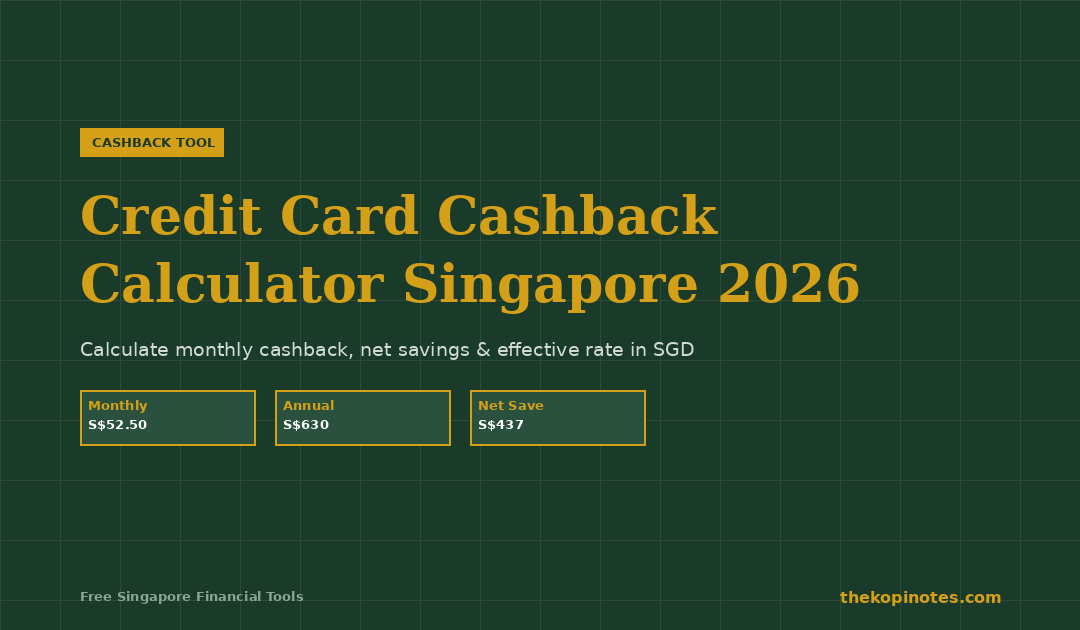
Monthly cashback = (S$1,500 × 1.5%) + (S$500 × 6%) = S$22.50 + S$30.00 = S$52.50
Annual cashback = S$52.50 × 12 = S$630
Net savings (after S$192.60 annual fee) = S$437.40
Effective cashback rate = S$52.50 ÷ S$2,000 = 2.625%
The effective rate is the key metric. It accounts for your actual spending split and is always lower than the headline bonus rate. Most Singaporean cardholders achieve effective rates of 1.5%–4% in practice, depending on how much of their spend falls in bonus categories and whether they consistently meet the minimum spend threshold.
Caps add another wrinkle. Many tiered cashback cards impose a monthly cashback ceiling — commonly S$50–S$80 per category or S$100 overall. A card with 6% grocery cashback and a S$60/month cap on grocery cashback effectively limits grocery spend earning the bonus rate to S$1,000/month. Spending S$1,500 on groceries only earns S$60, not S$90. Always check the fine print before assuming your spending scales proportionally.
Cashback vs Miles vs Points Cards in Singapore
Singapore’s credit card landscape offers three primary reward currencies. The right one depends on your lifestyle and discipline:
| Feature | Cashback | Miles | Points |
|---|---|---|---|
| Redemption | Auto statement credit | Flights / hotels | Vouchers / gifts |
| Effective value | ~1.5%–5% | 1.5%–6% (if redeemed optimally) | ~0.5%–2% |
| Complexity | Low | High | Medium |
| Expiry | None (credited monthly) | 2–3 years | 1–2 years |
| Best for | Everyday investors | Frequent flyers | Flexible redeemers |
For Singapore investors focused on passive income and wealth accumulation — rather than frequent travel — cashback cards deliver the most consistent, quantifiable value. Miles programmes theoretically yield higher returns on business class redemptions, but only if you fly regularly, book far in advance, and actively manage expiry. The guaranteed, liquid nature of cashback makes it the rational choice for most retail investors optimising their overall return across investment portfolio and daily spending.
Best Cashback Cards in Singapore 2026
Here are the leading cashback cards in Singapore as at Q1 2026. Rates and terms change — always verify current offers directly with the issuing bank before applying.
| Card | Bonus Rate | Base Rate | Min Spend | Annual Fee |
|---|---|---|---|---|
| UOB One | Up to 10% (groceries, Grab) | 0.3% | S$2,000 | S$192.60 |
| OCBC 365 | 6% dining, 3% groceries | 0.3% | S$800 | S$192.60 |
| DBS Live Fresh | 5% online & contactless | 0.3% | S$400 | S$0 (waived) |
| SC Simply Cash | 1.5% flat (all spend) | 1.5% | None | S$192.60 |
| Citi Cash Back+ | 1.6% flat (all spend) | 1.6% | None | S$192.60 |
For investing-focused Singaporeans, consider pairing your cashback card with a robo-advisor to automatically invest the monthly statement savings. Platforms like Endowus and Syfe allow regular top-ups from as little as S$50/month — the amount many Singaporeans can redirect from monthly cashback earnings.
CPF, SRS and Your Credit Card Strategy
CPF top-ups and SRS contributions cannot be made via credit card under current MAS rules — these are processed through GIRO or internet banking from a linked bank account. However, your credit card strategy can still support your CPF and SRS goals indirectly:
Insurance premiums: Many Singapore cards offer 1%–3% cashback on insurance premium payments via GIRO or NETS. If you pay S$3,000/year in life or CI premiums, this generates S$30–S$90 in annual cashback that can be redirected to a CPF Retirement Account (RA) top-up for the Enhanced Retirement Sum (ERS) top-up benefit.
SRS maximisation: Use the cashback earned from daily spending as a mental accounting buffer. Every dollar of cashback effectively frees up budget for voluntary CPF Special Account top-ups or SRS contributions. Use our SRS Tax Savings Calculator to see how much income tax you can save by maximising your S$15,300 annual SRS limit.
CPF OA savings: Singaporeans under 55 can invest CPF OA funds exceeding S$20,000 in approved instruments via the CPF Investment Scheme (CPFIS). If your cashback savings offset monthly expenses, this may allow you to leave more CPF OA funds invested at 2.5% p.a. risk-free. Our CPF OA/SA Allocation Calculator can help you model the optimal split.
Cashback as a Passive Savings Strategy for Retirement
For Singapore investors targeting financial independence, credit card cashback is a zero-effort, guaranteed-return savings layer on top of the investment portfolio. When reinvested rather than spent, it adds meaningfully to long-term wealth.
Assume S$2,500/month spending with an effective 2.5% cashback rate: annual cashback = S$750. Over 25 years, reinvested monthly at 6% p.a. (the approximate long-run DCA return from a diversified ETF portfolio), this compounds to approximately S$49,000 — a genuine wealth-building tail from daily spending. Use our DCA Investment Calculator to model this compounding effect with your own numbers.
For investors using S-REITs as a core income layer, the monthly cashback complements quarterly DPU distributions — providing a smoother, more predictable monthly income stream. The Dividend Portfolio Yield Calculator can model your combined cashback + dividend income against your monthly budget target.
Run the Retirement Planning Calculator to model how your net annual cashback savings (after fees) reduces your required investment portfolio size. For most Singaporeans, the FIRE number is lower than they think once you factor in CPF payouts, S-REIT dividends, and recurring cashback earnings working in parallel. See our Passive Income Singapore 2026 Guide for the full framework.
Frequently Asked Questions
What is a good cashback rate for credit cards in Singapore?
A competitive effective cashback rate in Singapore is 2%–4% of total monthly spend. Flat-rate cards offer 1.5%–2% with no minimum spend — good for simplicity. Tiered cards can push effective rates above 3% if a significant portion of your spend falls in a high-rate bonus category and you consistently meet the minimum spend threshold. The headline bonus rate (e.g., 10% on groceries) is rarely the effective rate — use this calculator to find your real number.
Is a cashback card or miles card better in Singapore?
For most Singapore residents, cashback cards deliver more reliable value. Miles cards theoretically yield 2%–6% on premium flight redemptions, but require discipline — tracking expiry dates, booking far ahead, and understanding transfer partners. If you fly business class at least twice yearly and actively manage your miles, a miles card can outperform. For investors who prioritise certainty and simplicity, a cashback card with a low or no minimum spend is the pragmatic choice.
How much cashback can I earn with S$2,000 per month spending?
At a flat 1.5% cashback rate: S$2,000 × 1.5% = S$30/month (S$360/year). With a tiered card where S$500 is in a 6% grocery category: (S$1,500 × 1.5%) + (S$500 × 6%) = S$22.50 + S$30 = S$52.50/month (S$630/year). After a typical S$192.60 annual fee, net savings are S$437.40/year. The effective cashback rate in this example is 2.63% — solid but far below the 6% headline grocery rate.
What is the minimum spend requirement for cashback cards in Singapore?
Minimum monthly spend requirements range from S$0 on flat-rate cards (e.g., Standard Chartered Simply Cash, Citi Cash Back+) to S$2,000/month for high-bonus-rate cards like UOB One. When your spending is below the threshold in any given month, most cards revert to a much lower base rate (often 0.3%). Use the minimum spend field in this calculator to model your real-world cashback under realistic conditions rather than optimistic ones.
Which Singapore cashback card gives the best rate for groceries?
As at Q1 2026, the UOB One Card offers up to 10% cashback on groceries at Giant, Cold Storage, Cheers, and FairPrice when you meet the S$2,000/month minimum spend. The OCBC 365 Card offers 6% on all supermarket and food and beverage spend with a lower S$800 minimum. POSB Everyday Card gives 5% at Cold Storage and Giant with no minimum spend requirement. Card terms change frequently — verify directly with the issuing bank before applying.
Can I use a credit card for CPF top-ups or SRS contributions?
No. CPF top-ups — whether OA to SA, MA top-ups, or Retirement Account top-ups — must be made via GIRO, PayNow, or internet banking from a linked bank account. Credit cards are not accepted by the CPF Board for any contribution type. Similarly, SRS contributions are processed via direct bank transfer to your SRS account operator. However, cashback earned from everyday credit card spending can be redirected to fund these contributions each month.
Is credit card cashback taxable in Singapore?
No. Credit card cashback is treated as a rebate or discount on your personal spending under Singapore tax law — it is not considered assessable income and does not need to be declared in your IRAS income tax return. This is consistent with IRAS’s long-standing position on consumer loyalty rebates and rewards received from spending your own after-tax money. Business credit card cashback may be treated differently — consult a tax professional if the card is used for business expenses.
How do I calculate my effective cashback rate?
The effective cashback rate = (total monthly cashback earned ÷ total monthly spending) × 100. This blended figure is the most accurate metric for comparing two cards side-by-side, as it accounts for the mix of base and bonus rate spending. For example: S$2,000 total spend generating S$52.50 cashback → effective rate = 2.625%. This calculator computes your effective rate in real time as you adjust the sliders — look for the percentage in the results summary below the card grid.
What happens if I do not meet the minimum spend in a month?
If your total monthly spend falls below the card’s minimum spend threshold, you typically earn only the much-lower base rate (often 0.3%) on all spending for that entire month — not just the shortfall. This can significantly reduce your annual earnings. The calculator flags this scenario automatically and shows S$0 bonus cashback. To avoid this, consider a card with a lower or no minimum spend requirement if your monthly outgoings vary widely.
Put Your Cashback Savings to Work
Model your full retirement plan with our free Singapore financial tools — combine cashback savings, S-REIT dividends, and CPF optimisation for a comprehensive passive income strategy.