
COE Renewal Calculator Singapore 2026
Work out your exact 5-year or 10-year COE renewal cost by vehicle category — free calculator with real-time PQP-based results in SGD.
COE Renewal Details
Understanding COE Renewal for Singapore Vehicle Owners
Every car, motorcycle, goods vehicle and bus in Singapore runs on a Certificate of Entitlement (COE) that must be renewed before it expires — or the vehicle has to be deregistered. When your COE lapses, LTA gives you two paths: pay the Prevailing Quota Premium (PQP) to renew for another 5 or 10 years, or let the vehicle go and start fresh with a new COE bid. This calculator uses LTA’s official monthly PQP rates by vehicle category (Cat A to D) to show you exactly what renewal will cost, on a per-year and per-month basis, so the decision isn’t just a gut call made a week before your COE lapses.
Not financial advice. All figures are for educational reference only. PQP rates shown are LTA’s published rates as at August 2026 and change monthly — always verify the live rate for your renewal month before paying.
Why the Renewal Decision Matters More Than Most Drivers Realise
A 10-year COE renewal on a Category A car can easily exceed S$120,000 today — often more than the car itself is worth. Get the period wrong (renewing 10 years when you only plan to keep the car 4) and you overpay dramatically per year of actual use. Get the category rules wrong (assuming you can renew 5 years twice for a private car) and you could find yourself forced to deregister earlier than expected. This tool exists to make both mistakes avoidable.
What This Calculator Covers
Enter your vehicle category, the current PQP rate (pre-filled with LTA’s August 2026 published rates, but editable), your chosen renewal period, and how long you actually intend to keep the car. The calculator returns your total PQP payable, cost per year, effective cost per year based on your real holding plan, and a side-by-side 5-year vs 10-year comparison for your category — plus the renewal-count rules that apply specifically to your vehicle type.
How to Use This COE Renewal Calculator
- Select your vehicle category: Category A (small/mid cars and lower-powered EVs), B (larger/higher-powered cars and EVs), C (goods vehicles and buses), or D (motorcycles). The PQP field auto-fills with LTA’s current published rate for that category.
- Confirm or adjust the PQP rate: PQP changes every month based on the last 3 months of COE bidding. If you’re renewing in a different month, overwrite the pre-filled figure with the live rate from LTA.
- Choose your renewal period: 5 years (50% of PQP) or 10 years (100% of PQP).
- Enter how long you actually plan to keep the car: This is different from the renewal period — it reveals your true effective cost per year if you sell, scrap, or deregister before the renewal period is up.
The calculator instantly updates your total PQP payable, cost per year, effective cost per year against your real holding plan, cost per month, a 5-year vs 10-year cost comparison, and the specific renewal-count rule for your vehicle category.
Pro tip: If you’re weighing renewal against deregistering and selling instead, run the numbers through our COE & PARF Rebate Calculator first to see what you’d get back by not renewing.
Contents — Click to Expand
- What Is COE Renewal in Singapore?
- How the PQP-Based Renewal Cost Is Calculated
- 5-Year vs 10-Year COE Renewal: Which Should You Choose?
- Renew, Sell, or Redirect the Cash? Weighing Your Options
- PARF Forfeiture & Other Rules You Must Know
- COE Renewal in Your Bigger Financial Plan
- Frequently Asked Questions
What Is COE Renewal in Singapore?
Every vehicle registered in Singapore needs a valid Certificate of Entitlement (COE) to stay on the road. When the original 10-year COE is about to expire, LTA gives owners the choice to renew rather than deregister. Renewal isn’t a bidding process like buying a new COE — instead, you pay the Prevailing Quota Premium (PQP), a fixed rate published monthly by LTA for each vehicle category. You can renew for either 5 years (paying 50% of PQP) or 10 years (paying the full PQP), and the choice has real consequences for both your cash outlay and your long-term flexibility. If you’re weighing renewal against buying a replacement car outright, our Car Loan Calculator is a useful companion to model the alternative.
How the PQP-Based Renewal Cost Is Calculated
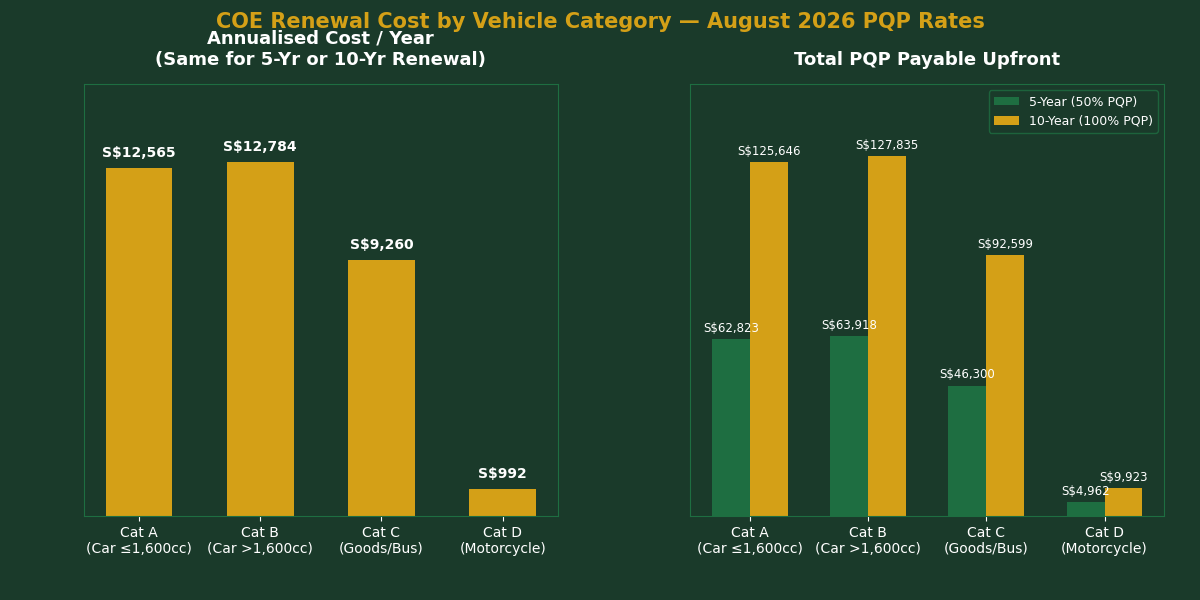
PQP is the 3-month moving average of actual COE bidding premiums for your category, so it moves with the market rather than being fixed for years at a time. As at August 2026, LTA’s published PQP rates were roughly S$125,646 for Category A, S$127,835 for Category B, S$92,599 for Category C, and S$9,923 for Category D. A 5-year renewal costs exactly half the PQP; a 10-year renewal costs the full PQP. The maths is simple, but the decision isn’t — because both options work out to the identical annualised cost per year of COE coverage. A S$125,646 Category A PQP costs S$12,565/year whether you renew for 5 years or 10. The real trade-off is upfront cash commitment and how many more times you’re allowed to renew, not the per-year price.
5-Year vs 10-Year COE Renewal: Which Should You Choose?
For Category A, B and D vehicles (cars and motorcycles), a 5-year renewal can only be used once — when it lapses, you must deregister, no further renewal is possible. A 10-year renewal, on the other hand, can be repeated indefinitely for as long as you want to keep paying PQP. Category C (goods vehicles and buses) works differently: you can keep renewing in repeated 5-year blocks right up until the vehicle hits its statutory lifespan (20 years for goods vehicles, 17 for buses). This means a Category A or B owner choosing a 5-year renewal is effectively committing to a hard stop in 5 years, while a 10-year renewal keeps the door open for another decade of ownership. Since the annualised cost is identical either way, the 5-year option mainly suits owners who are fairly confident they’ll want to give up the car within 5 years and don’t want to lock up a six-figure sum upfront.
Renew, Sell, or Redirect the Cash? Weighing Your Options
Before committing to a renewal, it’s worth comparing the full PQP outlay against what the car (and the cash) could be worth elsewhere. Deregistering instead of renewing may entitle you to a PARF rebate and unexpired COE rebate — worth checking before you decide (see the Pro Tip above). If you go ahead with the lower-cash-outlay 5-year renewal over a 10-year one, the difference (often S$60,000+ for a Category A or B car) doesn’t have to sit idle — many Singapore drivers channel it into a diversified portfolio via a robo-advisor like Endowus or Syfe rather than tying it all up in a depreciating asset for another decade.
PARF Forfeiture & Other Rules You Must Know
The single most overlooked consequence of COE renewal: once you renew (whether 5 or 10 years), you permanently forfeit any future PARF rebate on that vehicle, even if you deregister it later. PARF rebates only apply to vehicles deregistered within their original 10-year COE period — renewing removes that eligibility for good. Late renewal also carries a fee (S$50 to S$250 depending on vehicle type) if you renew within a month after expiry, and if you miss that one-month grace window entirely, the vehicle must be disposed of immediately. One detail that catches drivers out: LTA’s own guidance confirms that CPF savings cannot be used to pay PQP — it must be cash, cheque, cashier’s order, NETS or eNETS Debit, so this is a cash-flow decision, not a CPF one. Drivers who insure their renewed vehicle should also revisit their No-Claim Discount standing using our Car Insurance NCD Calculator, since a renewed vehicle’s insurance premium is priced independently of the COE decision.
COE Renewal in Your Bigger Financial Plan
A six-figure PQP renewal is one of the largest lump-sum decisions many Singapore households make outside of property and CPF planning — yet it’s rarely weighed against the opportunity cost of that capital. Before locking in a 10-year renewal, it’s worth asking whether that cash (or the gap between the 5-year and 10-year outlay) might do more for your household compounding in a diversified portfolio, especially if retirement is on the horizon. Run your numbers through our Retirement Planning Calculator to see how a large one-off renewal payment affects your broader retirement runway, and see our Passive Income guide for how S-REITs and dividend portfolios can help rebuild that capital over time.
Frequently Asked Questions
How much does it cost to renew my COE in Singapore in 2026?
It depends on your vehicle category and PQP rate at the time of renewal. As at August 2026, LTA’s published PQP rates were roughly S$125,646 (Category A), S$127,835 (Category B), S$92,599 (Category C) and S$9,923 (Category D). A 5-year renewal costs 50% of that figure, and a 10-year renewal costs the full amount.
Is a 5-year or 10-year COE renewal cheaper in Singapore?
Neither — the annualised cost works out identical either way, since 5-year renewal is exactly half the PQP for half the duration. The real difference is upfront cash commitment and how many more renewals you’re allowed, not the per-year price.
Can I renew my COE for 5 years more than once?
For Category A, B and D vehicles, no — a 5-year renewal can only be used once, and the vehicle must be deregistered when it lapses. Category C (goods vehicles and buses) can keep renewing in repeated 5-year blocks until the vehicle reaches its statutory lifespan.
What happens if I don't renew my COE before it expires?
Your vehicle is automatically deregistered and cannot legally be used on the road. You have a 1-month grace period to renew late with a fee of S$50 to S$250 (depending on vehicle type) — after that, the vehicle must be disposed of immediately.
Does renewing my COE affect my PARF rebate?
Yes, and this is often missed. Renewing your COE (5 or 10 years) permanently forfeits any future PARF rebate on that vehicle, since PARF only applies to vehicles deregistered within their original 10-year COE period.
What is PQP and how is it calculated?
PQP (Prevailing Quota Premium) is the 3-month moving average of actual COE bidding premiums for your vehicle category. It’s published monthly by LTA and is the fixed rate you pay to renew your COE without going through open bidding.
Can I use CPF savings to pay for COE renewal in Singapore?
No. LTA only accepts cash, cheque, cashier’s order, NETS or eNETS Debit for COE renewal payments — CPF funds cannot be used directly, so this must be planned as a cash-flow decision.
Which Singapore platform is best for investing the cash I save by choosing the cheaper renewal option?
Many drivers redirect the difference into a low-cost diversified portfolio via a robo-advisor such as Endowus or Syfe rather than leaving it idle — see our referral pages for current sign-up offers on both platforms.
How does a large COE renewal payment affect my retirement planning in Singapore?
A six-figure renewal is one of the biggest lump-sum outflows many households face outside of property and CPF. Running it through a retirement calculator alongside your existing savings rate helps you see whether it delays your retirement runway — and whether redirecting part of that cash into dividend-paying assets could offset the gap.
Plan Beyond the COE Decision
Whatever you decide on renewal, make sure the cash flow fits your bigger financial picture. Use our free tools and referral bonuses to put your knowledge into action.