
Accumulating vs Distributing ETF Calculator Singapore 2026
See exactly how much manual dividend reinvestment on ETFs like CSPX, IUSA, VWRA or VWRD costs you in SGD over time — free calculator with real-time results.
Accumulating vs Distributing ETF Calculator
Your Results After 20 Years
Illustrative projection only, not a guarantee of future returns. Assumes both share classes hold the same underlying fund and total return before reinvestment friction. Not financial advice.
Understanding Accumulating vs Distributing ETFs for Singapore Investors
Most globally diversified UCITS ETFs popular with Singapore DIY investors — such as the iShares Core S&P 500 UCITS ETF and the Vanguard FTSE All-World UCITS ETF — come in two share classes tracking the exact same underlying index: an accumulating (Acc) class that automatically reinvests dividends inside the fund, and a distributing (Dist) class that pays dividends out to you in cash. The choice looks cosmetic but compounds into a real, measurable gap over a 10-30 year investing horizon, because every manual reinvestment of a cash payout costs brokerage fees and loses a few days of market exposure while the cash sits idle. This calculator quantifies that gap in SGD.
Not financial advice. All figures are for educational reference only. Data as at Q3 2026 unless noted.
Why This Matters More the Longer You Invest
A single reinvestment fee of a few dollars looks trivial. But a typical distributing ETF investor reinvests dividends 2-4 times a year for decades — that is 40-120+ separate trades over a 30-year horizon, each one shaving a small amount off compounding. The calculator above runs the exact year-by-year maths so you can see the real number for your own contribution amount and time horizon, rather than a rule of thumb.
What the Calculator Assumes
Both share classes are assumed to hold identical underlying assets and deliver the same total return before reinvestment frictions are applied — this mirrors reality, since Acc and Dist share classes of the same fund (e.g. CSPX and IUSA) track the same index and have near-identical total expense ratios. The only difference modelled is the brokerage fee and cash drag applied each time the distributing investor manually reinvests a payout.
How to Use This Acc vs Dist ETF Calculator
- Set your lump sum and monthly contribution: Enter what you plan to invest upfront and add monthly, in SGD.
- Pick your investment horizon: Drag the slider from 1 to 30 years — the reinvestment gap widens sharply the longer you hold.
- Enter expected growth and dividend yield: Default 6% price growth and 1.3% yield roughly reflect a global equity index like the FTSE All-World; adjust for your own fund.
- Set payout frequency, brokerage fee and cash drag: Most UCITS ETFs pay quarterly or semi-annually; enter your broker’s minimum commission and a small cash-drag estimate for the days your dividend sits uninvested.
The calculator instantly shows the projected final value of both approaches, the total SGD cost of doing it yourself, and how many separate reinvestment trades that would take.
Pro tip: Combine this with our DCA Investment Calculator to see how regular contributions compound alongside dividend reinvestment.
Contents — Click to Expand
- What Is an Accumulating vs Distributing ETF?
- How the Reinvestment Drag Calculation Works
- Accumulating vs Distributing: Which Wins Over 10, 20, 30 Years?
- Best Platforms for Buying Accumulating ETFs in Singapore
- Tax and CPF/SRS Angle for Singapore Investors
- Retirees and Passive Income: When Distributing Still Makes Sense
- Frequently Asked Questions
What Is an Accumulating vs Distributing ETF?
An accumulating (Acc) ETF share class reinvests any dividends it receives from underlying holdings back into the fund automatically, so your unit price grows to reflect the reinvested income and you never see a cash payout. A distributing (Dist) share class instead pays those dividends out to you as cash, typically quarterly or semi-annually, which you then have to manually reinvest if you want to keep compounding. The two most common Acc/Dist pairs Singapore investors encounter are the iShares Core S&P 500 UCITS ETF, where CSPX is the accumulating class and IUSA is the distributing class, and the Vanguard FTSE All-World UCITS ETF, where VWRA is accumulating and VWRD is distributing. Both share classes in each pair track the identical underlying index and hold the same securities — the only structural difference is what happens to dividend income.
How the Reinvestment Drag Calculation Works
This calculator splits your expected total return into a price-growth component and a dividend-yield component. For the accumulating path, both components compound together automatically every period with no friction. For the distributing path, only the price-growth component compounds inside the position; the dividend-yield component is paid out as cash each period, then a brokerage fee and a small cash-drag percentage (representing settlement delay and rounding to whole shares) are deducted before the remainder is reinvested. Over dozens of reinvestment cycles across a multi-decade horizon, these small deductions compound into a meaningfully lower final value — this is the “cost of DIY reinvestment” the calculator reports.
Accumulating vs Distributing: Which Wins Over 10, 20, 30 Years?
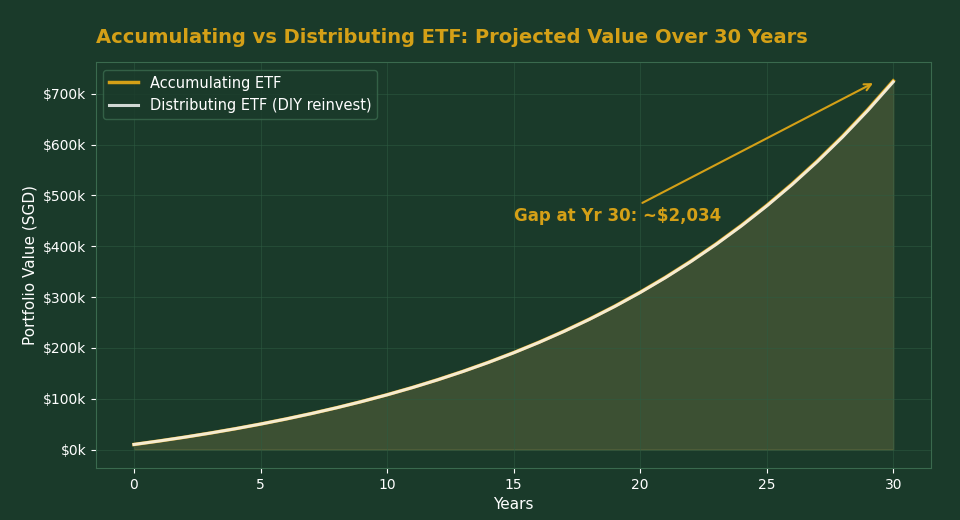
Run the calculator with a S$2.50 brokerage fee, 0.5% cash drag and quarterly payouts on a S$10,000 lump sum plus S$500 monthly at 6% growth and 1.3% yield, and the gap over a 10-year horizon is only around S$188 — barely noticeable against a six-figure portfolio. Stretch the same assumptions to 30 years and the gap grows to roughly S$2,034, purely from the compounding of small, repeated frictions across 120 separate reinvestment trades. The lesson for long-horizon investors accumulating wealth (rather than drawing income) is that the accumulating share class removes an entirely avoidable cost, without changing your underlying exposure or expense ratio.
| Horizon | Friction Gap (Default Assumptions)* | Reinvestment Trades |
|---|---|---|
| 10 years | ~S$188 | 40 trades (quarterly) |
| 20 years | ~S$705 | 80 trades |
| 30 years | ~S$2,034 | 120 trades |
*Based on the calculator’s default assumptions: S$10,000 lump sum, S$500/month, 6% price growth, 1.3% yield, quarterly payouts, S$2.50 brokerage fee and 0.5% cash drag per reinvestment. Your actual figure depends on the inputs you set above.
Best Platforms for Buying Accumulating ETFs in Singapore
Low-commission brokerages such as Interactive Brokers, moomoo Singapore and Tiger Brokers all let you buy accumulating UCITS ETFs like CSPX or VWRA directly on the London Stock Exchange or SGX, with per-trade fees that make occasional lump-sum purchases cheap. For investors who want to dollar-cost average monthly without paying a brokerage commission on every contribution, robo-advisors like Endowus, Syfe and FSMOne build globally diversified accumulating portfolios and automate regular monthly investing, which sidesteps the reinvestment-friction problem entirely since there is no periodic dividend payout to manage. This is often the simplest way to compound a distributing tendency into an accumulating outcome without doing the manual work yourself.
Tax and CPF/SRS Angle for Singapore Investors
Singapore does not impose capital gains tax on investment returns for individual investors, and Acc vs Dist has no bearing on this — you are not taxed differently for choosing one share class over the other. Both CSPX/IUSA and VWRA/VWRD are Ireland-domiciled UCITS funds, which benefit from the reduced 15% US dividend withholding tax under the Ireland-US tax treaty rather than the 30% non-resident rate on US-domiciled funds — this withholding is deducted inside the fund automatically regardless of whether you hold the Acc or Dist class, so it is not a differentiator between the two. Some SRS-linked brokerage and robo-advisor accounts allow you to deploy Supplementary Retirement Scheme funds into globally diversified accumulating portfolios as part of a long-term retirement strategy — check with your specific SRS operator (DBS, OCBC or UOB) and platform for exact fund access before committing SRS funds.
Retirees and Passive Income: When Distributing Still Makes Sense
Everything above assumes you are still accumulating wealth and do not need the cash. If you are retired or drawing a passive income stream, a distributing ETF’s periodic cash payout can actually be the more convenient structure, since you would otherwise have to manually sell down units of an accumulating fund to generate spending cash — a process that has its own friction and timing risk. For Singapore retirees building a decumulation strategy, it is worth comparing a distributing ETF’s natural cash yield against the systematic withdrawal approach modelled in our Retirement Planning Calculator, and reading our Passive Income Singapore guide for how S-REITs and dividend ETFs fit alongside CPF LIFE payouts in a retirement income plan.
Frequently Asked Questions
What is the difference between an accumulating and a distributing ETF?
An accumulating (Acc) ETF automatically reinvests dividends inside the fund, so you never receive cash and your unit price reflects the reinvested income. A distributing (Dist) ETF pays dividends out to you as cash, which you must manually reinvest if you want to keep compounding.
Is CSPX accumulating or distributing?
CSPX, the iShares Core S&P 500 UCITS ETF, is the accumulating share class. Its distributing sibling tracking the same index is IUSA, also from iShares.
Is VWRA accumulating or distributing?
VWRA, the Vanguard FTSE All-World UCITS ETF, is the accumulating share class. VWRD is the distributing share class of the same underlying fund.
Does choosing accumulating or distributing affect the dividend withholding tax I pay?
No. Both share classes hold the same underlying securities and have the same withholding tax applied inside the fund before either distribution or reinvestment happens. For Ireland-domiciled funds like CSPX and VWRA, this is a reduced 15% US withholding rate under the Ireland-US tax treaty, regardless of Acc or Dist class.
How much does manual dividend reinvestment really cost over time in Singapore?
It depends on your brokerage fee, dividend yield and holding period, but the friction typically compounds from a negligible amount over 5-10 years into a noticeable four-figure sum over 20-30 years, purely from repeated small fees and cash drag on dozens of reinvestment trades. Use the calculator above with your own numbers for an exact estimate.
Can I switch from a distributing to an accumulating ETF without triggering capital gains tax in Singapore?
Singapore does not tax capital gains for individual investors, so switching funds by selling one and buying the other does not trigger a local capital gains tax event. You will still pay brokerage fees on the sale and repurchase, and should check whether your holding could be viewed as trading income in unusual circumstances.
Which Singapore brokers or platforms let me buy accumulating ETFs like CSPX or VWRA?
Interactive Brokers, moomoo Singapore and Tiger Brokers all offer direct access to accumulating UCITS ETFs on the London Stock Exchange or SGX. Robo-advisors such as Endowus, Syfe and FSMOne also build accumulating, globally diversified portfolios with automated monthly investing.
Do I need to do anything to reinvest dividends in an accumulating ETF?
No. The reinvestment happens automatically inside the fund structure — you do not receive cash, place any trades, or pay any brokerage fees for it.
Is a distributing ETF ever the better choice for a Singapore investor?
Yes, particularly for retirees or investors who want a natural, low-effort cash income stream without having to sell down units. For investors still in the accumulation phase who do not need the cash, an accumulating share class avoids the reinvestment friction modelled in this calculator.
Compound Smarter, Not Harder
Skip the manual reinvestment friction entirely. Use our free tools and referral bonuses to put your knowledge into action.