
Gold Investment Calculator Singapore 2026
Estimate your gold returns in SGD — enter your investment, gold purity, holding period and expected growth rate for instant results.
💰 Gold Investment Return Calculator
Understanding Gold Investment in Singapore
Gold has served as a store of value for millennia, but its role in a Singapore retail investor’s portfolio has evolved significantly. As at Q2 2026, spot gold trades near US$3,900–4,100 per troy ounce — approximately S$160–170 per gram of 999/24K gold — driven by persistent central bank buying, geopolitical uncertainty, and US dollar weakness. Singapore offers one of Asia’s most accessible and tax-efficient gold investment ecosystems: investment-grade gold (purity ≥ 99.5%) is exempt from GST under the Goods and Services Tax (General) Regulations, giving local buyers a material cost advantage over many other countries.
This calculator helps you model your potential returns from both lump-sum and monthly DCA gold purchases. It accounts for gold purity (999, 916, or 750), entry price per gram, expected annual price appreciation, holding period, and an annual storage or management fee — giving you a realistic picture of what your gold portfolio could be worth in SGD terms over time. Not financial advice. All projections are illustrative only. Data as at Q2 2026 unless noted.
Why Gold Belongs in a Singapore Investor’s Portfolio
The Monetary Authority of Singapore (MAS) regularly publishes guidelines on portfolio diversification, and gold is widely regarded by institutional investors as a portfolio hedge. Historically, gold has delivered annualised returns of approximately 7–10% in SGD terms over 10-year rolling periods (1990–2026), though past performance does not guarantee future results. Gold’s low correlation with SGX-listed equities and S-REITs makes it a natural diversifier — when REIT yields compress during economic stress or equity markets correct, gold has typically held or appreciated in value. For Singapore investors building a retirement portfolio alongside CPF contributions, a 5–10% gold allocation is a common rule of thumb used by licensed financial advisers.
The Singapore Gold Market: What You Need to Know
Singapore is a major global gold trading hub, home to the Singapore Commodity Exchange (SICOM) and a thriving physical gold market. Local investors have multiple access points: UOB Gold Savings Account (buy gold in grams, no physical delivery), BullionStar (physical bars and coins with GST-exempt investment gold), the SPDR Gold Shares ETF (SGX ticker: O87, TER ~0.40%), and international gold ETFs accessible through FSMOne, Endowus, or Syfe. Each route has different fee structures, storage considerations, and minimum investment thresholds. The calculator’s “Annual Storage / Fee” input lets you model the cost drag of each approach — for example, 0% for self-stored physical gold, ~0.40% for an ETF, or ~0.15% for UOB Gold Savings Account.
How to Use This Gold Investment Calculator
- Set your initial investment: Drag the slider to your planned lump-sum SGD amount. This is the capital you invest upfront to buy gold at today’s price.
- Set your monthly top-up: If you plan to dollar-cost average into gold monthly, enter that amount. Set to S$0 for a one-time lump-sum calculation.
- Choose holding period: Slide to the number of years you intend to hold your gold position — 1 to 30 years.
- Select gold purity: Pick 999/24K (investment-grade), 916/22K (common for jewellery), or 750/18K. Purity affects the actual gold content per gram you receive at the stated price.
- Set current gold price: Adjust the price per gram in SGD. As at August 2026, 999/24K gold trades around S$165/g. Cross-check with UOB Gold or BullionStar for live rates.
- Expected annual growth: The long-run average for gold in SGD terms is approximately 7–8%/year over 20-year periods. You can model conservative (4%), base (7%), or optimistic (10–12%) scenarios.
The calculator instantly shows your total grams accumulated, total amount invested, projected portfolio value, and estimated profit in SGD.
Pro tip: Combine this tool with our DCA Investment Calculator to compare gold DCA against equity index fund DCA and see which delivers better risk-adjusted returns for your retirement plan.
What Is Gold Investment?
Gold investment refers to the purchase of gold — in physical or paper form — with the expectation that its price will appreciate over time, preserving or growing your purchasing power in SGD terms. Unlike equities or S-REITs, gold does not pay dividends or distributions. Its return is purely capital appreciation driven by supply and demand dynamics, currency fluctuations, inflation expectations, and macroeconomic uncertainty.
In Singapore, gold investment takes several forms. Physical gold (bars, coins) provides direct ownership but requires secure storage. Gold Savings Accounts — offered by UOB, OCBC, and DBS — let you hold fractional grams of gold digitally without physical delivery, typically at lower cost and with higher liquidity. Gold ETFs listed on the SGX (e.g., SPDR Gold Shares, ticker O87) trade like shares and provide exposure to international spot gold prices. Finally, some robo-advisors and platforms offer indirect gold exposure through diversified commodity portfolios or inflation-protected bond funds.
For Singapore retail investors, investment-grade gold (purity ≥ 99.5%) is GST-exempt — a meaningful cost advantage. Jewellery-grade gold (916/22K, 750/18K) is typically purchased for personal use rather than investment due to significant making charges and buyback spreads. This calculator supports all three purities so you can compare the effective gram-per-dollar value across purchase types.
How Gold Returns Work: The Maths Behind Your SGD Projection
Gold returns are driven by one variable: the price per gram at exit relative to the price per gram at entry. There are no dividends, no coupon payments, and no compounding in the traditional sense. The formula is straightforward:
| Metric | Formula |
|---|---|
| Grams Purchased | Capital ÷ Price per gram × Purity factor |
| Projected Value | Grams × Future Price per gram |
| Future Price | Entry Price × (1 + Net Annual Growth)^Years |
| Net Annual Growth | Expected Growth Rate − Annual Fee Rate |
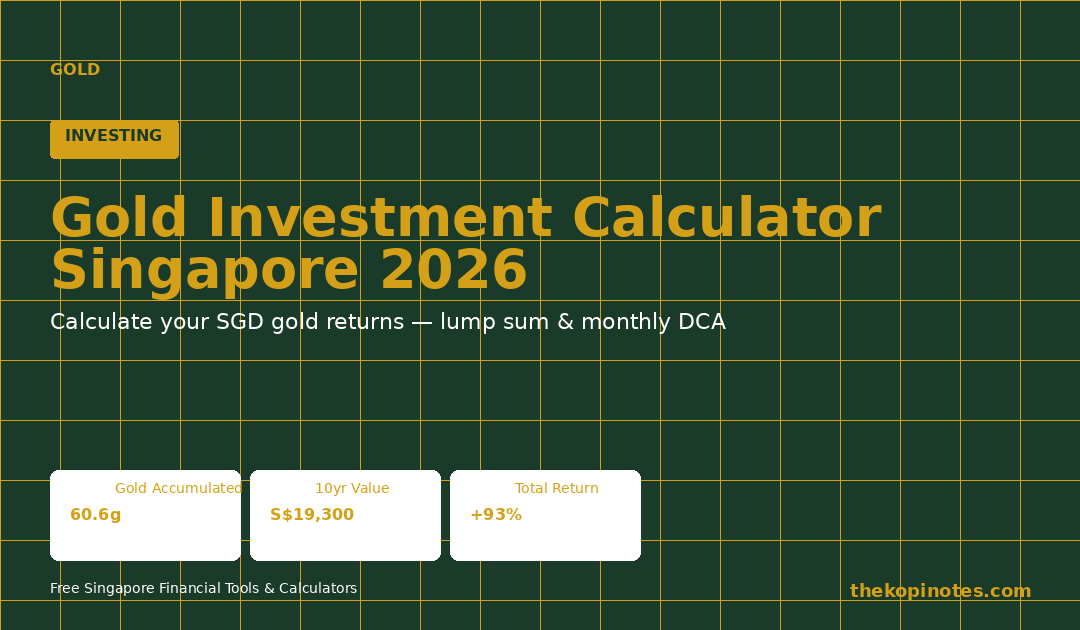
For example: S$10,000 invested at S$165/g of 999 gold buys approximately 60.6 grams. At a 7% annual growth rate (net of 0.2% fee = 6.8% net), over 10 years the future price would be approximately S$319/g, giving a projected portfolio value of about S$19,325 — a gain of S$9,325 or 93%, equivalent to a CAGR of approximately 6.8%. Monthly DCA adds additional grams at progressively higher prices, but as more grams are accumulated, the overall portfolio value grows with gold’s price trajectory.
Gold vs S-REITs in Singapore: Which is Better for Your Portfolio?
This is one of the most common questions from Singapore retail investors building a diversified retirement portfolio. Both S-REITs and gold serve different roles. S-REITs are income assets — they distribute 90%+ of taxable income as dividends (DPU), currently yielding around 5–7% for major SGX-listed trusts like Mapletree Logistics Trust, CapitaLand Ascott Trust, and Keppel DC REIT. Gold generates zero income but has historically appreciated in capital value over multi-decade periods.
| Factor | Gold | S-REITs |
|---|---|---|
| Income | None | 5–7% DPU yield |
| Capital Growth | ~7–9%/yr (LT avg) | Variable (rate-sensitive) |
| Inflation Hedge | Strong | Moderate |
| GST (SG) | Exempt (999+) | N/A |
| Interest Rate Risk | Low (inverse USD) | High (gearing costs) |
| CPF Eligible | Via CPFIS (ETF) | Via CPFIS |
Many Singapore investors hold both — using S-REITs for cash flow to fund living expenses and gold as a long-term capital preservation hedge. Use our Dividend Portfolio Yield Calculator to model your S-REIT income alongside this gold return projection.
Best Platforms for Gold Investment in Singapore
Choosing the right platform affects your effective return through fee drag. Here are the main options as at Q2 2026:
| Platform | Type | Annual Fee | Min Investment |
|---|---|---|---|
| UOB Gold Savings Account | Digital gold (grams) | ~0.15% p.a. | S$1 (1g min) |
| BullionStar (physical bar) | Physical gold | 0% (storage extra) | ~S$330 (2g bar) |
| SPDR Gold Shares (O87, SGX) | ETF | 0.40% TER | 1 unit (~S$270) |
| FSMOne (iShares Gold ETF) | ETF | 0.25% TER | S$100 |
| Endowus / Syfe (commodity fund) | Fund wrapper | 0.40–0.65% | S$1 |
For regular monthly DCA, the UOB Gold Savings Account and FSMOne offer the lowest friction. For larger lump-sum holdings, physical gold via BullionStar eliminates counterparty risk. New to Endowus or Syfe? Both platforms offer sign-up bonuses through referral links that can offset your first year’s fees.
CPF, SRS and Gold Investment in Singapore
Can you use CPF to buy gold? Yes — with restrictions. Under the CPF Investment Scheme (CPFIS), you can invest your CPF Ordinary Account (OA) funds in approved gold instruments, specifically gold ETFs listed on the SGX (such as SPDR Gold Shares, O87) and certain other approved products. Physical gold bars and most digital gold accounts are not CPFIS-eligible.
For Supplementary Retirement Scheme (SRS) funds, gold ETFs accessible through brokerages like OCBC Securities, DBS Vickers, or UOB Kay Hian are eligible. The SRS provides a tax deduction on contributions (up to S$15,300 per year for Singaporeans and PRs), making it a tax-efficient wrapper for long-term gold holding. If you are considering using SRS for gold ETFs, our SRS Tax Savings Calculator can show you the exact income tax savings from an SRS contribution in your tax bracket. Pair this with our CPF OA/SA Allocation Calculator to see how much OA headroom you have for CPFIS gold investments without compromising your housing and retirement goals.
Gold as a Passive Income and Retirement Strategy
Gold does not generate passive income in the traditional sense — it produces no dividends, rent, or coupons. However, many Singapore pre-retirees build a gold position as a capital preservation strategy: at retirement, they liquidate gold holdings (in part or in full) and redeploy the proceeds into income-generating assets like S-REITs, Singapore Savings Bonds (SSBs), or CPF LIFE. This two-stage approach — accumulate gold during working years, convert to income assets at retirement — is a legitimate retirement planning strategy recognised by fee-only financial planners in Singapore.
A rule of thumb used by some Singapore financial advisers is to hold gold equal to 6–12 months of living expenses as a “crisis fund” that also appreciates over time — distinct from your emergency cash fund. If your monthly expenses are S$4,000, that equates to approximately S$24,000–S$48,000 of gold — roughly 145–290 grams at today’s S$165/g price. Use this calculator to see how that position could grow over your remaining working years, and use our Retirement Planning Calculator to integrate gold into your full retirement projection. For a broader passive income strategy combining S-REITs, dividends, and capital assets, see our Passive Income Singapore 2026 Guide.
Frequently Asked Questions
What is a good annual return for gold investment in Singapore?
Over the 20-year period from 2005 to 2025, gold delivered an annualised return of approximately 8–10% in SGD terms, outperforming the STI Index and broadly tracking or exceeding Singapore CPI inflation. However, gold is volatile in the short run — it can fall 20–30% in a single year during risk-on market cycles. A reasonable long-run base assumption for modelling purposes is 7% per annum in SGD, with conservative and optimistic scenarios of 4% and 10% respectively.
Is gold a good investment in Singapore in 2026?
Gold has performed strongly in 2025–2026, driven by US Federal Reserve rate cut expectations, persistent central bank demand (notably from the People’s Bank of China), and geopolitical uncertainty. As at mid-2026, spot gold trades near US$3,900–4,100/oz. While short-term valuations look stretched by some metrics, long-term structural demand from Asian central banks and inflation concerns continue to support gold’s case as a portfolio diversifier. Most Singapore financial advisers recommend a 5–10% allocation rather than a concentrated position.
How much will S$10,000 in gold be worth in 10 years?
Using a base case of 7% annual gold price growth and a 0.2% fee, S$10,000 invested today at S$165/g (999/24K) buys approximately 60.6 grams. In 10 years at a projected price of around S$319/g, those grams would be worth approximately S$19,300 — a gain of roughly S$9,300 or 93%. Use the Gold Investment Calculator above to model your specific inputs and holding period.
Can I use CPF to invest in gold in Singapore?
Yes, but only through approved instruments under CPFIS-OA. You can use CPF Ordinary Account funds to invest in gold ETFs listed on the SGX, such as SPDR Gold Shares (ticker: O87). Physical gold bars, UOB Gold Savings Account, and most digital gold platforms are not CPFIS-eligible. Your CPF OA must maintain a minimum balance (S$20,000) before CPFIS investments are permitted, and you can invest up to 10% of your investible savings in gold-related instruments.
Is investment gold GST-exempt in Singapore?
Yes. Investment-grade precious metals with a purity of at least 99.5% (gold) are exempt from Singapore’s Goods and Services Tax (GST) under the Investment Precious Metals (IPM) scheme. This covers most 999/24K gold bars, coins, and wafers sold for investment purposes. Jewellery gold (916/22K, 750/18K) and collectibles are typically not exempt and attract the current 9% GST rate, which significantly erodes returns if you buy at retail jewellery prices.
What gold price per gram should I use in the calculator for Singapore?
As at August 2026, 999/24K investment gold trades at approximately S$165–175 per gram in Singapore. For 916/22K gold, apply a purity factor of 0.916 to the 999 spot price. Check live rates on UOB’s gold price page, BullionStar, or the SGX website for the SPDR Gold Shares ETF. The calculator’s default of S$165/g is a reasonable mid-2026 baseline, but adjust to reflect the rate quoted by your chosen platform on the day you invest.
Which Singapore platform is best for monthly gold DCA?
For small monthly amounts (S$100–S$500), the UOB Gold Savings Account is the most accessible — you can set up a standing instruction to buy gold in grams each month with no brokerage commission. For larger monthly amounts (S$500+), gold ETFs via FSMOne or Endowus offer lower TERs (0.25–0.40%) and broader liquidity. Physical gold DCA via BullionStar is also possible but involves physical delivery costs. Use our Endowus referral link or FSMOne referral link to access sign-up bonuses when you open an account.
What is the difference between 999 gold and 916 gold in Singapore?
999 gold (24K) has a purity of 99.9% gold and is the standard for investment-grade gold bars, wafers, and coins. It is GST-exempt in Singapore and commands the lowest premium over spot price. 916 gold (22K) has a purity of 91.6% gold — commonly used in Singapore jewellery. While 916 gold is sold at a price close to spot, it typically carries making charges and buyback spreads of 10–15% at jewellery retailers, making it less efficient as a pure investment vehicle. The calculator lets you select purity so you can see the actual gold content (in grams) per SGD invested under each option.
How does gold investment affect my retirement plan in Singapore?
Gold can serve as a capital preservation and inflation-hedge component in your broader retirement plan. It does not generate income, so it should complement rather than replace income-producing assets like S-REITs, CPF LIFE, or Singapore Savings Bonds in retirement. A practical approach is to hold 5–10% of your investible assets in gold during your accumulation phase, then gradually liquidate and redeploy into income assets as you approach retirement. Use our Retirement Planning Calculator to model your full retirement income picture including CPF, S-REITs, and capital assets.
Ready to Build Your Singapore Investment Portfolio?
Gold is one piece of the puzzle. Use our free tools and referral bonuses to put your full retirement strategy into action.