
VES Calculator Singapore 2026
Check your car or taxi’s Vehicular Emissions Scheme (VES) band, rebate or surcharge, and net ARF payable — free calculator with instant results in SGD.
VES Rebate / Surcharge Calculator
Your VES Result
Understanding the Vehicular Emissions Scheme for Singapore Car Buyers
The Vehicular Emissions Scheme (VES) is run jointly by the Land Transport Authority (LTA) and the National Environment Agency (NEA) to nudge car and taxi buyers toward cleaner vehicles. Every new car or taxi registered in Singapore is placed into one of five VES bands based on its tailpipe emissions, and that band determines whether you get a rebate off your Additional Registration Fee (ARF) or have to pay a surcharge on top of it. From 1 January 2026, the scheme was revised again: only fully electric vehicles can now reach the top rebate band, hybrids no longer qualify for any rebate, and surcharges on the most polluting petrol and diesel cars have gone up. If you’re shopping for a car this year, VES can easily swing your total upfront cost by S$20,000 to S$50,000 depending on what you buy.
Not financial or motoring advice. All figures are based on LTA’s official Revised VES tables for vehicles registered 1 January 2026 to 31 December 2027, current as at Q3 2026. Always confirm your car’s exact emissions data and VES band with LTA or your dealer before signing any purchase agreement.
Why VES Matters More From 2026
Previous versions of VES let hybrids and even some efficient petrol cars claim a rebate. The 2026–2027 revision closes that door — Band A (the only rebate band) now requires zero hydrocarbon, carbon monoxide, nitrogen oxide and particulate matter emissions in addition to CO2 ≤ 90g/km, a bar that only battery electric vehicles can clear. Meanwhile Band C3 surcharges have climbed to S$35,000 in 2026 and will rise again to S$45,000 in 2027, so buyers of larger petrol SUVs and performance cars are paying meaningfully more than they did a few years ago.
What This Calculator Does
Enter your vehicle category, powertrain, CO2 rating and registration year, and this tool instantly returns your VES band, the rebate or surcharge amount, the minimum ARF floor that applies, and — if you enter your quoted ARF — your net ARF payable after the VES adjustment. It’s built specifically around LTA’s published Revised VES bands so the numbers match what you’ll see on your Certificate of Entitlement (COE) bidding results and vehicle registration paperwork.
How to Use This VES Calculator
- Vehicle Category: Select whether you’re registering a private Car or a Taxi — taxis get larger rebates and surcharges than cars at every band.
- Powertrain: Choose Fully Electric, Hybrid, or Petrol/Diesel. Only fully electric vehicles can realistically reach Band A, since hybrids and combustion vehicles cannot achieve zero HC, CO, NOx and PM emissions even at a low CO2 rating.
- CO2 Emissions (g/km): Enter the figure from your car’s LTA registration document, the OneMotoring listing, or the manufacturer’s spec sheet.
- Registration Year: Pick 2026 or 2027 — the rebate and surcharge amounts step down for EVs and step up for surcharge bands between the two years.
- Your ARF Payable (optional): If your dealer has already quoted you an ARF figure, enter it to see your net ARF after the VES rebate or surcharge is applied.
The calculator instantly shows your VES band, rebate or surcharge amount, the minimum ARF floor, and your net ARF payable if you supplied a starting ARF figure.
Pro tip: Combine this with our COE & PARF Rebate Calculator to see the full picture — what you’ll pay upfront under VES, and what you’d get back if you deregister the car early.
Contents — Click to Expand
What Is the Vehicular Emissions Scheme (VES)?
VES is Singapore’s emissions-based car tax adjustment, jointly administered by LTA and NEA since 2018. Every new car or taxi is classified into a band — A, B, C1, C2 or C3 under the current 2026–2027 structure — based on the worst-performing of five pollutants: carbon dioxide (CO2), hydrocarbons (HC), carbon monoxide (CO), nitrogen oxides (NOx) and particulate matter (PM). Depending on the band, LTA either grants a rebate that offsets your Additional Registration Fee (ARF), or charges a surcharge on top of it. VES replaced the older Carbon Emission-Based Vehicle Scheme (CEVS) in 2018 and has been revised several times since, most recently for vehicles registered from 1 January 2026.
How VES Bands Are Calculated
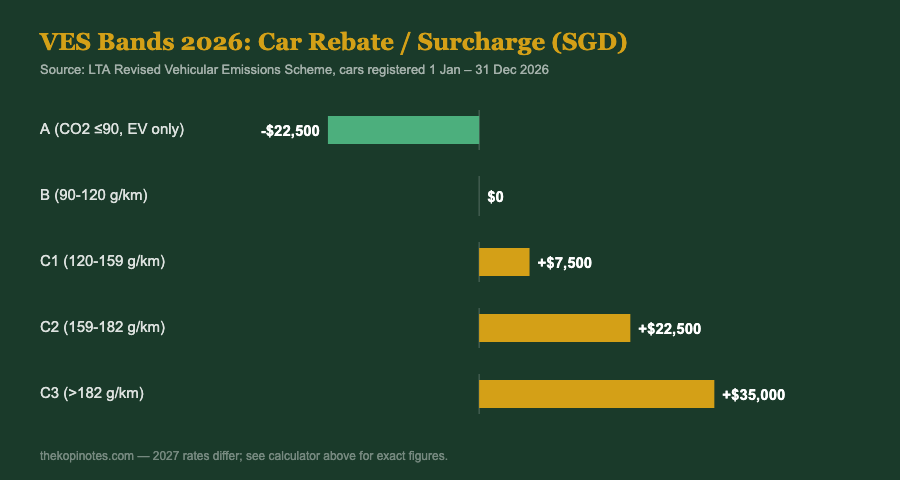
Under the Revised VES (2026–2027), the five bands and their CO2 thresholds are: Band A (CO2 ≤ 90g/km, plus zero HC/CO/NOx/PM), Band B (90–120g/km), Band C1 (120–159g/km), Band C2 (159–182g/km) and Band C3 (above 182g/km). Crucially, the band is set by whichever pollutant performs worst — not just CO2. A car with a good CO2 figure but a high NOx reading from its exhaust after-treatment system can still be pushed into a higher (worse) band. This calculator uses CO2 as the primary input, which is accurate for the vast majority of production petrol, diesel and hybrid cars sold in Singapore, but if your car uses an unusual engine configuration, verify the exact band on your LTA registration paperwork.
VES vs ARF: How the Rebate or Surcharge Affects Your Car’s Price
ARF is a separate tax charged on top of a car’s Open Market Value (OMV) when you register it — it is not the same tax as VES. VES simply adjusts how much ARF you actually pay: a Band A rebate is deducted from your ARF bill (subject to a minimum ARF floor of S$5,000 for combustion cars, or S$0 for electric cars), while a Band C1–C3 surcharge is added on top. For example, a Band C3 car registered in 2026 pays an extra S$35,000 in ARF purely because of its emissions rating, on top of whatever ARF its OMV already generates. This is why two cars with a similar sticker price can end up thousands of dollars apart once VES is applied — always ask your dealer to break out the VES component separately in your quote.
EVs vs Hybrids vs Petrol/Diesel Cars Under VES
The 2026 revision was designed specifically to steer buyers toward fully electric vehicles. Only EVs can achieve Band A’s requirement of zero HC, CO, NOx and PM emissions, so only EVs are eligible for the S$22,500 (2026) or S$20,000 (2027) rebate. Hybrid cars, even efficient petrol-electric models with low CO2 figures, are capped at Band B (VES-neutral, S$0) at best under the current rules — they lost their rebate eligibility entirely in this revision. Petrol and diesel cars with higher emissions typically land in Band C1 to C3 depending on engine size and tuning, meaning a surcharge is now the norm rather than the exception for larger combustion-engine vehicles. If EV rebates factor into your buying decision, it’s also worth checking the separate EV Early Adoption Incentive (EEAI), which offers up to 45% off ARF (capped at S$7,500) for EVs registered in 2026, stacking on top of the VES rebate.
VES Rates: 2026 vs 2027 Compared
LTA tapers the scheme’s incentives year by year. For cars, the Band A EV rebate steps down from S$22,500 in 2026 to S$20,000 in 2027, while Band C1–C3 surcharges step up — Band C3 rises from S$35,000 in 2026 to S$45,000 in 2027. Taxis follow the same pattern at 1.5x the car rates (for example, a Band A taxi rebate is S$33,750 in 2026 versus S$30,000 in 2027). The practical takeaway: if you’re set on an EV, registering in 2026 nets a slightly larger rebate; if you’re buying a higher-emission petrol or diesel car, registering in 2026 means a smaller surcharge than waiting until 2027. Use the registration year selector in the calculator above to compare both scenarios side by side before committing to a purchase timeline.
Should VES Change Which Car You Buy in Singapore?
For many buyers, VES is now a genuinely large line item — tens of thousands of dollars swinging on emissions data alone — so it’s worth factoring into your decision alongside COE, insurance and fuel costs, not treating it as a footnote. If a Band C2 or C3 surcharge would add S$20,000–S$35,000 to your ARF, it’s worth asking whether that money is better spent on the car at all. Some Singaporeans are increasingly choosing not to own a car and instead using car-sharing platforms like TribeCar for occasional trips, redirecting what would have gone into ARF, VES surcharges, COE and depreciation into an investment portfolio instead. Whether you buy or skip car ownership, the maths is worth running properly — our Car Loan Calculator and Car Insurance NCD Calculator can help you see the full annual cost of ownership before you commit.
Frequently Asked Questions
What is the Vehicular Emissions Scheme (VES) in Singapore?
VES is a joint LTA-NEA scheme that grants a rebate or charges a surcharge on a new car or taxi’s Additional Registration Fee (ARF), based on the vehicle’s emissions across five pollutants: CO2, HC, CO, NOx and PM. It applies to all cars and taxis registered from 1 January 2018 onward, with the bands and amounts revised periodically — most recently for 1 January 2026 to 31 December 2027.
How is my car's VES band determined in Singapore?
Your car is placed into whichever band matches its worst-performing pollutant among CO2, HC, CO, NOx and PM — not simply its CO2 figure. This calculator uses CO2 as a close approximation, which is accurate for most mainstream cars, but LTA’s official assessment considers all five pollutants together.
Do hybrid cars qualify for the VES rebate in Singapore?
No. Under the Revised VES for 2026–2027, only fully electric vehicles can meet Band A’s requirement of zero HC, CO, NOx and PM emissions. Hybrid cars, regardless of how low their CO2 rating is, are capped at Band B (VES-neutral) at best, and no longer receive any VES rebate.
Is the VES rebate or surcharge the same as ARF in Singapore?
No. ARF is a separate tax based on a car’s Open Market Value (OMV). VES adjusts how much ARF you actually pay — a rebate is deducted from your ARF bill (down to a minimum floor), while a surcharge is added on top of it. They are two different calculations that combine into your final upfront tax bill.
How much is the VES surcharge for a Band C3 car registered in 2026?
A Band C3 private car (CO2 above 182g/km, or failing any of the other four pollutant thresholds) registered in 2026 pays a S$35,000 surcharge on top of its ARF. For a taxi, the Band C3 surcharge is S$52,500 in 2026.
Will VES rebates and surcharges change in 2027 in Singapore?
Yes. LTA has scheduled the amounts to taper year by year within the 2026–2027 extension: EV rebates step down (for example, S$22,500 in 2026 to S$20,000 in 2027 for cars), while surcharges on Bands C1–C3 step up (Band C3 rises from S$35,000 in 2026 to S$45,000 in 2027 for cars).
Does the VES surcharge apply differently to taxis than to private cars?
Yes. Taxis are charged and rebated at 1.5x the private car rate at every VES band, reflecting their higher mileage and emissions impact. For example, a Band C2 taxi pays a S$33,750 surcharge in 2026, versus S$22,500 for an equivalent private car.
Where can I check my car's official CO2, HC, CO, NOx and PM figures in Singapore?
Your car dealer or agent will typically provide these figures as part of your purchase quotation, sourced from LTA’s vehicle type approval database. You can also check the OneMotoring website or ask your dealer to confirm the exact VES band assigned to your specific model and variant before you commit to a purchase.
Is it worth buying a car in Singapore just for the VES rebate, or should I invest the money instead?
A VES rebate alone shouldn’t drive a car purchase — it’s one line item among COE, insurance, fuel, parking and depreciation. If you don’t need daily use of a car, redirecting the total cost of ownership into a diversified investment portfolio, and using car-sharing for occasional trips, can leave you meaningfully better off over a 5–10 year horizon. Compare the numbers with our Retirement Planning Calculator before deciding.
Plan the Full Cost of Car Ownership — Or Skip It Entirely
Use our free tools to see your real VES, ARF and COE costs, or find out what skipping car ownership could be worth in your investment portfolio instead.