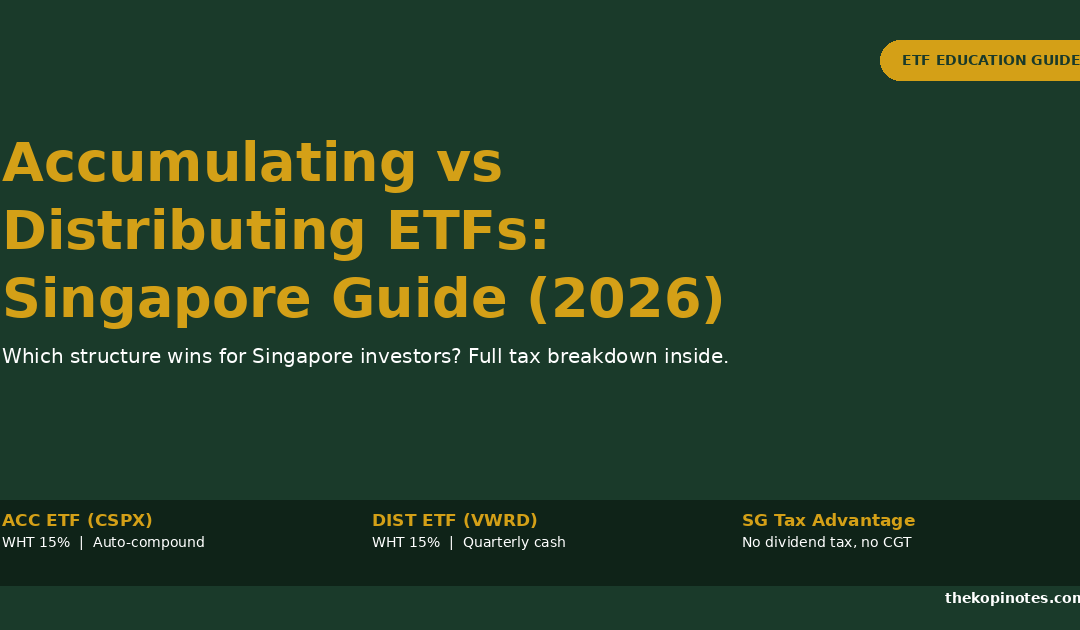
Accumulating vs Distributing ETFs: Which Should Singapore Investors Pick? (2026)
A complete breakdown for Singapore investors — tax implications, compounding differences, and which ETF structure wins for your goals in 2026.
For Singapore investors, accumulating ETFs are generally the better choice for long-term wealth building. Both structures are treated identically under Singapore tax law — no dividend income tax, no capital gains tax — but accumulating ETFs automatically reinvest dividends, eliminating brokerage friction and timing risk. Distributing ETFs make more sense only if you need regular cash flow for retirement income or living expenses.
Not financial advice. All figures are for educational reference only. Data as at Q1 2026 unless noted.
Table of Contents
Contents — Click to expand
- The Quick Answer: Which Is Better?
- How Accumulating and Distributing ETFs Work
- Singapore Tax Context: Why This Changes Everything
- Accumulating vs Distributing: Head-to-Head Comparison
- Popular Accumulating and Distributing ETFs for Singapore Investors
- A Worked SGD Example: 20-Year Compounding
- Which Should Singapore Investors Choose?
- Frequently Asked Questions
The Quick Answer: Which Is Better?
If you are investing in ETFs for long-term wealth accumulation — and most Singapore investors are — then an accumulating ETF is the better default choice. The reason is straightforward: dividends are automatically reinvested inside the fund, so you never deal with brokerage fees to reinvest, partial share lots, or the temptation to spend your dividends instead of compounding them.
That said, the gap between the two structures is much smaller in Singapore than in countries like the United Kingdom or Australia. Singapore imposes no dividend income tax and no capital gains tax. This means a Singapore investor holding a distributing ETF does not face a tax bill when dividends are paid out — they simply receive cash and can choose what to do with it. In tax-heavy jurisdictions, the distributing structure creates an annual tax event that drags on compounding; in Singapore, it does not.
The decision therefore comes down to your financial life stage and goals:
- Still building wealth? Choose accumulating. Let the fund compound for you automatically.
- Drawing down for income or retirement? Choose distributing. Receive regular cash without needing to sell units.
Read on for the full mechanics, a side-by-side comparison, and a worked SGD example showing how the two structures perform over 20 years.
How Accumulating and Distributing ETFs Work
Both accumulating and distributing ETFs hold the same underlying basket of stocks. The only difference is what happens when the stocks inside the fund pay dividends.
Accumulating ETFs
When a company inside an accumulating ETF pays a dividend, the ETF manager receives that cash and immediately buys more shares of that same company (or rebalances across the portfolio). The dividend never leaves the fund. Instead, it raises the Net Asset Value (NAV) per unit. As an investor, you see your units appreciate in value rather than receiving cash distributions.
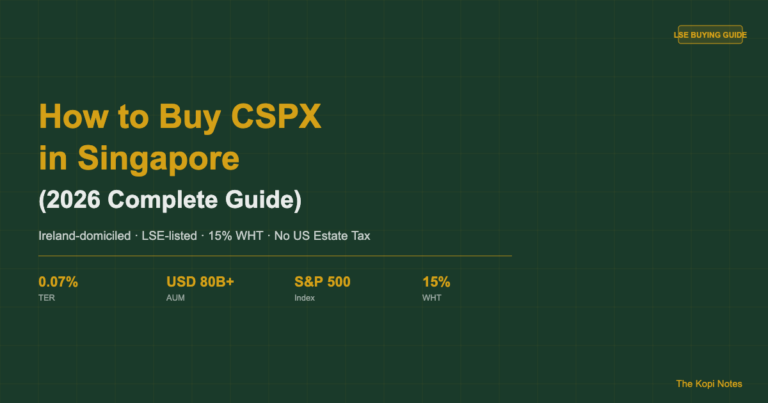
Examples on the London Stock Exchange (LSE): CSPX (iShares Core S&P 500 UCITS ETF Acc), VWRA (Vanguard FTSE All-World UCITS ETF USD Acc), and IWDA (iShares Core MSCI World UCITS ETF Acc). You can read about both in our detailed CSPX ETF Singapore guide and VWRA ETF Singapore guide.
Distributing ETFs
When a company inside a distributing ETF pays a dividend, the ETF manager collects that cash and then distributes it to unitholders — typically quarterly or semi-annually. The NAV of the fund drops by approximately the dividend amount on the ex-dividend date, and the investor receives cash in their brokerage account.
Examples on the LSE: VWRD (Vanguard FTSE All-World UCITS ETF USD Dist — the distributing twin of VWRA), SPYL (SPDR Portfolio S&P 500 UCITS ETF), and IWDG (iShares MSCI World UCITS ETF Dist).
What About Withholding Tax at the Fund Level?
Importantly, both accumulating and distributing ETFs face the same withholding tax (WHT) at the fund level. Ireland-domiciled UCITS ETFs pay 15% WHT on US dividends received — regardless of whether the fund is accumulating or distributing. This is governed by the Ireland-US tax treaty and applies before the fund does anything with the dividend. There is no WHT advantage of one structure over the other; the tax efficiency of Ireland domicile (15% vs 30% for a US-domiciled ETF like VOO) applies equally to both.
For a full explanation of why Ireland domicile matters, see our guide on why Singapore investors buy ETFs on the London Stock Exchange.
Singapore Tax Context: Why This Changes Everything
The accumulating vs distributing debate is far more significant in countries with dividend income tax. In the UK, for example, dividends received above the annual allowance (£500 as at 2026) are taxed at 8.75% (basic rate) to 39.35% (additional rate). Every distributing ETF payout creates a tax liability that an accumulating ETF avoids entirely. This is why the UK investing community strongly favours accumulating ETFs.
Singapore investors are in a privileged position:
- No dividend income tax: Whether VWRD pays you a quarterly distribution or VWRA reinvests it, Singapore’s Inland Revenue Authority of Singapore (IRAS) does not tax that dividend receipt.
- No capital gains tax: When you eventually sell your accumulating ETF units at a profit, Singapore does not impose any capital gains tax on that gain.
- No stamp duty on ETF purchases: Unlike property transactions, ETF purchases through MAS-regulated brokers attract no stamp duty.
This means the annual tax drag that makes distributing ETFs inferior in the UK simply does not apply in Singapore. The accumulating structure still wins — but the reason is compounding efficiency and lower friction, not tax avoidance.
One nuance worth noting: if you hold a distributing ETF and receive regular cash distributions, you will need to manually reinvest those distributions. Most Singapore brokers (Interactive Brokers, Saxo, moomoo, Syfe) do not offer automatic dividend reinvestment plans (DRIPs) for LSE-listed ETFs. This means you either accumulate the cash (losing compounding time) or pay a brokerage commission to reinvest small amounts — neither is ideal for a long-term investor.
You can use our Singapore retirement calculator to model how different compounding rates affect your retirement portfolio over time.
Accumulating vs Distributing: Head-to-Head Comparison
The table below compares the two structures across the metrics that matter most to Singapore investors.
| Feature | Accumulating | Distributing |
|---|---|---|
| Dividend handling | Auto-reinvested in fund | Paid out as cash to investor |
| Singapore income tax on payouts | None (no payout) | None (SG exempts dividend income) |
| Singapore capital gains tax on sale | None | None |
| WHT at fund level (Ireland-US) | 15% on US dividends | 15% on US dividends |
| Auto-compounding | Yes — seamless | No — manual reinvestment |
| Regular cash income | No | Yes — quarterly or semi-annually |
| SRS / CPF eligibility | SRS: Yes (via eligible brokers). CPF: No (LSE ETFs not CPFIS-approved) | Same as accumulating |
| Best for | Wealth builders, accumulators, younger investors | Retirees, income investors, drawdown phase |
| LSE examples | CSPX, VWRA, IWDA | VWRD, SPYL, IWDG |
Source: iShares, Vanguard, SPDR fund factsheets; MAS and IRAS Singapore tax rules — as at Q1 2026.
Popular Accumulating and Distributing ETFs for Singapore Investors
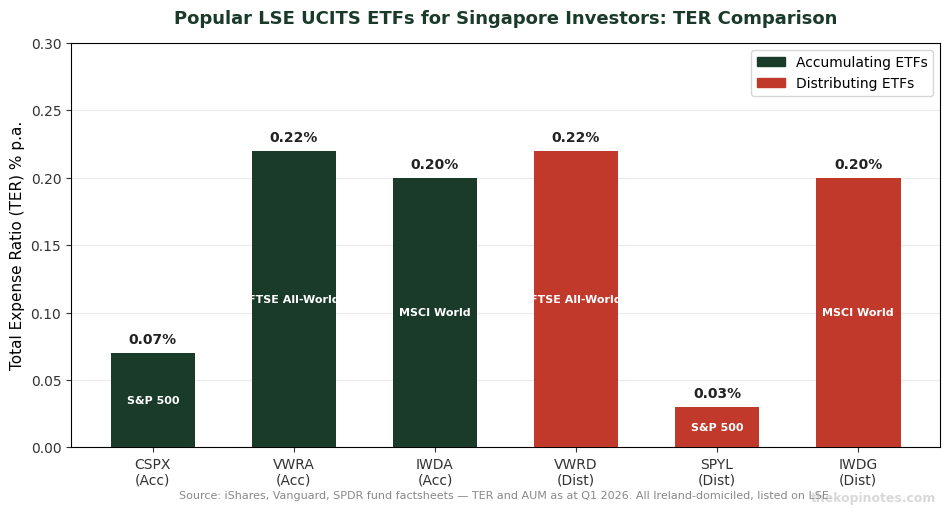
The following table covers the most widely held LSE-listed ETFs among Singapore investors, split by structure. All are Ireland-domiciled UCITS ETFs — which gives them the 15% withholding tax rate on US dividends (vs 30% for US-domiciled equivalents) and eliminates US estate tax exposure.
| Ticker | Full Name | Structure | Index | TER | AUM (approx.) |
|---|---|---|---|---|---|
| CSPX | iShares Core S&P 500 UCITS ETF | Accumulating | S&P 500 | 0.07% | ~USD 80B |
| VWRA | Vanguard FTSE All-World UCITS ETF USD Acc | Accumulating | FTSE All-World | 0.22% | ~USD 22B |
| IWDA | iShares Core MSCI World UCITS ETF Acc | Accumulating | MSCI World | 0.20% | ~USD 75B |
| VWRD | Vanguard FTSE All-World UCITS ETF USD Dist | Distributing | FTSE All-World | 0.22% | ~USD 5B |
| SPYL | SPDR Portfolio S&P 500 UCITS ETF | Distributing | S&P 500 | 0.03% | ~USD 8B |
| IWDG | iShares MSCI World UCITS ETF Dist | Distributing | MSCI World | 0.20% | ~USD 4B |
Source: iShares, Vanguard, SPDR fund factsheets — AUM and TER as at Q1 2026. All ETFs listed on the London Stock Exchange (LSE), Ireland-domiciled.
Notice that VWRA and VWRD are identical twins — same index (FTSE All-World), same TER (0.22%), same domicile (Ireland), same exchange (LSE). The only difference is what happens to dividends. This makes VWRA vs VWRD a perfect test case: for most Singapore investors building wealth, VWRA wins on compounding efficiency. For retirees drawing income, VWRD provides quarterly cash flow without requiring unit sales.
SPYL deserves special mention: its TER of 0.03% makes it the lowest-cost S&P 500 ETF on the LSE. However, it is distributing. For Singapore investors purely focused on minimising costs, SPYL can make sense — especially for larger portfolios where the 0.04% TER saving over CSPX is meaningful. On a SGD 500,000 portfolio, SPYL saves approximately SGD 200 per year in management fees. That said, the manual reinvestment friction and brokerage cost of reinvesting quarterly distributions often offsets this advantage for most retail investors.
If you are considering opening a brokerage account to invest in these ETFs, see our Syfe comparison (our Syfe referral code and sign-up bonus can give you a reduced fee period) or our FSMOne referral code for one of Singapore’s lowest-cost CPFIS-approved platforms.
A Worked SGD Example: 20-Year Compounding
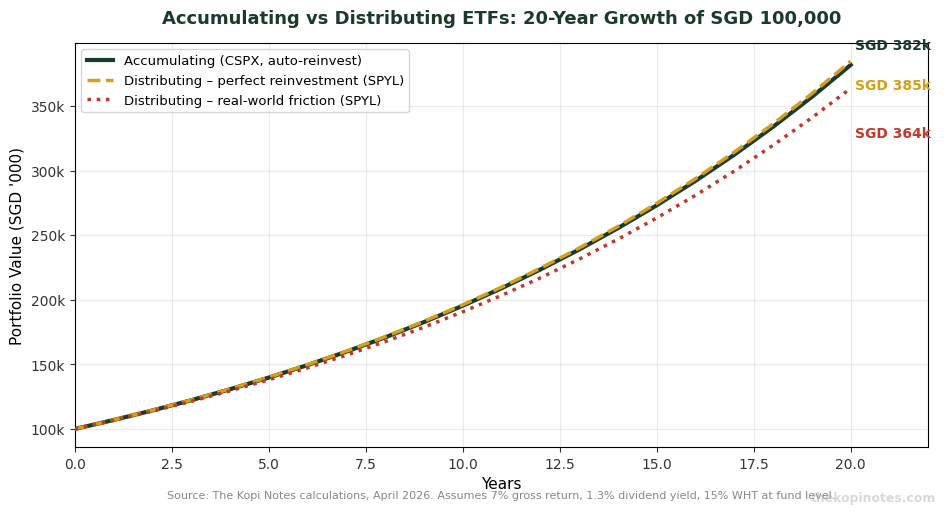
Let us run the numbers on a SGD 100,000 lump sum investment, assuming a 7% gross annual return and a 1.3% annual dividend yield built into that return. We compare three scenarios over 20 years, as at April 2026:
Scenario A — Accumulating ETF (CSPX, TER 0.07%): Dividends auto-reinvested. Net return after TER ≈ 6.93% p.a.
Scenario B — Distributing ETF, perfect reinvestment (SPYL, TER 0.03%): Quarterly distributions reinvested immediately, zero brokerage cost assumed. Net return after TER ≈ 6.97% p.a.
Scenario C — Distributing ETF, real-world reinvestment (SPYL, TER 0.03%): Quarterly distributions reinvested with one quarter’s delay (cash sitting idle) and SGD 5 brokerage commission per reinvestment. Effective drag ≈ 0.30% p.a. Net return ≈ 6.67% p.a.
| Scenario | ETF | After 10 years | After 20 years | Difference vs Acc. |
|---|---|---|---|---|
| A — Accumulating | CSPX (0.07%) | SGD 195,700 | SGD 382,900 | — |
| B — Dist. (perfect) | SPYL (0.03%) | SGD 196,400 | SGD 385,800 | +SGD 2,900 |
| C — Dist. (real-world) | SPYL (0.03%) | SGD 189,300 | SGD 358,400 | −SGD 24,500 |
Assumptions: SGD 100,000 lump sum, 7% gross annual return, 1.3% annual dividend yield embedded. WHT at 15% applied uniformly at fund level to dividend component for all scenarios. Brokerage costs in Scenario C: SGD 5/trade × 4 trades/year. Calculations as at April 2026 for illustration purposes only.
The key takeaway: in a perfect world where you reinvest distributions instantly at zero cost, SPYL (distributing, 0.03% TER) very slightly outperforms CSPX (accumulating, 0.07% TER) over 20 years — by about SGD 2,900 on a SGD 100,000 portfolio. In reality, the friction of manual reinvestment costs you SGD 24,500 compared to just holding the accumulating CSPX. The enemy of compounding is not fees — it is friction and delay.
Which Should Singapore Investors Choose?
Choose accumulating if:
- You are in the wealth-building phase and do not need regular cash from your investments
- You want fully automatic compounding without the need to manage quarterly payouts
- You invest via a Regular Savings Plan (RSP) or plan to dollar-cost average
- You are using your Supplementary Retirement Scheme (SRS) account — accumulating ETFs in SRS compound tax-sheltered until withdrawal
- Your portfolio is below SGD 500,000, where the TER difference between CSPX (0.07%) and SPYL (0.03%) is less than SGD 200/year and not worth the reinvestment friction
Choose distributing if:
- You are in or near retirement and need regular income from your portfolio without selling units
- You have a large portfolio (SGD 500,000+) where the TER advantage of SPYL over CSPX — SGD 200/year savings — justifies the reinvestment logistics
- You want psychological visibility over your investment returns (seeing dividends credited is motivating for some investors)
- You have a disciplined system to reinvest all distributions immediately and without missing a beat
For most Singapore investors in their 20s to 50s still accumulating assets, the answer is clear: hold CSPX or VWRA in an accumulating structure, keep costs low, and let the fund compound on autopilot. Only switch to a distributing ETF when your life stage demands regular cash flow.
Before making this decision, it is worth modelling your retirement trajectory using our Singapore retirement planning calculator to understand exactly how much monthly income your portfolio will need to generate in retirement.
Frequently Asked Questions
What is the difference between accumulating and distributing ETFs?
Accumulating ETFs automatically reinvest dividends back into the fund, raising the NAV per unit over time. Distributing ETFs pay dividends out as cash to investors on a regular schedule — typically quarterly or semi-annually. Both hold identical underlying portfolios; the only difference is what happens to dividend income generated by the stocks inside the fund.
Is CSPX accumulating or distributing?
CSPX (iShares Core S&P 500 UCITS ETF) is an accumulating ETF. Dividends from the S&P 500 companies held inside CSPX are automatically reinvested within the fund, raising the share price rather than being paid out to investors. This is one reason CSPX is popular with Singapore investors who want long-term compounding without managing quarterly cash distributions.
Is VWRA accumulating or distributing?
VWRA (Vanguard FTSE All-World UCITS ETF USD Acc) is an accumulating ETF — the “Acc” in the ticker name confirms this. Its distributing counterpart is VWRD (Vanguard FTSE All-World UCITS ETF USD Dist). Both track the same FTSE All-World index at the same 0.22% TER and are listed on the London Stock Exchange. For Singapore investors building wealth, VWRA is generally the preferred choice; for those seeking income, VWRD pays quarterly dividends of approximately 1.5–1.8% yield per year.
Do Singapore investors pay tax on distributing ETF dividends?
No. Singapore does not impose dividend income tax at the individual investor level. When a distributing ETF like VWRD or SPYL pays a quarterly distribution into your brokerage account, you owe nothing to IRAS. This is unlike the United Kingdom or Australia, where dividend distributions from ETFs can trigger income tax bills. However, the ETF itself does pay 15% withholding tax to the US IRS on dividends received from US companies — this applies equally to both accumulating and distributing ETFs domiciled in Ireland.
Can I buy accumulating ETFs with CPF or SRS funds?
LSE-listed ETFs like CSPX and VWRA are not approved under the CPF Investment Scheme (CPFIS), so you cannot buy them with CPF OA or SA funds. However, they are compatible with the Supplementary Retirement Scheme (SRS) — you can buy CSPX or VWRA through SRS-eligible brokers such as Endowus, Syfe, FSMOne, or DBS Vickers. Using an accumulating ETF inside an SRS account is particularly efficient: dividends compound tax-deferred, and withdrawals in retirement are only 50% taxable at your then-applicable marginal rate.
Which is better for retirement income — accumulating or distributing ETFs?
For the income drawdown phase of retirement, distributing ETFs have a practical advantage: they generate regular cash flow without requiring you to sell units. With VWRD, for example, you receive quarterly dividends automatically — useful if you want to match investment income to monthly expenses. Accumulating ETFs (like VWRA) require you to manually sell units periodically to generate income, which involves brokerage costs and timing decisions. That said, both approaches are viable in Singapore — there is no tax penalty for selling accumulating ETF units to fund living expenses, since Singapore has no capital gains tax.
Ready to Start Investing in Accumulating ETFs?
Open a brokerage account and buy your first accumulating ETF today. Use our referral links for exclusive sign-up bonuses.
This article was researched with the help of AI. While we strive to keep all information accurate and up to date, there may be errors. If you notice any discrepancies, please contact us.