
Currency Hedged vs Unhedged ETF Calculator Singapore 2026
See exactly how USD/SGD swings affect your CSPX, VWRA or IWDA returns — free calculator with real-time results in SGD.
Your Investment Scenario
—
Illustrative only, not financial advice. Assumes constant annual return, currency movement and hedging cost — actual markets are volatile year to year.
Understanding Currency Hedging for Singapore ETF Investors
Most Singapore investors building a globally diversified portfolio end up buying USD-denominated, Ireland-domiciled UCITS ETFs like CSPX (S&P 500), VWRA (world equities) or IWDA (developed markets) through brokers such as Endowus, Syfe, FSMOne or Interactive Brokers. These funds report their net asset value in USD, so every dollar of investment return is automatically bundled with however the Singapore dollar happens to move against the US dollar over your holding period. According to MAS exchange rate data, USD/SGD has traded in a wide band over the past decade — roughly 1.28 to 1.45 — which means currency alone has added or subtracted several percentage points from an unhedged investor’s annual return in any given year, independent of how the underlying stock market performed. This calculator isolates that currency effect from the asset return, then layers on the realistic cost of paying a fund manager to hedge it away, so you can see the actual SGD trade-off rather than relying on a gut feeling. Data as at Q1 2026 unless noted.
Not financial advice. All figures are for educational reference only and assume simplified, constant annual rates — real markets do not move in a straight line.
Why Most SGX-Listed ETFs Are Unhedged
CSPX and VWRA, the two most widely held US/global equity ETFs among Singapore retail investors, are both USD share classes with no SGD-hedged SGX-listed alternative. IWDA, the LSE-listed sibling many investors buy through Interactive Brokers, is the same story. A handful of SGD-hedged unit trusts are distributed through bank platforms and robo-advisors, but the low-cost, highly liquid ETF ecosystem that Singapore investors gravitate towards is overwhelmingly unhedged by default — which is exactly why understanding the currency impact matters more here than in markets with a wider hedged-ETF selection.
The Real Cost of Hedging
Currency hedging is not free. A fund (or an investor using forward contracts) pays a cost driven mainly by the interest rate differential between USD and SGD, plus roll and transaction costs on the hedging instruments themselves. In practice this drag has typically run around 0.1%–0.5% per year for the USD/SGD pair in stable periods, though it can spike higher when rate differentials widen or markets turn volatile. That ongoing cost is the price of certainty — it removes currency swings in both directions, good and bad.
How to Use This Currency Hedging Calculator
- Investment Amount: Enter the SGD amount you plan to invest in the ETF or fund.
- Investment Horizon: Drag the slider to your expected holding period, from 1 to 30 years.
- Expected Annual Return: Enter your assumed annual return of the underlying asset (e.g. 7% for a globally diversified equity fund), before any currency effect.
- Expected Annual USD Movement vs SGD: Drag the slider to reflect whether you expect the US dollar to strengthen (positive) or weaken (negative) against the Singapore dollar on average, per year, over your horizon.
- Annual Hedging Cost: Enter the yearly drag a hedged share class would cost you — 0.1%–0.5% is a realistic starting range.
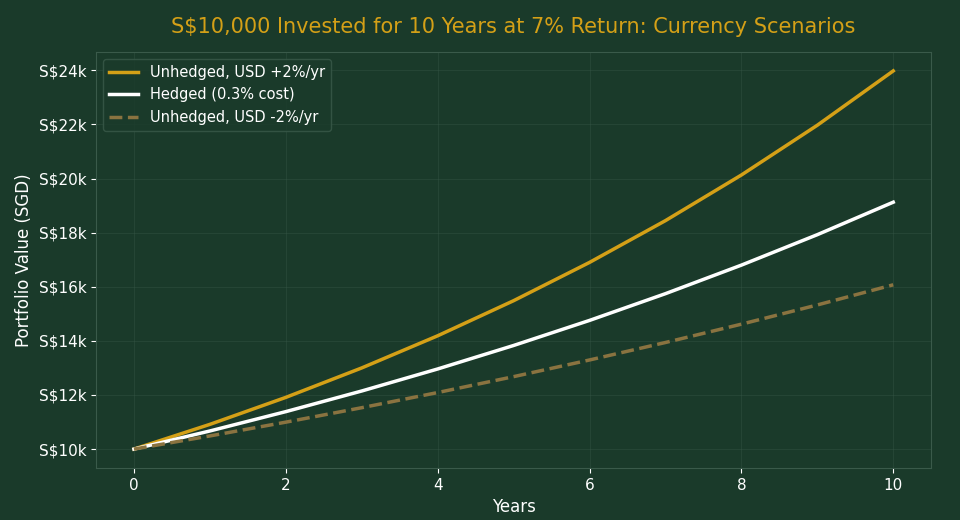
The calculator instantly shows your projected unhedged and hedged ending values in SGD, the total difference, and how much of the unhedged outcome came purely from currency movement — plus a year-by-year chart of both paths.
Pro tip: Once you have a return assumption from this tool, plug it into our DCA Investment Calculator to model regular monthly investing into the same ETF instead of a lump sum.
Contents — Click to Expand
- What Are Currency-Hedged and Unhedged ETFs?
- How Currency Hedging Works: The Maths Behind the Hedge
- Hedged vs Unhedged: Historical USD/SGD Impact in Singapore
- Best Platforms to Buy CSPX, VWRA & IWDA in Singapore
- CPF, SRS and the Currency Question for Singapore Investors
- Currency Hedging as Part of Your Retirement Plan
- Frequently Asked Questions
What Are Currency-Hedged and Unhedged ETFs?
An unhedged ETF simply holds the underlying stocks in their local currency (usually USD for global equity funds) and lets your SGD return move with whatever the USD/SGD exchange rate does over your holding period — CSPX, VWRA and IWDA all work this way. A currency-hedged share class uses forward contracts to offset most of that exchange-rate exposure, so your return more closely tracks the fund’s local-currency performance regardless of what the US dollar does against the Singapore dollar. Neither approach is inherently “better” — hedging removes a source of volatility and uncertainty, but it comes at an ongoing cost and also removes any upside if the foreign currency happens to appreciate over your holding period. The right choice depends on your view on the currency, your time horizon, and how much currency volatility you’re comfortable riding out.
How Currency Hedging Works: The Maths Behind the Hedge
For an unhedged fund, your SGD ending value is approximately Principal × (1 + asset return)years × (1 + USD/SGD movement)years — the asset return and the currency return compound independently and multiply together. For a hedged fund, the currency term drops out entirely, but a hedging cost (c) is subtracted from the return each year: Principal × (1 + asset return − c)years. So if you expect a 7% annual return from VWRA, a 0.3% annual hedging drag, and no net currency movement over 10 years, the hedged and unhedged outcomes are nearly identical (the hedged version trails slightly by the cumulative cost). But the moment you introduce a real currency view — say the US dollar strengthens 2% a year against SGD on average — the unhedged path pulls ahead by a wide margin, and the reverse is true if the US dollar weakens.
Hedged vs Unhedged: Historical USD/SGD Impact in Singapore
Over the past decade, USD/SGD has ranged roughly between 1.28 and 1.45, with the pair generally trending weaker for the US dollar in the years after 2022 before stabilising in the 1.30–1.35 region in early {YEAR}. An investor who bought VWRA in a period when the US dollar subsequently strengthened would have seen an unhedged return meaningfully higher than the fund’s USD-denominated performance alone; an investor buying just before a US dollar weakening phase would have seen the opposite. Because nobody can reliably predict multi-year currency direction, most long-term Singapore investors treat the currency component as a source of extra volatility to be diversified away with time, rather than something to actively bet on — which is one reason unhedged, low-cost ETFs remain the default choice for the majority of local retail portfolios.
| Scenario (10-year horizon) | Unhedged Result | Hedged Result |
|---|---|---|
| USD flat vs SGD | Slightly ahead (no hedging cost) | Slightly behind (pays hedging cost) |
| USD strengthens | Wins by a wide margin | Misses the currency upside |
| USD weakens | Loses ground to currency | Protected from the downside |
Best Platforms to Buy CSPX, VWRA & IWDA in Singapore
For SGX-listed ETFs like CSPX and VWRA, most Singapore brokerages offer access, but cost and CPF/SRS compatibility vary widely. Endowus is one of the few platforms that lets you invest CPF-OA and SRS funds directly into globally diversified unhedged equity funds, which matters if you’re trying to keep your entire retirement portfolio in one currency framework. FSMOne offers a wide selection of both ETFs and unit trusts, including some funds with hedged and unhedged tranches of the same underlying strategy, useful if you want to compare the two side by side within a single platform. For IWDA specifically, which is LSE-listed rather than SGX-listed, most Singapore investors use an international brokerage such as Interactive Brokers to access it directly in USD.
CPF, SRS and the Currency Question for Singapore Investors
If you’re investing CPF-OA or SRS funds, the currency-hedging decision carries slightly more weight because these are typically long-horizon, retirement-earmarked monies you may be less willing to actively manage or rebalance around currency swings. In practice, the CPF Investment Scheme and SRS-approved fund lists available through Endowus and FSMOne are dominated by unhedged share classes, so most CPF/SRS investors are unhedged by default unless they specifically seek out one of the smaller number of SGD-hedged unit trusts on offer. There’s no CPF or SRS rule against choosing a hedged fund if one is available on your platform of choice — the decision is purely about your currency view and cost tolerance, not a regulatory constraint.
Currency Hedging as Part of Your Retirement Plan
If your long-term goal is to build a passive income stream from a globally diversified portfolio, currency volatility mainly matters in the years close to when you plan to start drawing down — a weak USD/SGD rate right before retirement can meaningfully dent the SGD value of your nest egg at the worst possible time, a form of “currency sequence risk” that sits alongside the more familiar sequence-of-returns risk. Many investors address this not by hedging the entire portfolio for decades, but by shifting a portion into hedged or SGD-denominated assets in the final 3–5 years before retirement. Use our Retirement Planning Calculator to model your overall retirement number, and see our Passive Income Guide for how S-REITs and SGD-denominated income assets can complement a globally diversified, currency-exposed equity core.
Frequently Asked Questions
What is a good hedging cost assumption to use for USD/SGD in Singapore in 2026?
A realistic starting range is 0.1% to 0.5% per year for USD/SGD hedging in stable rate environments — this covers the interest rate differential and transaction costs. It can rise temporarily when interest rate gaps widen or markets are volatile, so stress-test your plan with a higher figure like 0.6%–0.8% if you want a conservative estimate.
Is currency hedging a good idea for Singapore investors buying US or global ETFs?
For most long-term Singapore investors with a 10+ year horizon, staying unhedged is the more common default because currency effects tend to average out over long periods and unhedged ETFs (CSPX, VWRA, IWDA) are cheaper and more liquid. Hedging can make more sense for shorter horizons, near-retirement portfolios, or investors with a strong directional view on USD/SGD.
How much difference would hedging have made if I invested S$10,000 in a global ETF over 10 years?
It depends entirely on how USD/SGD actually moved over your specific 10 years — use the calculator above with your own return and currency assumptions to see the SGD difference. As a rough illustration, a 7% annual return with a 2% annual USD appreciation and a 0.3% hedging cost produces a gap of several thousand SGD in favour of staying unhedged over a 10-year, S$10,000 investment.
What is the difference between a hedged and an unhedged share class in Singapore?
An unhedged share class (like CSPX or VWRA) lets your SGD return move with both the underlying asset’s performance and the USD/SGD exchange rate. A hedged share class uses forward contracts to strip out most of the currency movement, so your return tracks the underlying asset’s local-currency performance more closely, minus an ongoing hedging cost.
How much of my portfolio should I currency-hedge in Singapore?
There’s no universal rule, but a common approach is to keep long-horizon growth assets unhedged and consider hedging a larger portion of the assets you plan to draw down within the next 3–5 years, when a sudden currency swing would have the biggest practical impact on your SGD spending power.
Which Singapore platform lets me buy hedged or unhedged ETFs and funds?
Endowus and FSMOne both offer access to globally diversified unhedged ETFs and unit trusts, with FSMOne offering a wider range of unit trusts that include some hedged share classes. For SGX- or LSE-listed ETFs directly, brokers like Interactive Brokers, Endowus and FSMOne all provide access to the standard unhedged CSPX, VWRA and IWDA share classes.
Can I use CPF-OA or SRS funds to invest in currency-hedged funds in Singapore?
Yes — there’s no CPF or SRS restriction specifically around currency hedging. Whether a hedged option is available depends on your platform’s approved fund list; most CPF Investment Scheme and SRS-approved options are unhedged share classes, but a smaller number of hedged unit trusts are also available through platforms like FSMOne.
What USD/SGD movement rate should I use in this calculator?
If you have no strong view, use 0% (flat) as your base case and then test the calculator at +2% and -2% to see the range of outcomes — this shows you how sensitive your specific investment amount and horizon are to currency swings, without requiring you to predict the exchange rate.
How does currency hedging affect my retirement income if I hold US-denominated ETFs?
If you plan to convert your US-denominated ETF holdings to SGD for retirement spending, an unfavourable USD/SGD move in the years just before or during drawdown can reduce your effective retirement income even if the underlying US market performed well. This is why some investors shift a portion of their portfolio toward hedged or SGD-denominated assets as they approach their drawdown phase.
Turn Currency Insight Into a Full Investment Plan
Use our free tools and referral bonuses to put your knowledge into action.