
Savings Account Bonus Interest Calculator Singapore 2026
Compare DBS Multiplier, OCBC 360 and UOB One side by side — free calculator with real-time results in SGD.
Your Cash Balance
DBS Multiplier
OCBC 360
UOB One
Card spend is always required as a baseline for any bonus.
Best pick: —
Estimates only, based on each bank's published rate structure as at Jul 2026 (DBS verified 12 Jun 2026, OCBC effective 1 May 2026, UOB current 2026 structure). Banks revise rates and qualifying rules often — always confirm on the issuer's own page before acting. Not financial advice.
Understanding Bonus Interest Savings Accounts for Singapore Investors
Every major Singapore bank now runs a “bonus interest” savings account — DBS Multiplier, OCBC 360 and UOB One are the three most searched. Instead of one flat rate, each pays a base rate of just 0.05% p.a., then layers on bonus interest when you credit your salary and hit spending, saving, insurance or investment criteria each month. The catch is that every bank structures its bonus grid differently, so the “best” account depends entirely on your own income, spending and balance — not on whichever headline rate is being advertised that month.
Not financial advice. All figures are for educational reference only. Rates as at Jul 2026: DBS Multiplier verified 12 Jun 2026, OCBC 360 effective 1 May 2026, UOB One current 2026 structure. Banks revise these grids often — always confirm the latest terms on the issuer’s own page.
Why the Headline Rate Rarely Matches Reality
DBS advertises “up to 4.10% p.a.”, OCBC “up to 4.45% p.a.” — but both require salary credit plus every other bonus category (home loan, insurance, investment) at a high monthly transaction volume. Most working adults who only credit salary and spend on a card realistically land closer to 1.5–2.5% p.a., which is still meaningfully better than the 0.05% base rate almost every current account otherwise pays.
What This Calculator Solves
Rather than reading three separate rate tables and doing the maths by hand, this tool lets you tick the categories you actually qualify for and instantly compares your real effective rate and annual interest across all three banks side by side, so you can see which account suits your specific salary-and-spend profile.
How to Use This Bonus Interest Calculator
- Enter your balance: Type or slide to the SGD amount you plan to park in a savings account.
- Tick what you qualify for at each bank: Salary credit, card spend, home loan, insurance or investment — each bank has its own list of categories.
- Set your DBS transaction band: DBS Multiplier’s rate also depends on your total monthly eligible transaction volume, not just which categories you tick.
- Read the comparison: The dark green results panel updates instantly with your effective rate and estimated annual interest for each bank, plus a “best pick” call-out.
The chart underneath the results panel plots the same three annual-interest figures so you can see the dollar gap at a glance, not just the percentage difference.
Pro tip: Combine this with our Emergency Fund Calculator to decide how much cash actually needs to sit in an instant-access bonus account versus locked up in fixed deposits or T-bills.
What Are Bonus Interest Savings Accounts?
A bonus interest savings account pays a low base rate (0.05% p.a. on all three accounts in this calculator) plus additional “bonus” interest layered on top when you meet specific monthly criteria. DBS Multiplier, OCBC 360 and UOB One are Singapore’s three most-searched examples, each rewarding a mix of salary crediting, card spend, home loan instalments, insurance premiums and investment contributions. None of these accounts pay their advertised maximum rate automatically — the headline figure (4.10% for DBS, 4.45% for OCBC, 3.40% for UOB) only applies to the narrow slice of customers hitting every category at a high transaction volume, on a capped balance that’s usually S$75,000–S$150,000.
How the Interest Grids Actually Work
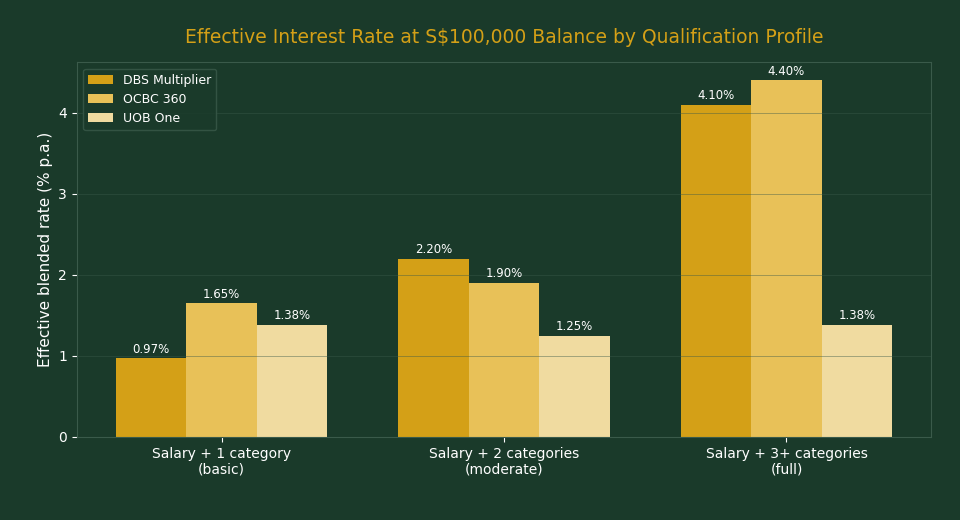
Each bank effectively runs a lookup table, not a simple formula. DBS Multiplier reads two axes at once: how many bonus categories you meet (income plus 1, 2, or 3-or-more), and your total monthly eligible transaction volume (S$500–<S$15,000 / S$15,000–<S$30,000 / S$30,000+). The same categories met at a lower transaction volume can land two full percentage points below the top cell. UOB One instead builds its rate as a waterfall of balance tiers — the first S$75,000 always earns a base bonus rate once you spend S$500+/month, with higher rates unlocked on the next S$50,000 and S$25,000 only if you add 3 GIRO transactions or salary credit. OCBC 360 is the most additive of the three: each of its five categories (salary, save, spend, insure, invest) contributes its own percentage on the first S$75,000 and next S$25,000, so your effective rate is genuinely the sum of whichever categories you tick.
DBS Multiplier vs OCBC 360 vs UOB One in Singapore
| Account | Base Rate | Published Max | Bonus Cap | Baseline Requirement |
|---|---|---|---|---|
| DBS Multiplier | 0.05% p.a. | 4.10% p.a. | S$50,000–S$100,000 | Income credit (mandatory) |
| OCBC 360 | 0.05% p.a. | 4.45% p.a. | S$100,000 | None mandatory — each category adds independently |
| UOB One | 0.05% p.a. | 3.40% p.a. | S$150,000 | S$500+/month card spend (mandatory) |
For a typical working adult who only credits salary and spends on one card — no home loan, insurance or investment product with the bank — OCBC 360’s additive structure usually wins at smaller balances (its Salary + Spend combo already reaches ~1.90% p.a. on the calculator above), while DBS Multiplier can overtake it once you add a second or third category and push S$30,000+ of monthly transactions through the account. UOB One’s baseline S$500 card-spend requirement makes it the easiest to qualify for at a modest 0.65–1.00% p.a., but its ceiling needs salary credit to really compete.
Simpler High-Yield Alternatives If You Don’t Want to Jump Through Hoops
Not everyone wants to juggle salary crediting, card spend minimums and category counting every single month. If that describes you, Singapore’s newer digital banks and cash-management funds are worth a look. GXS Bank and MariBank both pay a flat interest rate on savings with no salary crediting or spending hoops required, which makes the effective rate far more predictable month to month. On the investment side, Endowus Cash Smart and Syfe Cash+ route your cash into short-duration money market funds instead of a savings account, which can be competitive with the realistic (not headline) rates on DBS, OCBC and UOB once you factor in how few people actually hit every bonus category every month. For the exact current tiers straight from the source, see the official DBS Multiplier, OCBC 360 and UOB One pages.
Deposit Insurance, CPF and Tax: What Singapore Savers Need to Know
DBS, OCBC and UOB are all full banks insured under the Singapore Deposit Insurance Corporation (SDIC) scheme, which protects up to S$100,000 per depositor per Scheme member bank — if you’re spreading a large emergency fund across several of these accounts to chase bonus rates, keep each bank’s balance under that cap for full protection. None of the three accounts in this calculator accept CPF Ordinary or Special Account funds directly; CPF savings can only be invested through CPFIS-approved products via the CPF Investment Scheme, which is a separate track from these cash savings accounts. Interest earned on all three accounts is not taxable for individuals in Singapore, since Singapore does not tax personal savings or deposit interest.
Where This Fits Your Retirement and Passive Income Plan
Bonus interest savings accounts are best treated as the “cash bucket” of a broader plan — typically 3–6 months of expenses for emergencies, plus any short-term savings goals, rather than a long-term wealth-building vehicle. Once your cash buffer is covered, additional savings usually work harder in Singapore Savings Bonds, T-bills, or a diversified S-REIT and equity portfolio targeting genuine passive income. Our Retirement Planning Calculator and Passive Income Guide can help you work out how much should stay liquid in accounts like these versus how much should be deployed for long-term growth. If you’re deciding between locking up cash and keeping it flexible in a bonus account, our T-Bill, SSB & Fixed Deposit Comparison Calculator and Fixed Deposit Interest Calculator are the natural next stops.
Frequently Asked Questions
What is a good bonus interest rate for a savings account in Singapore in 2026?
Anything above 1.5% p.a. on your full balance is solid for a working adult who only credits salary and spends on one card, since the base rate on all three accounts is just 0.05% p.a. Hitting 3%+ p.a. typically means adding a second or third bonus category such as insurance, investment or a home loan with the same bank.
Is chasing multiple bank bonus interest accounts worth the effort in Singapore?
It depends on your balance size and how naturally the criteria fit your existing spending. On a S$20,000–S$50,000 emergency fund, the dollar difference between accounts is often S$200–S$800 a year — worth doing if it’s a one-time GIRO/salary crediting setup, less worth it if it means opening and closely monitoring three separate accounts every month.
How much would I earn with S$50,000 on DBS Multiplier meeting salary plus one category?
At the S$15,000–S$30,000 monthly transaction band, income plus one category pays 1.90% p.a. on the first S$50,000, which works out to about S$950 a year. Try the calculator above with your own transaction volume band to see the exact figure.
What is the real difference between DBS Multiplier, OCBC 360 and UOB One?
DBS Multiplier’s rate depends on both category count and transaction volume together, OCBC 360 simply adds up whichever of its five categories you qualify for, and UOB One is a balance-tier waterfall that only needs a S$500 card spend to start earning any bonus at all. Your own income and spending pattern — not the headline maximum — determines which is actually best for you.
How much of my cash should I keep in a bonus interest account versus T-bills or SSBs in Singapore?
A common rule of thumb is to keep 3–6 months of expenses in an instant-access bonus account for liquidity, and consider T-bills, Singapore Savings Bonds or fixed deposits for money you’re confident you won’t need for several months, since those instruments often pay a comparable rate without needing to hit monthly spending criteria.
Which Singapore bank account currently gives the highest effective interest rate?
There is no single answer — it depends entirely on your balance and which categories you meet. Someone with a home loan, insurance and investment product at DBS can out-earn someone using only OCBC 360’s salary and spend bonuses, and vice versa. Use the calculator above with your own inputs rather than relying on a bank’s advertised maximum.
Can I use my CPF savings in DBS Multiplier, OCBC 360 or UOB One?
No. These are cash savings accounts and do not accept CPF Ordinary Account or Special Account funds directly. CPF savings can only be invested through CPFIS-approved unit trusts, fixed deposits, Singapore Government Securities and other approved instruments via the CPF Investment Scheme.
What interest rate assumptions should I use in this calculator?
Use the categories and transaction bands you can realistically sustain every month, not the ones you might hit occasionally — missing a single month’s criteria typically drops your entire balance back to the 0.05% p.a. base rate for that month on all three accounts. The default selections in the calculator reflect a common salary-plus-one-category profile as a starting point.
How does the Singapore Deposit Insurance Scheme protect my savings in these accounts?
DBS, OCBC and UOB are all Deposit Insurance Scheme member banks, meaning the Singapore Deposit Insurance Corporation (SDIC) insures up to S$100,000 of your deposits per depositor per bank. If your combined cash savings exceed that per-bank cap, splitting the excess across additional insured banks keeps the full amount protected.
Put Your Cash to Work Smarter
Use our free tools and referral bonuses to optimise every dollar of your savings and investments.