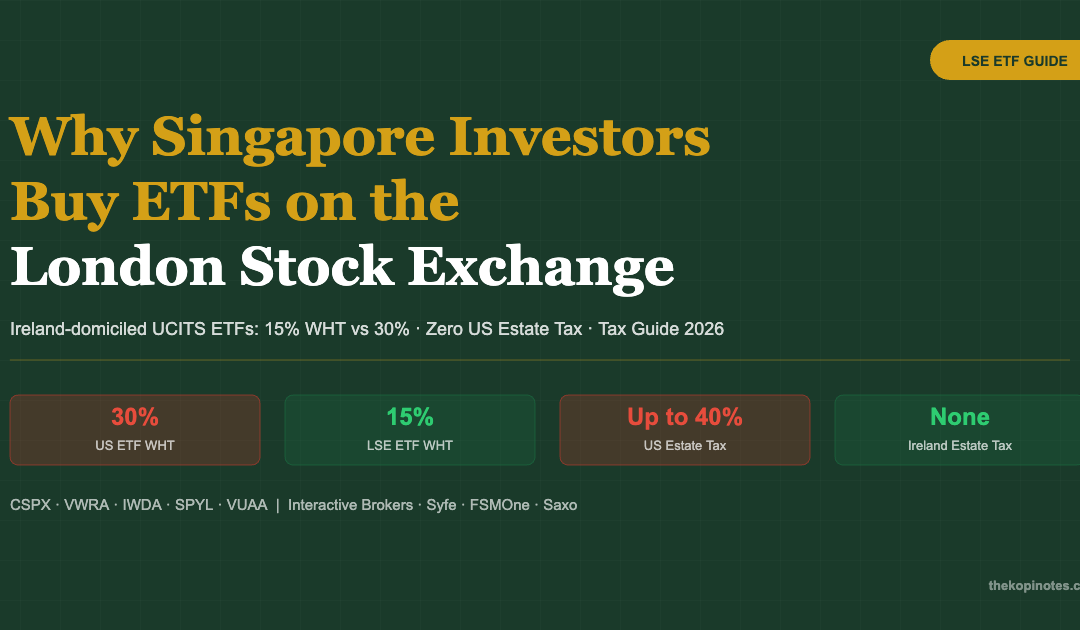
Why Singapore Investors Buy ETFs on the London Stock Exchange: The Full Tax Guide (2026)
How Ireland-domiciled UCITS ETFs save Singapore investors thousands in withholding tax and eliminate US estate tax risk — with worked SGD examples and step-by-step broker guidance.
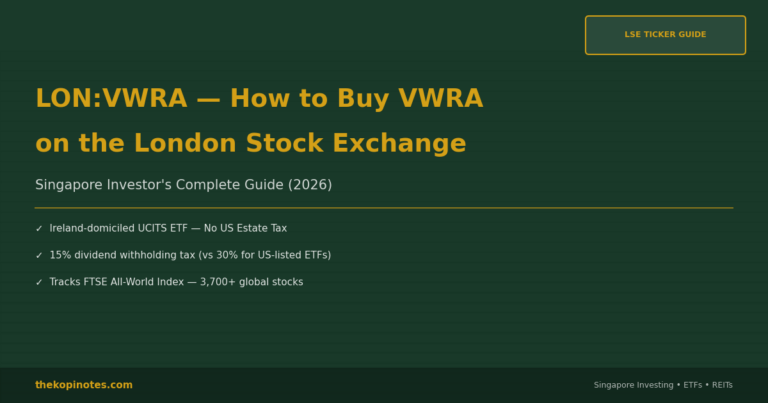
Singapore investors buy ETFs on the London Stock Exchange — not the New York Stock Exchange — because Ireland-domiciled UCITS ETFs pay only 15% withholding tax on US dividends, versus 30% for US-listed equivalents. Combined with zero US estate tax exposure on holdings of any size, this structural tax advantage means LSE-listed funds like CSPX and VWRA typically deliver higher net returns for Singapore residents than their American counterparts.
Not financial advice. All figures are for educational reference only. Data as at April 2026 unless otherwise noted.
Table of Contents
Contents — Click to expand
- The Problem: Which Exchange Should Singapore Investors Use?
- How Ireland-Domiciled ETFs Cut Your Withholding Tax Bill
- The Withholding Tax Maths: Real SGD Examples
- US Estate Tax: The Hidden Risk Most Singapore Investors Miss
- Singapore Tax Context: Why LSE ETFs Fit Perfectly
- LSE vs NYSE vs SGX: Side-by-Side Comparison
- Top LSE ETFs for Singapore Investors (2026)
- What Singapore Investors Should Do: Step-by-Step
- Frequently Asked Questions
The Problem: Which Exchange Should Singapore Investors Use?
When a Singapore investor decides to buy a global or US equity ETF for the first time, they quickly encounter a confusing array of choices. The same underlying index — say, the S&P 500 — can be accessed through a dozen different fund products listed on multiple exchanges. You can buy SPY or VOO on the New York Stock Exchange (NYSE), CSPX on the London Stock Exchange (LSE), or ES3 on the Singapore Exchange (SGX). The expense ratios, fund names, and prices all look slightly different, and it is far from obvious which is the better choice.
Most Singapore investors who start with a US brokerage or who have watched American finance content end up defaulting to NYSE-listed funds like SPY, IVV, or VOO. These are excellent funds with low costs and enormous liquidity. But for a Singapore resident who is not a US citizen or permanent resident, buying US-domiciled ETFs creates two significant structural disadvantages that slowly erode returns over time: higher dividend withholding tax and US estate tax exposure.
The London Stock Exchange, specifically through its UCITS (Undertakings for Collective Investment in Transferable Securities) segment, offers a far better home for the same index exposure. Ireland-domiciled UCITS ETFs — funds structured in Ireland and listed on the LSE — benefit from the Ireland-United States double taxation treaty, which reduces US dividend withholding tax from 30% to 15%. They are also structurally outside the reach of US estate tax, which can apply to non-US persons holding US-situs assets above USD 60,000 at the time of death.
Understanding this difference is arguably the single most impactful piece of tax optimisation available to the average Singapore retail investor. It requires no complex financial planning, no specialist advice, and no change to your investment strategy — just buying the LSE-listed version of the fund instead of the NYSE-listed one.
How Ireland-Domiciled ETFs Cut Your Withholding Tax Bill
To understand why Ireland matters, you need to understand how US withholding tax (WHT) works for foreign investors. When a US company pays a dividend to a non-US shareholder, the US Internal Revenue Service (IRS) requires that tax is withheld at source before the dividend leaves the country. For most foreign investors with no tax treaty relationship with the US, this rate is 30%.
Ireland, however, has a comprehensive double taxation treaty with the United States that reduces this withholding rate to 15% for Irish-resident entities such as UCITS funds. When iShares structures a fund like the iShares Core S&P 500 UCITS ETF (CSPX) as an Irish company holding US equities, that fund pays only 15% WHT on dividends received from US companies — not 30%. This is a structural advantage built into the fund itself, not something the individual investor has to claim or arrange.
Singapore has its own tax treaty with the US, but it reduces the rate only to 15% for specific categories of income, and Singapore-resident individuals holding US stocks or US-domiciled ETFs directly still typically face 30% WHT because the treaty does not apply in the same way to investment fund structures. By contrast, Irish UCITS funds benefit from the treaty rate automatically.
For an accumulating ETF like CSPX, the dividends are never actually distributed to the investor — they are reinvested directly inside the fund. The 15% WHT is still paid by the fund on the underlying US dividends, but the investor receives the full compound growth of the remaining 85% of each dividend. With a US-domiciled accumulating ETF, the equivalent tax drag would be 30% on every dividend before reinvestment.
For distributing ETFs — those that pay out dividends to investors — the same principle applies. The fund pays 15% WHT on US dividends before distributing to investors. Singapore investors receiving those distributions then pay no additional tax in Singapore, because Singapore does not levy personal income tax on dividends from foreign funds for retail investors. This means the after-tax income is higher than it would be from a comparable US-domiciled distributing fund.
The Withholding Tax Maths: Real SGD Examples
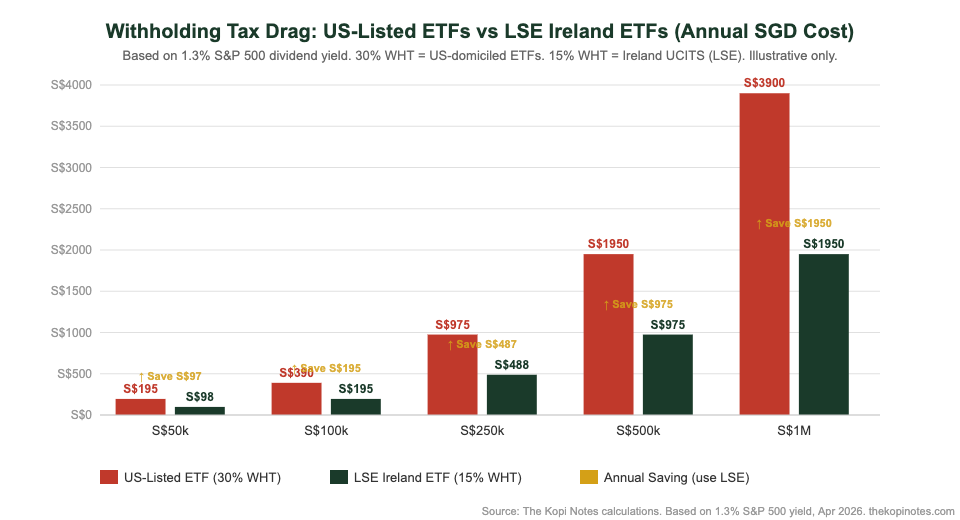
Let us put some Singapore dollar numbers to this. The S&P 500 currently yields approximately 1.3% in dividends per year (as at April 2026). On a SGD 100,000 S&P 500 ETF portfolio, that represents about SGD 1,300 in gross dividends annually.
| Portfolio Size | Annual Dividends (1.3% yield) | WHT at 30% (US ETF) | WHT at 15% (LSE ETF) | Annual Saving |
|---|---|---|---|---|
| SGD 50,000 | SGD 650 | SGD 195 | SGD 98 | SGD 97 |
| SGD 100,000 | SGD 1,300 | SGD 390 | SGD 195 | SGD 195 |
| SGD 250,000 | SGD 3,250 | SGD 975 | SGD 488 | SGD 488 |
| SGD 500,000 | SGD 6,500 | SGD 1,950 | SGD 975 | SGD 975 |
| SGD 1,000,000 | SGD 13,000 | SGD 3,900 | SGD 1,950 | SGD 1,950 |
Source: S&P 500 dividend yield ~1.3% as at April 2026. WHT calculations based on Ireland-US tax treaty (15%) vs standard US non-resident rate (30%). For illustrative purposes only.
The saving of SGD 195 per year on a SGD 100,000 portfolio does not sound dramatic in isolation. But consider the compounding effect: over 20 years, that same SGD 195 annual saving — reinvested at a 7% annual return — becomes approximately SGD 8,400 in additional terminal wealth per SGD 100,000 invested. For a retirement-scale portfolio of SGD 500,000, the compounded difference exceeds SGD 42,000. This is money that exists simply because you chose the LSE-listed version of the same fund.
It is also worth noting that the WHT drag is not the only cost difference. Many Singapore investors combine ETF investing with a passive income Singapore strategy that includes S-REITs and dividend stocks. When you add up all the tax-efficient structures available — LSE ETFs, S-REITs with no withholding tax for Singapore residents, SSBs, and CPF top-ups — the overall picture is considerably more favourable than investing through US platforms with US-domiciled products.
US Estate Tax: The Hidden Risk Most Singapore Investors Miss
Withholding tax is the primary day-to-day consideration, but US estate tax is the bigger existential risk for larger portfolios. Most Singapore investors are unaware of it until they seek financial planning advice for the first time.
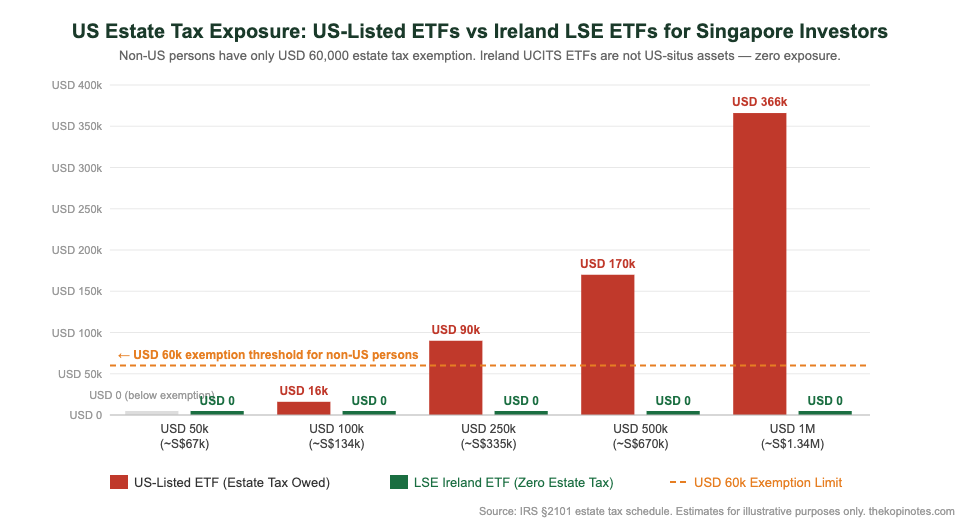
The United States imposes a federal estate tax on “US-situs assets” — assets that are legally situated in the US — held by non-US persons at the time of their death. Shares in US companies and units in US-domiciled ETFs are classified as US-situs assets. The critical threshold for non-US persons is USD 60,000: non-resident aliens receive an estate tax exemption of only USD 60,000, compared to the USD 13.61 million exemption available to US citizens and residents in 2026.
Above USD 60,000, the effective US estate tax rate for non-US persons rises steeply. The first USD 10,000 above the threshold is taxed at 18%, rising progressively to 40% on amounts above USD 1 million. Singapore has no estate tax treaty with the United States that would modify these rates. This means a Singapore investor with USD 500,000 in US-domiciled ETFs (roughly SGD 670,000) could face an estate tax bill of approximately USD 170,000 — paid to the IRS, not the Singapore government — on death.
| Scenario | US ETF Holding (USD) | US Estate Tax (Approx.) | LSE/Ireland ETF Estate Tax |
|---|---|---|---|
| Below threshold | USD 50,000 | USD 0 (below USD 60k exemption) | USD 0 |
| Small portfolio | USD 100,000 | ~USD 16,000 | USD 0 |
| Mid portfolio | USD 500,000 | ~USD 170,000 | USD 0 |
| Large portfolio | USD 1,000,000 | ~USD 366,000 | USD 0 |
Source: IRS estate tax rate schedule (IRC §2001, §2101). Estimates for non-US persons using USD 60,000 exemption. As at April 2026. Not tax advice — consult a qualified adviser for your specific situation.
Ireland-domiciled ETFs are not US-situs assets. Units of an Irish UCITS fund are Irish securities, not US securities, even though the fund holds US equities internally. A Singapore investor who dies holding CSPX on the LSE does not have US estate tax exposure on those units. The underlying US stocks are owned by the Irish fund company, not by the individual investor directly.
This distinction is fundamental and explains why the LSE choice is not just about a few basis points of withholding tax — it is about protecting your estate from a foreign government’s tax claim that most Singapore investors would never anticipate.
Singapore Tax Context: Why LSE ETFs Fit Perfectly
Singapore’s domestic tax framework is uniquely accommodating for LSE ETF investing. There are three key pillars that make it work so well for local investors.
No capital gains tax. Singapore does not levy capital gains tax on the sale of investment assets. When a Singapore-resident investor sells their CSPX units at a profit after 10 or 20 years, the entire gain is tax-free. This is equally true for NYSE-listed ETFs, but it means there is no offsetting advantage to US-listed funds that could justify the higher WHT and estate tax exposure.
No personal income tax on foreign dividends for retail investors. Singapore individual investors receiving distributions from foreign funds — including distributing LSE ETFs like VWRD — do not pay personal income tax on those distributions in Singapore. Combined with the reduced 15% WHT already paid at the fund level, this means the effective total tax drag on distributions is just 15%, with nothing further owed to the Inland Revenue Authority of Singapore (IRAS).
SRS compatibility. LSE ETFs can be purchased through eligible brokerage accounts that accept SRS (Supplementary Retirement Scheme) funds. If you buy LSE ETFs through an SRS-linked account — such as FSMOne or Saxo Markets — you gain an additional layer of tax deferral on the investment contribution. Your SRS contributions are deductible from taxable income in the year they are made, and the investment grows tax-deferred until withdrawal. This stacks nicely with the lower WHT structure of the ETFs themselves. You can explore your options via the FSMOne referral code page for current sign-up promotions.
CPF limitation. It is worth noting one key constraint: ETFs listed on the LSE are generally not eligible for investment under the CPF Investment Scheme (CPFIS). CPF OA funds can be invested in certain SGX-listed ETFs, but not in UCITS funds on the LSE. If maximising CPF investment is your priority, you will need a different strategy. The CPF investment strategy Singapore guide covers your options in detail.
LSE vs NYSE vs SGX: Side-by-Side Comparison
For a Singapore investor choosing between the three main exchange options for index ETF exposure, the key differences are as follows:
| Feature | LSE (Ireland UCITS) | NYSE/NASDAQ (US-domiciled) | SGX (Singapore-listed) |
|---|---|---|---|
| Domicile | Ireland | USA | Singapore |
| US Dividend WHT | 15% | 30% | 15–30% (varies) |
| US Estate Tax Risk | None | Yes (above USD 60k) | None |
| Product Range | Excellent — 100s of UCITS ETFs | Excellent — deepest market | Limited — ~40 ETFs |
| Typical TER (S&P 500) | 0.07% (CSPX) | 0.03% (VOO) | 0.35% (ES3 — STI only) |
| Accumulating Structure | Available (CSPX, VWRA) | Rare — most US ETFs distribute | Distributing only |
| CPF OA Eligible | No | No | Select ETFs only |
| SRS Compatible | Yes (via eligible brokers) | Yes (via eligible brokers) | Yes |
| FX Required | USD or GBP | USD | SGD |
Source: iShares, Vanguard, SGX factsheets. TERs as at April 2026. CPF/SRS eligibility subject to MAS-approved product lists — verify with your broker before investing.
The table makes clear that SGX-listed ETFs have one key advantage (CPF OA eligibility for select products) but a very limited product range and higher TER. NYSE/NASDAQ ETFs have the lowest expense ratios but the worst tax profile for Singapore residents. The LSE UCITS space delivers the optimal combination of product breadth, low TER, accumulating structures, and Singapore-favourable tax treatment.
Top LSE ETFs for Singapore Investors (2026)
The LSE UCITS ETF market is large, but most Singapore investors focus on a handful of core building blocks. Below are the most commonly held funds, all Ireland-domiciled and listed on the LSE.
| Ticker | Full Name | Index | TER | Structure | AUM |
|---|---|---|---|---|---|
| CSPX | iShares Core S&P 500 UCITS ETF | S&P 500 | 0.07% | Accumulating | ~USD 80B |
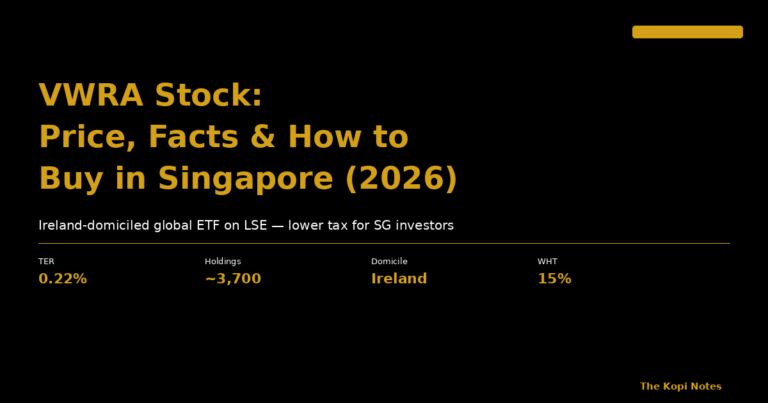
| VWRA | Vanguard FTSE All-World UCITS ETF | FTSE All-World | 0.22% | Accumulating | ~USD 23B |
| IWDA | iShares Core MSCI World UCITS ETF | MSCI World | 0.20% | Accumulating | ~USD 85B |
| VWRD | Vanguard FTSE All-World UCITS ETF | FTSE All-World | 0.22% | Distributing | ~USD 10B |
| SPYL | SPDR S&P 500 UCITS ETF | S&P 500 | 0.03% | Accumulating | ~USD 5B |
| VUAA | Vanguard S&P 500 UCITS ETF | S&P 500 | 0.07% | Accumulating | ~USD 45B |
Source: iShares, Vanguard, SSGA fund factsheets. AUM approximate as at April 2026. All funds domiciled in Ireland, listed on London Stock Exchange.
For a comprehensive breakdown of the largest S&P 500 option, see the CSPX ETF Singapore guide. For the most widely held global option, the VWRA ETF Singapore guide covers everything from how to buy VWRA to how it compares with IWDA and VWRD. Both articles include worked SGD cost examples and broker-specific buying instructions.
What Singapore Investors Should Do: Step-by-Step
If you are convinced that LSE-listed ETFs are the right choice for your Singapore portfolio, here is how to get started.
Step 1: Choose a broker that offers LSE access. Not every broker marketed to Singapore investors provides LSE ETF trading. The main options in 2026 are Interactive Brokers (IBKR), Saxo Markets, moomoo Singapore, and Syfe Brokerage. IBKR is widely regarded as the most cost-effective for larger portfolios (commission from USD 1.00 per trade). Syfe Brokerage is the simplest for beginners. For SRS investors, FSMOne is a strong choice as it offers SRS-linked brokerage accounts with access to LSE ETFs. You can access current sign-up bonuses via the Syfe referral code page.
Step 2: Fund your account. Once your brokerage account is open and verified, transfer SGD and convert to USD (CSPX and VWRA are both USD-denominated on the LSE, though they trade in USD on the LSE). IBKR offers excellent FX rates for this conversion. Most other brokers charge a spread — compare before transferring large amounts.
Step 3: Search for the correct ticker on the LSE. When placing your order, always verify you are buying the LSE-listed version. Search for “CSPX” and confirm the exchange shown is “LONDON” or “LSE”. The same ticker may appear on multiple exchanges — always select the London listing. For VWRA, the ticker is the same on the LSE; confirm it is the USD-denominated London listing (not the Amsterdam Euronext listing, which is EUR-denominated).
Step 4: Place a limit order, not a market order. LSE ETFs trade during London market hours (3:00 PM – 11:30 PM Singapore time). Outside these hours, the spread can widen significantly. Always use a limit order at or near the mid-price to avoid overpaying.
Step 5: Incorporate into your broader plan. LSE ETFs are an excellent core holding for global equity exposure. If you are building toward a retirement income goal, use the Singapore retirement calculator to see how regular LSE ETF investments project over your time horizon. Many Singapore investors combine LSE ETFs with best S-REITs in Singapore 2026 for income, and T-bills or SSBs for the stable portion of their portfolio.
The choice to buy ETFs on the London Stock Exchange rather than New York is not about preferring one city over another. It is a straightforward, data-backed tax optimisation that every Singapore investor with more than a few thousand dollars in global equity ETFs should understand and act on.
Not financial advice. All figures are for educational reference only. Consult a qualified financial adviser for personalised guidance.
Frequently Asked Questions
Why do Singapore investors buy ETFs on the London Stock Exchange instead of NYSE?
Singapore investors prefer LSE-listed ETFs because they are domiciled in Ireland, which has a tax treaty with the US that reduces dividend withholding tax from 30% to 15%. They are also outside the scope of US estate tax — which can apply to non-US persons holding US-situs assets above USD 60,000 at death. These two structural advantages mean LSE ETFs deliver better after-tax returns for Singapore residents than equivalent US-listed funds, even when the US versions have slightly lower expense ratios.
What does Ireland-domiciled or UCITS ETF mean?
A UCITS (Undertakings for Collective Investment in Transferable Securities) ETF is an investment fund structured under European Union regulations, typically domiciled in Ireland or Luxembourg. Ireland is the most common domicile for LSE-listed UCITS ETFs because Ireland has a favourable tax treaty with the US, robust fund regulation, and a large ETF administration industry. Being “domiciled” in Ireland means the fund company is incorporated there, which determines its tax treaty access and legal structure — even though the fund holds global equities and is listed on the London Stock Exchange.
Can I buy London Stock Exchange ETFs using my CPF or SRS funds?
LSE-listed ETFs are generally not eligible for CPF Investment Scheme (CPFIS) investment. CPF OA funds can only be invested in approved SGX-listed products, which do not include UCITS ETFs on the LSE. However, LSE ETFs are SRS-compatible if purchased through an eligible SRS brokerage account — FSMOne, Saxo Markets, and some other brokers offer SRS accounts that allow LSE ETF purchases. Always verify SRS eligibility with your specific broker before transacting.
How much US estate tax could I owe on US-listed ETFs if I die?
As a Singapore resident (non-US person), you receive only a USD 60,000 estate tax exemption on US-situs assets — compared to over USD 13 million for US citizens. Above USD 60,000, US estate tax rates start at 18% and rise to 40% on amounts above USD 1 million. On a USD 500,000 US ETF portfolio, the potential estate tax bill is approximately USD 170,000, payable to the IRS. Ireland-domiciled ETFs on the LSE are not US-situs assets, so they are fully outside the scope of US estate tax regardless of portfolio size.
Which broker is best for buying LSE ETFs in Singapore?
Interactive Brokers (IBKR) is the most cost-effective option for larger portfolios, with commissions from USD 1.00 per trade and competitive FX rates for SGD-to-USD conversion. Syfe Brokerage is the simplest for beginners and offers a clean mobile interface. FSMOne is the best choice if you want to use SRS funds, as it offers SRS-linked brokerage with LSE ETF access. Saxo Markets is a solid all-round option with good research tools. moomoo Singapore has competitive commissions but check current LSE ETF availability in its product list before opening an account.
Is the tax saving from LSE ETFs really worth the extra complexity?
Yes — for most Singapore investors, the answer is clearly yes. On a SGD 100,000 portfolio, choosing an LSE ETF over the US equivalent saves approximately SGD 195 per year in withholding tax alone, compounding into over SGD 8,000 of additional wealth over 20 years. The estate tax protection becomes increasingly valuable as portfolios grow above SGD 80,000. The operational complexity is minimal: you are simply buying a different ticker on a different exchange through the same brokerage account. The learning curve is low; the financial benefit is real and permanent.
Ready to Start Investing in LSE ETFs?
Open a brokerage account and buy your first Ireland-domiciled ETF today. Use our referral links for exclusive sign-up bonuses.
This article was researched with the help of AI. While we strive to keep all information accurate and up to date, there may be errors. If you notice any discrepancies, please contact us.