Singapore Inflation 2026: What Rising Prices Mean for S-REIT Investors
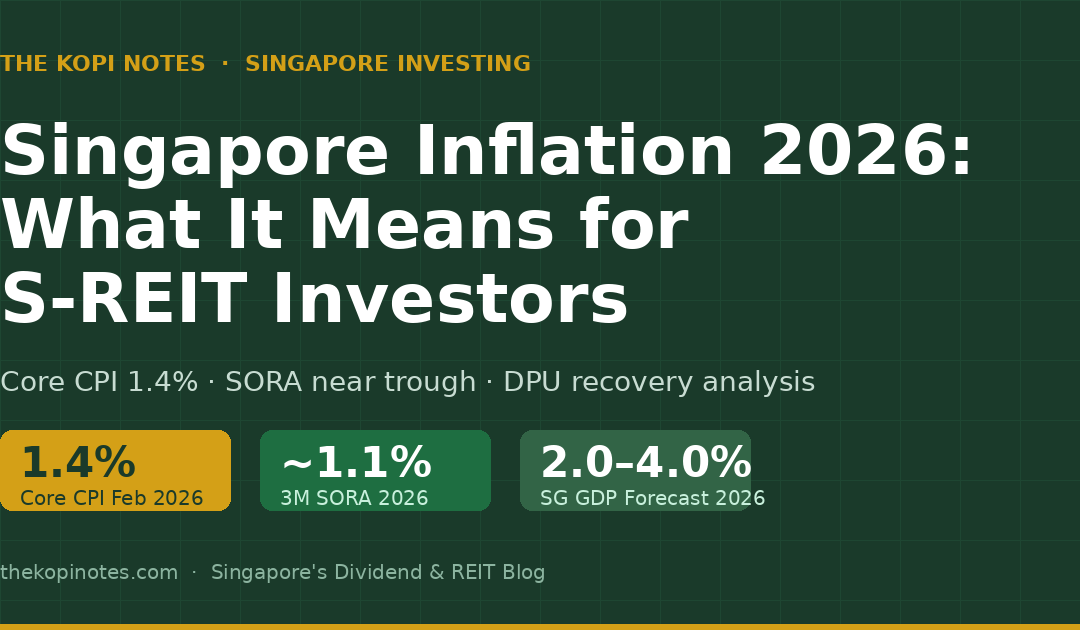
Core CPI hit 1.4% in February 2026. SORA is near its cyclical trough. Here is the complete playbook for Singapore REIT unitholders navigating the inflation-rate pivot — and what to watch next.
Singapore’s inflation landscape in 2026 sits at a delicate inflection point. The Monetary Authority of Singapore (MAS) has raised its full-year core inflation forecast to 1.0–2.0%, core CPI quickened to 1.4% year-on-year in February 2026, and electricity tariffs are rising from April to June. Meanwhile, the 3-month SORA rate — which drives borrowing costs for most S-REITs — is hovering near its cyclical low of around 1.0–1.1%, well below the 3.03% peak seen in 2023.
For S-REIT investors, this combination creates a nuanced investing environment: moderately higher inflation puts upward pressure on operating costs and cap rates, but the low-rate backdrop is simultaneously cutting financing costs and supporting DPU recovery. Getting the balance right matters for your dividend income in 2026.
This article is for informational and educational purposes only. It does not constitute financial advice. Please consult a licensed financial adviser before making any investment decisions.
Table of Contents
Contents — Click to expand
- Singapore Inflation Snapshot — February 2026
- What Is Driving Singapore Inflation in 2026
- The SORA-Inflation Link and S-REIT Borrowing Costs
- Sector-by-Sector Inflation Impact on S-REITs
- DPU Outlook: Recovery or Setback?
- What S-REIT Investors Should Do Now
- Risks and What to Watch
- Frequently Asked Questions
1. Singapore Inflation Snapshot — February 2026
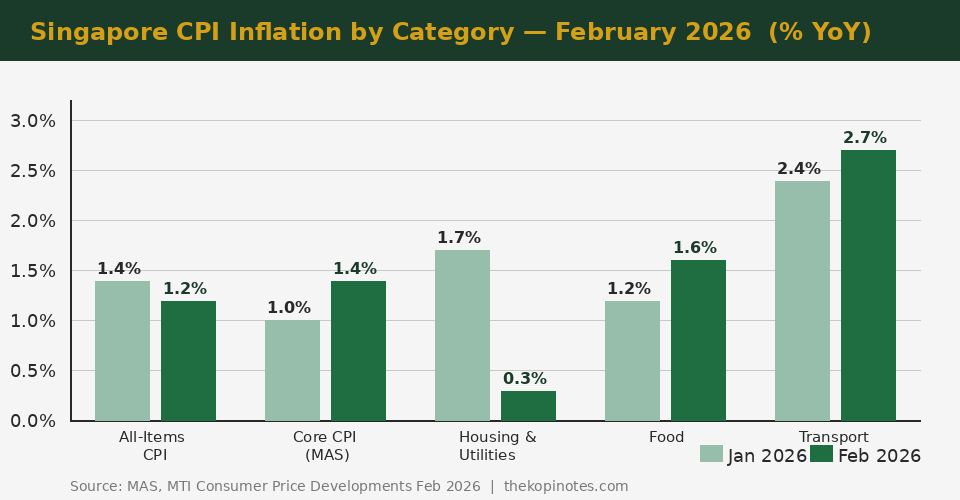
The latest official Consumer Price Index (CPI) data from MAS and the Ministry of Trade and Industry (MTI) covers February 2026. Here is where prices stand:
| CPI Category | Feb 2026 (YoY %) | Jan 2026 (YoY %) | Direction |
|---|---|---|---|
| All-Items CPI | 1.2% | 1.4% | ↓ Eased |
| MAS Core Inflation | 1.4% | 1.0% | ↑ Quickened |
| Housing & Utilities | 0.3% | 1.7% | ↓ Eased sharply |
| Food | 1.6% | 1.2% | ↑ Picked up |
| Transport | 2.7% | 2.4% | ↑ Accelerated |
| MAS Full-Year 2026 Forecast (Core) | 1.0–2.0% | Maintained | |
Source: MAS, MTI Consumer Price Developments February 2026. As at April 2026.
Two things stand out: First, MAS core inflation quickened to 1.4% in February — the highest reading since late 2024 — driven by food and transport. Second, the headline number eased because of a sharp drop in housing and utilities costs in February, partly driven by seasonal utility price fluctuations. However, electricity tariffs are scheduled to rise 2.1% from April to June 2026 (to 29.72 cents per kWh), so headline CPI is likely to pick up again in Q2.
The MAS full-year 2026 core inflation forecast of 1.0–2.0% is notably higher than the 0.5–1.5% range projected in the October 2025 Monetary Policy Statement. MAS attributes this to resilient domestic demand and pass-through from elevated global commodity costs.
2. What Is Driving Singapore Inflation in 2026
Singapore’s inflation story in 2026 is shaped by four converging forces:
Global commodity and tariff pressures. US tariffs on a broad range of imports — including goods from Asia — are feeding through into global supply chain costs. While Singapore’s zero-tariff status shields it from direct US tariff exposure, higher input costs for imported goods (raw materials, electronics, food commodities) are gradually passing through to domestic prices. MTI has flagged that “further increases to effective tariff rates could impact Singapore’s externally-oriented sectors.”
Resilient domestic demand. Singapore’s GDP grew 4.8% in 2025 — its strongest full-year performance since 2021 — driven by strong manufacturing (up 5.7% in Q4 2025 alone). MTI has upgraded its 2026 GDP growth forecast to 2.0–4.0% from the initial 1.0–3.0% range. Strong employment and wage growth keep services and food prices elevated.
Electricity tariff increases. SP Group has confirmed a 2.1% electricity tariff increase for households from April to June 2026, with the Energy Market Authority warning of steeper hikes possible later in the year as fuel prices remain elevated. This directly affects retail REITs (mall operating costs), industrial REITs (warehouse electricity), and data centre REITs (cooling and power costs).
MAS monetary policy stance. In the January 2026 Monetary Policy Statement, MAS maintained the prevailing rate of appreciation of the S$NEER policy band — an unchanged stance focused on keeping imported inflation in check via a stronger Singapore dollar. This is relevant for S-REITs: a stable-to-strong SGD helps cap import-driven cost inflation, but it also means MAS is not actively easing policy to stimulate growth.
3. The SORA-Inflation Link and S-REIT Borrowing Costs
Most S-REIT floating-rate loans are pegged to the Singapore Overnight Rate Average (SORA). Understanding where SORA stands — and how inflation interacts with it — is critical for assessing S-REIT financing costs and DPU recovery trajectories.
SORA fell dramatically from its 2023 peak of around 3.03% to approximately 1.07% at its recent trough in early 2026. As of April 2026, the 3-month SORA rate is expected to settle in the 1.2–1.3% range for 2026, with some forecasters projecting it could drift back up to around 1.39% by year-end as global rate expectations stabilise.
The SORA-inflation relationship works as follows: if Singapore inflation remains persistently elevated above the MAS target range, MAS could delay or reduce the pace of NEER appreciation — effectively allowing a slightly weaker SGD — which could push imported inflation higher and keep SORA from falling further. Conversely, if core inflation stays anchored within the 1.0–2.0% forecast range, there is no pressure for MAS to tighten, which is benign for S-REIT financing costs.
The key takeaway for unitholders: S-REITs that have significant floating-rate debt maturing in 2026–2027 stand to benefit materially from refinancing at SORA rates that are 150–200bps lower than their existing cost of debt. Market consensus points to low-single-digit DPU uplift across the sector as this refinancing tailwind flows through over the next four to six quarters.
For a deeper look at how SORA drives S-REIT distributions, see our full guide: SORA Rate Singapore 2026: The S-REIT DPU Recovery Window Is Now Open.
4. Sector-by-Sector Inflation Impact on S-REITs
Inflation does not affect all REIT sectors equally. Here is a breakdown of how the 2026 inflationary environment lands across the major S-REIT sectors:
| Sector | Key Inflation Exposure | Net Impact | DPU Outlook |
|---|---|---|---|
| Retail REITs (CICT, FCT, Suntec) | Higher mall opex, utilities; shopper spending resilience | Mixed — cost pressure offset by positive retail sales | Neutral to slight positive |
| Industrial REITs (MLT, MIT, CLAR) | Electricity costs; construction replacement costs | Mild negative on opex; leases often CPI-linked → partial offset | Positive (refinancing tailwind dominant) |
| Office REITs (Keppel REIT, Suntec office) | Property maintenance costs; labour costs | Moderate negative; CBD Grade A rents resilient | Stable |
| Data Centre REITs (Keppel DC REIT) | Power/cooling costs; long-term leases with step-up clauses | Higher electricity a concern but CPI-linked leases provide natural hedge | Positive (structural demand drivers dominant) |
| Hospitality REITs | Labour, food and beverage costs; RevPAR pricing power | Revenue pass-through partially offsets cost inflation | Neutral to slightly negative |
| Healthcare REITs | Regulated rent structures; long master leases | Minimal direct inflation exposure | Stable to positive |
The Kopi Notes analysis, April 2026. Not financial advice.
The overarching theme is that S-REITs with long weighted average lease expiries (WALE), CPI-linked rent escalations, and low gearing are best positioned to weather moderate inflation while still benefiting from SORA’s decline. Sectors exposed to high electricity consumption — particularly data centres and large format retail — face the clearest near-term headwind from the April 2026 tariff increase.
For a curated selection of the best-positioned S-REITs for 2026, see: Best S-REITs Singapore 2026: Yield, Gearing & DPU Comparison.
5. DPU Outlook: Recovery or Setback?
The central question for S-REIT investors in 2026 is whether the DPU recovery narrative — driven by falling SORA rates — survives moderate inflation. Our assessment: yes, for the majority of blue-chip S-REITs, the refinancing tailwind dominates.
Here is the arithmetic: the average S-REIT all-in cost of debt at peak SORA (2023 era) was approximately 3.8–4.2%. Refinancing into a 1.2–1.3% SORA environment means all-in borrowing costs could fall to approximately 2.5–3.0% for new facilities — a 100–150 basis point reduction on refinanced tranches. For a REIT with S$1 billion in floating rate debt, that translates to roughly S$10–15 million in annual interest savings, which flows directly into distributable income.
Compare this to the inflation headwind: a 2% increase in operating expenses for a REIT with S$200 million in annual property expenses adds approximately S$4 million in costs. The financing savings are 2–4x larger than the operating cost headwind in most scenarios — provided core inflation stays below 2.5% and SORA does not reverse sharply upward.
The iEdge S-REIT Index delivered +15.9% total returns year-to-date as at November 2025, before pulling back approximately 7% in March 2026 amid global geopolitical uncertainty and repriced rate-cut expectations. This pullback has created a more attractive entry point: many large-cap S-REITs are now trading at 5.5–6.5% forward distribution yields — a meaningful spread above the Singapore 10-year government bond yield of approximately 2.8%.
Want to model your own dividend income from S-REITs? Use our Singapore Dividend Portfolio Yield Calculator to estimate your blended yield and annual passive income.
6. What S-REIT Investors Should Do Now
Given the current macro environment — moderate Singapore inflation, near-trough SORA rates, global trade uncertainty, and the S-REIT index trading below November 2025 highs — here is a practical framework for retail investors:
1. Prioritise REITs with CPI-linked lease escalations. Industrial and logistics REITs (such as Mapletree Industrial Trust, Mapletree Logistics Trust, and CapitaLand Ascendas REIT) often have leases with built-in annual rental step-ups tied to Singapore CPI or a fixed percentage (typically 2–3%). These structures provide a natural inflation hedge at the portfolio level.
2. Check gearing and debt maturity profiles. REITs with gearing below 35% and significant debt maturing in 2026–2027 are the prime beneficiaries of the SORA refinancing tailwind. Gearing above 40% (MAS statutory limit is 50%) leaves less headroom and implies sensitivity to any rate reversal. Review the latest annual reports or SGX filings for each REIT’s debt schedule.
3. Consider diversified exposure via S-REIT ETFs. If picking individual REITs feels daunting, a Singapore REIT ETF gives you broad sector exposure and automatic rebalancing. Our Singapore REIT ETF Guide covers the major options including NikkoAM-StraitsTrading Asia Ex Japan REIT ETF and the Lion-Phillip S-REIT ETF.
4. Use a robo-advisor for automated REIT income. Platforms such as Syfe (REIT+ and Income+ portfolios) and Endowus (Income Portfolios) offer managed S-REIT exposure with quarterly or monthly income distribution — useful for investors who want passive income without stock-picking. See our Syfe vs Endowus 2026 comparison.
5. Integrate CPF and SRS optimisation. If you are holding S-REITs inside an SRS account or using CPF-OA funds for CPFIS investments, the moderate inflation environment reinforces the case for maximising CPF contributions to earn the risk-free 2.5% (OA) and 4.0% (SA/RA) — especially relative to the inflation rate of 1.0–2.0%. See our CPF Investment Strategy Guide for a framework on when CPFIS makes sense.
7. Risks and What to Watch
Even with the base case favourable for S-REIT investors in 2026, these risks could derail the thesis:
Risk 1: Inflation re-acceleration above 2.5% core. If global commodity prices surge or Singapore wage growth accelerates further, core CPI could break above MAS’s 2026 upper band. This would signal MAS tightening — potentially a steeper NEER appreciation slope — which would put upward pressure on SGD funding costs and compress REIT spreads.
Risk 2: SORA reversal from US Fed hawkishness. The Fed held rates at 3.50–3.75% in March 2026 and pencilled in only one cut for 2026. Any re-acceleration in US inflation (PCE above 3%) could push the Fed to postpone cuts or even hike — which would flow through into global and Singapore short-end rates, pushing SORA back up. This would reduce or eliminate the refinancing tailwind for S-REITs.
Risk 3: Global trade war escalation. MAS has explicitly warned that further increases to effective tariff rates could weigh on Singapore’s externally-oriented sectors. If trade war disruptions cause Singapore GDP growth to undershoot the 2.0–4.0% forecast, corporate tenant demand for industrial and logistics space could soften, pressuring occupancy rates and NPI.
Risk 4: Electricity cost escalation. The April–June 2026 tariff increase of 2.1% is modest. But the Energy Market Authority has warned of steeper hikes later in 2026 if fuel prices stay elevated. Data centre REITs (Keppel DC REIT), large retail malls (CICT, Suntec), and logistics hubs (MLT, MIT) all have significant electricity exposure.
Risk 5: Geopolitical disruption to Middle East supply chains. MAS issued formal comments in March 2026 monitoring “developments arising from the ongoing situation in the Middle East.” A significant escalation affecting shipping routes through the Strait of Hormuz could push oil and freight costs sharply higher, feeding into Singapore CPI and REIT operating costs simultaneously.
Frequently Asked Questions
What is Singapore's current inflation rate in 2026?
As at February 2026 (the latest data released), Singapore’s All-Items CPI inflation was 1.2% year-on-year. MAS Core Inflation — which excludes accommodation and private transport — was 1.4% YoY in February 2026. MAS forecasts full-year 2026 core inflation to average between 1.0% and 2.0%.
How does Singapore inflation affect S-REIT DPU?
Singapore inflation affects S-REIT DPU through two main channels: (1) Operating costs — higher utilities, maintenance, and property expenses reduce net property income (NPI). (2) Interest rates — inflation expectations influence SORA, which drives floating-rate borrowing costs. In 2026, the SORA refinancing tailwind (rates down from 3.03% to ~1.1%) is significantly larger than the operating cost headwind for most blue-chip S-REITs, so net DPU impact is broadly positive.
What is the MAS January 2026 Monetary Policy Statement?
In the January 2026 Monetary Policy Statement, MAS maintained the prevailing rate of appreciation of the Singapore dollar Nominal Effective Exchange Rate (S$NEER) policy band — no change to its width or the level at which it is centred. MAS raised its 2026 core inflation forecast to 1.0–2.0% from the earlier 0.5–1.5%, reflecting resilient domestic demand and higher global commodity costs. The next MAS Monetary Policy Statement is expected around April 2026.
Is SORA expected to rise in 2026 due to inflation?
SORA is currently near its cyclical low of around 1.07–1.1% in early 2026. Forecasters expect the 3-month SORA to average approximately 1.2–1.3% in 2026, with some upward drift toward 1.39% by year-end. The key risk is that stronger-than-expected US or Singapore inflation leads to a reversal of current rate-cut expectations. For now, the base case is for SORA to remain well below 2023 peak levels throughout 2026, which is supportive of S-REIT DPU recovery.
Which S-REIT sectors are most exposed to Singapore inflation?
Data centre REITs (high electricity consumption) and large-format retail REITs (mall operations, energy costs) face the most direct exposure to rising Singapore electricity tariffs. Industrial REITs have moderate exposure but often benefit from CPI-linked lease escalation clauses. Healthcare REITs are least exposed due to long master leases with fixed rental structures. Hospitality REITs face labour and food cost inflation but can partially pass through via room rates.
Should I invest in S-REITs during inflation?
S-REITs can be an effective partial inflation hedge because many leases include annual rental step-ups tied to CPI or fixed percentages (2–3%), allowing income to grow over time. Additionally, real property assets tend to appreciate in nominal terms during inflationary periods. However, rising interest rates — a frequent companion to inflation — can pressure S-REIT prices. In the current 2026 environment where SORA is still near its trough, S-REITs with strong balance sheets and CPI-linked leases are well-positioned. This is not financial advice — please consult a licensed financial adviser for personalised guidance.
How does Singapore inflation affect CPF and retirement planning?
Singapore CPF interest rates (OA: 2.5%, SA/RA: 4.0%) are set by legislation, not by CPI. With inflation at 1.0–2.0%, CPF’s guaranteed returns still offer a positive real return — particularly the SA/RA rate of 4.0%, which comfortably beats the current inflation rate. For long-term retirement planning, CPF remains one of the best risk-adjusted options for Singapore residents. Use our Retirement Planning Calculator to model how inflation affects your retirement corpus over time.
Conclusion: Navigate the Inflation-Rate Pivot With Confidence
Singapore’s inflation outlook for 2026 — core CPI at 1.4% in February and expected to average 1.0–2.0% for the full year — is elevated compared to recent years but far from alarming. For S-REIT investors, the key insight is that the SORA refinancing tailwind remains the dominant factor for DPU recovery in 2026, outweighing the moderate inflation headwind across most blue-chip sectors.
The playbook is clear: focus on S-REITs with CPI-linked leases, strong gearing headroom, and debt maturities concentrated in 2026–2027 where refinancing savings are greatest. Monitor the MAS April 2026 Monetary Policy Statement closely — any signal of a change in the S$NEER appreciation slope would be a material development for the rate and inflation outlook.
The March 2026 pullback in the iEdge S-REIT Index — down approximately 7% from late 2025 highs — has created an entry window for investors willing to take a 12–18 month view on the DPU recovery cycle. At current prices, many large-cap S-REITs offer 5.5–6.5% forward yields — a historically attractive spread above Singapore government bond yields.
As always, diversification across S-REIT sectors, regular CPF optimisation, and a long-term perspective are the foundations of sound Singapore retirement planning.
This article is for informational purposes only. It does not constitute financial advice. All investments carry risk. Past performance is not indicative of future results. Data sourced from MAS, MTI, SGX, and public market data as at April 2026.
Start Building Your Passive Income Portfolio Today
Whether you are just starting out or optimising an existing S-REIT portfolio, The Kopi Notes has the tools and analysis to guide your journey.
This article was researched with the help of AI. While we strive to keep all information accurate and up to date, there may be errors. If you notice any discrepancies, please contact us.