Best Travel Credit Card Singapore 2026: GXS, Trust Bank & Digital Banks Guide
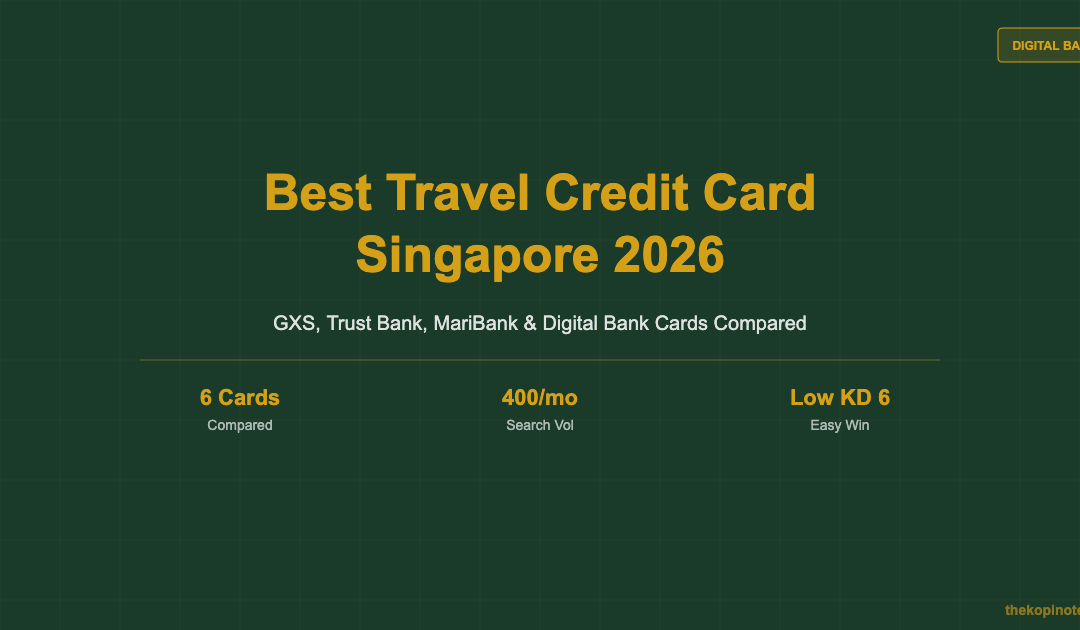
Compare the best travel cards from Singapore’s digital banks — GXS, Trust Bank, and MariBank — plus top traditional cards for miles and cashback in 2026.
The best travel credit card in Singapore for 2026 depends on your spending habits and whether you prioritise miles, cashback, or no annual fees. Digital banks like GXS and Trust Bank now offer competitive travel-friendly debit and credit cards with zero annual fees — making them strong contenders alongside traditional cards like Citi PremierMiles and UOB PRVI Miles for frequent flyers spending S$3,000 or more per month.
Not financial advice. All figures are for educational reference only. Data as at June 2026 unless noted.
- GXS and Trust Bank offer no-annual-fee travel-friendly cards — great for beginners or low spenders
- For serious miles accumulation (S$3k+ monthly spend), Citi PremierMiles or UOB PRVI Miles deliver better earn rates
- Digital bank cards shine for FX savings and everyday cashback; traditional cards win on miles earn rates and lounge access
Table of Contents
Contents — Click to expand
Digital Bank Travel Cards: GXS, Trust Bank & MariBank
Singapore’s digital banks — GXS, Trust Bank, and MariBank — have shaken up the banking scene since their launches in 2022 and 2023. While they don’t yet match traditional banks in premium travel perks like airport lounge access or dedicated travel insurance, they offer real advantages: zero annual fees, competitive FX rates, and seamless app-based management.
Here’s what each digital bank offers for travellers in 2026:
GXS Bank — Best Digital Bank Card for FX Savings
GXS Bank (backed by Grab and Singtel) offers the GXS Debit Card, which earns GXS FlexiRewards on everyday spend including travel bookings. The card charges no annual fee and no foreign transaction fee for FX spending — a genuine saving for travellers who make multiple overseas transactions each trip.
GXS FlexiRewards can be redeemed as cashback or used to offset transactions directly in the GXS app. For a light traveller making S$1,500 per month in general spend, you’d accumulate roughly S$30 in monthly rewards — modest, but at zero annual cost. Use our Syfe referral code for a complementary investment account alongside your GXS savings. GXS referral code: YONG477.
Trust Bank — Best Digital Bank Card for Everyday Cashback
Trust Bank (backed by Standard Chartered and FairPrice Group) offers the Trust Platinum Visa. It’s technically a credit card, not just a debit card — a major step up from GXS’s debit-only offering. You earn 1.5% cashback on general spend with no annual fee.
The real edge: Trust Bank links to your FairPrice/Kopitiam spending, giving you extra cashback on groceries and hawker food. For a Singapore-based traveller, this makes Trust Bank a strong everyday card — use it for local spend, then switch to a miles card for overseas bookings. Trust Bank referral code: HTWYQP95.
MariBank — Digital Savings First, Travel Benefits Later
MariBank (backed by Sea Limited / Shopee) is primarily a savings-focused digital bank with an impressive 2.88% p.a. interest rate as at June 2026. Their travel card benefits remain limited compared to GXS and Trust Bank. MariBank is best treated as a high-yield savings account for your travel fund, rather than a primary travel spending card. MariBank referral code: 2DCT80WQ.
Full Card Comparison Table 2026
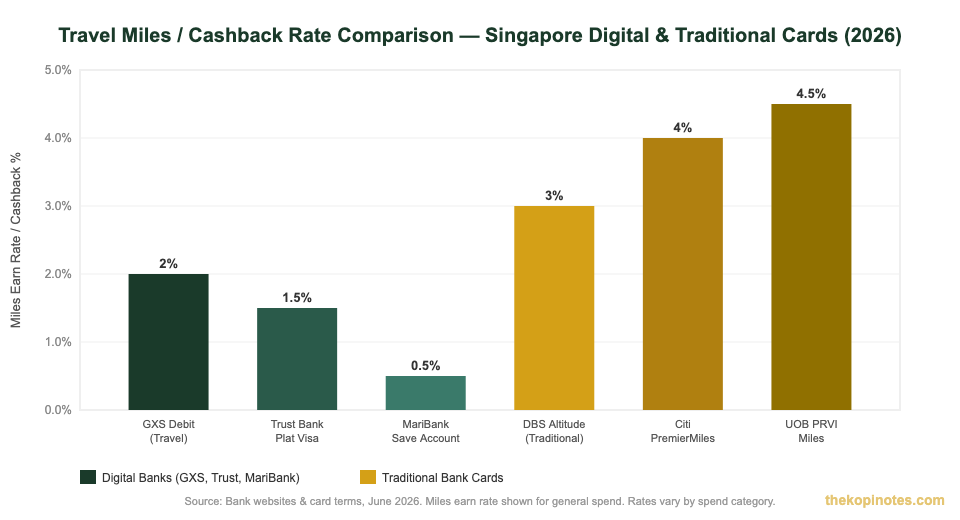
Here’s how Singapore’s top travel cards stack up across the key metrics you care about — miles earn rate, foreign transaction fee, annual fee, and sign-up bonus:
| Card | Annual Fee | Earn Rate | FX Fee | Lounge Access | Best For |
|---|---|---|---|---|---|
| GXS Debit Card | S$0 | ~2% cashback | 0% | No | FX savings, no-fee travel spend |
| Trust Platinum Visa | S$0 | 1.5% cashback | 1.8% | No | Everyday cashback, local spend |
| DBS Altitude Visa | S$194 | 1.2–3 mpd | 2.0% | Yes | Miles + lounge, DBS customers |
| Citi PremierMiles | S$194 | 1.2–2 mpd | 3.25% | Yes (2/yr) | Miles flexibility, no expiry |
| UOB PRVI Miles | S$261 | 1.4–2.4 mpd | 2.8% | Yes | High miles earn for big spenders |
Source: Bank websites and card terms, June 2026. mpd = miles per dollar. Earn rates vary by spend category. Always check the issuing bank’s latest terms before applying.
Miles vs Cashback: Which Is Better for Singapore Travellers?
This is the most common question for Singapore travellers choosing a card. The short answer: miles cards win if you fly business class or premium economy; cashback cards win if you mostly fly economy or don’t fly often.
Here’s the maths. A Citi PremierMiles card earns 1.2 miles per dollar (mpd) on general spend. At S$5,000 monthly spend, you accumulate 6,000 miles per month — about 72,000 miles per year. A Singapore Airlines Business Class redemption to London costs around 120,500 KrisFlyer miles. You’d get there in roughly 20 months of spending.
Alternatively, the GXS Debit Card at 2% cashback on the same S$5,000 monthly spend gives you S$100 cashback per month — S$1,200 per year in real cash. That buys a cheap economy return flight to Bangkok or Bali.
| Scenario | Miles Card (Citi PM) | Cashback Card (GXS) |
|---|---|---|
| Monthly spend: S$2,000 | 2,400 miles | S$40 cashback |
| Monthly spend: S$5,000 | 6,000 miles | S$100 cashback |
| Annual fee | S$194 | S$0 |
| Best redemption value | Business class flights | Instant cash in your account |
Source: The Kopi Notes analysis, June 2026. Miles value estimated at S$0.02 per mile (Singapore Airlines KrisFlyer). Actual value depends on redemption.
For most everyday Singaporeans flying economy 2–3 times a year, cashback cards like GXS or Trust Bank are simpler and deliver guaranteed value without needing to track miles expiry or manage transfer partners. If you’re a points nerd who books business class, a traditional miles card pays off handsomely.
Best Card for Each Traveller Type
The Budget Traveller (Economy, 1–2 trips/year)
Your best pick: GXS Debit Card or Trust Platinum Visa. Zero annual fee means you keep 100% of your rewards. The GXS card’s 0% FX fee saves you S$30–S$80 per trip versus traditional cards charging 2–3.25% on overseas spend. For your longer-term financial goals, pair this with a Endowus referral account to grow your travel fund while it sits idle.
The Frequent Flyer (3–6 trips/year, S$3k+ monthly spend)
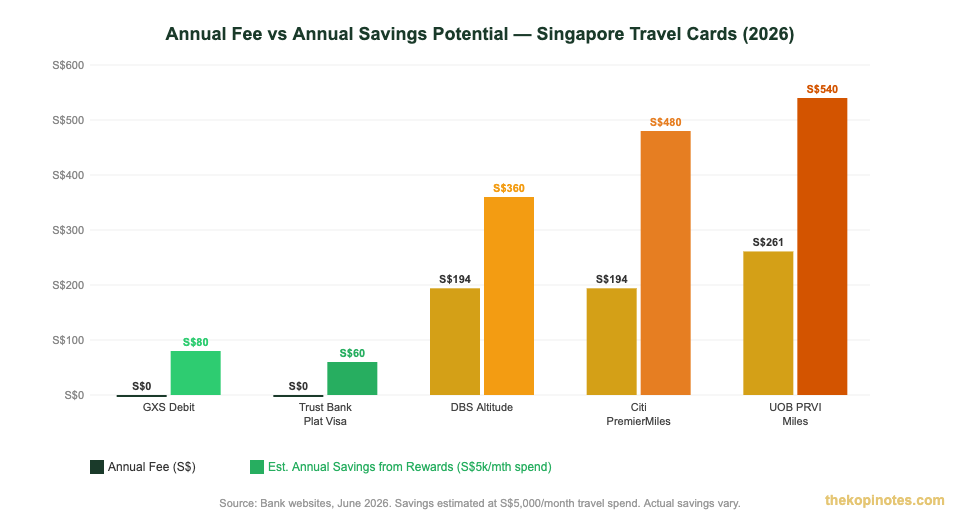
Your best pick: Citi PremierMiles or DBS Altitude Visa. Miles earned on these cards don’t expire (Citi) or can be transferred to multiple airline programmes (DBS). Lounge access on both cards adds genuine value if you travel frequently. You’ll break even on the S$194 annual fee within 2–3 months of earning miles at S$3,000 monthly spend.
The Business Traveller (Weekly flights, company-reimbursed spend)
Your best pick: UOB PRVI Miles Amex (2.4 mpd on overseas spend) or consider the moomoo Singapore review for insights on how other high-earners manage their investment portfolios alongside premium card rewards.
The Digital Native (Prefers app-first banking)
Your best pick: GXS Bank with referral code YONG477, or Trust Bank with referral code HTWYQP95. Both apps are slick, instant-notification-enabled, and integrate savings and spending seamlessly. Pair your digital bank card with a Singapore retirement calculator to ensure your travel habits don’t derail your long-term savings goals.
Top Traditional Travel Cards in Singapore
Digital bank cards have their place, but traditional banks still dominate the premium travel card space in 2026. Here’s a quick rundown of the top three:
Citi PremierMiles Visa — Best Miles Card Overall
Citi PremierMiles earns 1.2 mpd on local spend and 2 mpd on overseas spend. Miles never expire — a key advantage over some bank programmes. You get 2 complimentary lounge visits per year via Priority Pass. Annual fee: S$194 (first year often waived). Best for: travellers who want flexibility to transfer miles to multiple airlines including Singapore Airlines KrisFlyer, Cathay Asia Miles, and British Airways Avios.
UOB PRVI Miles — Highest Earn Rate for Big Spenders
UOB PRVI Miles Amex earns 1.4 mpd locally and 2.4 mpd overseas — the highest overseas earn rate among mainstream cards in Singapore. Annual fee: S$261. The catch: you need to spend at least S$50,000 per year to maximise the card’s value proposition. For high earners with heavy overseas spend, this card pays for itself many times over.
DBS Altitude Visa — Best for DBS/POSB Customers
DBS Altitude earns 1.2 mpd locally, 2 mpd on online travel bookings (airlines, hotels), and 3 mpd for bookings via the DBS travel portal. Annual fee: S$194. If you’re already a DBS or POSB customer, the integrated banking relationship makes account management seamless. Complement your card strategy with Syfe referral code for a robo-advisory account to invest your cashback rewards.
How to Choose the Right Travel Card
Follow this simple decision framework before you apply:
Step 1 — Calculate your monthly spend. If you spend less than S$2,000 per month, a no-fee cashback card (GXS, Trust Bank) almost always beats a miles card after factoring in the annual fee.
Step 2 — Know your travel frequency. Flying more than 4 times per year? Lounge access alone can justify the S$194 annual fee on a Citi PremierMiles or DBS Altitude card (average lounge visit cost: S$50–S$80 per person).
Step 3 — Check the FX fee. Travelling to countries where you’ll spend heavily in local currency? GXS’s 0% FX fee vs Citi’s 3.25% fee makes a real difference. On S$3,000 of overseas spend, that’s S$97 saved with GXS.
Step 4 — Match the airline programme. If you’re loyal to Singapore Airlines, ensure your miles card transfers to KrisFlyer at a decent ratio. Citi PremierMiles and UOB PRVI Miles both transfer to KrisFlyer at 1:1.
For a broader look at growing your money between trips, explore our guide on passive income Singapore strategies — many savvy travellers use dividend income to fund their travel budget.
Not financial advice. All product details are as at June 2026 and subject to change. Always check the card issuer’s latest terms before applying. The Kopi Notes may earn referral fees from some links on this page.
Frequently Asked Questions
What is the best travel credit card in Singapore for 2026?
The best travel credit card in Singapore depends on your spending level. For no-fee travel cards, GXS Debit Card and Trust Platinum Visa lead the digital bank options with 0% or low FX fees. For premium miles cards, Citi PremierMiles (miles never expire, 2 lounge visits/year) and UOB PRVI Miles (highest overseas earn rate at 2.4 mpd) are the top choices for frequent flyers spending S$3,000 or more per month.
Does GXS Bank have a travel credit card?
GXS Bank offers the GXS Debit Card, which functions as a travel-friendly card with 0% foreign transaction fees and FlexiRewards on eligible spend. As at June 2026, GXS has not launched a dedicated credit card product. However, the debit card’s zero FX fee makes it useful for overseas spending. You can sign up with referral code YONG477 for bonus rewards.
Is Trust Bank a good card for travelling overseas?
Trust Bank’s Platinum Visa is a reasonable everyday card for light travellers. It earns 1.5% cashback on general spend and has no annual fee. The downside: it charges a 1.8% foreign transaction fee on overseas spend, which adds up on large purchases. For heavy overseas spenders, a card with 0% FX fee (GXS) or a premium miles card with lounge access will deliver more value. Use Trust Bank referral code HTWYQP95 to get started.
Which Singapore travel card has no annual fee?
GXS Debit Card and Trust Platinum Visa both have no annual fee as at June 2026. Among traditional bank offerings, some cards like the Citi Cashback Visa also have annual fee waivers available. However, premium miles cards like Citi PremierMiles (S$194), DBS Altitude (S$194), and UOB PRVI Miles (S$261) charge annual fees — though these are often waived in the first year and can be justified if you travel frequently enough to earn lounge visits and high miles.
What is miles per dollar (mpd) and how does it work?
Miles per dollar (mpd) is the number of air miles you earn for every S$1 spent on a credit card. For example, a card with 1.2 mpd means every S$1 spent earns 1.2 air miles. Most Singapore travel cards earn between 1.2 and 2.4 mpd depending on the spend category. These miles are then transferred to airline programmes like Singapore Airlines KrisFlyer or Cathay Asia Miles, and redeemed for flights or upgrades. Miles values vary — KrisFlyer miles are typically worth around S$0.015–S$0.025 per mile depending on how you redeem them.
Can I use MariBank as a travel card?
MariBank is primarily positioned as a high-yield savings account (2.88% p.a. as at June 2026) rather than a travel card. Their card offerings have limited travel-specific perks compared to GXS or Trust Bank. MariBank is best used to park your travel savings fund and earn interest between trips, not as your primary overseas spending card. Use referral code 2DCT80WQ when signing up. For overseas spending, pair MariBank savings with a zero-FX-fee card like GXS.
Open Your Digital Bank Account Today
Earn more on your travel spend with Singapore’s digital banks. Use referral codes for sign-up bonuses.
This article was researched with the help of AI. While we strive to keep all information accurate and up to date, there may be errors. If you notice any discrepancies, please contact us.