Trump Tariffs Singapore 2026: How S-REIT Investors Should Respond After Liberation Day
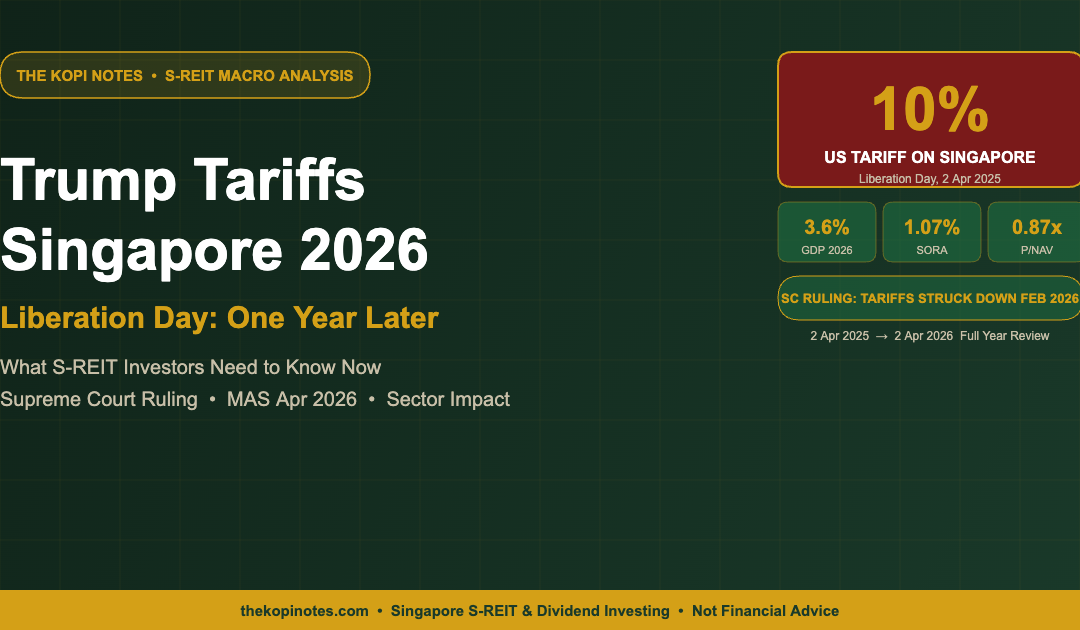
On 2 April 2025 â a date Donald Trump called “Liberation Day” â the United States imposed a sweeping 10% baseline tariff on virtually all imports into America. Singapore, despite holding a free trade agreement with the US and running a goods trade deficit with Washington, was not exempted.
Markets panicked. The Singapore REIT index fell sharply. Prime Minister Lawrence Wong called the move “not actions one does to a friend.” The Monetary Authority of Singapore warned of a potential “demand shock” to the economy.
One year later â as at 2 April 2026 â the picture looks very different. The US Supreme Court struck down most of those emergency tariffs in February 2026. Singapore’s GDP growth was revised up to 3.6% for 2026. SORA has tumbled from 3.03% to 1.07%. And S-REITs? Many proved far more resilient than the initial selloff suggested.
Here is the definitive 2026 update for Singapore REIT investors: what happened, what changed, and what you should do now.
This is not financial advice. Data as at 2 April 2026. Please consult a licensed financial adviser before making investment decisions.
ð Table of Contents
Contents â Click to Expand
- What Were the Liberation Day Tariffs? A Quick Recap
- Why Singapore Was in the Crosshairs
- How S-REITs Reacted in 2025
- The February 2026 Supreme Court Ruling: Game Changer
- Sector Breakdown: Exposed vs. Resilient S-REITs
- MAS April 2026 Policy Outlook: What Investors Should Watch
- Risks and What to Monitor Going Forward
- Frequently Asked Questions
- Our Take and Next Steps
1. What Were the Liberation Day Tariffs? A Quick Recap
On 2 April 2025, President Donald Trump signed Executive Order 14257 in a White House Rose Garden ceremony, dubbing the occasion “Liberation Day.” The order imposed a 10% universal baseline tariff on virtually all goods imported into the United States, replacing the patchwork of IEEPA tariffs that had been in place previously.
Countries with large trade surpluses with the US faced steeper “reciprocal tariffs” â China bore the heaviest brunt, but even US allies were not spared the baseline 10% rate.
Key Numbers from Liberation Day
| Data Point | Figure |
|---|---|
| Date of Liberation Day | 2 April 2025 |
| Tariff rate on Singapore goods | 10% baseline |
| Singapore’s tariff rate on US goods | 0% (existing FTA) |
| Legal authority cited | IEEPA / Trade Act Section 122 |
| Supreme Court ruling | February 2026 â most tariffs unconstitutional |
| US consumer goods price impact | ~+2% over 12 months (90â95% passed to consumers) |
Singapore’s position was particularly galling: under the US-Singapore Free Trade Agreement, Singapore already charges zero tariffs on US goods. Washington’s reciprocal framing was widely criticised as asymmetric â and PM Lawrence Wong did not hold back, saying these were “not actions one does to a friend.”
2. Why Singapore Was in the Crosshairs
Singapore punches far above its weight in global trade. As a small open economy â with trade volumes exceeding 3Ã its GDP â any slowdown in global goods flows hits hard. The MAS immediately flagged a potential “demand shock” that could reduce export volumes, dampen business sentiment, and slow hiring across logistics, manufacturing, and professional services.
For S-REIT investors, the transmission mechanism works like this:
- Industrial and logistics REITs depend on tenants who manufacture or move goods. A trade slowdown reduces warehouse and factory demand, increases vacancy risk, and squeezes renewal rates.
- Retail REITs are insulated by domestic consumer spending â but if the broader Singapore economy slows and unemployment rises, consumer sentiment eventually dips.
- Office REITs face softer MNC demand if multinationals restructure Asia-Pacific operations in response to US protectionism.
- Hospitality REITs see reduced business travel when regional trade volumes fall.
The immediate 2025 reaction? Singapore’s benchmark REIT index fell approximately 7â8% in the weeks following Liberation Day, as markets priced in recession risk. Gearing-sensitive REITs and those with high China/overseas exposure took the heaviest hits.
The good news: S-REITs are fundamentally property income vehicles. Their DPU is tied to existing leases, not day-to-day trade flows â and most of those leases had 2â5 year weighted average lease expiries (WALE) at the time, providing a cushion.
3. How S-REITs Reacted in 2025
The market’s initial reaction was fear-driven rather than fundamental-driven â a recurring pattern when macro shocks hit property markets. Here’s what actually played out over 2025:
What Happened
- Q2 2025 (tariff shock): S-REIT index fell sharply. Industrial and overseas-exposed REITs â Mapletree Logistics Trust (M44U), Mapletree Pan Asia Commercial Trust (N2IU) â saw steeper corrections, amplified by SGD currency headwinds on their China/Japan/Australia revenues.
- H2 2025 (recovery begins): As SORA continued declining from 3.03% towards 2%, financing costs dropped for leveraged REITs, improving distribution coverage ratios. The REIT index began recovering.
- Q4 2025 / Q1 2026 (normalisation): With SORA at 1.07% by early 2026 and Singapore GDP revised to 3.6% growth for 2026, S-REITs saw a re-rating. Forward yields above 6% on quality names attracted fresh institutional buying.
Winners and Laggards
REITs with Singapore-only domestic exposure proved most resilient: Frasers Centrepoint Trust (J69U) and CapitaLand Integrated Commercial Trust (C38U) â anchored by suburban malls with strong occupancies â barely blinked. Mapletree Industrial Trust (ME8U) benefited from its expanding data centre portfolio in the US and Japan, offsetting trade-linked headwinds. By contrast, purely trade-exposed logistics plays faced tenant enquiry slowdowns in Q2âQ3 2025, though occupancy held up thanks to long WALEs.
The key lesson from 2025: the tariff fear was real, but the tariff damage to S-REIT DPU was far more contained than the initial -8% selloff implied. The bigger driver of S-REIT performance in 2025 was not Trump â it was interest rates. SORA’s decline was the far more powerful catalyst for the sector’s recovery.
For a full breakdown of Singapore’s best S-REITs by yield and gearing, see our guide: Best S-REITs Singapore 2026 â Full Comparison Table.
4. The February 2026 Supreme Court Ruling: Game Changer
In February 2026, the US Supreme Court delivered a landmark ruling: most of Trump’s emergency tariffs â including the Liberation Day baseline â were unconstitutional. The court found that the executive branch had exceeded its authority under IEEPA in imposing blanket import duties without Congressional approval.
The ruling set in motion an “unprecedented” refund process for affected importers. For Singapore exporters, this was significant news: the legal basis for the 10% duty on their goods had been struck down.
What This Means for S-REIT Investors
The direct trade impact on Singapore is now substantially reduced. This supports:
- Improved export volumes and manufacturing capacity utilisation â supporting industrial REIT tenant demand
- Recovery in Singapore trade-linked GDP â underpinning commercial and retail REIT leasing activity
- Reduced uncertainty discount on overseas-exposed REITs like MLT and MPACT
However, investors should note that some tariff measures remain â the court ruling was not a total reset, and new legislative tariffs are possible. The refund process is also complex and slow. Trade policy uncertainty has not gone away; it has merely been dialled down from “extreme” to “elevated.”
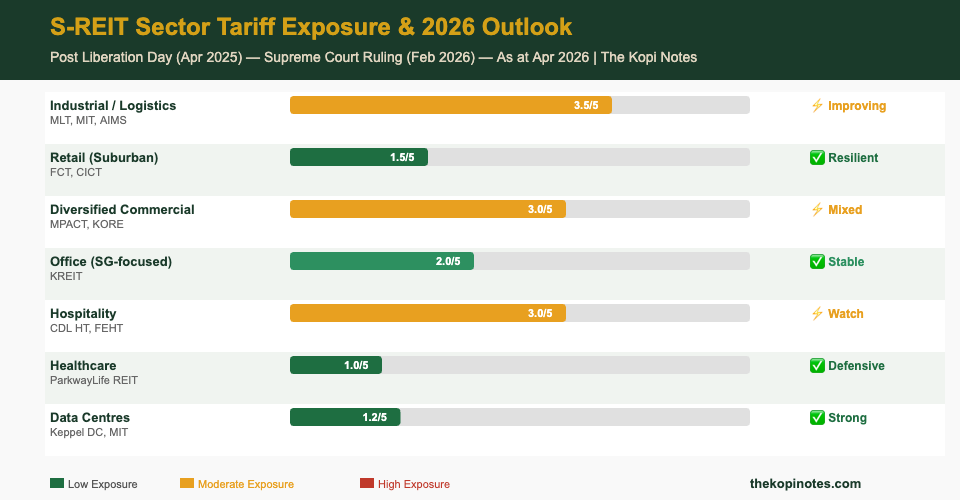
5. Sector Breakdown: Exposed vs. Resilient S-REITs
Not all S-REITs face the same tariff exposure. Here is a breakdown by sector â covering their vulnerability and the 2026 outlook after the Supreme Court ruling.
| Sector | Tariff Exposure | Key Risk | 2026 Outlook |
|---|---|---|---|
| Industrial / Logistics (MLT, MIT, AIMS APAC) |
ModerateâHigh | Tenant demand softens if ChinaâUS trade slows; currency headwinds on overseas DPU | â¡ Improving â data centre tailwind for MIT; MLT domestic demand 85% insulated |
| Retail (Suburban) (FCT, CICT) |
Low | Indirect â job losses or sentiment could reduce footfall | â Resilient â Singapore domestic consumer spending stable |
| Diversified Commercial (MPACT, KORE) |
Moderate | China/overseas office and retail assets most at risk; SGD strength reduces DPU | â¡ Mixed â selective recovery in better-quality assets |
| Office (SG-focused) (KREIT, Keppel REIT) |
LowâModerate | MNC tenant base â if firms downsize in response to trade war, demand softens | â Stable â Singapore as global business hub remains intact |
| Hospitality (CDL HT, FEHT, Far East H-Trust) |
Moderate | Trade-linked business travel drops; leisure offset by regional tourism recovery | â¡ Watch RevPAR data â business segment key |
| Healthcare (ParkwayLife REIT) |
Very Low | Japan/Singapore healthcare assets â not trade-sensitive | â Defensive income play â low correlation to tariff risk |
| Data Centres (Keppel DC REIT, MIT) |
Very Low | US tariffs on hardware could raise capex; offset by AI demand surge | â Strong â AI/cloud demand drives occupancy and DPU growth |
For REIT ETF investors who want diversified exposure across all sectors â reducing single-REIT tariff risk â see our comprehensive guide: Singapore REIT ETF Guide 2026 â Lion-Phillip S-REIT ETF and More.
6. MAS April 2026 Policy Outlook: What Investors Should Watch
The Monetary Authority of Singapore (MAS) operates an exchange-rate-based monetary policy, managing the Singapore Dollar Nominal Effective Exchange Rate (S$NEER) band rather than setting interest rates directly. In January 2026, MAS held policy steady â maintaining the prevailing slope, width, and centre of the S$NEER band.
Now, in April 2026, the next MAS policy review is on the horizon. Here’s why it matters for S-REIT investors:
What Economists Are Expecting
A February 2026 MAS survey showed that 47.4% of professional economists now expect MAS to tighten in April 2026 â specifically by increasing the rate of appreciation of the S$NEER band. This would allow the Singapore dollar to strengthen faster against a basket of trading partner currencies.
The rationale: Singapore’s GDP growth was upgraded to 3.6% for 2026 (from 2.3% previously), core inflation was forecast at 1.5%, and the economy remains in positive output gap territory. With the tariff threat receding and growth accelerating, some economists argue there is no longer a case for easy monetary policy.
Why a Stronger SGD Is a Double-Edged Sword for S-REITs
| REIT Type | Impact of Stronger SGD |
|---|---|
| Singapore-only REITs (FCT, CICT, PLife SG portfolio) | â Neutral to positive â costs cheaper in USD/JPY terms; SGD stability reduces FX risk |
| Overseas-asset REITs (MLT, MPACT, MIT US/Japan assets) | â ï¸ Negative â overseas DPU in JPY/CNY/AUD converts back at less SGD |
| S$-denominated debt REITs | â Positive â refinancing costs lower if SORA stays suppressed; SGD strength â rate hike |
| Foreign investors in S-REITs | â Positive â stronger SGD means higher returns in USD/EUR terms |
Key insight: MAS tightening via S$NEER is not the same as a rate hike. It does not directly raise borrowing costs for S-REITs â SORA is independently determined. The main channel is FX: a stronger Singapore dollar will put mild pressure on the SGD-translated DPU of REITs with Japan, China, Australia, or US assets.
For unitholders of MLT and MPACT in particular, watch the S$NEER trajectory closely after the April 2026 MAS decision.
To understand how CPF investors can optimise through these policy changes, see: CPF Investment Strategy 2026 â S-REITs, ETFs and Optimisation Guide.
7. Risks and What to Monitor Going Forward
The tariff threat has receded but not disappeared. Here are the five key risk factors Singapore REIT investors should monitor in the remainder of 2026:
Risk 1: Legislative Tariffs Replacing the Struck-Down Executive Orders
The Supreme Court ruling nullified executive branch tariffs. Congress could still pass new trade legislation imposing duties on imports â potentially with bipartisan support framed around national security or supply chain resilience. If new tariffs are enacted legislatively, they would survive judicial scrutiny. Timeline: watch US Congressional calendar Q2âQ3 2026.
Risk 2: Renewed US-China Trade Escalation
Even with the headline tariffs gone, bilateral trade tensions between the US and China remain elevated. REITs with significant China exposure â MLT (15% of NPI), MPACT (China retail/office) â remain vulnerable to any new escalation. A US-China decoupling scenario would weigh on renewal demand from Chinese manufacturing tenants.
Risk 3: MAS Tightening Shock on Overseas DPU
If MAS tightens aggressively in April 2026, a sharper-than-expected SGD appreciation could compress overseas DPU contributions. This is particularly relevant for Q1 FY2026/27 results due in mid-2026 for Mapletree REITs and Keppel REIT’s overseas assets.
Risk 4: AI Investment Bubble Risk
Professional economists flagged an “AI investment bubble burst” as the top tail risk to Singapore’s 2026 GDP forecast. If AI capex by hyperscalers (Google, Microsoft, Meta, Amazon) reverses, demand for data centre space collapses â hitting Keppel DC REIT and MIT’s US/Japan data centre assets hardest.
Risk 5: Singapore Property Market Softening
If trade headwinds slow Singapore’s economy more than forecast, office vacancy could rise, reducing net property income for CICT, KREIT, and MPACT’s Singapore assets. Watch MTI’s advance GDP estimate for Q1 2026 (due April 2026) as an early signal.
To stress-test your REIT income against various scenarios, use our free tool: Singapore Retirement Planning Calculator â Passive Income Edition.
8. Frequently Asked Questions
What is the current US tariff rate on Singapore goods in 2026?
As at April 2026, the situation is in flux. The US Supreme Court ruled in February 2026 that most of Trump’s IEEPA-based emergency tariffs â including the 10% Liberation Day baseline â were unconstitutional. A refund process is now underway for affected importers. However, some tariff measures under other legal authorities may remain in effect. Singapore exporters should check with Singapore Customs or their trade lawyers for the latest status on specific product categories.
Did the Liberation Day tariffs actually hurt Singapore REITs?
Yes and no. The initial market reaction was severe â the S-REIT index fell approximately 7â8% in the weeks following Liberation Day on 2 April 2025, as investors priced in recession risk. However, the actual DPU impact was far more contained, because: (1) most REIT leases have 2â5 year WALEs that protect near-term income; (2) SORA’s decline from 3.03% to 1.07% offset financing cost pressures; (3) Singapore’s GDP remained resilient, revised to 3.6% growth for 2026. REITs with purely Singapore-focused assets (FCT, CICT) barely saw any operational impact.
Which S-REITs were most affected by Trump's tariffs?
REITs with significant overseas assets in trade-exposed regions were most affected â particularly those with China, Australia, and US exposure. Mapletree Logistics Trust (M44U) saw pressure on its China-linked revenue as tariffs dampened export activity. Mapletree Pan Asia Commercial Trust (N2IU) faced both softer China retail/office demand and SGD currency headwinds translating overseas DPU. Mapletree Industrial Trust (ME8U) partially offset tariff headwinds through data centre growth in Japan. Purely Singapore-focused retail REITs like FCT and CICT were the most resilient.
What does the MAS April 2026 policy decision mean for S-REIT investors?
MAS manages monetary policy via the Singapore dollar exchange rate (S$NEER), not interest rates directly. If MAS tightens in April 2026 â as 47.4% of economists surveyed expect â it means the SGD will be allowed to appreciate faster. This has two key effects on S-REITs: (1) REITs with overseas assets (MLT, MPACT, MIT) will see their foreign DPU translated back to fewer SGD, reducing distributions. (2) S$-denominated borrowing costs (SORA-linked) are not directly affected by S$NEER tightening â so Singapore-focused REITs are largely insulated.
Is SORA expected to rise or fall in 2026?
As at April 2026, SORA is at approximately 1.07%, down sharply from the 3.03% peak in 2023. SORA is influenced by global interest rate cycles and Fed policy. With the US Supreme Court striking down most tariffs and Singapore’s economy growing above trend, MAS may tighten monetary policy via SGD appreciation rather than via rate increases â which would not directly raise SORA. The base case for most analysts is SORA remaining in the 1.0â1.5% range through 2026, which is supportive for leveraged S-REIT distribution coverage. See our dedicated SORA analysis: SORA Rate Singapore 2026: What It Means for S-REITs.
Should I buy, hold or sell S-REITs in light of the tariff situation?
This is not financial advice â please consult a licensed adviser. That said, the structural picture has improved significantly from the Liberation Day panic of April 2025. S-REITs are trading at a forward yield spread of approximately 3.8% above the risk-free rate and at 0.87Ã P/NAV â historically attractive entry levels. The tariff risk has reduced post-Supreme Court ruling; SORA is supportive; and Singapore GDP is growing. The key selectivity point is overseas exposure: REITs with large China/overseas portfolios face ongoing FX and operational risk, while Singapore-focused REITs (retail, healthcare, data centres) offer cleaner income visibility.
How does the US-Singapore FTA affect tariff risk?
The US-Singapore Free Trade Agreement (USSFTA), signed in 2003, provides for zero tariffs on Singapore goods entering the US for qualifying products under normal circumstances. However, the Liberation Day tariffs were imposed under emergency powers (IEEPA) that explicitly override existing trade agreements â which is precisely why the Supreme Court ruled them unconstitutional. With those emergency tariffs struck down, goods trade under the USSFTA may revert to more normal treatment, though the legal and refund process will take time to work through. Singapore remains among the US’s most FTA-aligned trading partners in Asia.
9. Our Take: One Year On, S-REITs Have Proven Their Resilience
Liberation Day triggered one of the sharpest short-term selloffs in S-REIT history. But one year on, the story is one of resilience, not damage. Singapore’s GDP grew; SORA fell; DPU held up. The Supreme Court ruling has removed the legal foundation of the most aggressive tariff measures. And S-REITs â with their lease-backed income structures and 5â7% yields â are looking better value today than they did in the fear-driven trough of mid-2025.
The nuances matter: overseas-exposed REITs (MLT, MPACT) still carry residual FX and demand risk. MAS tightening via SGD could shave translation gains. A new legislative round of US tariffs remains a tail risk. But for the Singapore retail investor building a dividend portfolio anchored in quality S-REITs, the fundamentals have not broken.
Our three action points for April 2026:
- Review your portfolio’s overseas exposure â REITs with China/Japan heavy assets face SGD headwinds if MAS tightens
- Use the current 3.8% yield spread window â historically, entry at P/NAV below 0.9Ã has delivered strong 12-month forward returns
- Consider adding a REIT ETF for diversified sector coverage across residential, retail, industrial and healthcare â reducing single-REIT concentration risk
The Kopi Notes covers Singapore investing, S-REITs, and dividend income for the everyday Singapore investor. Not financial advice. Always do your own research and consult a licensed adviser before investing. Data sourced from MAS, MTI, SGX, and public REIT quarterly updates as at 2 April 2026.
This article was researched with the help of AI. While we strive to keep all information accurate and up to date, there may be errors. If you notice any discrepancies, please contact us.