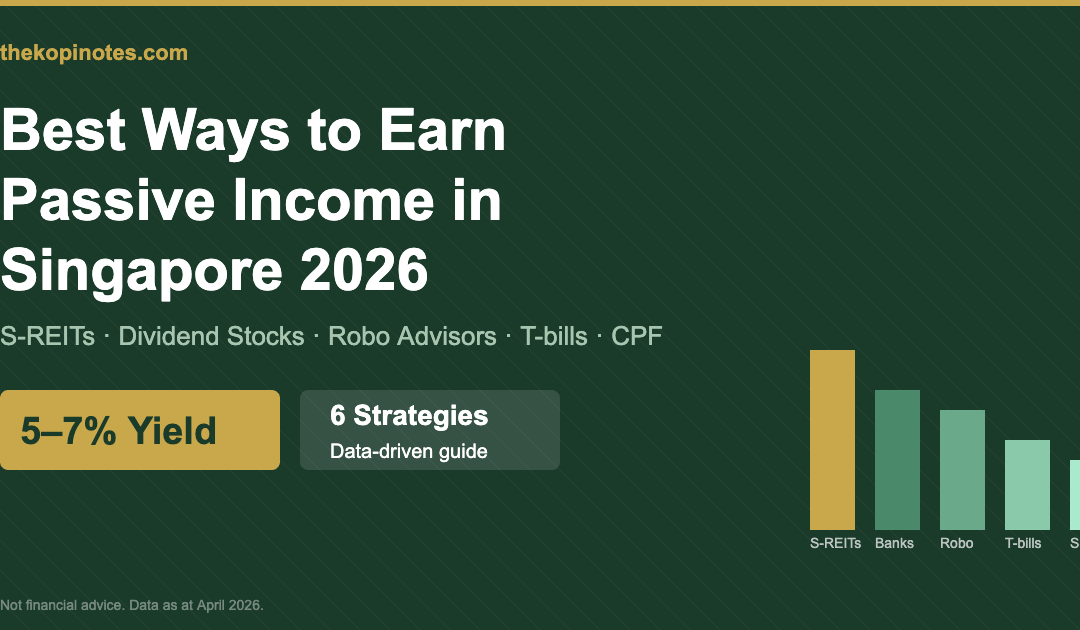
Singapore consistently ranks among the most expensive cities in the world, yet it also offers some of Asia’s most accessible passive income vehicles — from tax-exempt S-REIT distributions to CPF interest rates that outpace most bank deposits. In 2026, with SORA at a multi-year trough of around 1.07% and the iEdge S-REIT Index offering distribution yields of 5–7%, the case for building a passive income portfolio in Singapore has rarely been stronger.
This guide covers every practical route to passive income available to Singapore residents in 2026: S-REITs, dividend stocks, robo advisors, Singapore Savings Bonds, T-bills, CPF strategies, and REIT ETFs. We include actual yield data (as at Q1 2026), original calculations, and an honest comparison of risk versus return so you can decide which approach — or combination — fits your situation best.
Disclaimer: This article is for informational and educational purposes only and does not constitute financial advice. All yield figures are based on publicly available data as at Q1 2026. Past distributions are not a guarantee of future payouts. Consult a licensed financial adviser before making investment decisions.
Table of Contents
Table of Contents — Click to Expand
- What Counts as Passive Income in Singapore?
- Strategy 1: S-REITs — The Workhorse of Singapore Passive Income
- Strategy 2: Singapore Dividend Stocks (Banks & Blue Chips)
- Strategy 3: Robo Advisors & Income Portfolios
- Strategy 4: T-Bills & Singapore Savings Bonds
- Strategy 5: CPF — The Risk-Free Foundation
- Strategy 6: S-REIT ETFs on SGX
- Passive Income Comparison Table
- How to Build a Passive Income Portfolio in Singapore
- Frequently Asked Questions
- The Kopi Notes Verdict
What Counts as Passive Income in Singapore?
Passive income is money earned with minimal ongoing active effort — interest on deposits, dividends from stocks and REITs, rental income, or distributions from funds. The good news for Singapore residents: most investment income is tax-exempt. Singapore does not impose a capital gains tax. Dividends from Singapore-listed companies and S-REIT distributions are paid gross of tax at the investor level (the REIT or company pays corporate tax or property tax at the trust level). Interest income from SSBs and fixed deposits is also not taxed in the hands of individuals.
This tax-friendly environment means every dollar of yield you earn is yours to keep — a structural advantage compared to many developed markets where dividend and interest income can face marginal tax rates of 20–45%. Combine that with Singapore’s deep capital markets, SGX-listed S-REITs with mandatory 90%+ distribution payouts, and a stable regulatory framework under MAS, and the city-state becomes an exceptionally favourable base for income investing.
With that context set, let us walk through each strategy in descending order of yield potential.
Strategy 1: S-REITs — The Workhorse of Singapore Passive Income
Why S-REITs Dominate Passive Income Portfolios
Singapore Real Estate Investment Trusts (S-REITs) are listed on SGX and legally required to distribute at least 90% of their taxable income to unitholders each year. This structure, mandated by MAS under the Code on Collective Investment Schemes (Property Fund Appendix), makes S-REITs the single most popular passive income vehicle among Singapore retail investors — and for good reason. As at Q1 2026, the sector trades at a trailing distribution yield of roughly 5.5–7.5%, well above CPF-OA rates, bank deposits, and most bond yields.
S-REIT distributions are typically paid quarterly or semi-annually in Singapore dollars. They require no management effort from the investor beyond monitoring gearing levels and distribution per unit (DPU) trends. Unitholders receive their payout directly into their brokerage account or CDP, making it true set-and-collect passive income.
How to Calculate S-REIT Yield
The distribution yield formula is straightforward:
Distribution Yield (%) = (Annual DPU ÷ Current Unit Price) × 100
Example: Mapletree Industrial Trust (ME8U) pays a trailing 12-month DPU of S$0.1388. At a unit price of S$2.10:
Yield = (0.1388 ÷ 2.10) × 100 = 6.61%
This is the trailing yield based on historical payouts. Forward-looking yield may differ if DPU grows (positive) or declines (negative) in the next financial year.
S-REIT Yield Comparison Table (Q1 2026)
The table below covers 10 major S-REITs across key sectors. Data sourced from SGX company announcements and quarterly results releases. Gearing limit under MAS Property Fund Appendix: 50% (with ICR ≥ 2.5×) or 45% without.
| S-REIT | SGX Code | Asset Type | DPU (TTM, S$) | Unit Price (S$) | Yield | Gearing |
|---|---|---|---|---|---|---|
| CapitaLand Integrated Commercial Trust | C38U | Retail/Office | 0.107 | 1.92 | 5.6% | 40.2% |
| Mapletree Pan Asia Commercial Trust | N2IU | Retail/Office | 0.0848 | 1.27 | 6.7% | 40.6% |
| Mapletree Industrial Trust | ME8U | Industrial/Data Centre | 0.1388 | 2.10 | 6.6% | 39.7% |
| Mapletree Logistics Trust | M44U | Logistics/Warehouse | 0.0840 | 1.39 | 6.0% | 39.8% |
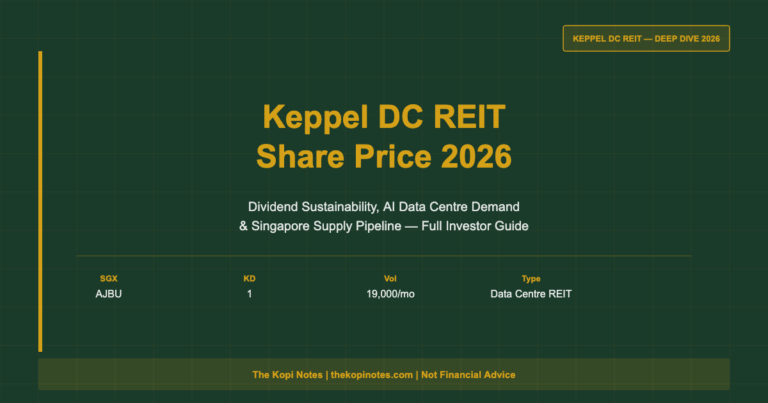
| Keppel DC REIT | AJBU | Data Centre | 0.0927 | 2.08 | 4.5% | 37.2% |
| Frasers Centrepoint Trust | J69U | Suburban Retail | 0.120 | 2.16 | 5.6% | 38.3% |
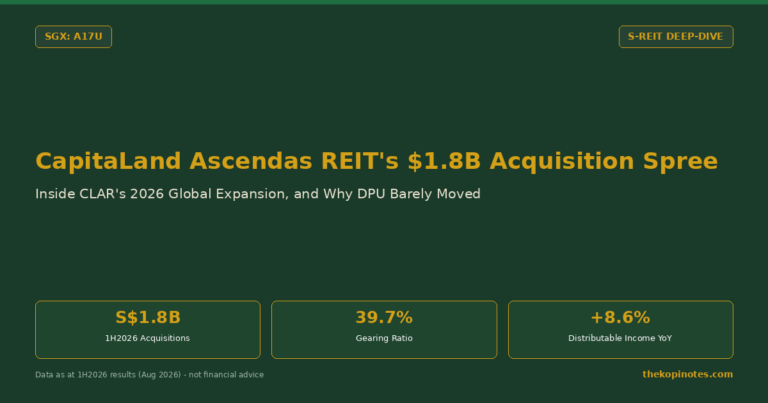
| CapitaLand Ascendas REIT | A17U | Industrial/Business Park | 0.154 | 2.57 | 6.0% | 38.5% |
| Parkway Life REIT | C2PU | Healthcare | 0.148 | 3.58 | 4.1% | 35.5% |
| Keppel REIT | K71U | Office | 0.058 | 0.875 | 6.6% | 40.9% |
| Suntec REIT | T82U | Office/Retail/Convention | 0.0641 | 1.10 | 5.8% | 43.5% |
Data as at Q1 2026. DPU = trailing 12-month distributions per unit. Unit prices indicative. Not a recommendation to buy or sell. Sources: SGX company announcements, Mapletree/CapitaLand/Keppel/Frasers investor relations pages.
Key Risk: Interest Rate Sensitivity and Gearing
S-REITs carry debt (gearing), and their distributions are sensitive to borrowing costs. With SORA having fallen from a peak of ~3.03% to around 1.07% by early 2026, S-REITs with floating-rate debt are seeing natural interest cost tailwinds — a positive DPU recovery catalyst. However, gearing above 40% (as seen in Suntec, MPACT, and CICT) still warrants attention should rates reverse. MAS caps aggregate leverage at 50% (with interest coverage ratio ≥ 2.5×) or 45% without — a guardrail that limits the most aggressive leverage plays.
For a deeper breakdown of individual S-REITs, read our Best S-REITs Singapore 2026 guide which ranks the top picks by sector with a full risk/reward analysis.
Strategy 2: Singapore Dividend Stocks — Banks & Blue Chips
Singapore’s three local banks — DBS (D05), OCBC (O39), and UOB (U11) — are among the most reliable dividend payers on SGX. Unlike S-REITs, banks are not required to distribute 90% of income, but their strong capital generation has supported progressive and often special dividend policies over the years. As at Q1 2026, the trio offers trailing dividend yields in the 4.5–5.5% range — competitive with many S-REITs, but with the added benefit of capital appreciation potential.
| Stock | SGX Code | Annual DPS (S$) | Share Price (S$) | Div Yield | Payout Freq. |
|---|---|---|---|---|---|
| DBS Group | D05 | 2.16 | ~44.00 | 4.9% | Quarterly |
| OCBC Bank | O39 | 0.90 | ~16.50 | 5.5% | Semi-Annual |
| UOB | U11 | 1.80 | ~33.80 | 5.3% | Semi-Annual |
Beyond banks, other blue-chip SGX dividend payers include Keppel Ltd (BN4), Venture Corporation (V03), and Singapore Telecommunications (Z74). Blue chips differ from S-REITs in that dividends are not guaranteed and can be cut in a downturn — as seen in 2020 when MAS required banks to cap dividends at 60% of 2019 levels. That said, the Singapore banks bounced back strongly and have grown dividends consistently since 2022.
For a tax-advantaged angle, DBS, OCBC, and UOB shares can be held inside a CPF Investment Scheme (CPFIS-OA) account, allowing you to earn dividends while using CPF monies that would otherwise earn 2.5% in the OA. Read our CPF investment strategy guide for the full mechanics.
Strategy 3: Robo Advisors & Income Portfolios
For investors who want professionally managed passive income without selecting individual REITs or stocks, robo advisors offer income-focused portfolios that blend bonds, REITs, and dividend equities. Two platforms dominate the Singapore market for income investing: Syfe and Endowus.
Syfe Income+ offers three income portfolio options targeting projected distribution yields of roughly 4.5–6.5% per annum, paid monthly. The portfolios invest in a mix of Asian investment-grade bonds, S-REITs, and global high-yield assets. There are no lock-up periods and no minimum holding periods — you can withdraw anytime. The platform fee ranges from 0.35–0.65% p.a. depending on AUM. Syfe also accepts CPF-OA and SRS funds for certain portfolios, which is a meaningful advantage for CPF investors seeking yield above 2.5%.
Endowus Income Portfolios take a more globally diversified approach using institutional-class fund share classes (with trailer fee rebates passed back to investors). Their Passive Income portfolio targets ~4–5.5% annual income, with automatic reinvestment or monthly cash-out options. Endowus is also one of the few platforms that accepts CPF-OA, CPF-SA, and SRS funds for investment, making it particularly useful for retirement planning. Management fees start at 0.25% p.a. (for amounts above S$200k) to 0.60% p.a. for smaller portfolios.
Both platforms are regulated by MAS as Registered Fund Management Companies (RFMCs). If you are new to either platform, check our Syfe referral code page and Endowus referral code page for the latest sign-up promotions and fee waivers.
Strategy 4: T-Bills & Singapore Savings Bonds
For capital-safe passive income with zero credit risk (backed by the Singapore government), T-bills and Singapore Savings Bonds (SSBs) are the benchmark. They won’t match S-REIT yields, but they are the only passive income instruments in Singapore with essentially zero default risk.
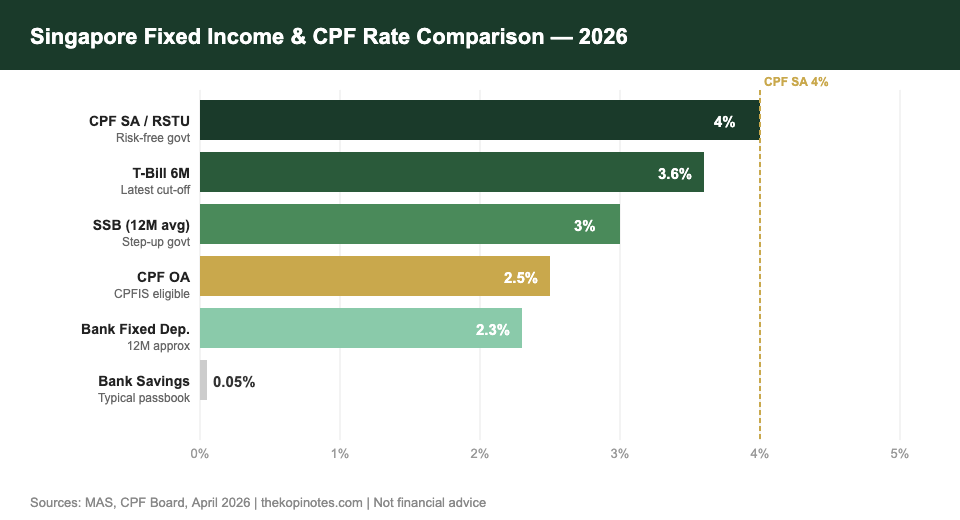
6-Month T-Bills: Singapore’s 6-month Monetary Authority of Singapore bills trade at a cut-off yield of approximately 3.5–3.7% p.a. as at Q1 2026. You can apply via DBS/OCBC/UOB internet banking or ATM, or via CDP, using cash or CPF-OA funds. T-bills are ideal for the capital preservation portion of your passive income portfolio — money you need liquid within 12 months and cannot afford to risk on REITs.
Singapore Savings Bonds (SSBs): SSBs offer a step-up interest structure over 10 years, with the blended 10-year average yield running around 2.8–3.2% p.a. for recent issues. The key attraction is full liquidity (redeem in any month with no penalty) and the MAS guarantee. Each Singapore resident can hold up to S$200,000 in SSBs. Application is via the SSB website through your bank or ATM.
Fixed Deposits: Singapore bank 1-year fixed deposits currently offer around 2.5–3.0% p.a. for amounts above S$10,000. For amounts above S$250,000 (or for private banking clients), rates can exceed 3.5%. These are useful for short-term capital parking but lack the upside of equity-linked passive income.
The takeaway: T-bills and SSBs form an excellent risk-free core in a passive income portfolio — allocate what you cannot afford to lose here, then deploy the surplus into higher-yielding S-REITs and dividend stocks.
Strategy 5: CPF — The Risk-Free Foundation
CPF is often overlooked in passive income discussions because it is locked up until retirement — but it earns guaranteed government-backed interest that compounds tax-free. Understanding CPF rates is essential context for any Singapore passive income strategy.
- CPF Ordinary Account (OA): 2.5% p.a. The first S$60,000 of combined CPF balances (with a cap of S$20,000 from OA) earns an additional 1% — effectively 3.5% on the first S$20,000 in OA.
- CPF Special Account (SA): 4.0% p.a. As at January 2025, MAS closed the SA to voluntary cash top-ups and OA-to-SA transfers for members below age 55. The SA still earns 4.0% on existing balances and on mandatory contributions.
- MediSave Account (MA): 4.0% p.a.
- Retirement Account (RA): 4.0% p.a. (for members aged 55+).
The CPF-SA’s 4.0% risk-free return remains the benchmark for evaluating any passive income investment. If a robo advisor’s income portfolio targets 4.5% net of fees, the incremental pickup over the SA’s guaranteed 4% is only 0.5% — for considerably more risk. In contrast, S-REITs at 6–7% offer a meaningful spread of 2–3 percentage points above the SA rate, which may justify the additional risk for investors with a longer horizon.
For CPF members looking to deploy OA funds into higher-yielding assets, the CPF Investment Scheme (CPFIS-OA) allows investment in approved S-REITs, unit trusts, and ETFs — provided you maintain the first S$20,000 in your OA as cash. Check our CPF investment strategy guide for the approved instrument list and step-by-step instructions.
Strategy 6: S-REIT ETFs on SGX
For investors who want S-REIT exposure without the concentration risk of picking individual trusts, two dedicated S-REIT ETFs trade on SGX:
Lion-Phillip S-REIT ETF (SGX: CLR) tracks the Morningstar Singapore REIT Yield Focus Index, selecting REITs with high and sustainable distributions. Distribution yield is approximately 5.5–6.5% p.a. (paid semi-annually), and the total expense ratio (TER) is 0.60% p.a. The portfolio holds 20–25 Singapore-listed REITs, providing broad sector diversification across retail, industrial, office, logistics, and healthcare. It is one of the most popular REIT ETFs in Singapore for retail investors seeking a hands-off S-REIT allocation.
Phillip SGX APAC Dividend Leaders REIT ETF (SGX: BYJ) takes a broader Asia-Pacific scope — it includes Australian A-REITs, Hong Kong REITs, and other APAC listed trusts alongside S-REITs. Distribution yield is approximately 5–6% p.a. and the TER is 0.50% p.a. The wider geographic footprint means currency exposure, which may suit or penalise depending on the SGD’s relative strength.
Both ETFs can be bought through any SGX-connected brokerage (DBS Vickers, OCBC Securities, moomoo, Tiger Brokers, FSMOne). For FSMOne’s fee structure and any cashback promotions, see our FSMOne referral code page. For a comprehensive breakdown of S-REIT ETFs vs individual REIT selection, read our Singapore REIT ETF Guide.
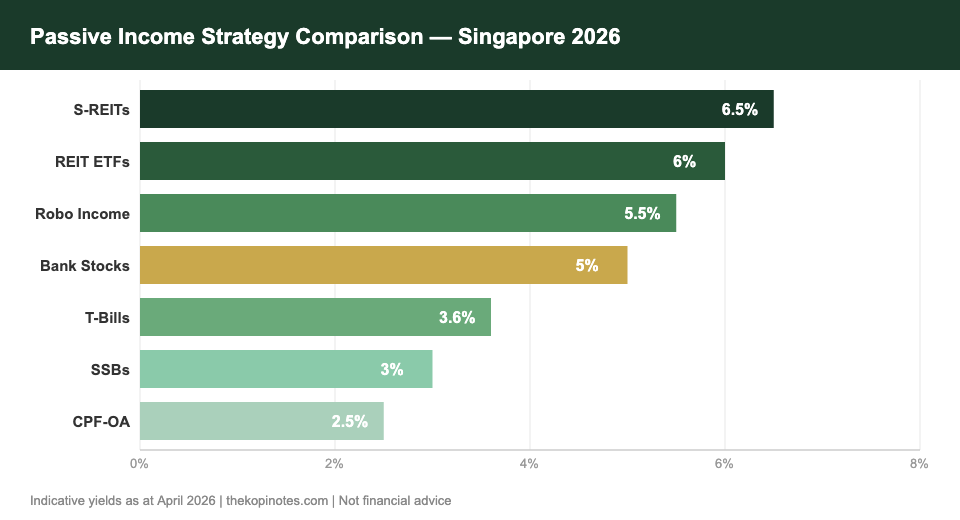
Passive Income Strategy Comparison (Singapore 2026)
| Strategy | Indicative Yield | Risk Level | CPF/SRS Eligible | Liquidity | Effort |
|---|---|---|---|---|---|
| S-REITs (individual) | 5–7.5% | Medium | ✅ CPFIS-OA | High (SGX) | Medium |
| Dividend Stocks (Banks) | 4.5–5.5% | Medium | ✅ CPFIS-OA | High (SGX) | Low |
| Robo Advisor (Income) | 4–6.5% | Low–Medium | ✅ Syfe/Endowus | High (T+3) | Very Low |
| S-REIT ETF (CLR/BYJ) | 5–6.5% | Medium | ✅ CPFIS-OA | High (SGX) | Very Low |
| 6-Month T-Bills | 3.5–3.7% | Very Low | ✅ CPF-OA | Medium (6mo) | Low |
| Singapore Savings Bonds | 2.8–3.2% | Negligible | ❌ Cash only | High (monthly) | Very Low |
| CPF (OA/SA) | 2.5–4.0% | None | N/A (is CPF) | Locked (age 55+) | None |
How to Build a Passive Income Portfolio in Singapore
There is no single passive income formula that suits every investor — your allocation depends on age, risk tolerance, existing CPF balances, and income goals. That said, here is a practical tiered framework used by many Singapore income investors:
Tier 1: Capital Safety Base (15–25% of liquid savings)
Allocate to SSBs and T-bills — zero credit risk, full government backing, and decent returns of 3–3.7% in the current rate environment. This is your emergency fund equivalent that still earns meaningful passive income. Target: enough to cover 6–12 months of expenses.
Tier 2: Core S-REIT and Dividend Stock Allocation (50–65%)
The bulk of your passive income engine. Combine 3–5 S-REITs across sectors (e.g., a retail REIT like CICT for stability, an industrial REIT like CapitaLand Ascendas REIT for growth, and a diversified trust like Mapletree Industrial Trust for data centre exposure) with 1–2 Singapore bank stocks for dividend stability. Target yield: 5.5–7% on this tranche.
Tier 3: Growth or Managed Income (15–25%)
Robo advisor income portfolios or a S-REIT ETF for diversification without stock-picking effort. This layer also makes sense for SRS or CPFIS-OA funds where you want investment management without active stock selection. Target yield: 4.5–6%.
To model how much passive income you need for retirement, use our Singapore Retirement Planning Calculator — input your target monthly income and it will calculate the required portfolio size at various yield assumptions.
Frequently Asked Questions: Passive Income Singapore
How much money do I need to earn $3,000/month passive income in Singapore?
At a blended portfolio yield of 6% (a realistic target with a mix of S-REITs and dividend stocks), you would need a portfolio of approximately S$600,000 to generate S$3,000 per month (S$36,000 per year) in passive income. At a more conservative 4.5% yield, the required portfolio rises to S$800,000. Use our retirement calculator to model your own numbers with different yield and withdrawal rate assumptions.
Is passive income from S-REITs taxable in Singapore?
For Singapore tax residents holding S-REITs in a standard CDP or brokerage account, S-REIT distributions are tax-exempt at the individual investor level. The REIT pays any applicable tax at the trust level under Singapore’s property tax and income tax framework. This means 100% of the distribution per unit you receive is yours to keep — a significant advantage over bond interest or rental income in many other jurisdictions.
Can I use my CPF to invest in S-REITs?
Yes. Under the CPF Investment Scheme (CPFIS-OA), you can invest OA funds in approved SGX-listed S-REITs and unit trusts, provided your OA balance remains above S$20,000 after the investment. Note that CPFIS-SA (Special Account) has been closed to new investments since October 2023 following MAS policy changes, and you can no longer top up or transfer to the SA voluntarily since January 2025. For details, see our CPF investment strategy guide.
What is a safe gearing level for an S-REIT?
MAS limits S-REIT gearing to 50% of total assets (with interest coverage ratio ≥ 2.5×) or 45% without that ICR buffer. As a practical rule of thumb, most institutional investors consider gearing below 40% comfortable, 40–45% as elevated but manageable, and above 45% as a potential risk flag — especially in a rising interest rate environment. Several REITs in the comparison table above fall in the 38–41% range, which is broadly acceptable given current SORA levels.
How often do S-REITs pay distributions?
Most S-REITs pay distributions either quarterly or semi-annually. A few smaller trusts pay annually. The exact payment schedule is disclosed in each REIT’s distribution announcement on SGX. By building a diversified portfolio of S-REITs with staggered payment dates, it is possible to receive distributions almost every month of the year.
Are robo advisors safe for passive income investing in Singapore?
MAS-regulated robo advisors like Syfe and Endowus hold client assets in segregated custodian accounts — meaning your funds are legally separated from the company’s own assets. In the unlikely event of the platform’s insolvency, your investments would be transferred or returned. That said, the underlying investments (REITs, bonds, equities) can still lose value — there is no capital guarantee on income portfolios. Both platforms are also MAS-licensed Registered Fund Management Companies (RFMCs), providing an additional regulatory safeguard.
What is the best passive income investment for beginners in Singapore?
For complete beginners, the lowest-effort entry points are: (1) a robo advisor income portfolio (Syfe or Endowus — minimum S$100, no stock-picking required), or (2) a S-REIT ETF like Lion-Phillip S-REIT ETF (CLR) via a low-cost broker. Both options give instant diversification across multiple REITs or assets with a single investment decision, making them ideal while you build knowledge of individual S-REIT selection.
How does SORA affect S-REIT passive income?
SORA (Singapore Overnight Rate Average) is the benchmark interest rate that S-REITs with floating-rate debt reference for their borrowing costs. When SORA rises, interest expenses increase → DPU falls. When SORA falls (as it has done from a 3.03% peak to around 1.07% in early 2026), interest costs decline → DPU recovery becomes possible. This is why the current SORA environment is bullish for S-REIT passive income — falling borrowing costs are a tailwind for distribution growth in highly leveraged trusts.
The Kopi Notes Verdict: Best Passive Income Strategy for Singapore 2026
In 2026, S-REITs remain the most compelling passive income vehicle for Singapore investors who can tolerate moderate market volatility. With trailing yields of 5.5–7.5%, quarterly distributions, CPF compatibility, and a favourable SORA tailwind, the case for allocating to a diversified basket of S-REITs as the core of your passive income portfolio is well-supported by data.
That said, the optimal strategy is not all-in on REITs. A sensible passive income framework for most Singapore investors looks like: a capital safety base in T-bills and SSBs, a core S-REIT and dividend stock allocation earning 5.5–7%, and a managed layer via robo advisors or REIT ETFs for CPF/SRS funds or those who prefer hands-off management.
The worst mistake is leaving everything in a bank savings account earning 0.05–0.1% when T-bills are at 3.5%+ and S-REITs are at 6%+. The opportunity cost of inertia is measurable and significant over a decade of compounding.
Start small, diversify across sectors, reinvest distributions in the early years, and let time do the work. Singapore’s tax-free investment income environment is one of the most investor-friendly frameworks in the world — take advantage of it.
References
- MAS Code on Collective Investment Schemes — Property Fund Appendix (gearing and distribution requirements for S-REITs)
- SGX REITs & Property Trusts Listings (unit prices, DPU announcements)
- CPF Board — CPF Interest Rates (OA, SA, MA, RA rates)
- MAS — Singapore Overnight Rate Average (SORA)
This article was researched with the help of AI. While we strive to keep all information accurate and up to date, there may be errors. If you notice any discrepancies, please contact us.