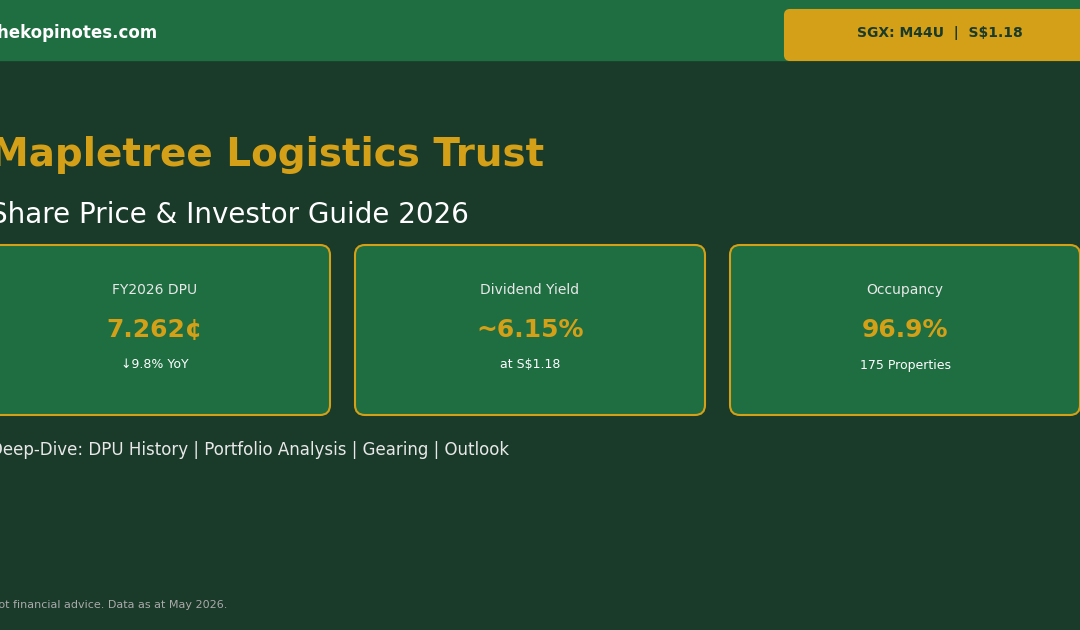
Mapletree Logistics Trust (MLT) Share Price & Investor Guide 2026
A deep-dive into SGX: M44U — DPU history, portfolio analysis, gearing, yield outlook and whether MLT belongs in your dividend portfolio.
Data as at May 2026. Not financial advice. Always do your own due diligence.
Mapletree Logistics Trust (SGX: M44U), commonly known as MLT, is one of Asia’s largest and most geographically diversified logistics REITs. Listed on the Singapore Exchange since 2005, MLT holds a portfolio of 175 properties spread across nine countries, with assets under management of approximately S$13 billion as at September 2025.
For Singapore dividend investors, MLT has long been a core holding — offering exposure to the booming Asia-Pacific logistics sector while delivering regular quarterly distributions. But FY2026 brought real headwinds: full-year DPU fell 9.8% year-on-year to 7.262 cents, driven by divestment activity and persistent currency pressure from China. With the share price sitting around S$1.18 in May 2026, the forward yield is approximately 6.15% — still attractive in the current interest rate environment.
This guide covers everything you need to know about MLT: its share price history, DPU track record, portfolio geography, gearing, analyst outlook, and how it stacks up against S-REIT peers. We also flag where to buy it — including through Endowus, Syfe, and FSMOne.
Table of Contents
Contents — Click to expand
- MLT at a Glance — Key Facts & Metrics
- MLT Share Price Analysis 2026
- DPU History & Distribution Track Record
- Portfolio Overview — 175 Properties Across 9 Countries
- Financial Health — Gearing, ICR & Debt Profile
- Yield Comparison vs S-REIT Peers
- MLT 2026 Outlook & Analyst Targets
- Buying MLT with CPF or SRS
- Where to Buy MLT in Singapore
- FAQ
MLT at a Glance — Key Facts & Metrics
Here is a quick-reference snapshot of Mapletree Logistics Trust as at May 2026:
| Metric | Value |
|---|---|
| SGX Ticker | M44U |
| Share Price (May 2026) | ~S$1.18 |
| Market Capitalisation | ~S$5.4 billion |
| FY2026 Full-Year DPU | 7.262 cents (↓9.8% YoY) |
| Forward Dividend Yield | ~6.15% |
| Distribution Frequency | Quarterly |
| Portfolio Properties | 175 properties, 9 countries |
| Assets Under Management | ~S$13 billion |
| Occupancy Rate | 96.9% (FY2026) |
| Aggregate Leverage (Gearing) | ~40.7% |
| Analyst Price Target Range | S$1.45 – S$1.55 |
| Sponsor | Mapletree Investments (Temasek-linked) |
| Financial Year End | 31 March |
MLT Share Price Analysis 2026
Mapletree Logistics Trust’s share price has been under pressure since early 2022, when rising global interest rates made REITs less attractive relative to risk-free bonds. From a peak of around S$2.00 in late 2021, the share price declined steadily and now trades around S$1.18 in May 2026 — a level not seen since 2019.
The key share price drivers for MLT in 2026 are:
- Interest rate trajectory: As the US Federal Reserve and MAS maintain a higher-for-longer rates environment, REIT valuations face headwinds. Any rate cuts would be a positive catalyst for MLT’s share price.
- China exposure: Approximately 17% of MLT’s gross revenue comes from China, where rental reversions remain negative (–9.4% as at 3QFY26 before improving). China’s logistics property market has seen weaker demand and oversupply in some submarkets.
- DPU decline: Two consecutive years of DPU reduction (FY2025: –11%; FY2026: –9.8%) have weighed on sentiment. Income investors are sensitive to distribution cuts.
- Asset recycling: MLT’s plan to divest S$100M–S$150M of China/HK assets and redeploy capital into India and Vietnam is a positive long-term strategy, but creates near-term income uncertainty.
At current prices, MLT trades at a meaningful discount to its net asset value (NAV), which analysts estimate at around S$1.35–S$1.45. This NAV discount, combined with a 6%+ yield, is what’s attracting value-oriented investors at these levels.
For a broader context on S-REIT valuations, see our Best S-REITs Singapore 2026 guide and our S-REIT Yield vs Bond Spread Calculator.
DPU History & Distribution Track Record
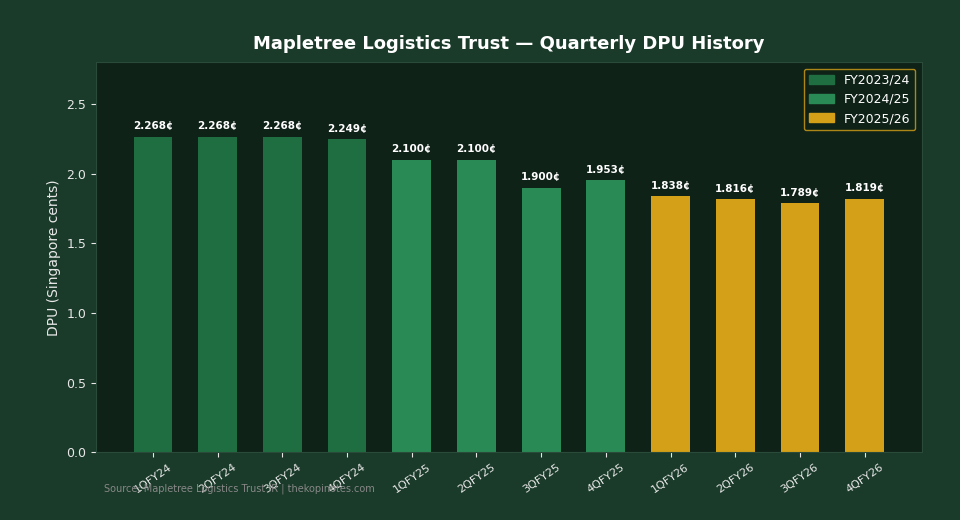
MLT pays distributions quarterly. The table below summarises the full-year and quarterly DPU track record:
| Quarter | DPU (cents) | YoY Change |
|---|---|---|
| FY2023/24 — Full Year: 9.053 cents | ||
| 1Q FY23/24 | 2.268 | — |
| 2Q FY23/24 | 2.268 | — |
| 3Q FY23/24 | 2.268 | — |
| 4Q FY23/24 | 2.249 | — |
| FY2024/25 — Full Year: 8.053 cents (↓11.0%) | ||
| 1Q FY24/25 | 2.100 | ↓7.4% |
| 2Q FY24/25 | 2.100 | ↓7.4% |
| 3Q FY24/25 | 1.900 | ↓16.2% |
| 4Q FY24/25 | 1.953 | ↓13.2% |
| FY2025/26 — Full Year: 7.262 cents (↓9.8%) | ||
| 1Q FY25/26 | 1.838 | ↓12.5% |
| 2Q FY25/26 | 1.816 | ↓13.5% |
| 3Q FY25/26 | 1.789 | ↓5.8% |
| 4Q FY25/26 | 1.819 | ↓7.0% |
Source: Mapletree Logistics Trust Investor Relations. Past DPU is not a guarantee of future distributions.
The DPU trend reflects two key challenges: (1) divestment of income-producing assets (reducing NPI), and (2) a weakening of regional currencies against the Singapore dollar, particularly the Chinese yuan and Japanese yen. The positive news is that the rate of decline appears to be moderating — 4QFY26 DPU of 1.819 cents was actually slightly higher quarter-on-quarter versus 3Q’s 1.789 cents, suggesting the trough may be near.
Want to model your MLT income? Use our Dividend Portfolio Yield Calculator or the REITs Dividend Yield Calculator.
Portfolio Overview — 175 Properties Across 9 Countries
MLT’s geographic diversification is both its strength and a source of complexity. As at September 2025, the portfolio spans:
| Market | % of Revenue | Key Highlights |
|---|---|---|
| Singapore | ~16% | Prime logistics hub; high occupancy, positive reversions |
| China | ~17% | Negative reversions moderating; targeted for divestment |
| Japan | ~21% | Largest revenue contributor; yen weakness a headwind |
| Australia | ~14% | Strong e-commerce demand; acquisition pipeline active |
| South Korea | ~12% | Positive reversions; modern cold-chain assets |
| Malaysia | ~7% | Data centre-adjacent; growing industrial market |
| India | ~5% | Target for growth; fast-expanding logistics sector |
| Vietnam | ~4% | Supply chain diversification beneficiary |
| Hong Kong SAR | ~4% | Under review for divestment alongside China |
Overall portfolio occupancy reached 96.9% by the end of FY2026 — a healthy figure that speaks to the structural demand for logistics space across Asia-Pacific. Ex-China rental reversions were positive at +4.2%, indicating that the core portfolio (outside of the China drag) is performing well.
Management’s strategic pivot is clear: reduce exposure to China and Hong Kong, and grow in India, Vietnam, and Australia — markets where the logistics demand-supply balance is more favourable and rental growth prospects are stronger. The planned S$100M–S$150M asset recycling program is a meaningful step in this direction.
Financial Health — Gearing, ICR & Debt Profile
MLT’s balance sheet quality is a key factor for assessing distribution sustainability. The MAS regulatory gearing limit for S-REITs is 50% (or 55% with a minimum ICR of 2.5x). Here are the key financial metrics:
| Metric | Value | Comment |
|---|---|---|
| Aggregate Leverage | ~40.7% | Below MAS 50% limit; moderate headroom |
| Cost of Debt | ~2.6% | Relatively low; benefits from yen-denominated debt |
| FY2026 Revenue | S$708.3M | ↓2.6% YoY due to divestments and FX |
| Distribution Payout | 100% of distributable income | REIT structure mandates 90%+ distribution |
At 40.7% gearing, MLT has approximately S$1.2–1.5 billion of debt headroom before approaching the 50% regulatory cap. This gives management flexibility for selective acquisitions — particularly in high-growth markets like India — without needing to issue equity at depressed prices.
The cost of debt at 2.6% is notably low, partly because MLT finances some of its Japanese and other Asian assets in local currency, benefiting from lower interest rates in those markets. This hedging strategy reduces refinancing risk but introduces currency translation risk on distributions.
Use our S-REIT Gearing Ratio & ICR Calculator to model MLT’s debt headroom under different scenarios, or the S-REIT Total Return Calculator to estimate your total return including capital appreciation.
Yield Comparison vs S-REIT Peers
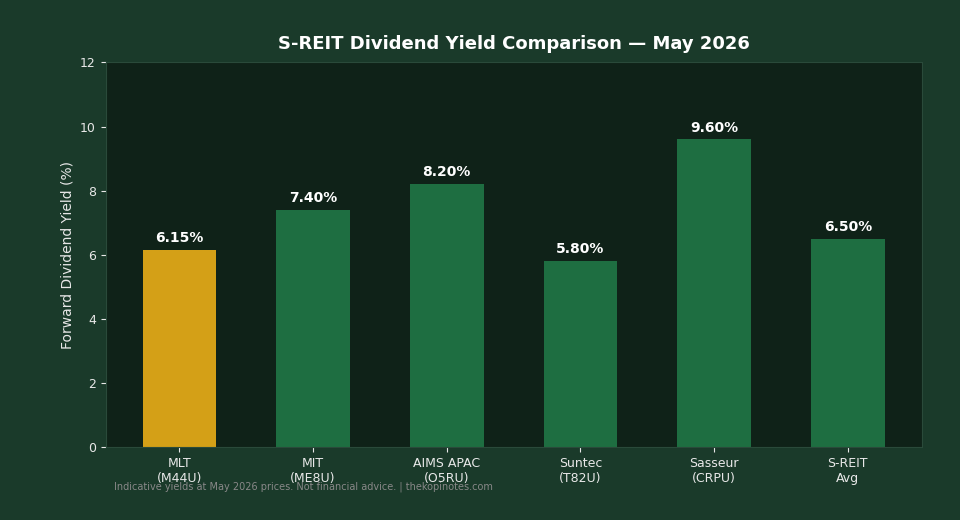
At a forward dividend yield of approximately 6.15%, MLT sits in the mid-range of the S-REIT universe. Here is how it compares to selected peers as at May 2026:
| REIT | Ticker | Fwd Yield | Gearing | Sector |
|---|---|---|---|---|
| Mapletree Logistics Trust | M44U | ~6.15% | 40.7% | Logistics |
| Mapletree Industrial Trust | ME8U | ~7.40% | ~41% | Industrial/Data Centre |
| AIMS APAC REIT | O5RU | ~8.20% | ~35% | Industrial |
| Suntec REIT | T82U | ~5.80% | ~44% | Office/Retail |
| Sasseur REIT | CRPU | ~9.60% | ~26% | Outlet Mall (China) |
| S-REIT Average | — | ~6.50% | — | Mixed |
Indicative yields based on May 2026 prices. Not financial advice.
MLT’s 6.15% yield is slightly below the S-REIT average, reflecting its large portfolio, blue-chip sponsor (Temasek-linked Mapletree Investments), and the quality premium investors assign to its diversified logistics assets. If you are yield-hunting, AIMS APAC or Sasseur may offer higher yields, but they come with higher risk profiles (smaller portfolios, concentrated exposure). For a comparison of industrial S-REITs, see our Best S-REITs 2026 guide.
MLT 2026 Outlook & Analyst Targets
Analysts remain cautiously optimistic on MLT at current levels, with price targets ranging from S$1.45 to S$1.55 — implying 23%–31% upside from the May 2026 price of S$1.18. The bull case rests on several recovery catalysts:
- DPU stabilisation: FY2026 may represent peak DPU pain. Management’s asset recycling strategy (selling weaker China/HK assets, buying India/Vietnam) should improve portfolio quality and rental reversion trends from FY2027 onwards.
- Rental reversion recovery: Ex-China rental reversions of +4.2% demonstrate that the logistics fundamentals across Asia-Pacific remain sound. As China reversions moderate (from –9.4% to gradually less negative), the blended portfolio reversion should improve.
- Rate cuts: Any US Fed rate cuts in late 2026 would benefit REIT valuations broadly, and MLT — trading at a significant discount to NAV — could re-rate meaningfully.
- India growth: India’s logistics sector is expanding rapidly, driven by e-commerce penetration, infrastructure investment, and supply chain reshoring. MLT’s plan to increase India exposure is strategically sound.
- Currency tailwinds: A strengthening yen or yuan would translate into higher SGD-equivalent distributions from MLT’s overseas properties.
The bear case involves further China rental declines, persistent yen weakness, and any equity fundraising at distressed prices. Investors should monitor quarterly results closely, particularly the China occupancy rate and rental reversion data.
For a deeper look at how interest rates affect S-REIT valuations, read our Singapore REIT ETF guide and use our S-REIT Yield vs SGS Bond Spread Calculator.
Buying MLT with CPF or SRS
MLT (SGX: M44U) is eligible for purchase using CPF Ordinary Account (OA) funds through the CPF Investment Scheme (CPFIS-OA). This makes it attractive for Singaporeans looking to put idle CPF OA savings (currently earning 2.5% p.a.) to work in a higher-yielding S-REIT.
Key points for CPF/SRS investors:
- CPFIS-OA eligible: MLT is on the CPF Board’s approved investment list. You can invest CPF OA funds above S$20,000 (after leaving S$20,000 in OA).
- SRS eligible: MLT can also be purchased using Supplementary Retirement Scheme (SRS) funds through your SRS broker account. SRS investments are tax-deductible up to S$15,300/year.
- No withholding tax for Singapore residents: Unlike some overseas REITs, S-REIT distributions to Singapore tax residents are generally not subject to withholding tax at the individual level.
- 6.15% vs CPF OA 2.5%: At current prices, MLT’s yield is roughly 2.5x the CPF OA rate — but comes with capital risk that the CPF OA guarantee does not.
For a comprehensive look at using CPF for investments, see our CPF Investment Strategy guide and our CPF Investment Scheme (CPFIS) Calculator.
Where to Buy MLT in Singapore
You can buy Mapletree Logistics Trust (M44U) through any SGX-connected brokerage. Here are our recommended platforms for Singapore investors:
These are referral links — using them supports The Kopi Notes at no extra cost to you. Always compare platforms for fees, features and suitability before investing.
FAQ — Mapletree Logistics Trust
What is Mapletree Logistics Trust's current share price?
As at May 2026, Mapletree Logistics Trust (SGX: M44U) trades at approximately S$1.18 per unit. The share price has declined significantly from its 2021 peak of ~S$2.00, reflecting rising interest rates and DPU headwinds. Check your brokerage or SGX for the latest live price.
What is MLT's dividend yield in 2026?
Based on the FY2026 full-year DPU of 7.262 cents and a share price of S$1.18, MLT’s dividend yield is approximately 6.15%. Distributions are paid quarterly, making MLT a source of regular passive income.
Did MLT cut its DPU in FY2026?
Yes. MLT’s FY2026 full-year DPU of 7.262 cents was 9.8% lower than FY2025’s 8.053 cents. The decline was driven by the absence of divestment gains and persistent currency headwinds — primarily a weaker Chinese yuan and Japanese yen against the Singapore dollar. However, the rate of decline appears to be moderating heading into FY2027.
Is Mapletree Logistics Trust a good investment in 2026?
This is not financial advice. MLT offers a ~6.15% yield, Temasek-linked sponsorship, a diversified 175-property portfolio, and trades at a discount to NAV. Risks include continued China headwinds, yen weakness, and near-term DPU uncertainty. Analysts have price targets of S$1.45–S$1.55, implying significant upside if sentiment improves. Assess your own risk tolerance and investment horizon before investing.
Can I buy MLT with CPF?
Yes. MLT (M44U) is CPFIS-OA eligible, meaning you can use your CPF Ordinary Account funds to invest in it, subject to CPF Board rules. You must have at least S$20,000 remaining in your OA after investment. Note that CPF funds invested in REITs carry market risk — the value can go down as well as up.
How often does MLT pay dividends?
Mapletree Logistics Trust distributes income quarterly — four times per year. Each quarterly distribution is typically announced together with financial results (1Q, 2Q, 3Q, and 4Q). The financial year runs from 1 April to 31 March.
What is MLT's gearing ratio and is it safe?
MLT’s aggregate leverage (gearing ratio) was approximately 40.7% as at December 2025, below the MAS regulatory limit of 50%. The cost of debt is around 2.6%. At this gearing level, MLT has meaningful debt headroom for acquisitions without risking a rights issue, though investors should monitor this metric if interest rates rise further.
What markets does MLT invest in?
MLT has 175 properties across nine countries: Singapore, China, Japan, Australia, South Korea, Malaysia, India, Vietnam, and Hong Kong SAR. Japan is the largest revenue contributor (~21%), followed by China (~17%) and Singapore (~16%). Management is actively growing the India and Vietnam portfolio while divesting some China and HK assets.
This article was researched with the help of AI. While we strive to keep all information accurate and up to date, there may be errors. If you notice any discrepancies, please contact us.