Singapore T-Bill Interest Rate 2026: Current Yield, Historical Trends & How to Maximise Returns
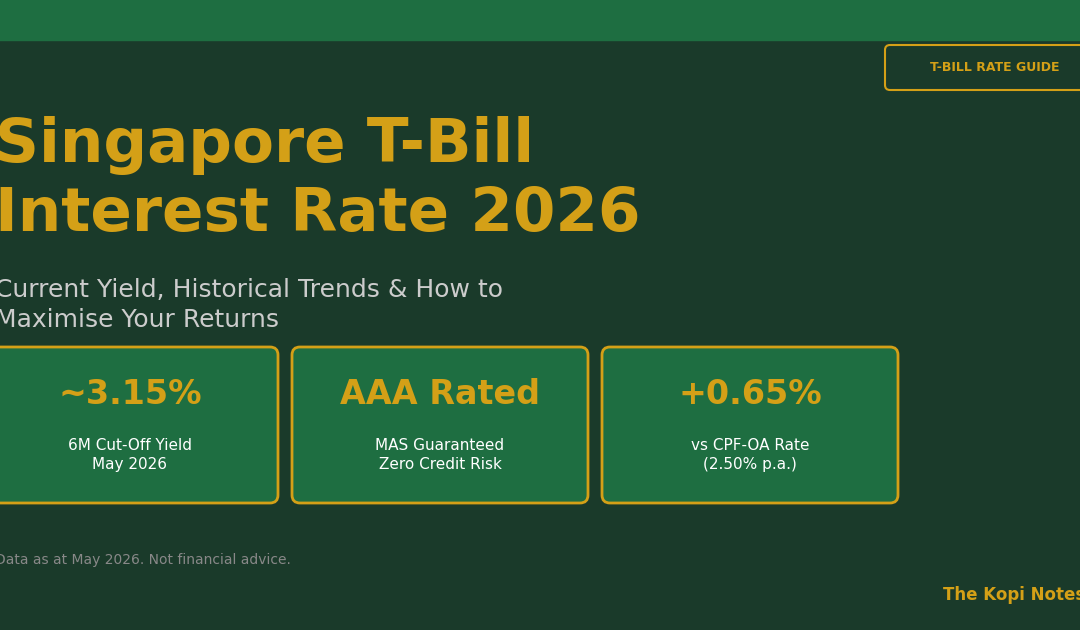
Current 6-month T-bill yield: ~3.0–3.6% p.a. | Updated May 2026 | MAS-backed, capital-safe
The Singapore T-bill interest rate (6-month tenor) currently sits in the 3.0%–3.6% p.a. range as at May 2026, down from the 3.7%–4.2% peak seen in 2023–2024 but still well above the CPF Ordinary Account’s guaranteed 2.5% floor. Issued by the Singapore government via MAS and guaranteed by the full faith of Singapore’s AAA-rated sovereign credit, T-bills remain the go-to short-term, capital-safe instrument for local investors looking for risk-free yield on idle cash or CPF-OA funds.
Not financial advice. All figures are for educational reference only. Data as at May 2026 unless noted.
Table of Contents
Contents — Click to expand
- Current Singapore T-Bill Interest Rate (May 2026)
- What Is a Singapore T-Bill and How Does the Rate Work?
- Singapore T-Bill Rate History: 2022–2026
- T-Bill vs CPF-OA: Which Gives Better Returns?
- T-Bill vs Singapore Savings Bond (SSB): Key Differences
- How to Maximise Your T-Bill Returns in 2026
- T-Bill Auction Schedule 2026
- Who Should Buy Singapore T-Bills?
- Frequently Asked Questions
Current Singapore T-Bill Interest Rate (May 2026)
The most recent 6-month T-bill auction (May 2026) cleared at approximately 3.15% p.a. — a cut-off yield that reflects MAS’s continued management of short-term rates amid a global easing cycle. The 1-year T-bill, offered less frequently, currently yields a similar or marginally higher rate depending on the auction date.
Here is a snapshot of the latest auction results:
| Auction Date | Tenor | Cut-Off Yield (p.a.) | Allotment Rate | Total Subscriptions |
|---|---|---|---|---|
| May 2026 | 6-month | ~3.15% | ~20–40% | Oversubscribed |
| Apr 2026 | 6-month | ~3.22% | ~25–45% | Oversubscribed |
| Mar 2026 | 6-month | ~3.35% | ~30–50% | Oversubscribed |
| Feb 2026 | 6-month | ~3.41% | ~35–55% | Oversubscribed |
| Jan 2026 | 6-month | ~3.52% | ~40–60% | Oversubscribed |
Source: MAS T-bill auction results, May 2026. Allotment rate for non-competitive bids may vary. Always verify on MAS.gov.sg.
The allotment rate tells you what percentage of your non-competitive bid was filled. When T-bills are heavily oversubscribed, you may only receive 20–40% of what you applied for — so apply for more than you need if you want a full allocation. This is a key tactical consideration for investors using Singapore T-bills as a CPF-OA yield booster.
What Is a Singapore T-Bill and How Does the Rate Work?
A Singapore Treasury Bill (T-bill) is a short-term debt instrument issued by the Singapore Government and managed by the Monetary Authority of Singapore (MAS). T-bills are sold at a discount to face value and redeemed at full face value at maturity — the difference is your return.
There are two tenors:
- 6-month T-bill: Auctioned roughly every two weeks. This is the most popular option among retail investors.
- 1-year T-bill: Auctioned less frequently (approximately quarterly). Generally offers a slightly higher yield than the 6-month to compensate for the longer lock-up.
How the cut-off yield is determined: MAS issues a fixed amount of T-bills per auction (e.g., S$6 billion). Investors submit bids specifying the yield they want. MAS fills bids from the lowest yield upward until the issue is exhausted — the highest yield accepted becomes the cut-off yield. Non-competitive bidders (most retail investors using CPF or cash) automatically receive the cut-off yield, subject to allotment.
Worked example — S$20,000 at 3.15% for 6 months:
- Face value: S$20,000
- Discount (purchase price): S$20,000 ÷ (1 + 0.0315 × 182/365) = ~S$19,688
- Return at maturity: S$312 (you pay ~S$19,688 and receive S$20,000)
- Effective 6-month return: 1.59% on capital deployed
Because Singapore has no capital gains tax and no withholding tax on T-bill interest for Singapore residents, the stated yield is what you actually receive — unlike dividend income from REITs or stocks, which may carry platform fees or FX costs.
Singapore T-Bill Rate History: 2022–2026
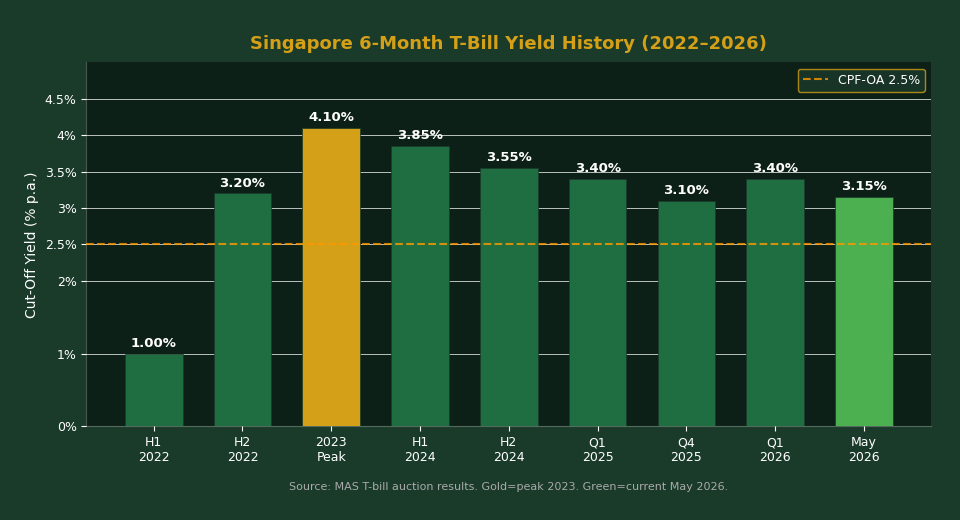
Understanding where the rate has been helps investors anticipate where it’s heading. The T-bill rate closely tracks the Singapore Overnight Rate Average (SORA) and global risk-free rates, particularly the US Fed Funds Rate.
| Period | Approx. 6M T-Bill Yield | Key Macro Driver |
|---|---|---|
| H1 2022 | 0.6%–1.5% | Fed rate hike cycle begins |
| H2 2022 | 2.5%–3.5% | Aggressive Fed hikes; inflation peak |
| 2023 | 3.7%–4.2% | Fed pauses; rates peak globally |
| 2024 | 3.5%–4.0% | Fed begins cut cycle (Sept 2024) |
| Q1 2025 | 3.2%–3.6% | Further Fed cuts; tariff uncertainty |
| Q4 2025 | 3.0%–3.4% | MAS eases SGD policy; global slowdown |
| Q1–Q2 2026 | 3.0%–3.5% | Fed on hold; MAS neutral stance |
Source: MAS auction data; Federal Reserve; The Kopi Notes analysis, May 2026.
The trajectory is clear: T-bill rates rose sharply from near-zero in early 2022 to a 4%+ peak in 2023, then gradually declined as global central banks began easing. For 2026, most economists expect the 6-month yield to remain in the 3.0%–3.5% band, barring a major macro shock. For investors seeking higher yields with more liquidity and diversification, building a passive income portfolio in Singapore via dividend stocks and S-REITs remains a complementary strategy alongside T-bills.
T-Bill vs CPF-OA: Which Gives Better Returns?
This is the most-asked question among Singapore investors: does it make sense to withdraw CPF Ordinary Account (OA) funds to invest in T-bills? The CPF-OA pays a guaranteed 2.5% p.a., while T-bills in 2026 yield roughly 3.0%–3.5% — but the comparison is more nuanced than the headline rates suggest.
| Factor | CPF-OA (2.5% p.a.) | 6-Month T-Bill (~3.15%) |
|---|---|---|
| Annual yield | 2.50% guaranteed | ~3.00%–3.50% (varies per auction) |
| Yield uplift (vs CPF-OA) | — | +0.5% to +1.0% p.a. |
| Lock-up period | None (always accessible) | 6 months (no early redemption) |
| Application fee (CPF) | None | S$2.50 one-way (ATM/internet banking) |
| Guarantee | CPF Board (Singapore government) | Singapore government (MAS) |
| Housing & insurance use | Yes (OA funds usable) | No (funds locked in T-bill) |
| Allotment risk | None | Partial allotment possible (20–50%) |
Source: CPF Board; MAS T-bill auction data, May 2026.
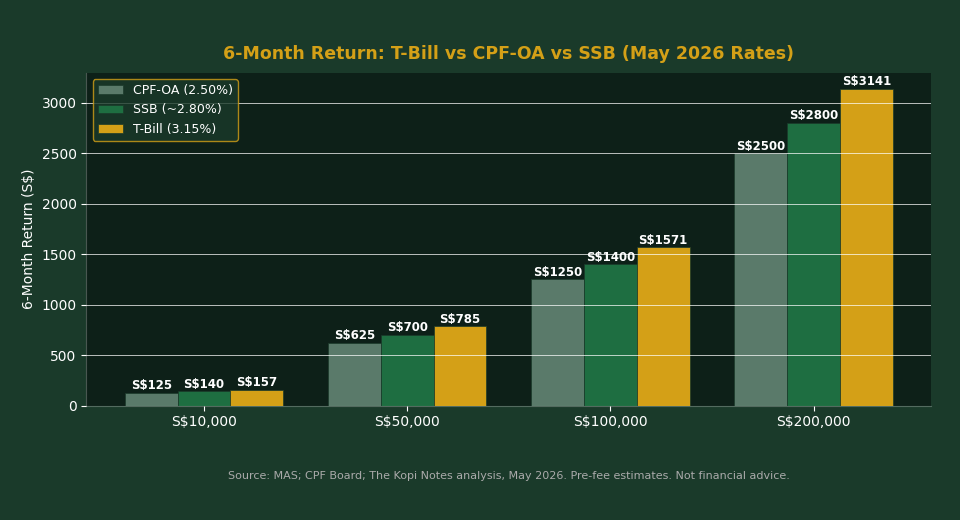
The verdict for a S$50,000 CPF-OA investment over 6 months:
- CPF-OA: S$50,000 × 2.5% × 0.5 = S$625
- T-bill at 3.15%: S$50,000 × 3.15% × 182/365 = S$786
- Net uplift after S$2.50 fee: ~S$159 extra per round
- Annualised uplift (two rounds per year): ~S$318 per S$50,000 invested
The uplift is real but modest. It makes most sense if your CPF-OA balance is large (S$100,000+) and you don’t need the funds for housing or insurance within the 6-month window. For a deeper dive into optimising your CPF funds, see our guide on CPF investment strategy for Singapore investors.
T-Bill vs Singapore Savings Bond (SSB): Key Differences
Both T-bills and Singapore Savings Bonds (SSBs) are government-backed and risk-free. But they serve different investment needs — here’s how to decide which fits your situation.
| Factor | 6-Month T-Bill | Singapore Savings Bond (10-year) |
|---|---|---|
| Typical yield (2026) | 3.0%–3.5% p.a. | 2.8%–3.2% average 10-year |
| Tenor | 6 months (fixed) | Up to 10 years (step-up) |
| Liquidity | Locked for 6 months | Redeemable any month (no penalty) |
| Individual cap | No cap | S$200,000 per individual (lifetime) |
| CPF-OA eligible | Yes | Yes (OA only, S$40,000 cap for SSB) |
| Min investment | S$1,000 | S$500 |
| Best for | Parking cash short-term at max yield | Long-term capital preservation + step-up yield |
Source: MAS; CPF Board, May 2026.
If T-bill yields are meaningfully above the SSB’s first-year rate (which they usually are), T-bills win for short-term parking. SSBs are superior if you want the flexibility to redeem without a lock-up penalty. For investors planning retirement income, see our Singapore retirement planning calculator. You can also read our detailed Singapore Savings Bonds 2026 guide for the latest SSB rates and steps.
How to Maximise Your T-Bill Returns in 2026
Getting the most out of T-bills isn’t just about the cut-off yield — it’s also about execution. Here are the key tactics Singapore investors use to optimise their T-bill strategy.
1. Apply More Than You Need (Partial Allotment Strategy)
When auctions are oversubscribed, non-competitive bidders receive only a fraction of their application. If the allotment rate is 30% and you apply for S$10,000, you’ll get S$3,000 worth of T-bills. Apply for 2–3× your target amount to ensure you receive the full allocation you actually want. Excess funds are returned to your bank account or CPF-OA after the auction.
2. Time Your CPF Withdrawals Carefully
CPF-OA interest accrues daily and is credited monthly. When you withdraw for T-bill investment, you lose CPF interest for the days the funds are in transit (typically 2–3 business days before auction and ~2 days after). This drag is small — roughly S$3–4 per S$50,000 — but worth knowing. Submit your application as close to the auction date as the bank’s cutoff allows.
3. Ladder Your T-Bill Investments
Don’t put all your cash into a single auction. Split your T-bill holdings across two or more auctions (e.g., apply every second auction). This way, you always have a T-bill maturing roughly every 3 months, giving you access to cash without a total lock-up and reducing the risk of reinvesting at a single low-yield auction.
4. Compare Across All Risk-Free Options Before Each Auction
Before each auction, compare the expected T-bill yield against the latest SSB rate, fixed deposit rates from DBS, OCBC, UOB, and digital banks, and your CPF-OA guaranteed 2.5% baseline. In some months, a 6-month fixed deposit from a digital bank may actually beat the T-bill yield — especially for smaller amounts where platform fees make T-bills less efficient.
5. Don’t Chase Yield Into Higher-Risk Instruments Unnecessarily
T-bills are genuinely risk-free (Singapore government guarantee, no default risk). For the safe-haven portion of your portfolio, T-bills remain hard to beat. To understand yield-vs-risk trade-offs across the Singapore market, the best S-REITs in Singapore 2026 guide shows what 5%–7% yield looks like with real estate risk attached.
T-Bill Auction Schedule 2026
MAS auctions 6-month T-bills roughly every two weeks, with 1-year T-bills offered quarterly. The exact dates are published on the MAS issuance calendar. Below is the approximate schedule for H1 2026 — always verify on MAS’s website before applying.
| Month | Auction Type | Approx. Auction Dates | Application Deadline |
|---|---|---|---|
| Jan 2026 | 6M T-bill | ~9 Jan, ~23 Jan | Day before auction, 9pm |
| Feb 2026 | 6M T-bill | ~6 Feb, ~20 Feb | Day before auction, 9pm |
| Mar 2026 | 6M T-bill + 1Y T-bill | ~5 Mar, ~19 Mar | Day before auction, 9pm |
| Apr 2026 | 6M T-bill | ~2 Apr, ~16 Apr | Day before auction, 9pm |
| May 2026 | 6M T-bill | ~7 May, ~21 May | Day before auction, 9pm |
| Jun 2026 | 6M T-bill + 1Y T-bill | ~4 Jun, ~18 Jun | Day before auction, 9pm |
Source: MAS issuance calendar (approximate). Always confirm exact dates on MAS.gov.sg before applying.
Applications can be made via DBS/POSB, OCBC, or UOB internet banking or ATM (for cash); CPF e-Cashier for CPF-OA funds; or your SRS operator bank. For a complete step-by-step on the application process, see the Singapore T-bills buying guide.
Who Should Buy Singapore T-Bills?
T-bills are not the right fit for every investor, but they are an excellent tool for specific situations. Here’s a quick framework:
| Investor Profile | T-Bill Suitable? | Why / Why Not |
|---|---|---|
| Large CPF-OA balance (S$100k+) not needed for housing | ✓ Yes | Meaningful yield uplift over 2.5% CPF floor |
| Cash sitting in savings account earning <1% | ✓ Yes | Significant yield uplift; capital fully safe |
| Near-retirees seeking capital preservation | ✓ Yes | Zero credit risk; predictable income |
| Investors with short-term cash needs in 6 months | ⚠ Maybe | Lock-up matches timing but no early redemption |
| Small amount (<S$10,000) with transaction fees | ⚠ Maybe | Fee drag reduces net yield; consider SSB instead |
| Long-term growth investors (20+ year horizon) | ✗ Partial only | Equities and S-REITs likely outperform; T-bills only for safe-haven allocation |
Source: The Kopi Notes analysis, May 2026.
If you’re building a long-term dividend income stream, platforms like Syfe and FSMOne offer low-cost access to Singapore ETFs and REITs alongside your T-bill holdings.
Frequently Asked Questions
What is the current Singapore T-bill interest rate in 2026?
As at May 2026, the Singapore 6-month T-bill cut-off yield is approximately 3.15% p.a. This rate fluctuates with each bi-weekly auction depending on market demand and global interest rate conditions. Always check the latest results on the MAS website before applying.
Is the Singapore T-bill interest rate fixed or variable?
Once you receive your allocation at a specific auction, your yield is fixed for the life of that T-bill (6 months or 1 year). However, the rate changes with every auction — so if you roll over your T-bills every 6 months, your effective yield will vary over time. There is no way to lock in a rate for multiple periods unless you buy multiple T-bills at different auctions.
Is Singapore T-bill interest taxable?
No. For Singapore tax residents, interest income from Singapore Government Securities (including T-bills and SSBs) is exempt from income tax. There is no withholding tax. The yield you see is the yield you keep — making T-bills especially attractive compared to corporate bonds or overseas fixed income instruments that may attract withholding tax.
Can I use my CPF-OA to buy T-bills?
Yes. You can use CPF-OA funds to invest in Singapore T-bills under the CPF Investment Scheme (CPFIS). You need a CPFIS-OA investment account opened with an approved agent bank (DBS, OCBC, or UOB). The minimum application amount is S$1,000. Your OA funds earn 2.5% while in CPF — when withdrawn for T-bills, you earn the T-bill cut-off yield instead.
What happens if the T-bill auction is oversubscribed and I only get partial allotment?
If the auction is oversubscribed, non-competitive bidders receive a prorated allocation. For example, if the allotment rate is 30%, you receive 30% of what you applied for at the cut-off yield. The remaining 70% is returned to your bank account (or CPF-OA) within a few days. To ensure you receive your desired allocation, apply for 2–3 times more than you actually want.
How do Singapore T-bill rates compare to fixed deposits in 2026?
In 2026, 6-month fixed deposit rates from major Singapore banks typically range from 2.5%–3.0% for promotional rates, while T-bills generally offer 3.0%–3.5%. Digital banks may offer higher savings rates (3.0%–3.5%) but often with conditions (salary credit, spending requirements). For large, unconditional short-term parking, T-bills usually win on yield.
Will Singapore T-bill rates rise or fall in the rest of 2026?
Market consensus as at May 2026 suggests rates will remain in the 2.8%–3.3% range through end-2026, assuming the US Federal Reserve holds rates steady or makes one additional cut. A significant global macro shock could push rates in either direction. Investors should not assume current yields will be available indefinitely — locking in a 6-month T-bill today secures today’s rate for that period.
Start Investing Alongside T-Bills
T-bills are the foundation of a safe-haven portfolio, but they are not the whole picture. Singapore investors building long-term wealth typically pair T-bills with dividend stocks, S-REITs, and ETFs for higher growth potential. Explore our recommended platforms below — all offer referral bonuses for new sign-ups.
This article was researched with the help of AI. While we strive to keep all information accurate and up to date, there may be errors. If you notice any discrepancies, please contact us.