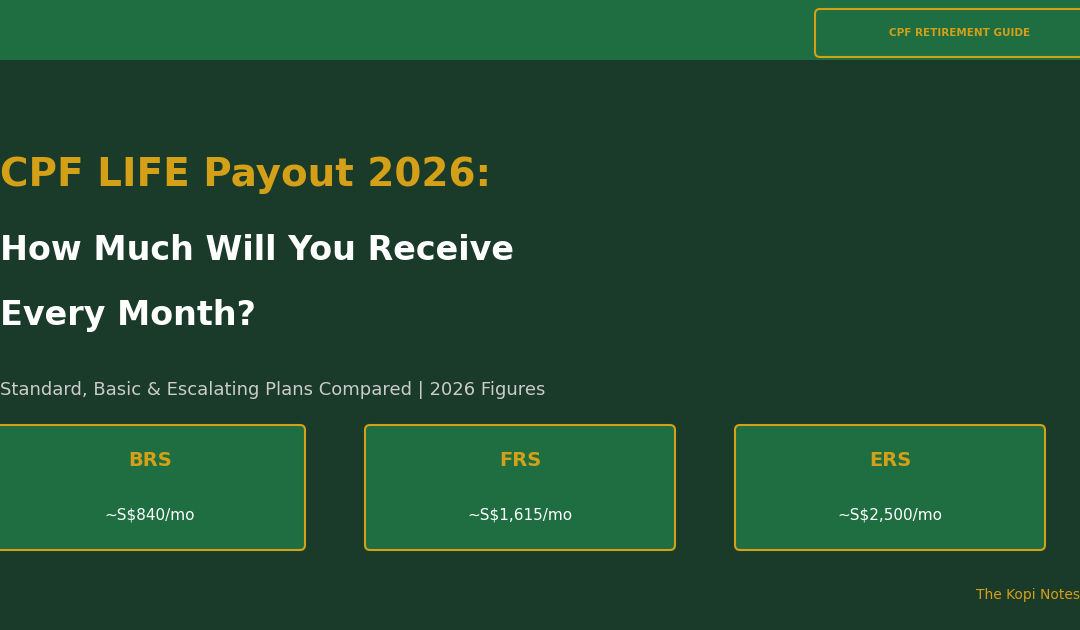
CPF LIFE Payout 2026: How Much Will You Receive Every Month?
Singapore’s national longevity annuity explained — payout amounts, plan types, and how to maximise your monthly retirement income.
CPF LIFE (Lifelong Income For the Elderly) is Singapore’s mandatory national annuity scheme that pays you a monthly income for life starting from age 65. As at 2026, members who set aside the Full Retirement Sum (FRS) of S$213,000 at age 55 can expect monthly payouts of approximately S$1,560–S$1,670 under the Standard Plan — rising to S$2,410–S$2,590 under the Enhanced Retirement Sum (ERS) of S$426,000. Your exact CPF LIFE payout depends on which plan you choose, how much you top up, and when you start payouts.
Not financial advice. All figures are for educational reference only. CPF LIFE payout estimates are based on CPF Board projections as at 2026. Actual payouts may vary.
Table of Contents
Contents — Click to expand
What Is CPF LIFE?
CPF LIFE stands for Lifelong Income For the Elderly. It is a national annuity scheme administered by the CPF Board that converts your Retirement Account (RA) savings into monthly payouts that continue for as long as you live — even if you outlive your savings.
Singapore citizens and permanent residents born in 1958 or later who have at least S$60,000 in their RA when they reach 65 are automatically enrolled in CPF LIFE. Those with less than S$60,000 receive payouts under the older CPF Retirement Sum Scheme (RSS) instead — but can opt into CPF LIFE voluntarily.
CPF LIFE solves a fundamental retirement problem: longevity risk. Many Singaporeans are living into their 80s and 90s. CPF LIFE guarantees income for life, regardless of market conditions or how long you live. The scheme is backed by the Singapore government, making it one of the safest income streams available to Singapore residents.
Your CPF LIFE monthly payout amount is determined by:
- The retirement sum you have set aside in your RA at age 55
- The CPF LIFE plan you choose (Standard, Basic, or Escalating)
- The payout start age (between 65 and 70 — deferring increases monthly income)
- Any additional voluntary top-ups you make to your RA
Want to supplement CPF LIFE with dividend income? See our guide on passive income strategies for Singapore investors in 2026 for a complete picture of retirement income sources.
CPF LIFE Payout Amounts 2026
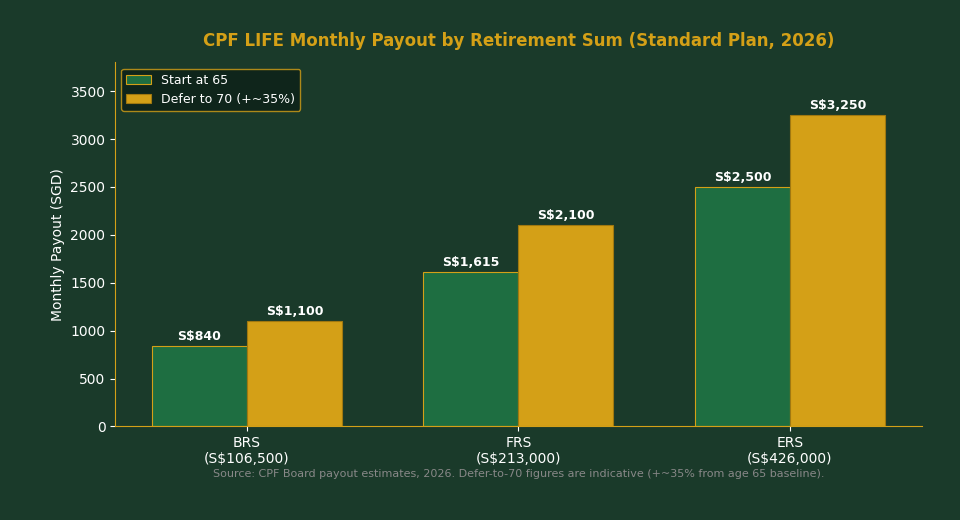
Below are the estimated monthly CPF LIFE payouts for members turning 65 in 2026, based on the retirement sum set aside at age 55. These figures are under the Standard Plan, which is the default option for most members.
| Retirement Sum at Age 55 | Estimated Monthly Payout (Standard Plan) | Retirement Sum Type |
|---|---|---|
| S$106,500 (BRS) | ~S$810 – S$870 | Basic Retirement Sum |
| S$213,000 (FRS) | ~S$1,560 – S$1,670 | Full Retirement Sum |
| S$426,000 (ERS) | ~S$2,410 – S$2,590 | Enhanced Retirement Sum |
Source: CPF Board payout estimates, 2026. Figures are indicative; actual payouts depend on plan type and interest earned.
These figures assume payouts begin at age 65. If you defer your payout start age to 70, your monthly amount increases by approximately 6–7% per year of deferral. A member with the FRS who defers to age 70 could receive roughly S$2,000–S$2,200/month — a 30%+ uplift versus starting at 65.
Real Example: 55-Year-Old Singaporean with FRS
Suppose you are 55 in 2026 and have set aside S$213,000 in your RA (Full Retirement Sum). Your CPF RA continues to earn 4% interest per annum on the first S$30,000 and 5% interest p.a. on the next S$30,000 (as per CPF Board’s current floor rates). By 65, your RA balance will have grown meaningfully — meaning your actual payout could be higher than the base estimate above.
At 65, starting Standard Plan payouts: approximately S$1,560–S$1,670/month for life. Combined with the payout from your spouse’s CPF LIFE and passive dividend income from S-REITs, many Singapore couples can cover their essential living expenses comfortably in retirement.
The Three CPF LIFE Plans Compared
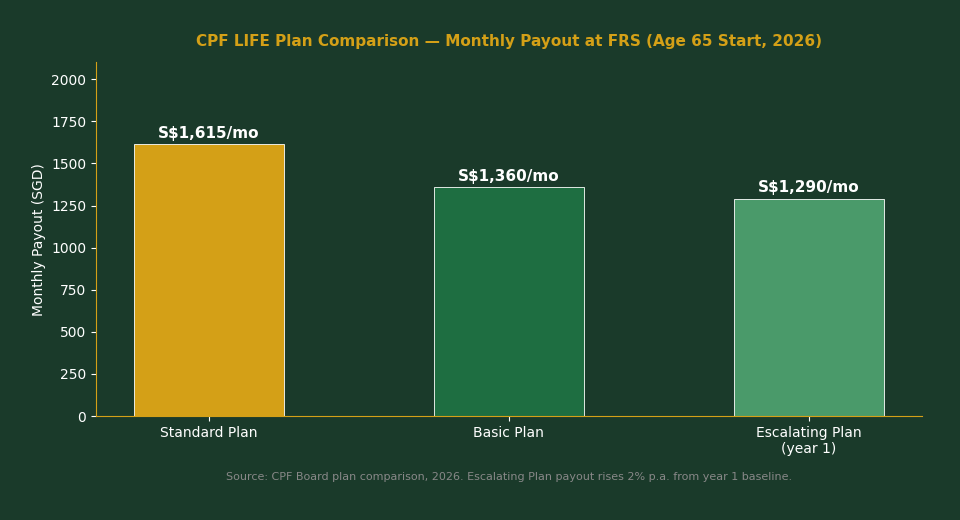
CPF LIFE offers three plan options. You must choose by your payout start age. Each plan balances monthly income against the bequest (money left to your estate when you pass away).
| Plan | Monthly Payout | Bequest to Beneficiaries | Best For |
|---|---|---|---|
| Standard Plan | Highest monthly payout | Lower bequest — decreases over time as payouts are made | Those who want maximum monthly income |
| Basic Plan | Lower monthly payout (~10–20% less than Standard) | Higher bequest — more savings preserved for beneficiaries | Those who prioritise legacy/inheritance |
| Escalating Plan | Starts 20% lower, rises 2% annually | Moderate bequest | Those worried about inflation eating into payouts |
Source: CPF Board, CPF LIFE Plan Comparison, 2026.
Which Plan Should You Choose?
Standard Plan is the default and most popular choice. It gives you the highest income from day one, which is important since essential costs like healthcare tend to peak in early retirement. Most financial planners in Singapore recommend the Standard Plan unless you have specific legacy planning goals.
Basic Plan suits those who have significant other assets (property, stocks, S-REIT dividends) and want CPF LIFE to serve as supplementary income rather than primary support. The higher bequest can be meaningful for families with dependants.
Escalating Plan is useful if you are concerned about long-run inflation eroding your purchasing power. The 2% annual increase means payouts keep pace with moderate inflation over time — though you must be prepared for lower income in your first few years of retirement.
For most Singaporeans relying on CPF LIFE as a core retirement pillar, the Standard Plan with deferral to age 68–70 offers the best combination of lifetime income and inflation buffer.
How CPF LIFE Payouts Are Calculated
CPF LIFE is a pooled annuity — your premiums (the RA balance transferred at 65) are pooled with other members. The CPF Board then uses actuarial calculations based on life expectancy, interest rates, and pool mortality to determine each member’s monthly payout.
The key inputs are:
- RA balance at payout start age — your full RA balance (including accrued interest from 55 to 65) becomes your CPF LIFE premium
- Interest rate — CPF LIFE uses the long-term government bond rate as the basis; currently the floor rate is approximately 4% p.a.
- Life expectancy assumptions — CPF Board uses Singapore population life tables; average Singaporean woman lives to ~88, man to ~84
- Pool sharing — members who pass away earlier contribute remaining balances to the pool, funding longevity payments for those who live longer
One important point: CPF LIFE is not an investment product. It is insurance against outliving your money. The “return” you get is not measured by yield — it is measured by how long you live. A Singaporean woman who lives to 95 gets exceptional value from CPF LIFE; someone who passes at 68 does not (though the bequest still goes to beneficiaries under the Basic Plan).
Want to model your own retirement income? Use the free Singapore retirement planning calculator to estimate how much CPF LIFE plus other income sources cover your projected expenses.
CPF Retirement Sums 2026
The three CPF retirement sums set at age 55 determine your CPF LIFE payout level. These sums are revised upward each year by approximately 3.5% to account for rising living costs. The 2026 figures are:
| Retirement Sum | Amount (2026) | Est. Monthly Payout at 65 (Standard Plan) | Property Pledge Allowed? |
|---|---|---|---|
| Basic Retirement Sum (BRS) | S$106,500 | ~S$810 – S$870/month | Yes (pledge property, keep half in RA) |
| Full Retirement Sum (FRS) | S$213,000 | ~S$1,560 – S$1,670/month | No |
| Enhanced Retirement Sum (ERS) | S$426,000 | ~S$2,410 – S$2,590/month | No |
Source: CPF Board, Retirement Sums 2026. ERS is 4× BRS from 2025 onwards per CPF reforms.
Note that from 2025, the Enhanced Retirement Sum (ERS) was raised from 3× to 4× the Basic Retirement Sum. This gives members who want maximum CPF LIFE income the ability to top up more — up to S$426,000 in their RA. For high earners and diligent CPF top-up savers, reaching ERS by 55 is now a meaningful retirement goal.
The BRS option is designed for those who own property. By pledging your HDB flat or private property, you can set aside only half the FRS (i.e., BRS) and still join CPF LIFE, using property as an implicit backstop for retirement funding.
Learn more about how CPF integrates with your overall CPF investment strategy — including CPFIS ETF options, SA top-ups, and OA allocation decisions.
How to Maximise Your CPF LIFE Payout
There are four proven strategies Singapore investors use to get the highest possible CPF LIFE monthly payout:
1. Top Up Your RA to the Enhanced Retirement Sum
The single most powerful lever is topping up your Retirement Account to the ERS (S$426,000 in 2026). This can be done via cash top-ups under the Retirement Sum Topping-Up Scheme (RSTU) or by transferring OA/SA savings to RA at 55. Every additional dollar in your RA earns 4% guaranteed, and converts to a higher lifetime monthly payout. Even topping up to FRS (S$213,000) instead of BRS roughly doubles your monthly payout.
2. Defer Your Payout Start Age
You can defer CPF LIFE payouts from the default age of 65 up to age 70. For every year you defer, your monthly payout increases by approximately 6–7%. Deferring from 65 to 70 boosts your monthly income by roughly 30–35%. This works best if you have other income sources (rental income, dividend stocks, part-time work) to bridge the gap from 65 to 70.
3. Make Voluntary CPF Top-Ups Before Age 55
Under the RSTU scheme, you can top up your SA (or MA) with cash before age 55 and enjoy tax relief of up to S$8,000/year for self top-ups and another S$8,000 for topping up a family member’s CPF. These funds earn 4–5% guaranteed interest inside CPF and eventually flow into your RA at 55, boosting your CPF LIFE payout base. Consistent top-ups from your 30s compound dramatically by 55.
4. Choose the Standard Plan (Not Basic)
If maximising monthly income is your goal, always choose the Standard Plan over the Basic Plan. The Standard Plan delivers the highest possible monthly payout. While the Basic Plan offers a larger bequest, the income sacrifice (10–20% less per month) over a 25–30 year retirement is substantial. Most Singaporeans with limited other assets should prioritise income over bequest.
For a complete retirement income strategy, consider how CPF LIFE pairs with S-REIT dividend investing. Check out our list of the best S-REITs in Singapore 2026 yielding 5–7% annually as a complement to CPF LIFE income.
CPF LIFE vs Singapore Savings Bonds
Two of the most common “safe” retirement income tools for Singapore investors are CPF LIFE and Singapore Savings Bonds (SSBs). They serve different purposes and work best in combination.
| Feature | CPF LIFE | Singapore Savings Bonds (SSB) |
|---|---|---|
| Income type | Lifelong monthly annuity | Fixed-term interest (up to 10 years) |
| Longevity protection | Yes — pays for life even past 100 | No — bond matures at 10 years |
| Liquidity | Locked (payouts only, no lump sum withdrawal) | High — redeem anytime, interest kept |
| Current yield (2026) | Implicit ~4% p.a. (floor rate on RA) | ~2.8–3.3% p.a. (10-year average, 2026) |
| Capital preserved | Partially (bequest depends on plan and longevity) | Yes — full principal at maturity or redemption |
| Inflation hedge | Partial (Escalating Plan only) | No |
Source: CPF Board; MAS Singapore Savings Bonds, April 2026.
The ideal retirement portfolio for a Singapore investor combines CPF LIFE as the lifelong income floor (guaranteed income regardless of markets), SSBs as a liquid safe reserve, and S-REIT or ETF dividends as a market-linked income layer.
For a full breakdown, read our Singapore Savings Bonds 2026 guide and compare it with your CPF LIFE projections.
When to Start Your CPF LIFE Payouts
You can start CPF LIFE payouts anytime between age 65 and 70. The decision is not trivial — the timing affects every payout you receive for the rest of your life.
Start at 65 If:
- You have no other reliable income and need CPF LIFE to cover essential expenses immediately
- You are in poor health or have family history of shorter lifespans
- You want maximum total lifetime income accumulated in your earlier retirement years
Defer to 68–70 If:
- You have other income (rental, dividends, part-time work, spouse’s CPF LIFE) to cover you from 65
- You are in good health and anticipate living to 85+
- You want maximum monthly income for the long haul — especially important if you outlive your spouse
The break-even analysis is instructive: if you defer from 65 to 70 (increasing payouts by ~33%), you “break even” at around age 82–83 — meaning if you live past ~83, deferral wins in total cumulative income. Since Singapore women have an average life expectancy of 87–88, deferral is statistically advantageous for most female members. For men (average ~84), the calculus is closer but still favours deferral for healthy individuals.
Use our retirement planning calculator to model your specific scenario — including CPF LIFE deferral, other income streams, and projected retirement expenses.
Ready to Build Your Retirement Income Plan?
CPF LIFE is your foundation — but a truly comfortable retirement in Singapore needs multiple income streams. Explore how S-REITs, ETFs, and robo-advisors can complement your CPF LIFE payouts.
Frequently Asked Questions: CPF LIFE Payout 2026
How much CPF LIFE payout will I get per month in 2026?
Your CPF LIFE monthly payout depends on your retirement sum at age 55 and which plan you choose. Under the Standard Plan in 2026: Basic Retirement Sum (S$106,500) gives approximately S$810–S$870/month; Full Retirement Sum (S$213,000) gives approximately S$1,560–S$1,670/month; Enhanced Retirement Sum (S$426,000) gives approximately S$2,410–S$2,590/month. These are estimates at age 65 start — deferring to 70 increases payouts by ~30–35%.
Can I get more than S$2,000/month from CPF LIFE?
Yes. To receive over S$2,000/month from CPF LIFE, you need to either: (1) top up your RA to the Enhanced Retirement Sum (S$426,000 in 2026) — estimated payout ~S$2,410–S$2,590/month; or (2) top up to FRS (S$213,000) and defer your payout start to age 68–70 — estimated payout rises to approximately S$1,900–S$2,200/month. Both strategies require consistent CPF savings and/or voluntary cash top-ups over your working life.
What happens to my CPF LIFE money when I die?
Under the Standard Plan, any remaining CPF LIFE premium balance at the time of your death is paid out to your nominated beneficiaries. The bequest decreases over time as payouts are made — the longer you live, the smaller the remaining bequest. Under the Basic Plan, a larger portion is preserved for beneficiaries. Under the Escalating Plan, the bequest treatment is similar to the Basic Plan. All CPF monies are distributed according to your CPF nomination, not your will.
Can I withdraw CPF LIFE as a lump sum?
No. Once your RA savings are used to join CPF LIFE, they cannot be withdrawn as a lump sum. CPF LIFE converts your savings into a stream of monthly payouts for life — the trade-off for the lifelong income guarantee is permanent lock-in. However, if you have savings above your Full Retirement Sum in your OA/SA at age 55, those excess funds can be withdrawn in cash. Only the amount earmarked for CPF LIFE (up to ERS) is locked in.
Is CPF LIFE payout taxable in Singapore?
No. CPF LIFE monthly payouts are not taxable under Singapore income tax rules. This makes them even more valuable compared to other income sources. For context, rental income and dividend income from non-Singapore-listed stocks may be subject to withholding tax, but CPF LIFE payouts are fully tax-free and paid gross into your bank account each month.
What is the difference between CPF LIFE and the old Retirement Sum Scheme?
The old CPF Retirement Sum Scheme (RSS) paid fixed monthly amounts until your RA was depleted — typically running out around age 90. CPF LIFE is different: it pools longevity risk across all members, so payouts continue for life even if you outlive the pool’s actuarial assumptions. Members born from 1958 onwards with sufficient RA savings (S$60,000 or more at 65) are automatically enrolled in CPF LIFE. Those on RSS who are eligible can apply to switch to CPF LIFE voluntarily.
Should I top up to the Enhanced Retirement Sum if I have the money?
Topping up to the ERS (S$426,000 in 2026) makes strong financial sense if: (1) you are in good health and expect a long retirement, (2) you value guaranteed, government-backed income above other investment returns, and (3) you do not urgently need liquidity. The ERS earns 4% guaranteed on your RA — better than most fixed deposits and SSBs. However, if you need liquidity (e.g. for healthcare costs, housing) or prefer to invest in higher-yield assets like S-REITs (5–7%), keeping money outside CPF may be preferable. Most planners suggest topping to at least FRS and investing the rest for growth.
Disclaimer: This article is for general educational purposes only and does not constitute financial advice. CPF LIFE payout figures are estimates based on CPF Board projections as at May 2026. Always verify current figures at cpf.gov.sg and consult a licensed financial adviser for personalised retirement planning.
This article was researched with the help of AI. While we strive to keep all information accurate and up to date, there may be errors. If you notice any discrepancies, please contact us.