CapitaLand Integrated Commercial Trust (CICT) Investor Guide 2026
DPU History, ~5% Dividend Yield, Share Price Analysis & How to Buy in Singapore
CapitaLand Integrated Commercial Trust (SGX: C38U), or CICT, is Singapore’s largest real estate investment trust by market capitalisation, managing a diversified SGD 24.6 billion portfolio of retail malls and grade-A office buildings across Singapore and Australia. As at May 2026, CICT trades at approximately SGD 1.85–2.00 per unit and offers a forward distribution yield of around 5.0–5.4%, making it a core holding for Singapore investors seeking stable passive income from blue-chip commercial property.
Not financial advice. All figures are for educational reference only. Data as at May 2026 unless noted.
Table of Contents
Contents — Click to expand
- What Is CapitaLand Integrated Commercial Trust?
- CICT Portfolio: Key Properties & AUM
- CICT DPU History & Dividend Yield 2026
- CICT Share Price Analysis 2026
- Financial Health: Gearing, Interest Coverage & NAV
- CICT vs Peer S-REITs: Yield Comparison Table
- How to Buy CICT in Singapore (CPF, SRS & Cash)
- Risks to Consider Before Investing
- Frequently Asked Questions
What Is CapitaLand Integrated Commercial Trust?
CapitaLand Integrated Commercial Trust (CICT) was formed in November 2020 through the merger of CapitaLand Mall Trust (CMT) and CapitaLand Commercial Trust (CCT) — two of Singapore’s most established S-REITs. The combined entity became Singapore’s largest REIT by market capitalisation and the first mixed-use commercial REIT on SGX, offering investors exposure to both retail and office properties under a single listed structure.
CICT is listed on the Singapore Exchange under ticker C38U and is a constituent of the best S-REITs in Singapore 2026 guide. It is managed by CapitaLand Investment Limited (CLI), a global real estate investment manager with over SGD 100 billion in assets under management.
For Singapore retail investors, CICT sits in the “core” tier of any REIT portfolio — the kind of holding you buy for stability, regular DPU distributions, and long-term capital preservation. Its assets include some of the most visited malls in Singapore (Raffles City, Plaza Singapura, Bugis Junction, Junction 8, Tampines Mall) and premium office buildings in the CBD (CapitaGreen, Asia Square Tower 2, 21 Collyer Quay).
Key Facts at a Glance (May 2026)
| Metric | Value |
|---|---|
| SGX Ticker | C38U |
| REIT Type | Mixed-use (Retail + Office) |
| Portfolio AUM | ~SGD 24.6 billion |
| Number of Properties | 21 (Singapore + Australia) |
| Share Price (May 2026) | ~SGD 1.90 |
| Forward Dividend Yield | ~5.0–5.4% |
| Market Cap | ~SGD 12.5 billion |
| Manager | CapitaLand Investment Ltd |
| Distribution Frequency | Semi-annual (Jun & Dec) |
Source: SGX, CICT investor relations, as at May 2026

CICT Portfolio: Key Properties & AUM
CICT holds 21 properties, predominantly in Singapore (18 assets) with a growing presence in Australia (3 assets). The portfolio is approximately 55% retail and 45% office by value, offering natural income diversification across two commercial property sectors.
Singapore Retail Assets
CICT’s retail portfolio is anchored by some of Singapore’s best-performing malls. Raffles City Shopping Centre alone generated over SGD 100 million in net property income annually in recent years. Other key malls include Bugis Junction, Bugis+, Junction 8, Tampines Mall, Westgate, IMM, and Lot One Shoppers’ Mall — a mix of suburban necessity retail and urban lifestyle destinations. Singapore retail occupancy has been consistently above 98% since 2022, supported by strong leasing demand from F&B, beauty, and experiential retail tenants.
Singapore Office Assets
CICT’s office portfolio is Grade A, concentrated in Singapore’s CBD. Key office assets include CapitaGreen (a LEED Gold certified tower at Market Street), Asia Square Tower 2 (a Raffles Place icon), and 21 Collyer Quay (Marina Bay financial district). Committed occupancy for CICT’s office portfolio has held above 93%.
Australia Assets
CICT’s three Australian assets — 101 Miller Street in Sydney’s North Sydney business district, Olderfleet at 477 Collins Street in Melbourne, and 66 Goulburn Street in Sydney — add geographic diversification in AUD-denominated income, representing approximately 8–10% of portfolio value.
CICT DPU History & Dividend Yield 2026
CICT pays distributions semi-annually — typically in June (for H2 distributions from the prior year) and December (for H1). Here is CICT’s distribution per unit (DPU) history since the 2020 merger:
| Financial Year | Total DPU (SGD cents) | YoY Change | Yield at ~SGD 2.00 |
|---|---|---|---|
| FY2021 | 10.40 | Recovery from COVID | 5.2% |
| FY2022 | 10.58 | +1.7% | 5.3% |
| FY2023 | 10.76 | +1.7% | 5.4% |
| FY2024 | 10.94 | +1.7% | 5.5% |
| FY2025E | ~10.5–10.8 | Flat; interest cost headwind | ~5.0–5.4% |
Source: CICT Annual Reports, SGX filings. FY2025 estimate as at May 2026.
CICT’s DPU has grown modestly but consistently since the merger. At a share price of SGD 1.90, a DPU of 10.5 SGD cents produces a yield of approximately 5.5%. For investors focused on passive income in Singapore, CICT’s semi-annual distributions and blue-chip asset quality make it one of the most widely held REITs in Singapore CPF Investment Scheme (CPFIS) portfolios.

CICT Share Price Analysis 2026
CICT’s share price has traded between approximately SGD 1.75 and SGD 2.15 over the 12 months to May 2026. The REIT was impacted in early 2025 by the global higher-for-longer interest rate environment, which pressured all REIT valuations by increasing the discount rate applied to future distributions. It recovered modestly through H2 2025 as the US Federal Reserve began cutting rates.
As at May 2026, CICT trades at a slight discount to its reported net asset value (NAV) per unit of approximately SGD 2.05–2.10. This discount (approximately 8–10%) is typical during periods of interest rate uncertainty and reflects the market pricing in the risk of further property valuation softness — particularly in the office sector.
What Drives CICT’s Share Price?
The four key drivers of CICT’s unit price are: (1) Singapore interest rate trajectory — as SIBOR/SORA falls, CICT’s borrowing costs ease and DPU grows; (2) retail mall footfall and tenant sales; (3) Grade A office vacancy in Singapore’s CBD; and (4) the SGD/AUD exchange rate for its Australian assets. CICT is not a high-growth REIT — its total return thesis is primarily income-driven: collect ~5% yield annually while the underlying property assets maintain value over the long term.
Financial Health: Gearing, Interest Coverage & NAV
Financial health is a critical metric when evaluating any S-REIT. MAS caps REIT aggregate leverage at 50% (or 55% with an Interest Coverage Ratio above 2.5x). CICT currently operates well within these limits.
| Financial Metric | FY2024 Actual | Assessment |
|---|---|---|
| Aggregate Leverage (Gearing) | ~39.4% | Comfortable (MAS limit: 50%) |
| Interest Coverage Ratio (ICR) | ~3.0x | Healthy (MAS min for 55% cap: 2.5x) |
| NAV Per Unit | ~SGD 2.07 | Unit trades at ~8% discount to NAV |
| Weighted Avg Debt Maturity | ~3.8 years | Well-laddered, low near-term risk |
| Fixed Rate Debt % | ~80% | Strong hedge vs rate volatility |
| Avg Borrowing Cost | ~3.5–3.8% | Elevated vs 2021 but stabilising |
Source: CICT FY2024 Annual Report, SGX filings
CICT’s ~80% fixed-rate debt structure is a deliberate hedge against SORA volatility. As rates fall in 2025–2026, the benefit will flow through gradually as fixed-rate tranches mature and are refinanced at lower prevailing rates. For investors comparing CICT against fixed income alternatives, the 5%+ yield is meaningfully above Singapore Savings Bonds (currently ~2.8–3.1%) and CPF OA rates (2.5%). For a broader CPF investment strategy that includes CICT via CPFIS, this yield differential is a common reason to allocate a portion of investable CPF OA funds into S-REITs.
CICT vs Peer S-REITs: Yield Comparison Table
How does CICT stack up against comparable S-REITs? The table below compares CICT to its closest peers across the commercial REIT space.
| REIT (SGX Ticker) | Type | Fwd Yield (May 2026) | Gearing | Market Cap |
|---|---|---|---|---|
| CICT (C38U) | Retail + Office | ~5.2% | ~39% | ~SGD 12.5B |
| Mapletree Pan Asia CT (N2IU) | Retail + Office | ~6.2% | ~40% | ~SGD 7.8B |
| Frasers Centrepoint Trust (J69U) | Suburban Retail | ~5.5% | ~38% | ~SGD 4.1B |
| Suntec REIT (T82U) | Office + Retail + Conv | ~6.5% | ~42% | ~SGD 3.1B |
| Keppel DC REIT (AJBU) | Data Centre | ~5.8% | ~37% | ~SGD 4.0B |
Source: SGX, Bloomberg estimates, REIT investor relations. May 2026. Forward yields are estimates, not guarantees.
CICT offers the lowest yield in this peer group by design — as Singapore’s largest, most liquid, most diversified commercial REIT, it commands a premium valuation. For a complete overview of all S-REITs ranked by yield, visit our best S-REITs in Singapore 2026 guide.
How to Buy CICT in Singapore (CPF, SRS & Cash)
CICT (SGX: C38U) is listed on the Singapore Exchange and can be purchased through any MAS-licensed broker. Here is a step-by-step guide:
Step 1: Open a Brokerage Account
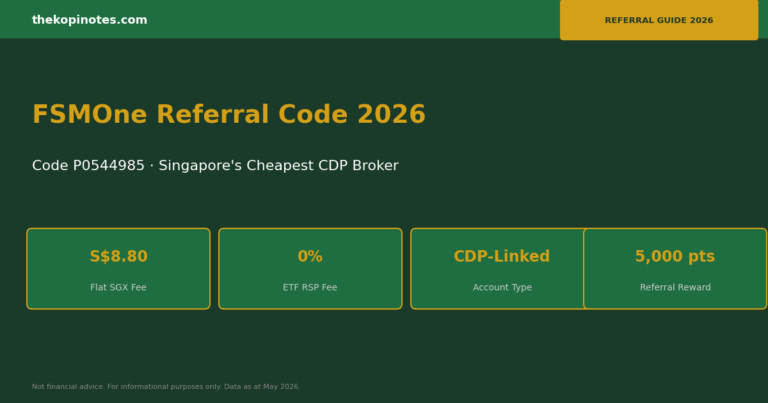
Syfe Trade — competitive commissions from SGD 1.49 per trade. Use our Syfe referral code and sign-up bonus to get started. FSMOne — access to all major S-REITs via our FSMOne referral code. moomoo Singapore — competitive pricing; read our moomoo Singapore review for details.
Step 2: Use CPF Investment Scheme (CPFIS) or SRS
CICT is approved under the CPF Investment Scheme (Ordinary Account). Singapore citizens and PRs can use CPF OA savings above SGD 20,000 to purchase CICT units through a CPFIS-approved broker. CICT is also eligible for Supplementary Retirement Scheme (SRS) investment.
Step 3: Buy at Lot Sizes
CICT is traded in board lots of 100 units. At SGD 1.90 per unit, one board lot costs approximately SGD 190 + brokerage commission — accessible even for investors with modest capital.
Worked Example: SGD 10,000 Investment (May 2026)
An investor deploying SGD 10,000 into CICT at SGD 1.90 per unit would acquire approximately 5,263 units and receive approximately SGD 552 in annual distributions at a 5.52% DPU yield — roughly SGD 276 per semi-annual payment, deposited directly to a bank or CPFIS account, tax-free for Singapore residents. Use our Singapore retirement calculator to model how REIT distributions compound over 10–20 years.
Risks to Consider Before Investing
Interest rate risk: CICT’s DPU is sensitive to borrowing costs. If SORA or global rates rise unexpectedly, refinancing costs increase and DPU could be pressured. The ~80% fixed-rate debt hedge provides protection, but not complete insulation.
Office demand softness: Hybrid work trends have reduced demand for Grade A office space in Singapore’s CBD. CICT’s committed office occupancy has held above 93%, but if it falls below 90%, DPU impact could be material.
Retail disruption: E-commerce continues to shift retail spending online. CICT’s malls have adapted by increasing F&B, experiential, and essential services tenants, but this remains a long-term structural risk.
AUD/SGD exchange rate risk: A weakening AUD reduces SGD distributions on the ~8–10% of AUM held in Australia.
For broader context on S-REIT macro resilience and rate sensitivity, see our Singapore T-bills 2026 guide for risk-free rate benchmarking, and the passive income Singapore 2026 guide for portfolio construction ideas.
Start Investing in S-REITs Today
Open a brokerage account and earn exclusive sign-up bonuses through The Kopi Notes referral links.
Frequently Asked Questions
What is CapitaLand Integrated Commercial Trust (CICT)?
What is CICT’s current dividend yield in 2026?
Can I buy CICT using my CPF?
What is CICT’s NAV per unit?
Is CICT a good REIT to invest in Singapore?
What is CICT’s gearing ratio?
How often does CICT pay dividends?
This article was researched with the help of AI. While we strive to keep all information accurate and up to date, there may be errors. If you notice any discrepancies, please contact us.