CapitaLand Integrated Commercial Trust (CICT) 2026: Complete Investor Guide — DPU, ~5% Yield & Portfolio Deep-Dive
SGX: C38U | Singapore’s Largest Diversified Commercial S-REIT
CapitaLand Integrated Commercial Trust (CICT, SGX: C38U) is Singapore’s largest listed commercial REIT, owning 26 properties across retail, office and mixed-use assets in Singapore, Australia and Germany — with a total AUM of approximately S$24.5 billion as at end-2025. CICT trades on the SGX Mainboard and has delivered an annualised distribution yield of approximately 5.0–5.4% as at May 2026, backed by a resilient portfolio anchored by Singapore’s most visited malls — ION Orchard, Raffles City Singapore and Plaza Singapura.
Not financial advice. All figures are for educational reference only. Data as at May 2026 unless noted.
Table of Contents
Table of Contents — Click to expand
- What Is CapitaLand Integrated Commercial Trust (CICT)?
- CICT Share Price 2026 & Key Metrics
- DPU History: FY2019–FY2025
- CICT Portfolio: 26 Properties Across 3 Countries
- Financial Performance & Balance Sheet
- Dividend Yield Analysis: Is CICT Worth Buying?
- Key Risks to Watch in 2026
- How to Buy CICT in Singapore
- FAQ — CICT Frequently Asked Questions
What Is CapitaLand Integrated Commercial Trust (CICT)?
CapitaLand Integrated Commercial Trust (CICT) was formed on 3 November 2020 through the merger of CapitaLand Mall Trust (CMT) — Singapore’s first REIT, listed in 2002 — and CapitaLand Commercial Trust (CCT). The combined entity is managed by CICT Management Pte. Ltd., a wholly-owned subsidiary of CapitaLand Investment Limited (CLI), one of Asia’s largest real estate investment managers.
CICT’s SGX ticker is C38U, and it is a component of the Singapore REIT ETF guide benchmarks, including the Lion-Phillip S-REIT ETF (CLR). As of May 2026, CICT has a market capitalisation of approximately S$13.5–14 billion, making it the largest commercial REIT in Singapore.
The trust’s investment mandate covers retail, office, and integrated development assets in Singapore and key overseas gateway cities. It targets long-term income distributions and asset appreciation for unitholders, with Singapore assets comprising approximately 93% of total portfolio value.
CICT’s Key Competitive Advantages
CICT’s portfolio is exceptionally hard to replicate. Its Singapore assets occupy irreplaceable locations — ION Orchard sits at Singapore’s prime Orchard Road corridor, Raffles City Singapore straddles the City Hall MRT interchange, and CapitaSpring anchors the Raffles Place CBD. These properties benefit from captive commuter traffic, high barriers to entry, and Singapore’s status as Southeast Asia’s commercial hub.
From a passive income Singapore perspective, CICT’s diversified tenant base — spanning international luxury retail, F&B, financial services, and technology firms — provides stable, recurring rental income across economic cycles.
CICT Share Price 2026 & Key Metrics at a Glance
The table below summarises CICT’s key investment metrics as at May 2026. Note that share price and yield fluctuate daily — always verify live prices on SGX or your broker platform before making investment decisions.
| Metric | Value (May 2026) |
|---|---|
| SGX Ticker | C38U |
| Share Price (approx.) | S$1.96–S$2.10 |
| Market Capitalisation | ~S$13.5–14 billion |
| Total AUM | ~S$24.5 billion |
| FY2025 DPU (full year) | ~10.56 cents |
| Indicative Dividend Yield | ~5.0–5.4% |
| Price-to-NAV | ~0.90–0.95x |
| Gearing Ratio | ~38–40% |
| Number of Properties | 26 |
| Property Segment | Retail, Office, Integrated |
| Distribution Frequency | Semi-annual (H1 & H2) |
| Manager | CICT Management Pte. Ltd. (wholly-owned by CapitaLand Investment) |
Source: SGX filings, CICT investor relations, May 2026. All figures are indicative — verify at cict.com.sg before investing.
CICT DPU History: FY2019–FY2025
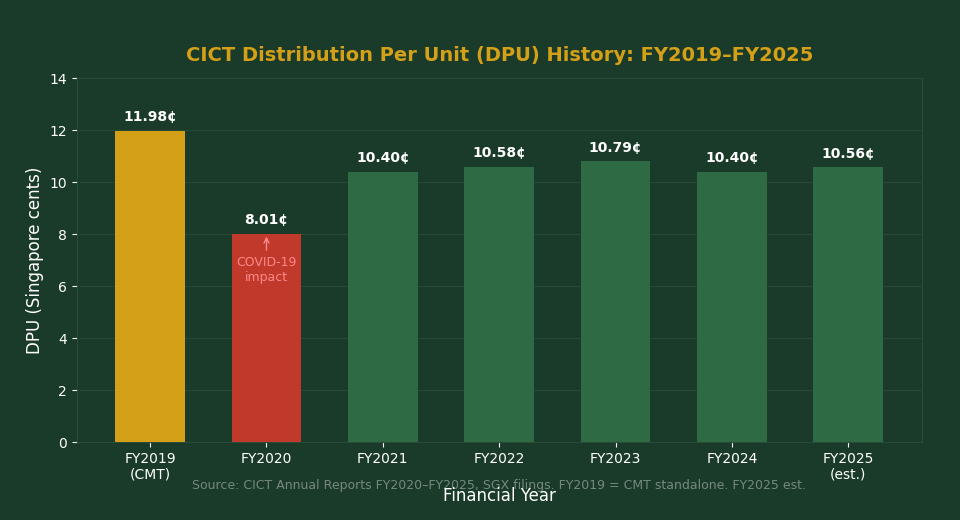
Understanding CICT’s Distribution Per Unit (DPU) history helps investors assess income reliability over time. Note that FY2020 was impacted by COVID-19 rent relief and retention of distributable income — a temporary measure, not a structural deterioration.
| Financial Year | DPU (Singapore cents) | Notes |
|---|---|---|
| FY2019 (CMT standalone) | 11.98¢ | Pre-merger, CMT only |
| FY2020 | 8.01¢ | COVID-19 impact; merger on 3 Nov 2020 |
| FY2021 | 10.40¢ | Recovery; first full year post-merger |
| FY2022 | 10.58¢ | Stable; CapitaSpring fully operational |
| FY2023 | 10.79¢ | Maiden full-year contribution from 101 Miller St (Australia) |
| FY2024 | 10.40¢ | Higher interest costs offset rental growth |
| FY2025 | ~10.56¢ | Resilient; office positive rental reversion, retail steady |
Source: CICT Annual Reports FY2020–FY2025, SGX filings. FY2019 refers to CapitaLand Mall Trust standalone. FY2025 DPU is indicative.
The DPU trajectory tells a compelling story. After the COVID-19 trough in FY2020, CICT recovered swiftly and has maintained distributions in the 10.40–10.79 cents range since FY2021. For a Singapore investor holding 100,000 units at S$2.00/unit (S$200,000 invested), the FY2025 DPU of ~10.56 cents translates to approximately S$10,560 in annual distributions — fully tax-exempt in Singapore hands.
CICT Portfolio: 26 Properties Across Singapore, Australia & Germany
CICT’s portfolio spans three asset classes — retail, office, and integrated developments — across Singapore (21 properties), Australia (2 properties) and Germany (3 properties). Approximately 93% of portfolio value sits in Singapore, underpinned by the city-state’s transparent rule of law and stable commercial property market.
Singapore Retail Portfolio — Flagship Malls
CICT’s Singapore retail assets are anchored by some of the most visited malls in Southeast Asia. ION Orchard (100% stake via joint venture), Raffles City Singapore, Plaza Singapura, Tampines Mall, Junction 8, Funan, Bugis Junction, Bugis+, IMM Building, Westgate, Lot One Shoppers’ Mall, Rivervale Mall, SingPost Centre (retail), and The Atrium@Orchard collectively attract tens of millions of shopper visits annually.
Singapore Office & Integrated Developments
The office portfolio includes CapitaSpring (a landmark Grade A office + retail integrated development in Raffles Place, completed 2021), Capital Tower, Six Battery Road, and a 45% stake in 21 Collyer Quay. These prime CBD assets command premium rents from financial services, technology, and professional services tenants, with committed occupancy rates consistently above 95%.
Overseas Properties — Australia & Germany
CICT’s overseas exposure includes Gallileo (Frankfurt), Main Airport Center (Frankfurt), 101 Miller Street (Sydney CBD), and Olderfleet (Melbourne CBD). These assets provide exposure to German and Australian commercial property markets and generate approximately 7% of portfolio NPI.
| Segment | No. of Properties | Est. % of NPI | Key Assets |
|---|---|---|---|
| Singapore Retail | 14 | ~58% | ION Orchard, Raffles City SG, Plaza Singapura |
| Singapore Office/Integrated | 7 | ~35% | CapitaSpring, Capital Tower, Six Battery Road |
| Overseas (AU + DE) | 5 | ~7% | 101 Miller St (Sydney), Gallileo (Frankfurt) |
Source: CICT FY2025 Annual Report, investor presentations. NPI split is approximate.
CICT Financial Performance & Balance Sheet Strength
Gearing ratio stands at approximately 38–40%, comfortably below the MAS regulatory cap of 50% (or 55% with ICR ≥ 2.5x). This provides CICT with meaningful headroom for debt-funded acquisitions without triggering a rights issue.
Interest coverage ratio (ICR) is approximately 3.0–3.2x, above the MAS threshold of 2.5x. Investors tracking the S-REIT yield vs bond spread will note that CICT’s yield spread over the Singapore 10-year SGS bond remains positive, above the 200 bps threshold considered “fair value” for commercial REITs.
Weighted average debt maturity is approximately 3.5–4 years as at end-2025. About 70–75% of CICT’s debt is on fixed rates, limiting near-term DPU sensitivity to interest rate movements.
NAV per unit is approximately S$2.15–S$2.20 as at end-2025, implying CICT is trading at a Price-to-NAV of approximately 0.90–0.95x — a discount to book value. The current sub-NAV pricing may represent an entry opportunity for long-term investors. For investors using the S-REIT gearing ratio calculator, CICT’s debt profile is a useful benchmark for investment-grade S-REIT balance sheets.
Dividend Yield Analysis: Is CICT Worth Buying in 2026?
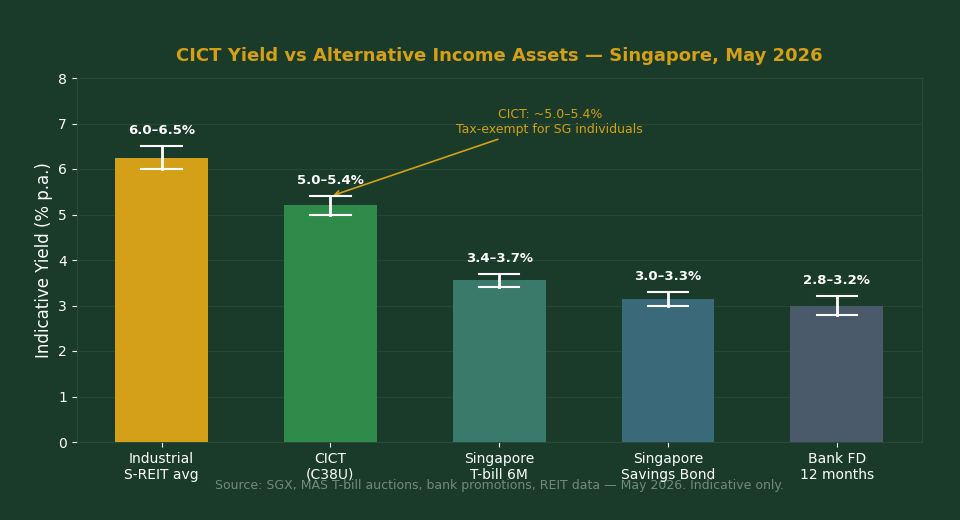
CICT’s ~5.0–5.4% yield sits below the S-REIT average of ~6.0–6.5% for industrial and logistics REITs, reflecting CICT’s blue-chip quality premium. Investors in best S-REITs in Singapore 2026 comparisons typically classify CICT as a “core-quality” holding — lower yield but greater capital stability.
| Income Asset | Indicative Yield (May 2026) | Tax Treatment (SG Investor) |
|---|---|---|
| CICT (C38U) | ~5.0–5.4% | Tax-exempt (no withholding tax for SG individuals) |
| Singapore 6-month T-bill | ~3.4–3.7% | Tax-exempt for individuals |
| Singapore Savings Bonds (SSB) | ~3.0–3.3% (10-year avg) | Tax-exempt for individuals |
| Bank fixed deposit (12 months) | ~2.8–3.2% | Taxable as interest income |
| Industrial S-REIT average | ~6.0–6.5% | Tax-exempt for individuals |
Source: MAS, SGX, T-bill auctions, bank promotions, REIT data — May 2026. Yields are indicative.
For retirement-oriented Singapore investors building retirement income, CICT’s semi-annual distributions complement CPF LIFE payouts. Using the S-REIT dividend yield calculator, a Singapore investor holding S$50,000 in CICT at S$2.00/unit (25,000 units) would receive approximately S$2,640 in annual distributions at a 10.56 cents DPU — a 5.28% cash yield, fully tax-exempt.
Key Risks to Watch for CICT in 2026
CICT is widely regarded as a defensive, high-quality S-REIT — but no investment is risk-free. Here are the material risks Singapore investors should monitor:
1. Interest Rate Sensitivity. At ~38–40% gearing, every 50 bps rise in the average cost of debt reduces annual DPU by approximately 0.15–0.20 cents on a fully floating basis. CICT hedges approximately 70–75% of its debt at fixed rates, buffering near-term DPU impact from Fed rate movements.
2. Office Demand Uncertainty. CICT’s office assets (CapitaSpring, Capital Tower, Six Battery Road) represent approximately 35% of NPI. Hybrid working patterns mean long-term structural demand for office space remains uncertain. Any sustained decline in CBD office rents would compress NPI and weigh on DPU.
3. Retail Tenant Mix & Consumer Spending. Singapore’s retail sector has proven resilient post-COVID, supported by tourism recovery and domestic spending. However, F&B and fashion tenants remain sensitive to consumer confidence cycles. A global recession or sharp drop in tourist arrivals could increase vacancies.
4. Overseas Property Valuation. CICT’s Australian and German assets are marked to market in AUD and EUR. Adverse currency movements and softer European office markets could lead to asset write-downs and NAV compression. At 7% of NPI, the impact is limited but real.
5. Sponsor-Related Concentration. CICT is managed by a CLI subsidiary. While this provides a strong acquisition pipeline, potential conflicts of interest exist around related-party transactions. Governance-conscious investors should monitor the independence of the CICT board.
How to Buy CICT in Singapore: Step-by-Step
CICT (C38U) trades on the SGX Mainboard in board lots of 100 units, meaning you can start investing from approximately S$200 (at S$2.00/unit).
Step 1 — Open a CDP (Central Depository) account. All SGX-listed securities are held via the CDP. Open a free account at cdp.sgx.com — processing takes 2–3 business days.
Step 2 — Choose a SGX broker. Popular choices include Syfe Trade, FSMOne, and POEMS. The Syfe referral code and sign-up bonus or the FSMOne referral code can offset your initial brokerage costs.
Step 3 — Fund your brokerage account and place a buy order. Search for ticker C38U. Use a limit order for price control. Settlement is T+2 (two business days).
CPF Investment Scheme (CPFIS): CICT is eligible for CPFIS investment using CPF Ordinary Account funds above the required S$20,000 CPF-OA floor. See our guide on CPF investment strategy for full CPFIS rules and risks.
SRS Investment: CICT is also eligible under the Supplementary Retirement Scheme (SRS). Use our SRS tax savings calculator to quantify your personal tax savings from SRS contributions.
Frequently Asked Questions — CICT (CapitaLand Integrated Commercial Trust)
What is CICT’s SGX ticker symbol?
What is CICT’s dividend yield in 2026?
How often does CICT pay dividends?
Can I buy CICT using CPF?
Can I buy CICT using CPF?
What is CICT’s gearing ratio?
What are CICT’s largest properties?
How does CICT compare to Mapletree Pan Asia Commercial Trust (MPACT)?
Start Building Your Singapore Investment Portfolio
CICT is one building block of a well-diversified Singapore income portfolio. Use our free tools to plan your retirement income and optimise your investments:
Disclaimer: The Kopi Notes is not a licensed financial adviser. All content is for educational purposes only and does not constitute financial advice. Investment in S-REITs involves risks including loss of principal. Always conduct your own due diligence or consult a licensed financial adviser before making investment decisions. Data accurate as at May 2026.
This article was researched with the help of AI. While we strive to keep all information accurate and up to date, there may be errors. If you notice any discrepancies, please contact us.