Singapore REITs Drop 7% in March 2026: Should You Buy the Dip?
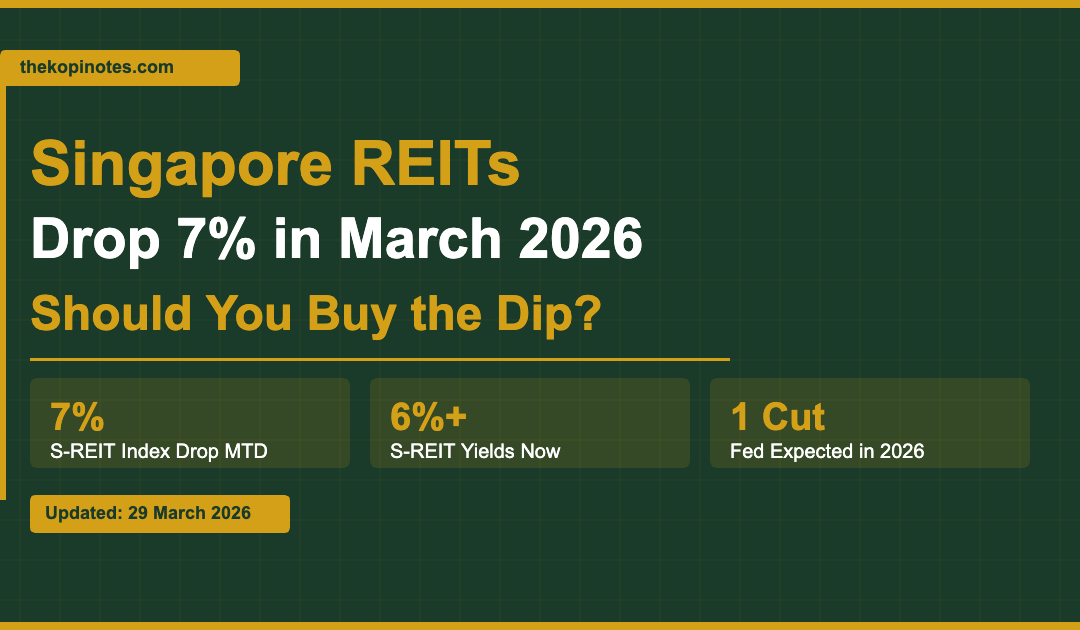
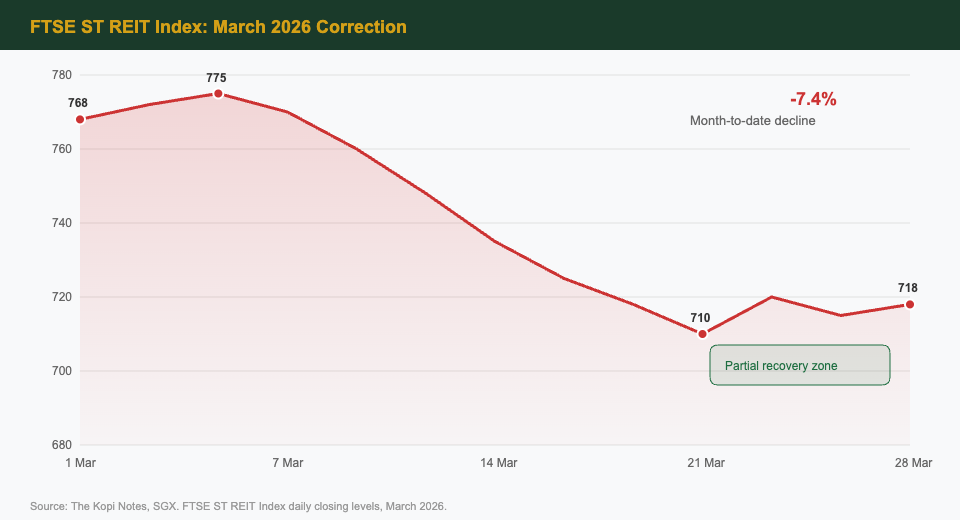
The S-REIT index has shed 7% in March 2026 — more than triple the Straits Times Index’s 2% decline — as the US Federal Reserve held rates higher for longer and Singapore’s bond yields climbed. For dividend investors, the question is: is this a buying opportunity or a warning sign?
What Happened: Fed Holds Rates, S-REITs Slide
On 18 March 2026, the US Federal Reserve kept its benchmark Fed Funds Rate unchanged at 3.5%–3.75% — in line with market expectations. But the accompanying dot plot and updated economic projections sent a more cautious signal: the Fed now expects PCE inflation to reach 2.7% in 2026, up from an earlier estimate of 2.4%, and the majority of Fed officials anticipate only one rate cut for the full year.
Markets quickly repriced. Singapore’s 10-year government bond yield jumped by around 33 basis points month-to-date to 2.29% as at 26 March 2026. When risk-free bond yields rise, income-producing assets like REITs become relatively less attractive — and the Singapore REIT market responded accordingly.
The result: the S-REIT index fell approximately 7% in March 2026, compared to a 2% pullback in the Straits Times Index (STI). That is a painful underperformance — but one that has pushed many S-REITs into yield territory above 6%, which historically represents compelling value for long-term dividend investors.
Compounding the pressure is the US tariff environment. Washington imposed a 10% baseline tariff on Singapore exports under Section 122 of the Trade Act in February 2026, with a possible rise to 15% being discussed. Singapore’s GDP growth has also cooled to 1.8% in Q1 2026 (advance estimate), weighing on office and industrial demand.
What It Means for Singapore REIT Investors
Interest Rate Sensitivity and Gearing
S-REITs are structurally sensitive to interest rates because they are required to distribute at least 90% of their taxable income — leaving limited retained earnings to service debt. Most Singapore REITs carry gearing ratios between 35% and 45% (the regulatory cap is 50%), meaning a significant portion of their assets are debt-financed.
When interest rates stay elevated:
- Debt refinancing costs rise — REITs with near-term debt maturities face higher interest expenses, compressing distributions per unit (DPU).
- Interest coverage ratios (ICR) come under pressure — MAS requires S-REITs maintaining gearing above 45% to keep an ICR of at least 1.5x. A rising cost of debt eats into this buffer.
- Net asset values (NAVs) may decline — Higher capitalisation rates used in property valuations translate to lower asset values, pushing gearing up even without new borrowing.
For investors, the key metrics to watch are weighted average cost of debt (WACD) and debt maturity profile. REITs with longer fixed-rate debt tenure are better insulated; those with floating-rate or short-dated loans face the most near-term pressure.
S-REIT Sector Breakdown: Who Benefits, Who Suffers?
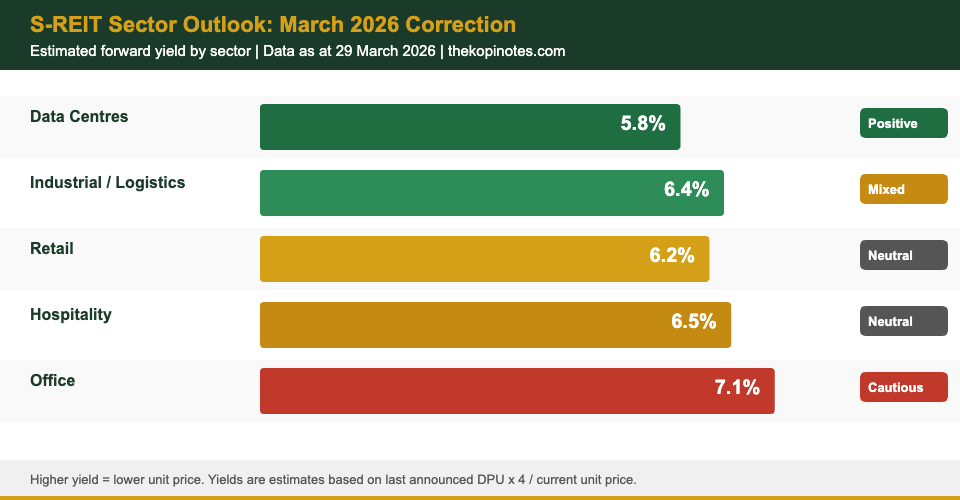
| Sector | Outlook | Key Risk / Driver | Example REITs |
|---|---|---|---|
| Retail | Neutral | Domestic consumption resilient; tourism spending holding | Frasers Centrepoint Trust, Lendlease REIT |
| Office | Cautious | Slower GDP dampens financial services hiring; rising vacancies | Keppel REIT, Manulife US REIT |
| Industrial / Logistics | Mixed | E-commerce demand intact but tariff uncertainty may soften trade | Mapletree Logistics Trust, AIMS APAC REIT |
| Data Centres | Positive | AI-driven infrastructure demand surging; long WALE leases | Keppel DC REIT, Digital Core REIT |
| Hospitality | Neutral | Tourism steady; RevPAR growth moderating from 2024-25 highs | CDL Hospitality Trusts, Far East Hospitality Trust |
The standout bright spot remains data centre REITs, where AI infrastructure demand is driving occupancy and rental growth largely insensitive to the macroeconomic slowdown. Keppel DC REIT benefits from a long weighted average lease expiry (WALE) of over five years, providing cash flow visibility regardless of short-term rate volatility.
For investors looking to add exposure to Singapore REITs during this correction, see our comprehensive guide to the best S-REITs in Singapore for 2026, which includes up-to-date yield and gearing data.
cpf“>What About CPF Investors?
CPF members investing through the CPF Investment Scheme (CPFIS-OA) can use their Ordinary Account savings to invest in eligible S-REITs and REIT ETFs. Here is how the current rate environment stacks up:
- CPF OA rate: 2.5% p.a. (floor rate, guaranteed)
- CPF SA rate: 4% p.a.
- Singapore 10Y Government Bond yield: ~2.29% (as at 26 March 2026)
- Average S-REIT dividend yield: 6%+ (after March 2026 correction)
The yield spread between S-REITs (6%+) and CPF OA (2.5%) now sits at over 3.5 percentage points — a level historically associated with attractive REIT entry points. However, CPF OA offers capital safety while REITs carry NAV risk in a rising-rate environment.
Key consideration: Singapore’s 10-year bond yield at 2.29% is actually below the CPF OA floor rate of 2.5%, meaning CPF remains a competitive risk-free return vehicle. CPFIS-OA investors should weigh the yield premium carefully against the capital volatility S-REITs have demonstrated in March.
For a deeper dive into how to optimise your CPF for investments, see our guide on CPF investment strategy.
Our Take
The March 2026 S-REIT sell-off is painful but not surprising — it is the market repricing for a higher-for-longer rate environment that squeezes REIT distributions and NAVs. However, for long-term dividend investors, a 7% index correction that pushes yields above 6% deserves serious attention. We favour REITs with long fixed-rate debt, strong sponsor pipelines, and exposure to data centres or logistics over rate-sensitive office plays. Dollar-cost averaging into quality S-REITs during this window — especially via a low-cost platform — could prove rewarding when rates eventually turn.
Frequently Asked Questions
Why do Singapore REITs fall when interest rates rise?
Is now a good time to buy Singapore REITs?
Which S-REIT sectors are best positioned in a high-rate environment?
Can I use my CPF to invest in S-REITs?
How many rate cuts is the Fed expected to make in 2026?
Conclusion
March 2026 has been a challenging month for Singapore REIT investors, with the S-REIT index dropping 7% as the US Federal Reserve signalled only one rate cut for the year and Singapore’s bond yields climbed. The correction has been broad — dragging down quality and lower-quality REITs alike — which typically creates selective buying opportunities for patient dividend investors.
The key is selectivity. Focus on S-REITs with strong balance sheets (gearing below 40%), long fixed-rate debt maturities, resilient sponsors, and sectors with structural tailwinds such as data centres and logistics. Avoid reaching for high headline yields from REITs with stretched gearing or near-term refinancing risk.
For a full analysis of the best-positioned S-REITs heading into 2H 2026, read our Best S-REITs in Singapore guide. For investing via a REIT ETF, our Singapore REIT ETF guide covers all the major options. Investors starting out may also want to explore Syfe for low-cost, diversified REIT exposure.
This is not financial advice. Data as at 29 March 2026. Market prices, yields, and gearing figures are subject to change. Please consult a licensed financial adviser before making any investment decisions.
This article was researched with the help of AI. While we strive to keep all information accurate and up to date, there may be errors. If you notice any discrepancies, please contact us.