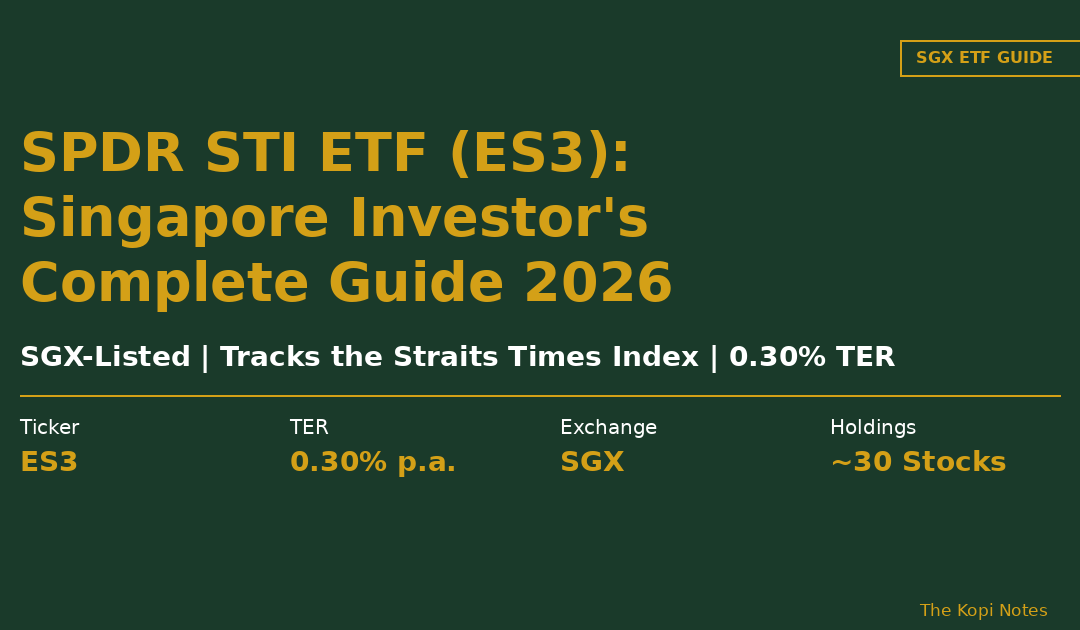
SPDR STI ETF (ES3): Singapore Investor’s Complete Guide 2026
SGX-listed | Tracks the Straits Times Index | 0.30% TER | Quarterly dividends
The SPDR STI ETF (SGX: ES3) is a Singapore Exchange-listed ETF managed by State Street Global Advisors that tracks the Straits Times Index (STI) — the 30 largest and most liquid companies listed on the SGX. With a Total Expense Ratio (TER) of 0.30% per annum, quarterly dividend distributions averaging approximately 3.0–3.5% yield, and no minimum investment beyond one lot (100 units), it is one of the simplest and most cost-effective ways for Singapore investors to gain broad exposure to the local equity market.
Not financial advice. All figures are for educational reference only. Data as at April 2026 unless noted.
Table of Contents
Contents — Click to expand
- What Is the SPDR STI ETF (ES3)?
- Key Facts at a Glance
- Top Holdings and Sector Breakdown
- Expense Ratio and Total Costs
- Dividend History and Yield
- How to Buy SPDR STI ETF in Singapore (Step-by-Step)
- SPDR STI ETF vs Nikko AM STI ETF
- CPF and SRS Eligibility
- Who Should Buy the SPDR STI ETF?
- Frequently Asked Questions
What Is the SPDR STI ETF (ES3)?
The SPDR Straits Times Index ETF, traded on the Singapore Exchange under the ticker ES3, is a passively managed exchange-traded fund designed to replicate the performance of the Straits Times Index (STI). The STI is Singapore’s benchmark equity index, comprising the 30 largest companies listed on the SGX by market capitalisation and liquidity — including DBS Group, Oversea-Chinese Banking Corporation (OCBC), United Overseas Bank (UOB), Singapore Telecommunications (Singtel), and CapitaLand Integrated Commercial Trust (CICT).
Launched in April 2002, the SPDR STI ETF is managed by State Street Global Advisors Singapore Limited, an arm of State Street Corporation — one of the world’s largest asset managers. The fund is structured as a unit trust listed on SGX, holding actual shares of the 30 STI constituents in the same weights as the index.
The ETF is distributing, meaning it pays out dividends quarterly rather than reinvesting them. This makes it attractive to investors seeking regular passive income from Singapore’s blue-chip stocks. For a Singapore investor looking for a low-cost, diversified exposure to domestic equities — without the complexity of selecting individual STI stocks — ES3 is one of the most accessible starting points.
The fund is denominated in Singapore Dollars (SGD), which eliminates foreign currency risk that comes with LSE-listed global ETFs like CSPX or VWRA. This also means no foreign exchange conversion costs when buying or selling through local brokers.
Key Facts at a Glance
| Metric | Detail |
|---|---|
| Full Name | SPDR Straits Times Index ETF |
| Ticker (SGX) | ES3 |
| Index Tracked | Straits Times Index (STI) |
| Fund Manager | State Street Global Advisors Singapore Ltd |
| Domicile | Singapore |
| Structure | Distributing (quarterly dividends) |
| TER (Expense Ratio) | 0.30% p.a. |
| AUM | SGD ~1.3 billion (as at April 2026) |
| Number of Holdings | 30 (full replication) |
| Currency | SGD |
| Minimum Investment | 1 lot = 100 units (~SGD 330–360) |
| Dividend Frequency | Quarterly |
| Exchange | Singapore Exchange (SGX) |
Source: SPDR ETF factsheet, SGX, April 2026
Top Holdings and Sector Breakdown
The SPDR STI ETF holds all 30 constituents of the Straits Times Index in full physical replication, weighted by free-float adjusted market capitalisation. As at April 2026, the top holdings are heavily concentrated in Singapore’s three major banks and a handful of blue-chip conglomerates and REITs.
| Company | Ticker | Approx. Weight | Sector |
|---|---|---|---|
| DBS Group Holdings | D05 | ~22% | Financials |
| OCBC Bank | O39 | ~17% | Financials |
| United Overseas Bank (UOB) | U11 | ~13% | Financials |
| Singapore Telecommunications | Z74 | ~4% | Telecommunications |
| CapitaLand Integrated Commercial Trust | C38U | ~4% | REITs |
| Jardine Matheson Holdings | J36 | ~4% | Industrials/Conglomerate |
| Other 24 constituents | — | ~36% | Various |
Source: SPDR factsheet, SGX, April 2026. Weights are approximate and change with index rebalancing.
From a sector perspective, the STI is dominated by Financials (~50%) — primarily DBS, OCBC, and UOB. This is both a strength (Singapore’s banks are among the most financially sound in Asia) and a concentration risk to be aware of. Other significant sectors include Real Estate/REITs (~15%), Telecommunications (~8%), and Industrials (~10%).
Expense Ratio and Total Costs
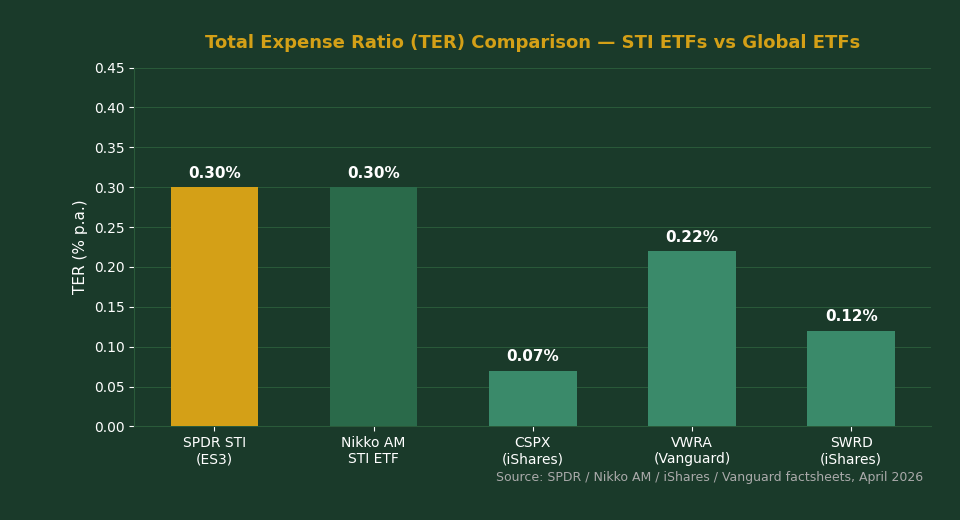
The SPDR STI ETF charges a Total Expense Ratio (TER) of 0.30% per annum. This is deducted from the fund’s net asset value daily and is reflected in the fund’s NAV — investors do not pay this separately. For context, the Nikko AM STI ETF (G3B) charges an identical 0.30% TER, making the two SGX-listed STI ETFs equivalent on this metric.
For a Singapore investor with a SGD 50,000 portfolio in ES3, the annual management cost works out to approximately SGD 150 per year — or SGD 12.50 per month. This is significantly lower than the typical unit trust or actively managed Singapore fund, which often charges 1.0–1.5% annually.
Beyond the TER, consider these additional costs:
- Brokerage commission: typically SGD 0 (if using platforms like Syfe Trade or POEMS Share Builders Plan) to ~0.08–0.28% per trade on standard broker accounts
- Spread: the bid-ask spread on ES3 is typically 0.5–1 tick (SGD 0.005–0.01 per unit), very tight given ES3’s liquidity
- No FX conversion cost: ES3 is priced in SGD — a key advantage over LSE-listed ETFs like CSPX or VWRA, which require USD/GBP conversion
Dividend History and Yield
One of the most compelling features of the SPDR STI ETF for Singapore investors is its quarterly dividend distribution. Unlike accumulating ETFs such as CSPX or VWRA that reinvest dividends internally, ES3 pays out dividends directly to investors — making it suitable for those seeking regular passive income.
The dividend yield has historically averaged between 3.0% and 3.8% per annum, depending on the year and the earnings cycle of the underlying STI constituents. The three Singapore banks (DBS, OCBC, UOB) are the primary dividend contributors and have maintained strong dividend growth over recent years. However, investors should note that dividends are not guaranteed and can vary quarter to quarter.
| Year | Approx. Annual DPU (SGD) | Approx. Yield (on ~SGD 3.30 NAV) |
|---|---|---|
| 2022 | ~SGD 0.092 | ~2.9% |
| 2023 | ~SGD 0.105 | ~3.2% |
| 2024 | ~SGD 0.112 | ~3.3% |
| 2025 (estimated) | ~SGD 0.110–0.120 | ~3.2–3.5% |
Source: SPDR factsheet, SGX. DPU = Distribution Per Unit. Past performance is not indicative of future results.
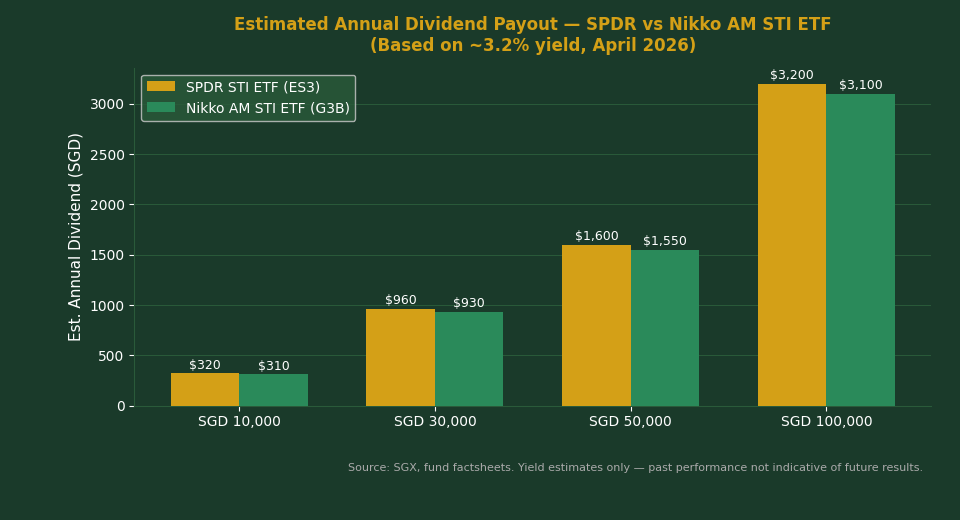
To illustrate the practical income potential: a Singapore investor who builds a SGD 100,000 position in ES3 would receive approximately SGD 3,200–3,500 per year in dividend income — paid quarterly in roughly equal instalments. This income is not subject to Singapore income tax, as dividends from SGX-listed ETFs are received tax-free for Singapore resident investors. You can model your own dividend projections using the Singapore retirement calculator.
How to Buy SPDR STI ETF in Singapore (Step-by-Step)
ES3 is listed on the SGX in SGD and can be bought through any SGX-connected brokerage. Unlike LSE-listed ETFs, there is no currency conversion required. Here is how to buy it through the main platforms Singapore investors use:
Option 1: Interactive Brokers (IBKR)
IBKR offers SGX-listed ETFs with competitive commissions. Search for ticker ES3, select SGX as the exchange, and place a limit or market order in SGD. Minimum commission is USD 1.00 per trade. Best for larger portfolios (SGD 50,000+) due to the fixed minimum. For a review of costs, see the moomoo Singapore review for a comparison with IBKR.
Option 2: Syfe Trade
Syfe Trade provides access to SGX-listed ETFs including ES3 with competitive fees. Using the Syfe referral code gets you a sign-up bonus when you open a new account. Syfe Trade is particularly suitable for beginners who want a simple, clean interface.
Option 3: FSMOne
FSMOne’s Regular Savings Plan (RSP) allows investors to buy ES3 on a monthly basis starting from as little as SGD 50 — making it ideal for dollar-cost averaging (DCA). Use the FSMOne referral code when signing up. FSMOne is one of the most popular platforms among Singapore retail investors for index ETF accumulation.
Option 4: POEMS (Phillip Securities) Share Builders Plan
The POEMS Share Builders Plan allows automated monthly purchases of ES3 starting from SGD 100 per month, with a fixed commission of SGD 6 per counter per month. This is one of the most cost-effective RSP options for regular small-amount investing in the STI ETF.
Option 5: MooMoo Singapore
MooMoo offers SGX trading with attractive promotions for new account holders. It provides a user-friendly mobile app and competitive commission rates for SGX-listed securities including ES3.
Step-by-Step (Generic)
- Open and fund a brokerage account with SGD
- Search for ticker ES3 on the SGX market
- Decide your lot size: 1 lot = 100 units (~SGD 330–360 at current NAV)
- Place a limit order at or near the current ask price for best execution
- Settlement is T+2 for SGX equities — units appear in your portfolio in 2 business days
- Set up a Regular Savings Plan (RSP) if you want automated monthly purchases
SPDR STI ETF vs Nikko AM STI ETF
The two main SGX-listed STI ETFs are the SPDR STI ETF (ES3) and the Nikko AM STI ETF (G3B). Both track the same Straits Times Index and charge the same 0.30% TER. For most investors, either is a suitable choice — but there are a few differences worth knowing.
| Feature | SPDR STI ETF (ES3) | Nikko AM STI ETF (G3B) |
|---|---|---|
| Fund Manager | State Street Global Advisors | Nikko Asset Management |
| TER | 0.30% p.a. | 0.30% p.a. |
| AUM (approx) | SGD ~1.3 billion | SGD ~600 million |
| Dividend Frequency | Quarterly | Semi-annual |
| Liquidity (daily vol) | Higher (more traded) | Lower |
| RSP availability | Yes (most brokers) | Yes (most brokers) |
| CPF-investable | Yes (CPFIS-OA approved) | Yes (CPFIS-OA approved) |
| Launch Date | April 2002 | February 2009 |
Source: SPDR / Nikko AM factsheets, SGX, April 2026
Which should you pick? For most investors, the SPDR STI ETF (ES3) is the marginal preference due to its larger AUM (greater liquidity and tighter spreads), quarterly dividend payments (better for income planning), and longer track record. However, if your broker’s RSP only supports G3B, the difference is minimal — both track the same index at the same cost.
CPF and SRS Eligibility
The SPDR STI ETF (ES3) is approved under the CPF Investment Scheme (CPFIS) for the Ordinary Account (OA). This means Singapore Citizens and Permanent Residents can use their CPF OA savings (above the first SGD 20,000) to invest in ES3 through CPF-authorised agents. This is a significant advantage — it allows long-term investors to potentially earn returns above the CPF OA’s 2.5% floor rate while staying invested in local blue chips. For more on this, read our guide on CPF investment strategy Singapore.
ES3 is also eligible for the Supplementary Retirement Scheme (SRS). Investors can use SRS funds to purchase ES3 through an SRS-linked brokerage account. SRS contributions provide an upfront income tax deduction, and SRS investments are only taxed upon withdrawal — making this a tax-efficient way to build a long-term STI ETF position.
This dual CPF/SRS eligibility is a major differentiator from LSE-listed ETFs like CSPX, VWRA, or IWDA — those cannot be bought with CPF funds. For investors with significant CPF savings looking for equity exposure beyond the CPF’s 2.5% OA rate, ES3 is the most straightforward CPF-investable index ETF option.
Who Should Buy the SPDR STI ETF?
The SPDR STI ETF is a good fit for investors who match one or more of these profiles:
ES3 is ideal if you:
- Want SGD-denominated equity exposure with no foreign currency risk
- Are building a regular savings plan (RSP) starting from SGD 50–100/month
- Want to invest CPF OA funds in equities under the CPFIS
- Prefer quarterly dividend income from Singapore’s blue-chip stocks
- Are a Singapore-focused investor seeking exposure to DBS, OCBC, UOB and REITs in one ETF
- Are new to investing and want a simple, locally-listed, SGD ETF to start with
Consider alternatives if you:
- Want global diversification — the STI covers only 30 Singapore stocks; VWRA ETF Singapore or CSPX ETF Singapore guide give global/US market exposure
- Are concerned about financial sector concentration (50%+ in banks)
- Prefer an accumulating structure where dividends are reinvested automatically — ES3 distributes and requires manual reinvestment
- Are optimising for lowest possible TER — global ETFs like CSPX (0.07%) or SWRD (0.12%) are much cheaper, though they carry currency risk and are not CPF-eligible
ES3 also pairs well with global ETFs. Many Singapore investors build a core-satellite portfolio: ES3 as the Singapore core (CPF/SRS funds or SGD savings) plus CSPX or VWRA as the global satellite (cash savings via IBKR or Syfe). This approach captures Singapore dividend income while maintaining international diversification. To plan your overall retirement allocation, try our Singapore retirement calculator and explore strategies for passive income in Singapore.
For investors interested in adding dividend-paying S-REITs alongside ES3, the Singapore REIT ETF guide and best S-REITs in Singapore 2026 offer complementary income strategies.
Disclaimer: This article is for informational and educational purposes only. It does not constitute financial advice. All investment decisions should be made based on your own financial situation, risk tolerance, and investment objectives. Past performance is not indicative of future results. Please consult a licensed financial adviser if in doubt.
Frequently Asked Questions
What is the SPDR STI ETF (ES3) and how does it work?
The SPDR STI ETF (SGX: ES3) is a passively managed exchange-traded fund listed on the Singapore Exchange that tracks the Straits Times Index — Singapore’s benchmark index of the 30 largest and most liquid SGX-listed companies. It works by holding the actual shares of all 30 STI constituents in proportion to their index weighting. When you buy 1 lot (100 units) of ES3, you effectively own a small slice of all 30 STI companies, including DBS, OCBC, UOB, Singtel, and CapitaLand. The fund distributes dividends quarterly, passing through income from the underlying shares to unit holders.
What is the expense ratio of the SPDR STI ETF?
The SPDR STI ETF charges a Total Expense Ratio (TER) of 0.30% per annum. This is deducted automatically from the fund’s net asset value — investors do not pay it as a separate bill. For a SGD 50,000 portfolio, the cost is approximately SGD 150 per year. The TER is identical to its main competitor, the Nikko AM STI ETF (G3B). Both are significantly cheaper than actively managed Singapore equity funds, which typically charge 1.0–1.5% per year.
What is the dividend yield of the SPDR STI ETF?
The SPDR STI ETF has historically paid an annual dividend yield of approximately 3.0–3.8%, paid quarterly. The exact yield varies each year depending on the dividend payouts of the 30 underlying STI companies — the three Singapore banks (DBS, OCBC, UOB) are the largest contributors. For 2024, the estimated annual distribution per unit was approximately SGD 0.112, representing about 3.3% on a unit price of ~SGD 3.40. Dividends are not guaranteed and can change year to year.
Can I buy the SPDR STI ETF using my CPF funds?
Yes. The SPDR STI ETF (ES3) is approved under the CPF Investment Scheme (CPFIS) for the Ordinary Account (OA). Singapore Citizens and Permanent Residents can invest CPF OA monies above the first SGD 20,000 in ES3 through a CPF Investment Account linked to an authorised broker. This allows you to potentially earn returns above the CPF OA interest rate of 2.5%. ES3 is also eligible for the Supplementary Retirement Scheme (SRS), making it one of the few SGX ETFs with both CPF and SRS eligibility.
What is the difference between the SPDR STI ETF (ES3) and the Nikko AM STI ETF (G3B)?
Both the SPDR STI ETF (ES3) and the Nikko AM STI ETF (G3B) track the same Straits Times Index and charge an identical TER of 0.30% per annum. The key differences are: ES3 has a larger AUM (~SGD 1.3 billion vs ~SGD 600 million for G3B), which typically means better liquidity and tighter spreads on SGX; ES3 pays dividends quarterly while G3B pays semi-annually; and ES3 has a longer track record since 2002 vs G3B since 2009. For most investors, either ETF is suitable — preference for quarterly income favours ES3, while some Regular Savings Plans may only offer G3B.
Is the SPDR STI ETF safe? What are the risks?
Like all equity investments, the SPDR STI ETF carries market risk — the value of your units can fall if the Singapore stock market declines. Specific risks to be aware of include: concentration risk (over 50% exposure to Singapore’s three banks — DBS, OCBC, UOB), which means the ETF is sensitive to financial sector downturns; Singapore-specific economic risk (the STI reflects Singapore’s economy, which can be affected by regional geopolitical events, trade disruptions, or property market cycles); and dividend variability (payouts depend on the earnings of underlying companies and are not guaranteed). ES3 is SGD-denominated, so there is no currency risk for Singapore investors. It is a legitimate, regulated product listed on SGX under MAS oversight.
What is the minimum investment for the SPDR STI ETF?
The standard minimum investment for the SPDR STI ETF is 1 lot = 100 units. At a unit price of approximately SGD 3.30–3.60, this means a minimum investment of roughly SGD 330–360, plus brokerage commission. However, many Regular Savings Plans (RSPs) on platforms like FSMOne, POEMS Share Builders Plan, and DBS Invest-Saver allow you to invest in ES3 from as little as SGD 50–100 per month, with fractional lots being accumulated over time. This makes ES3 very accessible even for first-time investors.
Ready to Start Investing in Singapore ETFs?
Open a brokerage account and buy ES3 or other Singapore ETFs today. Use our referral links for exclusive sign-up bonuses.
This article was researched with the help of AI. While we strive to keep all information accurate and up to date, there may be errors. If you notice any discrepancies, please contact us.