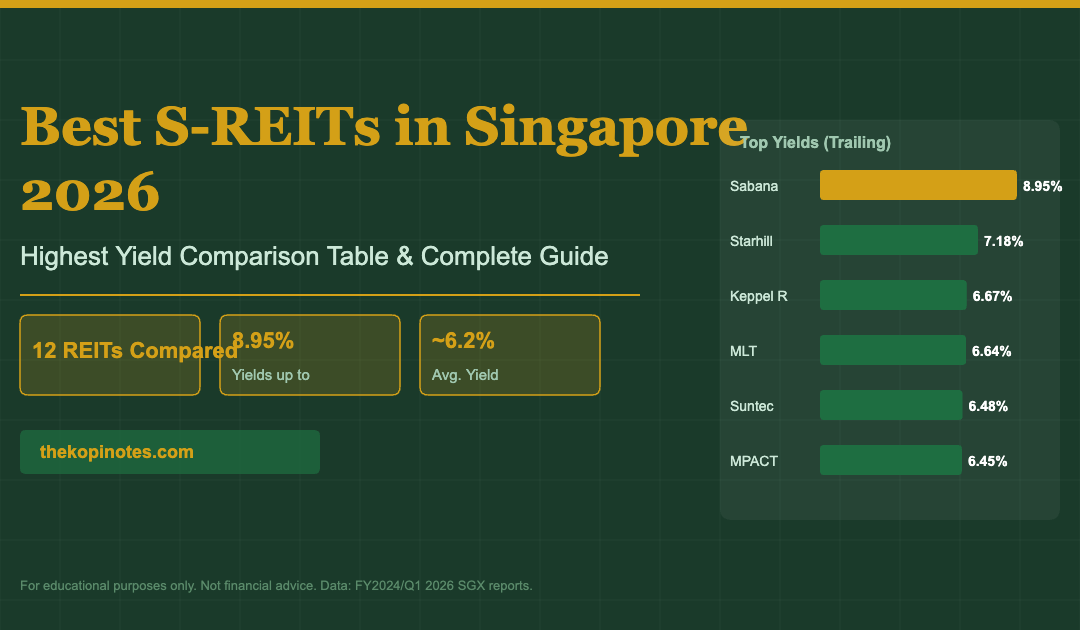
Best S-REITs in Singapore 2026
Average S-REIT trailing yield: 5.5–7.0% | 12 REITs compared | Q1 2026 data
Singapore Real Estate Investment Trusts (S-REITs) continue to be among the most popular passive income instruments for retail investors in 2026. With the FTSE ST REIT Index representing over 40 listed REITs and property trusts on the Singapore Exchange (SGX) — covering a combined market capitalisation exceeding S$100 billion — S-REITs span industrial, logistics, retail, office, healthcare, hospitality, and data centre sectors.
The macroeconomic backdrop has shifted meaningfully since 2023. The US Federal Reserve completed three rate cuts in the September 2024–March 2025 cycle, and Singapore’s SORA (Singapore Overnight Rate Average) has eased from its 2023 peak of approximately 3.68% to around 2.80% in early 2026. This declining rate environment typically supports higher REIT unit prices and gradually improving DPU (distribution per unit) as refinancing costs moderate. Meanwhile, 12-month fixed deposit rates have fallen to approximately 2.8–3.2%, making S-REIT yields of 5.5–8.9% increasingly attractive on a risk-adjusted basis.
This article gives you a complete S-REIT comparison table for 2026, sector-by-sector analysis, gearing health checks against MAS limits, and our view on the top picks for dividend investors. If you are also considering diversified REIT exposure, read our Singapore REIT ETF guide for a passive fund approach.
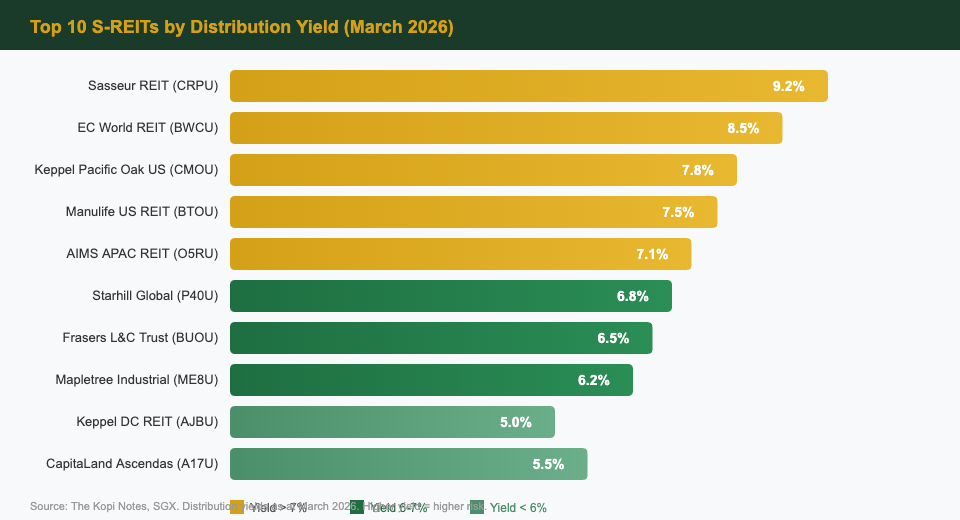
Table of Contents
Contents — Click to Expand
- What Are S-REITs?
- S-REIT Sector Overview 2026
- S-REIT Yield Comparison Table (Q1 2026)
- Top S-REIT Picks: Detailed Analysis
- Gearing Ratios & MAS Regulations
- Sector Outlook: Fed Rates, SORA & Macro Trends
- Pros & Cons of S-REIT Investing
- How to Invest in S-REITs
- Frequently Asked Questions
- Verdict & Recommendation
What Are S-REITs?
S-REITs are collective investment schemes regulated by the Monetary Authority of Singapore (MAS) under the Code on Collective Investment Schemes (CIS Code). They pool investor capital to acquire, manage, and distribute income from a portfolio of real estate assets. Listed on the Singapore Exchange (SGX), S-REIT units are freely traded during market hours, with a standard minimum lot size of 100 units.
Key S-REIT Characteristics
- 90% distribution requirement: S-REITs must distribute at least 90% of their taxable income annually to qualify for Singapore’s tax transparency treatment — meaning distributions flow to investors without being taxed at the REIT level. Most Singapore retail investors pay 0% tax on qualifying REIT distributions.
- MAS gearing limit: Maximum aggregate leverage of 50% of deposited property value, or up to 55% if the REIT maintains a minimum investment grade credit rating and provides an interest coverage ratio plan to unitholders.
- Independent oversight: A board of trustees supervises the REIT manager, who earns base management fees (typically 0.3–0.5% of deposited property value p.a.) plus performance fees tied to DPU or NAV growth.
- Distribution frequency: Most major S-REITs distribute semi-annually; select REITs (CICT, PLife REIT) pay quarterly.
For investors looking to build passive income, S-REITs complement CPF savings effectively. See how to optimise your CPF investment strategy alongside REIT holdings for a balanced retirement income approach.
S-REIT Sector Overview 2026
Singapore’s listed REIT market is one of the largest and most liquid in Asia. As of Q1 2026, the seven major sectors show distinctly different risk-return profiles:
| Sector | Key REITs | Avg. Yield Range | 2026 Outlook |
|---|---|---|---|
| Industrial & Logistics | CLAR, MIT, MLT, FLCT | 5.6%–6.7% | Positive — e-commerce, nearshoring, data centre demand |
| Retail | CICT, MPACT, Starhill | 5.4%–7.2% | Neutral-Positive — tenant sales recovery; limited new supply |
| Office | Keppel REIT, Suntec REIT | 6.5%–6.7% | Cautious — hybrid work headwinds; Grade A CBD rents stable |
| Healthcare | PLife REIT | 3.9%–4.2% | Positive — ageing population, long WALE, Japan portfolio |
| Data Centres | Keppel DC REIT | 4.5%–5.0% | Positive — AI/cloud demand; yield premium compressed |
| Hospitality | CDL Hospitality, Far East Hospitality | 5.5%–7.5% | Positive — RevPAR recovery; tourism tailwinds |
| Diversified/Overseas | IREIT Global, Elite UK REIT | 6.5%–8.5% | Neutral — higher yields but FX and geopolitical risk |
S-REIT Yield Comparison Table (Q1 2026)
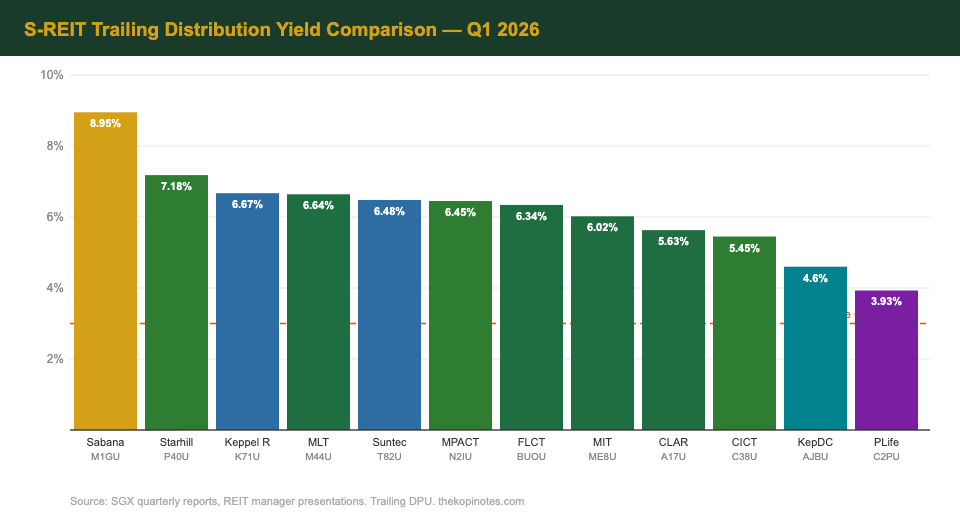
The table below compares 12 major S-REITs by trailing DPU (Distribution Per Unit), unit price, distribution yield, and aggregate leverage (gearing). Yield formula: Trailing Annual DPU ÷ Current Unit Price × 100. All DPU figures are sourced from SGX-published quarterly and full-year financial reports. Unit prices reflect Q1 2026 averages.
| REIT | SGX Code | Sector | Trailing DPU (¢) | Unit Price (S$) | Yield (%) | Gearing (%) |
|---|---|---|---|---|---|---|
| Sabana Industrial REIT | M1GU | Industrial | 3.40 | 0.38 | 8.95% | 32.8% |
| Starhill Global REIT | P40U | Retail | 3.52 | 0.49 | 7.18% | 35.4% |
| Keppel REIT | K71U | Office | 5.80 | 0.87 | 6.67% | 41.2% |
| Mapletree Logistics Trust (MLT) | M44U | Logistics | 8.50 | 1.28 | 6.64% | 39.1% |
| Suntec REIT | T82U | Office/Retail | 8.10 | 1.25 | 6.48% | 42.8% |
| Mapletree Pan Asia Commercial Trust (MPACT) | N2IU | Retail/Office | 8.00 | 1.24 | 6.45% | 40.4% |
| REIT | SGX Code | Sector | Trailing DPU (¢) | Unit Price (S$) | Yield (%) | Gearing (%) |
|---|---|---|---|---|---|---|
| Frasers Logistics & Commercial Trust (FLCT) | BUOU | Logistics/Commercial | 5.52 | 0.87 | 6.34% | 39.2% |
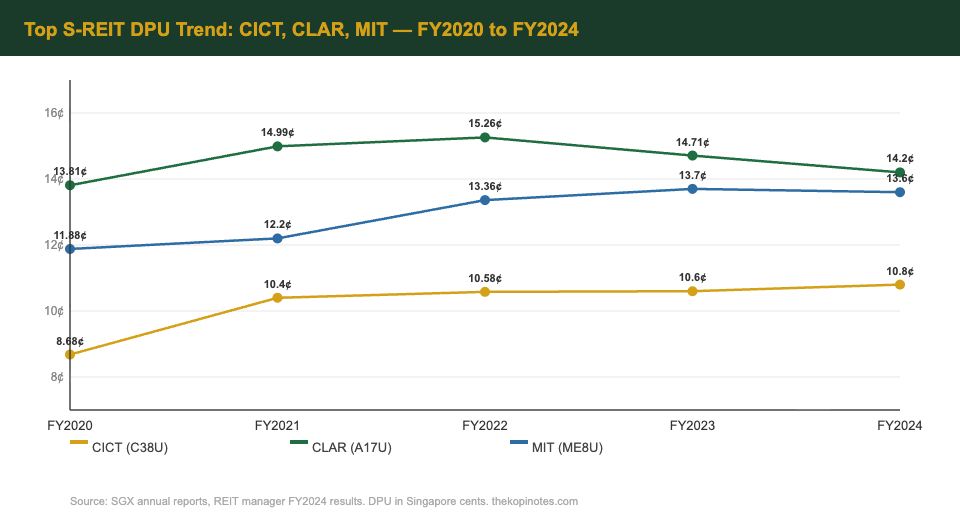
| Mapletree Industrial Trust (MIT) | ME8U | Industrial/Data Centre | 13.60 | 2.26 | 6.02% | 38.5% |
| CapitaLand Ascendas REIT (CLAR) | A17U | Industrial | 14.20 | 2.52 | 5.63% | 37.1% |
| CapitaLand Integrated Commercial Trust (CICT) | C38U | Retail/Office | 10.80 | 1.98 | 5.45% | 38.2% |
| Keppel DC REIT | AJBU | Data Centre | 9.20 | 2.00 | 4.60% | 30.5% |
| Parkway Life REIT (PLife) | C2PU | Healthcare | 15.00 | 3.82 | 3.93% | 35.8% |
Sources: SGX quarterly reports, REIT manager investor presentations (FY2024/Q4 2024). Unit prices are indicative Q1 2026 averages. Yield = Trailing DPU ÷ Unit Price × 100. DPU in Singapore cents.
Trailing Annual DPU: 10.80¢ = S$0.1080 | Unit Price: S$1.98
Yield = S$0.1080 ÷ S$1.98 × 100 = 5.45%
Compare vs. 12-month fixed deposit rate of ~3.0% — a yield premium of ~245 basis points.
Top S-REIT Picks: Detailed Analysis
Beyond the raw yield table, investors should consider portfolio quality, sponsor strength, WALE (Weighted Average Lease Expiry), and distribution growth trajectory. Here we analyse three standout picks across different risk-return profiles.
1. CapitaLand Ascendas REIT (CLAR) — SGX: A17U
CLAR is Singapore’s largest industrial REIT by market capitalisation (approximately S$11 billion), managed by CapitaLand Investment. Its diversified portfolio spans over 220 properties across Singapore, Australia, the UK, and the US — covering business parks, logistics, suburban offices, and data centres. FY2024 DPU of 14.20 Singapore cents represented a broadly stable distribution year on year despite higher refinancing costs in the rising rate environment.
Why it stands out: CLAR’s sponsor — CapitaLand Investment — is one of Asia’s largest real estate investment managers, providing a strong acquisition pipeline of pipeline assets. The REIT’s gearing (37.1%) sits comfortably below the MAS 50% limit, giving it acquisition capacity. Positive rental reversions across its Singapore and Australian logistics portfolios suggest DPU recovery as fixed-rate hedges roll off in 2026–2027.
Key metrics: WALE approximately 4.0 years; portfolio occupancy above 93%. Singapore accounts for approximately 60% of portfolio income.
2. Mapletree Industrial Trust (MIT) — SGX: ME8U
MIT offers investors a blend of traditional industrial assets and data centre exposure. Of its approximately S$9 billion portfolio, around 50% is attributed to data centre properties across Singapore and North America. Data centre assets command premium rents on long-term leases, contributing to distribution resilience and countering weakness in traditional flatted factory and hi-tech park segments.
Why it stands out: MIT’s data centre portfolio provides strong income visibility at a time when AI infrastructure demand is intensifying globally. Hyperscaler tenants typically sign 10–15 year triple-net leases, providing very low vacancy risk. The 6.02% trailing yield is attractive given this quality and structural growth angle.
Key metrics: Data centre assets contribute approximately 52% of MIT’s net property income (NPI). Portfolio occupancy above 95%; interest coverage ratio approximately 4.5x.
3. CapitaLand Integrated Commercial Trust (CICT) — SGX: C38U
CICT is Singapore’s largest REIT by market capitalisation (approximately S$14 billion), owning a portfolio of retail malls and Grade A office properties in Singapore and Germany. Key Singapore assets include Raffles City Singapore, IMM Building, Clarke Quay, and Funan. Quarterly distributions make CICT one of only a handful of S-REITs providing four annual income payments — particularly useful for investors managing regular cash flow needs.
Why it stands out: CICT’s Singapore retail portfolio benefits from high tourist footfall at prime Orchard Road and Bugis locations. Its Grade A office components enjoy robust tenant demand from financial and professional services firms. Positive retail rental reversions of +5–8% in FY2024 indicate growing portfolio income.
Key metrics: Retail occupancy above 99%; office occupancy above 93%. Distribution yield of 5.45% with quarterly payout frequency.
For a broader REIT portfolio approach, see our best S-REITs Singapore guide and Singapore REIT ETF guide.
Gearing Ratios & MAS Regulations
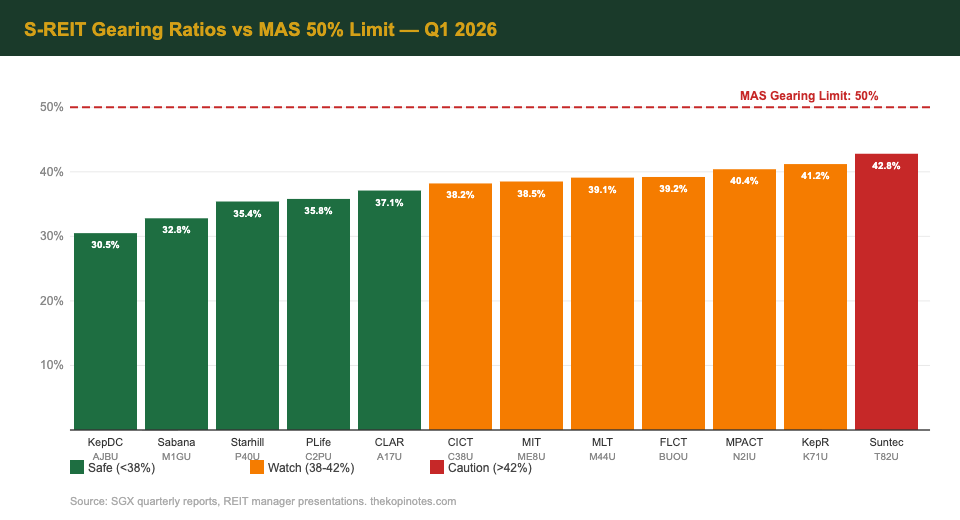
Gearing ratio is one of the most critical metrics to monitor when evaluating an S-REIT. Under MAS’s Property Fund Appendix to the Code on Collective Investment Schemes, Singapore-listed REITs are subject to strict aggregate leverage limits:
- Standard limit: 50% of deposited property value
- Enhanced limit: 55% — only applicable if the REIT maintains a minimum investment grade credit rating AND maintains an interest coverage ratio (ICR) of at least 2.5x
Breaching the gearing limit would require the REIT to divest assets or conduct equity fundraising (rights issues or private placements), which can be dilutive to existing unitholders. As a rule of thumb, gearing 10 percentage points or more below the MAS standard limit is considered comfortable headroom.
Gearing Health Check — Q1 2026
- Lowest gearing (safest headroom): Keppel DC REIT (30.5%), Sabana REIT (32.8%), PLife REIT (35.8%) — all have 14–19 percentage points of headroom
- Highest gearing (monitor closely): Suntec REIT (42.8%), Keppel REIT (41.2%), MPACT (40.4%)
- Suntec REIT caution flag: At 42.8%, Suntec REIT has approximately 7.2 percentage points of headroom to the MAS 50% standard limit. Any significant devaluation of its Australian or UK office assets could pressure this metric.
Interest Coverage Ratio (ICR) measures how many times a REIT’s net property income covers its interest expense. MAS requires REITs at the 55% gearing tier to maintain ICR ≥ 2.5x. Most major S-REITs maintain ICR of 3.5x–5.5x, providing comfortable debt servicing capacity. Always check the ICR alongside gearing when evaluating refinancing risk.
Sector Outlook: Fed Rates, SORA & Macro Trends 2026
Interest rate direction is the single most important macro variable for S-REIT valuations. Because REITs use significant leverage, their financing costs — and therefore distributable income — are sensitive to benchmark rates. Here is what matters for Singapore REIT investors in 2026:
US Federal Reserve Rate Path
The Fed began its easing cycle in September 2024 with a 50-basis-point cut, followed by further 25bp cuts in late 2024 and early 2025. As of Q1 2026, the Federal Funds Rate target range sits at approximately 4.00–4.25%, down from its 2023 peak of 5.25–5.50%. Further cuts remain data-dependent — sticky services inflation and a resilient US labour market suggest gradual easing. For S-REITs with USD-denominated debt (e.g., CLAR, MIT, MLT), lower US rates improve refinancing economics on dollar tranches.
SORA Trends
SORA (Singapore Overnight Rate Average) — which replaced SIBOR as Singapore’s primary interest rate benchmark — has eased in line with global rate trends, from 3.68% at its 2023 peak to approximately 2.80% in early 2026. Since most Singapore-dollar floating rate loans reference compounded SORA, this easing directly benefits S-REITs refinancing SGD debt tranches. Every 25bp reduction in SORA can improve distributable income for REITs with significant floating rate exposure by 0.5–1.5% depending on leverage.
Industrial & Logistics: E-Commerce and Nearshoring Tailwinds
E-commerce penetration in Southeast Asia continues to drive demand for last-mile logistics facilities. Singapore’s role as a regional logistics hub — with Tuas Mega Port ramping throughput — ensures sustained demand for high-specification warehouses. REITs like MLT, FLCT, and CLAR are positioned to capture positive rental reversions on lease renewals, which should grow DPU over time as leases signed at lower historic rents roll over to market rates.
Data Centres: AI Tailwinds, Yield Compression Caution
AI infrastructure demand is driving unprecedented data centre buildout globally. Singapore remains a key Asia-Pacific hub due to political stability, connectivity infrastructure, and skilled workforce — though MAS and the government have managed new DC approvals carefully to preserve power grid and water capacity. Keppel DC REIT and MIT’s data centre segment benefit from this structural demand. However, strong investor appetite for DC assets has compressed their trading yields (Keppel DC REIT at 4.6%) relative to broader S-REIT peers.
Office Sector: Navigating Hybrid Work
Singapore Grade A CBD office rents have remained relatively stable due to limited new supply through 2026, but hybrid work continues to moderate demand growth. Keppel REIT and Suntec REIT have diversified into Australia and the UK — adding FX exposure but also geographic diversification. Both currently trade at meaningful discounts to book value (NAV), offering potential upside if office sentiment recovers.
To model how S-REIT distributions contribute to your retirement income alongside CPF LIFE payouts, use our Singapore retirement calculator.
Pros & Cons of S-REIT Investing
| ✓ Pros | ✗ Cons & Risks |
|---|---|
| High income yields (5–9%) vs. fixed deposits (~3%) | Unit prices sensitive to interest rate movements |
| Tax-transparent distributions (0% withholding for most SG retail investors) | Mandatory 90% payout = limited retained earnings for reinvestment |
| Access to institutional-grade real estate from ~S$100–200 per lot | Dilution risk from equity fundraising (rights issues, private placements) |
| SGX-listed: fully liquid, sell any time during market hours | Overseas exposure introduces FX risk (USD, AUD, EUR, JPY) |
| Selected REITs are CPF-OA eligible via CPFIS — earn 5–7% vs. OA 2.5% | Manager conflicts of interest (sponsor preferential acquisitions) |
| MAS-regulated gearing limits protect against excessive leverage | Property devaluation risk (especially office sector with hybrid work trends) |
How to Invest in S-REITs in Singapore
- Open a brokerage account: Choose a Singapore-approved broker (DBS Vickers, POEMS/Phillip Securities, Tiger Brokers, moomoo, IBKR). You will need a CDP (Central Depository) account linked to your brokerage for SGX-listed securities.
- Fund your account: Transfer SGD via bank transfer or PayNow. Minimum S-REIT lot size is 100 units per trade.
- Search the SGX code: E.g., C38U for CICT, A17U for CLAR, ME8U for MIT. Place a limit or market order during SGX trading hours (9am–5pm SGT).
- Monitor distributions: S-REITs announce distribution per unit (DPU) with an ex-dividend date. Hold units before the ex-date to qualify for the distribution. Payment typically follows 4–6 weeks after the ex-date.
- Use CPF-OA for eligible REITs: Selected S-REITs (e.g., CICT, CLAR) are CPFIS-OA eligible. Read our CPF investment strategy guide before investing CPF funds — the guaranteed 2.5% OA floor means you should only invest CPF in REITs with confidence of outperforming this hurdle.
For a hands-off approach, robo-advisory platforms offer S-REIT portfolios with automatic rebalancing. View our Syfe referral code and FSMOne referral code for sign-up fee savings.
Frequently Asked Questions
What is the highest yield S-REIT in Singapore in 2026?
Are S-REIT distributions taxable in Singapore?
What is the MAS gearing limit for Singapore REITs?
Can I use CPF to invest in S-REITs?
What is WALE and why does it matter for REITs?
How often do S-REITs pay distributions?
Are S-REITs a good investment in a rate-cutting cycle?
What risks should I watch for with S-REITs in 2026?
Verdict & Recommendation
The best S-REIT for your portfolio in 2026 depends on your risk appetite, income requirements, and investment horizon. Our tiered recommendation:
- Core Holdings (Lower Risk, Stable Income): CICT (C38U) and CLAR (A17U) — blue-chip REITs with strong CapitaLand sponsorship, low gearing (37–38%), positive rental reversions, and proven track records. CICT pays quarterly; both yield 5.4–5.6%.
- Growth + Income (Moderate Risk): MIT (ME8U) offers data centre structural growth at a 6.0% yield. MLT (M44U) delivers pan-Asia logistics exposure at 6.6% yield with a well-diversified geographic footprint across 9 countries.
- Higher Yield (Higher Risk): Starhill Global REIT (P40U) at 7.2% — concentrated in Wisma Atria and Ngee Ann City but well-managed. Sabana REIT (M1GU) at 8.9% — small-cap, limited liquidity, scrutinise manager track record and portfolio quality carefully before investing.
For most retail investors, a core allocation to CICT and CLAR supplemented by MIT or MLT provides a balanced mix of yield quality and income stability. Investors with higher risk tolerance can allocate 10–20% to higher-yielding REITs for income uplift, accepting greater DPU volatility.
To model how S-REIT distributions integrate with your CPF LIFE payouts for retirement planning, try our Singapore retirement calculator.
References
- SGX — Singapore Listed REITs and Property Trusts
- MAS — Real Estate Investment Trusts Regulatory Framework
- REITAS — About S-REITs (REIT Association of Singapore)
- MAS SGS — Singapore Government Securities & Benchmark Rates
- ABS — SORA Rate History (Association of Banks in Singapore)
Last updated: March 2026. All data sourced from SGX-published financial reports and REIT manager investor presentations. All yields are trailing and for reference only. This article does not constitute financial advice.
This article was researched with the help of AI. While we strive to keep all information accurate and up to date, there may be errors. If you notice any discrepancies, please contact us.