STI ETF Share Price 2026: Live Data, History & What Drives It
Track Singapore’s most popular index ETFs — ES3 and G3B — with price history, dividend yield data, and a clear guide to what moves the STI ETF share price.
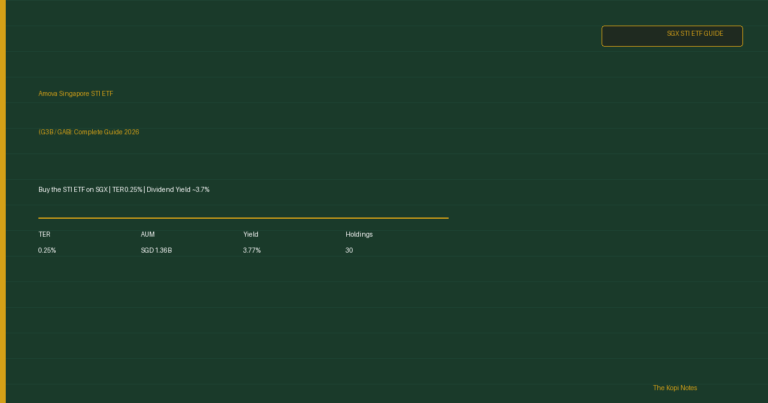
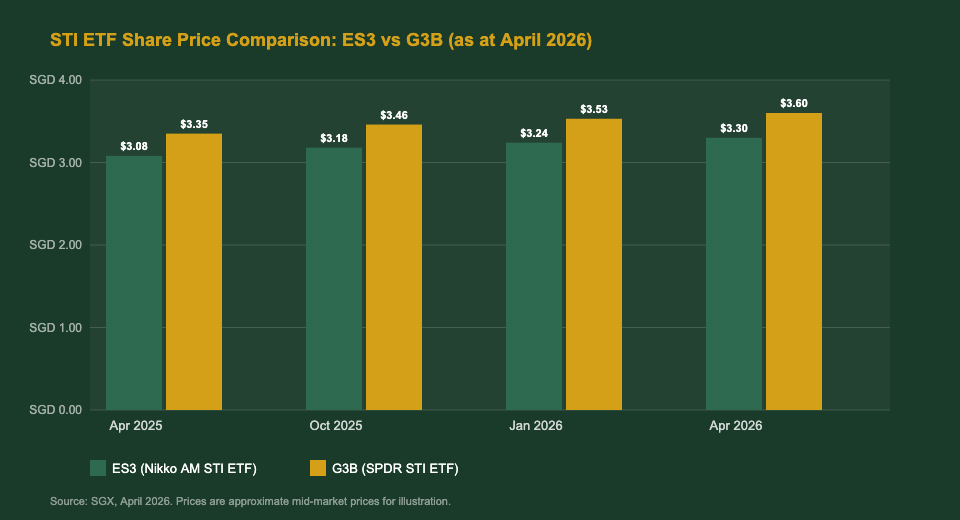
The STI ETF share price tracks Singapore’s Straits Times Index — a market-cap-weighted index of the 30 largest companies on the SGX. There are two main ETFs: ES3 (Nikko AM STI ETF, trading around SGD 3.30 per unit as at April 2026) and G3B (SPDR STI ETF, around SGD 3.60). Both distribute quarterly dividends, yield approximately 3.7–3.9% annually, and are among the simplest ways for Singapore investors to get broad local equity exposure.
Not financial advice. All figures are for educational reference only. Data as at April 2026 unless noted.
Table of Contents
Contents — Click to expand
What Is the STI ETF?
The STI ETF is an exchange-traded fund listed on the Singapore Exchange (SGX) that tracks the Straits Times Index (STI) — Singapore’s benchmark equity index comprising the 30 largest and most liquid companies traded on the SGX Mainboard. Think of it as a single investment that gives you exposure to Singapore’s blue-chip companies: DBS Group, OCBC Bank, UOB, Singapore Telecommunications, Keppel Corporation, and 25 more.
There are two STI ETFs available to Singapore investors:
- ES3 — Nikko AM STI ETF: Managed by Nikko Asset Management, it is one of the most actively traded ETFs on the SGX. It distributes dividends semi-annually and has an expense ratio (TER) of 0.30% p.a.
- G3B — SPDR STI ETF: Managed by State Street Global Advisors, it is slightly larger in AUM. It distributes dividends quarterly and has a TER of 0.30% p.a.
Both ETFs own all 30 STI constituent stocks in the same proportion as their index weight. When DBS or OCBC reports strong earnings, or when the STI rebalances to include a new constituent, the share price of both ES3 and G3B moves accordingly. Singapore investors frequently check the STI ETF share price as a proxy for how the local stock market is performing on any given day.
STI ETF Share Price: ES3 vs G3B at a Glance
The table below summarises the key metrics for both STI ETFs as at April 2026. Note that ES3 and G3B do not trade at the same price — they have different unit prices because they were launched at different times with different starting NAVs. Both track the same index, so their percentage returns over any period are nearly identical.
| Metric | ES3 (Nikko AM) | G3B (SPDR) |
|---|---|---|
| SGX Ticker | ES3 | G3B |
| Approx. Share Price (Apr 2026) | ~SGD 3.30 | ~SGD 3.60 |
| Index Tracked | Straits Times Index (STI) | Straits Times Index (STI) |
| TER (Expense Ratio) | 0.30% p.a. | 0.30% p.a. |
| AUM (Apr 2026) | ~SGD 650 million | ~SGD 1.8 billion |
| Distribution Frequency | Semi-annual | Quarterly |
| Approx. Dividend Yield | ~3.7–3.9% | ~3.6–3.8% |
| CPF-Investable? | Yes (CPFIS-OA) | Yes (CPFIS-OA) |
Source: SGX, Nikko AM, State Street Global Advisors, April 2026. Share prices are approximate and change daily.
STI ETF Price History (2021–2026)
Understanding the STI ETF share price history helps Singapore investors contextualise where the current price sits relative to historical ranges. The STI recovered strongly from its 2020 pandemic lows and has delivered steady, if unspectacular, returns over the 2021–2026 period — driven largely by the banking sector (DBS, OCBC, UOB collectively account for roughly 45% of the index weight).
Here is an approximate price history for ES3 (Nikko AM STI ETF):
| Period | ES3 Approx. Price | STI Level | Key Driver |
|---|---|---|---|
| April 2021 | ~SGD 3.02 | ~3,180 | Post-pandemic recovery, vaccine rollout |
| April 2022 | ~SGD 3.20 | ~3,380 | Rate hike cycle; banks benefited from NIM expansion |
| April 2023 | ~SGD 3.18 | ~3,290 | Global banking jitters (SVB collapse); STI resilient |
| April 2024 | ~SGD 3.22 | ~3,360 | Steady; DBS at record highs pre-correction |
| April 2025 | ~SGD 3.08 | ~3,180 | US tariff shock (April 2025) hit SG banks and REITs |
| April 2026 | ~SGD 3.30 | ~3,480 | Recovery; rate cut cycle, strong bank dividends |
Source: SGX historical data, Nikko AM factsheets, April 2026. Prices are approximate and for educational illustration only.
The key takeaway: the STI ETF price has trended upward over a 5-year horizon, but with meaningful short-term volatility tied to global macro events. The April 2025 tariff shock — which caused the STI to briefly drop below 3,200 — recovered fully within 6–8 months as investor sentiment stabilised. For Singapore investors seeking steady passive income, the passive income Singapore strategy of holding STI ETFs for dividends remains intact through short-term price swings.
What Drives the STI ETF Share Price?
The STI ETF share price moves in lockstep with the Straits Times Index. Because the index is heavily concentrated in financials (DBS, OCBC, UOB — approximately 45% weight) and real estate (REITs and developers — approximately 20% weight), several macro factors have an outsized influence on where ES3 and G3B trade on any given day.
1. Singapore Banking Sector Earnings
DBS, OCBC, and UOB together account for nearly half the STI’s weight. When these banks report strong quarterly net interest income (NIM), dividends, or lower loan loss provisions, the STI ETF price rises. Conversely, when interest rates fall sharply (compressing NIM), banking stocks pull the index down.
2. US Federal Reserve Interest Rate Decisions
Singapore’s interest rates, via SORA, are closely linked to global rate cycles. Rising rates in 2022–2023 boosted Singapore bank NIM and drove the STI ETF to multi-year highs. The rate normalisation in 2025–2026 compressed NIM slightly but supported REIT valuations within the index.
3. Global Risk-Off Sentiment
As a small, open economy, Singapore is highly sensitive to global trade and geopolitical shocks. The April 2025 US tariff announcements caused one of the sharpest single-week drops in STI ETF history — ES3 fell from approximately SGD 3.22 to SGD 3.05 in five trading days. Investors who held through the volatility recovered their losses within months.
4. SGX REIT Performance
REITs (including CapitaLand Integrated Commercial Trust, Mapletree Logistics Trust, and others) make up approximately 20% of the STI. When global interest rates rise sharply, REIT valuations compress — dragging the STI ETF price lower. For a deeper dive into how Singapore REITs interact with the broader market, see our guide to the Singapore REIT ETF guide.
5. SGD Exchange Rate
The STI is denominated in SGD. For foreign investors, a strengthening SGD boosts returns in their home currency; for Singapore residents, currency risk is not a factor since all holdings, dividends, and living expenses are in SGD — one of the STI ETF’s key advantages for local retail investors.
Dividend Yield and Distribution History
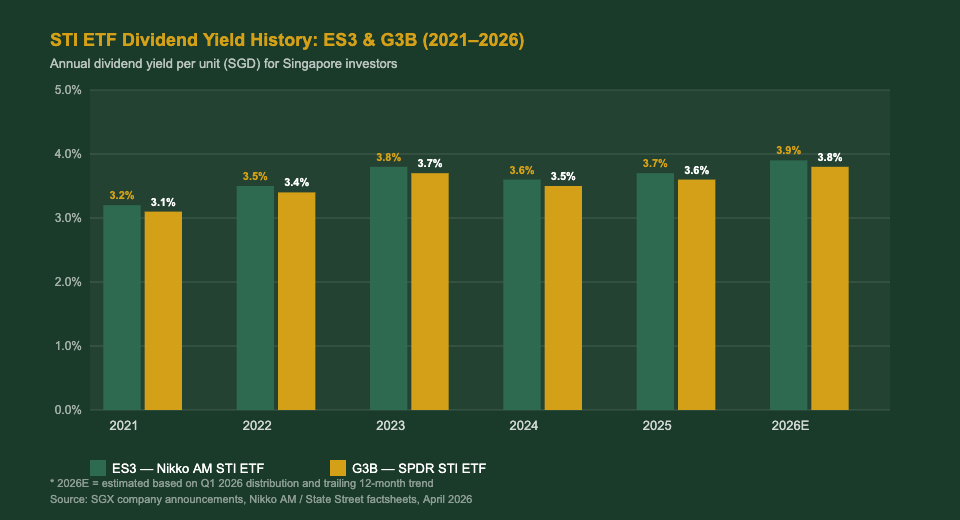
One of the strongest reasons Singapore investors hold STI ETFs is the regular dividend income. Both ES3 and G3B pass through the dividends received from all 30 STI constituent stocks, net of the 0.30% TER. Singapore investors pay no personal income tax on dividends from SGX-listed ETFs under Singapore’s single-tier tax system — making this a highly tax-efficient income source.
The approximate annual dividend per unit and yield for ES3 are as follows:
| Year | ES3 Dividend/Unit (SGD) | Approx. Yield | G3B Approx. Yield |
|---|---|---|---|
| 2021 | ~SGD 0.098 | ~3.2% | ~3.1% |
| 2022 | ~SGD 0.112 | ~3.5% | ~3.4% |
| 2023 | ~SGD 0.121 | ~3.8% | ~3.7% |
| 2024 | ~SGD 0.116 | ~3.6% | ~3.5% |
| 2025 | ~SGD 0.114 | ~3.7% | ~3.6% |
| 2026E | ~SGD 0.129 | ~3.9% | ~3.8% |
Source: Nikko AM STI ETF distribution announcements, State Street Global Advisors, SGX company filings, April 2026. 2026E = estimate based on Q1 2026 distribution.
A worked example: A Singapore investor holding SGD 30,000 worth of ES3 (approximately 9,090 units at approximately SGD 3.30/unit) would receive approximately SGD 1,170 in annual dividends at a 3.9% yield — paid in two semi-annual instalments. No withholding tax, no income tax declaration needed. To see how dividend income fits into a retirement plan, use our Singapore retirement calculator.
How to Buy the STI ETF in Singapore
Unlike LSE-listed ETFs (CSPX, VWRA) which are accessible only through international brokers, both ES3 and G3B are listed on the SGX and can be bought through virtually any Singapore brokerage — including CPF Investment Scheme (CPFIS) accounts. Here are the main options:
Via Regular Savings Plans (RSP) — Best for Beginners
POSB Invest-Saver, OCBC Blue Chip Investment Plan, and Syfe’s regular savings plan all offer STI ETF monthly investments from as little as SGD 100. Fees are typically 0.5–1.0% per transaction — acceptable for small monthly amounts. For investors starting out, an RSP removes the need to time the market and builds the habit of consistent investing. Using a Syfe referral code can provide a fee waiver for the first few months.
Via Brokerage (Lump Sum) — Best for Larger Amounts
Buying directly through a brokerage gives you more control over price and timing. SGX-listed ETFs can be bought in lots of 100 units. At SGD 3.30/unit, one lot of ES3 costs SGD 330. Key brokers and approximate commissions (as at April 2026):
- Tiger Brokers / MooMoo: SGD 0.99 flat fee per trade for SGX stocks — very competitive for smaller lots. See our moomoo Singapore review for a full breakdown.
- FSMOne: SGD 10 minimum or 0.08% per trade for SGX securities. RSP available from SGD 50/month. Access via our FSMOne referral code.
- Interactive Brokers (IBKR): USD 1.50 minimum per SGX trade — cost-effective for larger amounts (SGD 5,000+).
- CDP-Linked Accounts (DBS Vickers, UOB Kay Hian): Higher commissions (~0.18–0.28%) but shares deposited directly to your CDP account — useful for CPFIS.
Via CPF Investment Scheme (CPFIS)
Both ES3 and G3B are CPF-investable under the CPFIS-OA (Ordinary Account) scheme — one of the few ETFs that qualifies. You can invest your CPF-OA savings above the first SGD 20,000 into STI ETFs. For a detailed walkthrough of this strategy, see our guide on CPF investment strategy Singapore.
STI ETF vs Global ETF Alternatives
The STI ETF is excellent for local market exposure, dividend income, and CPF compatibility — but it concentrates your equity exposure in Singapore (30 stocks, heavy financials/REITs). Many Singapore investors hold both STI ETFs for local income and global ETFs (CSPX, VWRA) for growth diversification.
| Feature | ES3 / G3B (STI ETF) | CSPX (iShares S&P 500) | VWRA (Vanguard All-World) |
|---|---|---|---|
| Exchange | SGX | LSE | LSE |
| Holdings | 30 SG blue chips | ~500 US stocks | ~3,700 global stocks |
| TER | 0.30% p.a. | 0.07% p.a. | 0.22% p.a. |
| Approx. Dividend Yield | ~3.7–3.9% | Accumulating (no cash div) | Accumulating (no cash div) |
| CPF-Investable | Yes (CPFIS-OA) | No | No |
| US Estate Tax Risk | None | None (Ireland-domiciled) | None (Ireland-domiciled) |
| Best For | SG income + CPF investing | US equity growth | Global diversification |
Source: Nikko AM, iShares, Vanguard factsheets, April 2026.
For Singapore investors building a retirement portfolio, a common approach is to combine STI ETFs for local income (dividend reinvestment via CPFIS) with CSPX or VWRA for long-term global growth. Check our guide to best S-REITs in Singapore 2026 for the income component, and our Singapore T-bills 2026 guide for the fixed-income portion of your portfolio.
Disclaimer: The information above is for educational purposes only and does not constitute financial advice. Past performance of the STI ETF share price does not guarantee future returns. Always do your own research or consult a licensed financial adviser before investing.
Frequently Asked Questions
What is the current STI ETF share price?
As at April 2026, the ES3 (Nikko AM STI ETF) trades at approximately SGD 3.30 per unit, and G3B (SPDR STI ETF) trades at approximately SGD 3.60 per unit. Both track the same Straits Times Index, so they move in percentage terms almost identically — the different unit prices simply reflect that they were launched at different times. Always check the live price on SGX InvestOR or your brokerage app before trading.
Why are ES3 and G3B priced differently if they track the same index?
ES3 and G3B track the same Straits Times Index but were launched at different times with different starting net asset values (NAV). Over time, dividend distribution amounts and timing differences have caused a small divergence in unit price. From a return perspective, holding either ETF gives you near-identical STI performance — the choice between them is mostly about trading liquidity, dividend frequency (semi-annual for ES3 vs quarterly for G3B), and which is available through your preferred broker.
Can I buy the STI ETF using CPF money?
Yes — both ES3 and G3B are approved under the CPF Investment Scheme Ordinary Account (CPFIS-OA). You can invest CPF-OA savings above the first SGD 20,000 into STI ETFs. To do this, you need to open a CPFIS account with a participating bank (DBS, UOB, OCBC) or broker. Note that the 2.5% CPF-OA interest is a guaranteed floor — investing in STI ETFs means accepting market risk in exchange for potentially higher long-term returns and dividend income. LSE-listed ETFs like CSPX and VWRA are not CPF-investable.
Is the STI ETF a good long-term investment for Singapore residents?
The STI ETF offers several advantages for Singapore residents: no withholding tax on dividends, no capital gains tax, CPF compatibility, and low cost (0.30% TER). However, its concentration in 30 Singapore blue chips — heavily weighted to banks and REITs — means you have limited global diversification. Most financial planners suggest pairing an STI ETF (for local income and CPF optimisation) with a globally diversified ETF like VWRA or CSPX (for growth exposure). Over a 10–20 year horizon, a combined approach has historically delivered stronger risk-adjusted returns than either alone.
How does the STI ETF pay dividends and how much can I expect?
ES3 pays dividends semi-annually (typically March and September), while G3B pays quarterly. Both distribute the dividends they receive from the 30 STI constituent companies, net of the 0.30% TER. At current yield levels (~3.7–3.9%), an investor holding SGD 10,000 worth of ES3 can expect approximately SGD 370–390 per year in dividend income — paid directly to their brokerage account, with no additional tax to declare in Singapore. Use our retirement calculator to see how this compounds over time.
What is the minimum amount needed to buy the STI ETF?
The STI ETF trades on SGX in board lots of 100 units. At approximately SGD 3.30/unit (ES3) or SGD 3.60/unit (G3B), the minimum board lot purchase is approximately SGD 330–360, plus brokerage commission. If you want to start with less, regular savings plans (RSPs) through POSB Invest-Saver, OCBC Blue Chip Plan, or Syfe allow monthly investments from SGD 100, with no minimum lot requirement.
Ready to Start Investing in ETFs?
Open a brokerage account and buy your first ETF today. Use our referral links for exclusive sign-up bonuses.
This article was researched with the help of AI. While we strive to keep all information accurate and up to date, there may be errors. If you notice any discrepancies, please contact us.