STI ETF Dividend: Singapore Investors’ Guide to Yield, History & Payouts (2026)
ES3 and G3B — semi-annual payouts, 3–4% yield, CPF and SRS eligible.
The STI ETF pays a semi-annual cash dividend to unitholders, with a trailing yield of approximately 3.5% (ES3) to 3.8% (G3B) as at April 2026. Both Singapore-listed ETFs — SPDR STI ETF (ES3) and Nikko AM/Amova STI ETF (G3B) — track the Straits Times Index and distribute dividends in January/February and July/August each year. They are fully eligible for CPF Ordinary Account (CPFIS-OA) and Supplementary Retirement Scheme (SRS) investing.
Not financial advice. All figures are for educational reference only. Data as at April 2026 unless noted.
Table of Contents
Contents — Click to expand
- What Is the STI ETF Dividend?
- ES3 vs G3B: Key Dividend Differences
- STI ETF Dividend History (2021–2026)
- Dividend Payment Schedule
- How to Calculate Your STI ETF Dividend Income
- Using CPF or SRS to Receive STI ETF Dividends
- How to Buy ES3 or G3B for Dividend Income
- Risks and Limitations of STI ETF Dividends
- Frequently Asked Questions
What Is the STI ETF Dividend?
The STI ETF dividend is the cash distribution paid to unitholders of either the SPDR Straits Times Index ETF (SGX: ES3) or the Nikko AM Singapore STI ETF (SGX: G3B), now managed by Amova Asset Management after Nikko AM rebranded its Singapore operations in 2024. Both ETFs are distributing funds — meaning they collect dividends from the 30 constituent companies of the Straits Times Index (STI) and pass them through to investors as cash, twice a year.
This is a key structural difference from accumulating ETFs like CSPX or VWRA, which reinvest dividends back into the fund automatically. The STI ETF is designed for investors who want a regular, visible cash income stream — particularly retirees or those building a passive income Singapore portfolio.
The STI’s dividends are driven by the underlying index constituents — blue-chip Singapore companies including DBS, OCBC, UOB, Singapore Telecommunications, CapitaLand Integrated Commercial Trust, and other SGX-listed stalwarts. When these companies pay dividends, the ETF accumulates them and distributes the net amount (after fund expenses) to unitholders semi-annually.
Because there is no dividend withholding tax in Singapore on locally-domiciled ETFs, Singapore individual investors receive the full declared dividend with no tax deducted at source. This makes the STI ETF a clean, tax-efficient income vehicle for local investors — one of its strongest advantages over offshore-domiciled dividend funds.
ES3 vs G3B: Key Dividend Differences
Both ETFs track the same Straits Times Index, but there are meaningful differences in dividend yield, payment timing, and expense ratio that affect your actual take-home income.
| Feature | ES3 (SPDR STI ETF) | G3B (Amova STI ETF) |
|---|---|---|
| Manager | State Street Global Advisors | Amova Asset Management (formerly Nikko AM) |
| SGX Ticker | ES3 | G3B |
| TER (Expense Ratio) | 0.28% p.a. | 0.25% p.a. |
| Trailing Dividend Yield (TTM) | ~3.5% | ~3.8% |
| 2025 Total DPS | S$0.180 | S$0.185 |
| Payment Timing | Feb & Aug | Jan & Jul |
| CPF-OA (CPFIS) Eligible | Yes | Yes |
| SRS Eligible | Yes | Yes |
| Structure | Distributing | Distributing |
Source: SGX, State Street SSGA factsheet, Amova AM factsheet, April 2026.
The slightly higher yield on G3B is largely attributable to its lower TER (0.25% vs 0.28%). Since both ETFs track the same index and receive the same underlying dividends, the fund with lower expenses passes through marginally more to investors. Over a S$100,000 portfolio, this 0.03% difference translates to approximately S$30 per year — small but meaningful over decades of compounding.
One practical consideration: if you want earlier dividend income in the calendar year, G3B’s January ex-dividend date beats ES3’s February ex-dividend date. For investors building a staggered income stream alongside best S-REITs in Singapore 2026 (which often pay quarterly), this timing difference can help smooth monthly cash flow.
STI ETF Dividend History (2021–2026)
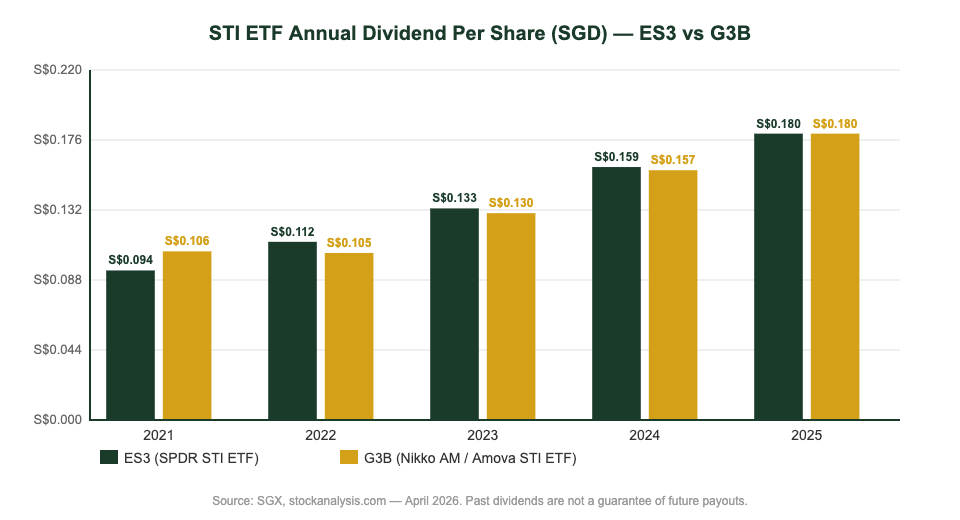
The STI ETF dividend fell sharply during COVID-19 in 2020 as many STI constituents cut or deferred payouts, but has since recovered strongly. The 2024 and 2025 distributions represent the highest per-unit payouts since the ETF’s inception — a reflection of record bank profits from DBS, OCBC, and UOB, which together account for roughly 45% of the STI.
| Year | ES3 H1 (Feb) | ES3 H2 (Aug) | ES3 Annual Total | G3B Annual Total |
|---|---|---|---|---|
| 2021 | S$0.051 | S$0.043 | S$0.094 | S$0.106 |
| 2022 | S$0.051 | S$0.061 | S$0.112 | S$0.105 |
| 2023 | S$0.060 | S$0.073 | S$0.133 | S$0.130 |
| 2024 | S$0.073 | S$0.086 | S$0.159 | S$0.157 |
| 2025 | S$0.091 | S$0.089 | S$0.180 | S$0.185 |
| 2026 H1 | S$0.085 (paid Feb 2026) | S$0.090 (est. Aug 2026) | ~S$0.175 (est.) | ~S$0.180 (est.) |
Source: stockanalysis.com, dividends.sg, SGX corporate actions — April 2026. 2026 H2 figures are estimates based on analyst consensus and prior year trends.
The trend is clearly positive — dividends more than doubled from 2021 to 2025, driven by the Singapore banking sector’s strong earnings cycle. However, investors should note that this growth is not guaranteed. If interest rates fall sharply or bank earnings normalise, dividend payouts may moderate in future years.
Dividend Payment Schedule
Both STI ETFs follow a predictable semi-annual pattern. Knowing the ex-dividend and payment dates allows you to plan your cash flow — particularly important if you are relying on STI ETF dividends as part of a retirement income strategy alongside tools like the Singapore retirement calculator.
| ETF | H1 Ex-Div | H1 Pay Date | H2 Ex-Div | H2 Pay Date |
|---|---|---|---|---|
| ES3 | ~Feb 11, 2026 | ~Feb 27, 2026 | ~Aug 12, 2026 | ~Aug 26, 2026 |
| G3B | ~Jan 2, 2026 | ~Jan 15, 2026 | ~Jul 1, 2026 | ~Jul 15, 2026 |
Source: SGX corporate actions, Stock Events app — April 2026. Exact 2026 H2 dates are indicative and subject to board declaration.
To receive a dividend, you must hold the ETF before the ex-dividend date. If you buy on or after the ex-dividend date, you will not receive that round’s distribution — the share price typically drops by approximately the dividend amount on the ex-dividend date to reflect this. This is standard for all SGX-listed securities, not unique to STI ETFs.
How to Calculate Your STI ETF Dividend Income
The STI ETF dividend yield is calculated as the trailing twelve-month (TTM) dividend per unit divided by the current unit price. As at April 2026, with ES3 trading at approximately S$4.85 and G3B at approximately S$4.90, and annual dividends of S$0.18 (ES3) and S$0.185 (G3B), the trailing yields are roughly 3.5% and 3.8% respectively.
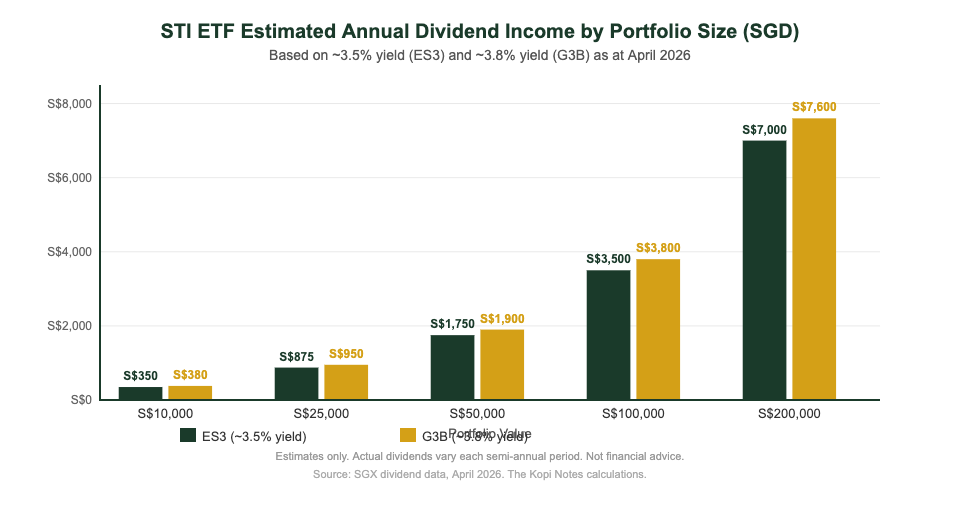
Here is a worked SGD example for three common portfolio sizes, using the 2025 dividend figures as a reference baseline:
| Portfolio Value | Units Held (approx.) | ES3 Annual Income | G3B Annual Income | Per Semi-Annual Payout |
|---|---|---|---|---|
| S$10,000 | ~2,060 units | ~S$371 | ~S$381 | ~S$185–190 |
| S$50,000 | ~10,300 units | ~S$1,854 | ~S$1,906 | ~S$925–953 |
| S$100,000 | ~20,600 units | ~S$3,708 | ~S$3,811 | ~S$1,854–1,906 |
Source: The Kopi Notes calculations based on 2025 DPS (ES3: S$0.180, G3B: S$0.185) and approximate April 2026 unit prices. Actual income will vary.
An important caveat: unlike S-REITs which must distribute at least 90% of taxable income, STI ETFs have no mandatory distribution floor. The dividend you receive each period depends entirely on what the underlying 30 STI companies declare — and this varies year to year. For comparison, you can read how Singapore REIT ETF dividends are structured differently, with REITs offering higher but more volatile distributions.
Using CPF or SRS to Receive STI ETF Dividends
One of the most compelling features of the STI ETF for Singapore investors is full eligibility for both the CPF Investment Scheme (CPFIS-OA) and the Supplementary Retirement Scheme (SRS). This is a significant advantage over LSE-listed ETFs like CSPX or VWRA, which are not accessible through these accounts.
CPF Ordinary Account (CPFIS-OA): You can invest CPF-OA savings exceeding S$20,000 in ES3 or G3B through a CPFIS-approved agent bank or broker. When dividends are paid, they are credited back into your CPF-OA account — not to your bank account. This means the dividend income continues to earn the CPF-OA floor rate (currently 2.5% p.a.) until you withdraw it at retirement. Some investors use this CPF dividend reinvestment loop to compound returns tax-free over decades. For a deep-dive on maximising this approach, see our guide on CPF investment strategy Singapore.
SRS Account: SRS contributions (capped at S$15,300/year for Singapore Citizens and PRs) can be invested in STI ETFs. SRS dividends are also credited back to the SRS account and not subject to income tax until withdrawal. Since SRS withdrawals are taxed at 50% of the amount withdrawn, and most retirees withdraw at lower marginal tax rates, this creates meaningful tax savings over a working career.
Cash brokerage account: For cash investors, STI ETF dividends are paid directly to your brokerage account — no withholding tax is deducted. Singapore does not impose dividend withholding tax on locally domiciled ETFs or their Singapore-resident investors. This is another advantage versus foreign-listed alternatives: Irish-domiciled ETFs like CSPX incur 15% WHT on US dividend components, while the STI ETF’s Singapore-sourced dividends are free of this friction.
How to Buy ES3 or G3B for Dividend Income
Both ES3 and G3B are traded on the Singapore Exchange (SGX) in Singapore dollars, making them accessible through any SGX-connected broker. Here are the main platforms Singapore investors use:
Interactive Brokers (IBKR): Lowest commission for larger portfolios — typically USD 1.50–3.00 per trade for SGX stocks. IBKR is well-suited for investors holding S$50,000 or more. Not the simplest platform for beginners, but costs compound meaningfully over time.
MooMoo Singapore: Commission-free SGX trades during promotional periods; standard rate is S$1.99/trade capped. Good mobile interface with dividend calendar tracking. Read the moomoo Singapore review for full fee details.
Syfe Brokerage: Beginner-friendly, S$1.49/trade for SGX stocks. Also worth checking the Syfe referral code and sign-up bonus for new account promotions. Syfe’s brokerage app shows dividend history per holding clearly — useful for yield tracking.
FSMOne: SGX trades at S$8.80 or 0.08%, whichever is higher. Better suited for regular savings plan (RSP) users; FSMOne’s RSP allows monthly automated purchases of ES3 or G3B from as little as S$50/month. See the FSMOne referral code for current promotions.
CDP vs custodian: When you buy ES3 or G3B through most SGX brokers, units can be held in your Central Depository (CDP) account or a custodian account depending on the platform. CDP-held units receive dividends directly to your bank account linked to CDP. Custodian-held units (e.g. via IBKR or MooMoo) receive dividends to the broker’s nominated account, which then credits your brokerage wallet.
Step-by-step (any SGX broker):
- Log in to your brokerage account and search for ticker ES3 or G3B.
- Select the SGX exchange (not SGX-ST derivative).
- Place a limit or market order in Singapore dollars — minimum lot size is 1 unit (both ETFs trade in 1-unit board lots).
- Settlement: T+2 business days on SGX.
- Dividend payment: credited to CDP or brokerage wallet on the declared pay date.
Risks and Limitations of STI ETF Dividends
The STI ETF dividend is not guaranteed and comes with specific risks that every income investor should understand before committing capital.
Concentration risk: The STI is heavily concentrated in financials — DBS, OCBC, and UOB together represent approximately 45% of the index. When the banking sector faces headwinds (rising credit losses, rate cuts, or regulatory capital requirements), STI ETF dividends can fall materially. The 2020 COVID-19 dividend cut — when MAS asked banks to cap dividends at 60% of the prior year — saw ES3’s annual distribution drop to approximately S$0.10 from S$0.16 in 2019.
No growth mandate: The STI has delivered modest total returns compared to global indices like the S&P 500. Over the 10 years to April 2026, the STI returned approximately 4–5% p.a. total return (including dividends), well below the S&P 500’s ~12% p.a. For investors seeking long-term capital growth alongside income, a split between STI ETF (for Singapore dividends) and an accumulating global ETF like CSPX may deliver better risk-adjusted outcomes.
Currency risk: The STI ETF is denominated in Singapore dollars. While this eliminates FX risk for Singapore residents, it also means you have no exposure to global currency diversification — unlike LSE-listed ETFs which hold assets in USD, EUR, and GBP.
Variable distribution: Each semi-annual dividend is declared at the managers’ discretion and based on what the underlying companies pay. There is no minimum guaranteed distribution. Years in which STI companies cut dividends (as happened in 2020) will result in lower-than-expected income.
For a comparison of how STI ETF yield stacks up against Singapore’s other passive income options, see our analysis of Singapore T-bills 2026 and Singapore Savings Bonds guide — both offer capital-guaranteed alternatives, though at lower yields.
Not financial advice. All figures are for educational reference only. Consult a licensed financial adviser before making investment decisions.
Frequently Asked Questions
What is the current STI ETF dividend yield in 2026?
As at April 2026, the SPDR STI ETF (ES3) has a trailing twelve-month (TTM) dividend yield of approximately 3.5%, while the Nikko AM / Amova STI ETF (G3B) yields approximately 3.8%. Both figures are based on 2025 full-year distributions of S$0.180 (ES3) and S$0.185 (G3B) divided by their respective April 2026 unit prices of approximately S$4.85–4.90. Yields fluctuate with the unit price and vary each distribution period.
How often does the STI ETF pay dividends?
Both STI ETFs pay dividends semi-annually — twice per year. ES3 pays in February and August, while G3B pays in January and July. Each distribution is based on dividends collected from the 30 Straits Times Index constituent companies during the preceding six-month period. There is no quarterly or monthly distribution option for STI ETFs.
Can I receive STI ETF dividends in my CPF account?
Yes. Both ES3 and G3B are fully eligible for investment under the CPF Investment Scheme (CPFIS-OA). If you hold them through CPFIS, dividends are credited back to your CPF-OA account — not to your bank account — and continue to earn the CPF-OA rate (minimum 2.5% p.a.) until you withdraw at retirement. SRS investors also receive dividends back into their SRS account, where they grow tax-deferred until withdrawal.
Is there withholding tax on STI ETF dividends for Singapore investors?
No. Singapore does not impose withholding tax on dividends paid by Singapore-domiciled ETFs to Singapore resident investors. You receive the full declared dividend per unit with no deductions. This is different from LSE-listed ETFs like CSPX or VWRA, which still incur a 15% US withholding tax on the American dividend component of their underlying holdings — a cost borne by the fund before distributions reach investors.
Which is better for dividends — ES3 or G3B?
For most Singapore investors focused on dividend income, G3B has a slight edge: it has a lower TER (0.25% vs 0.28%), a marginally higher trailing yield (~3.8% vs ~3.5%), and pays dividends one month earlier in the calendar year (January vs February; July vs August). The underlying index is identical, so the performance difference is almost entirely explained by the expense ratio. That said, ES3 has a longer track record and is issued by State Street, one of the world’s largest ETF managers — so both are equally reliable from a counterparty risk perspective.
What was the STI ETF dividend in 2025?
In 2025, ES3 paid a total dividend of S$0.180 per unit across two distributions: S$0.091 (H1, ex-date Feb 12, 2025, paid Feb 26, 2025) and S$0.089 (H2, ex-date Aug 12, 2025, paid Aug 26, 2025). G3B paid a total of approximately S$0.185 per unit: S$0.0878 (ex-date Jan 2, 2025) and S$0.0917 (ex-date Jul 1, 2025). These represent the highest annual distributions on record for both funds.
Can the STI ETF dividend be cut or reduced?
Yes — and it has happened before. During COVID-19 in 2020, the Monetary Authority of Singapore (MAS) requested that local banks cap dividends at 60% of the prior year’s level. Since DBS, OCBC, and UOB make up roughly 45% of the STI, this caused a material reduction in STI ETF distributions that year. The dividend is not guaranteed and depends entirely on what the 30 underlying STI companies declare each period. Investors relying on STI ETF dividends for regular income should maintain a cash buffer to cover periods of lower distributions.
Start Building Dividend Income Today
Open a brokerage account, buy your first STI ETF units, and collect dividends twice a year. Use our referral links for exclusive sign-up bonuses.
This article was researched with the help of AI. While we strive to keep all information accurate and up to date, there may be errors. If you notice any discrepancies, please contact us.