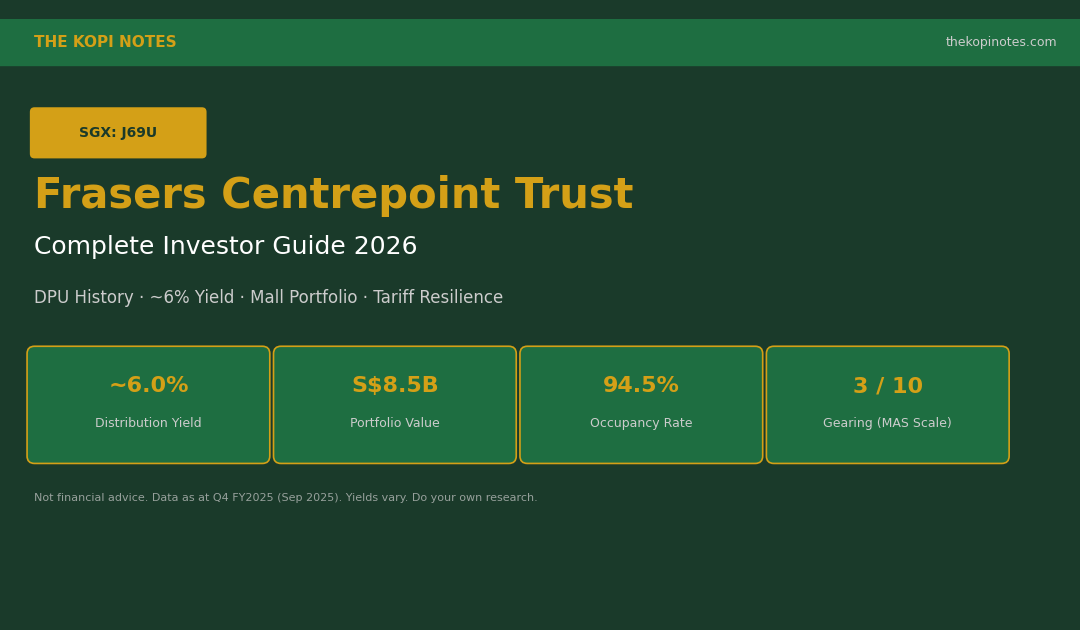
Frasers Centrepoint Trust (FCT) Complete Investor Guide 2026
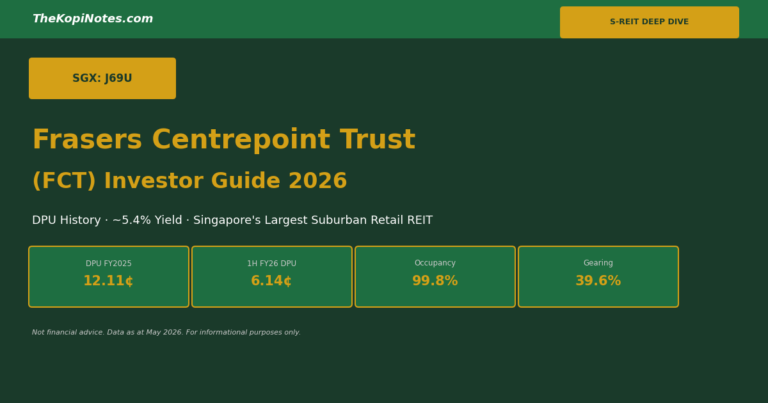
Frasers Centrepoint Trust (SGX: J69U) is Singapore’s premier suburban retail S-REIT, anchored by dominant community malls from Causeway Point to Waterway Point. This comprehensive guide covers FCT’s DPU history, ~6% distribution yield, portfolio analysis, gearing, and whether it belongs in your retirement income portfolio in 2026.
Not financial advice. Data as at Q4 FY2025 (September 2025). Always do your own research and consider your personal risk tolerance before investing.
Table of Contents
”Contents
- What Is Frasers Centrepoint Trust?
- Key Financial Metrics at a Glance
- DPU History (FY2019–FY2025)
- Yield Comparison vs S-REIT Peers
- Mall Portfolio Deep-Dive
- Occupancy Rates by Mall
- Gearing, ICR & Balance Sheet
- Tariff Resilience: Why Suburban Retail Wins
- Key Risks to Watch in 2026
- How to Buy FCT in Singapore
- FAQs
What Is Frasers Centrepoint Trust?
Frasers Centrepoint Trust (FCT) is a Singapore-listed real estate investment trust focused exclusively on suburban retail malls in Singapore. Listed on SGX in 2006 and managed by Frasers Centrepoint Asset Management, FCT owns a portfolio of nine suburban retail properties located within the Housing Development Board (HDB) heartlands — the daily shopping destinations for millions of Singaporeans.
Unlike city-centre malls that cater to tourists and discretionary shoppers, FCT’s malls serve essential, non-discretionary demand: supermarkets, clinics, food & beverage outlets, enrichment centres, and childcare. This community-anchored model has historically produced remarkably stable occupancy — averaging above 97% even through COVID-19.
FCT’s sponsor, Frasers Property Limited, provides a visible pipeline of assets, while its manager’s conservative approach to acquisitions and debt management has made it a favourite among income-focused Singapore retail investors, CPF-OA investors, and retirement portfolio builders.
Key identifiers:
- SGX ticker: J69U
- REIT type: Suburban retail / community malls
- Financial year end: 30 September
- Distribution frequency: Semi-annual (March and September)
- Market capitalisation: ~S$3.6 billion (as at Apr 2026)
- Listed since: 2006
Key Financial Metrics at a Glance
Here is a snapshot of FCT’s key metrics as at Q4 FY2025 (September 2025):
| Metric | Value | Notes |
|---|---|---|
| SGX Ticker | J69U | Retail REIT |
| FY2025 DPU | 12.12 Singapore cents | Slight dip from 12.141¢ in FY2024 |
| Distribution Yield | ~6.0% | At ~S$2.02 unit price (Apr 2026) |
| Portfolio Value | S$8.5 billion | 100% Singapore suburban retail |
| Number of Assets | 9 malls | + 1 stake in Hektar REIT (Malaysia) |
| Portfolio Occupancy | ~94.5%–99.8% | By asset; weighted avg ~98.2% |
| Aggregate Leverage | ~38.5% | Well below MAS 50% limit |
| Interest Coverage Ratio | ~3.3x | MAS minimum is 1.5x |
| Weighted Avg Lease Expiry | ~2.0 years | Retail typical — high renewal rates |
| Distribution Frequency | Semi-annual | March (H1) + September (H2) |
FCT DPU History (FY2019–FY2025)
FCT’s distribution per unit (DPU) record shows the resilience of suburban retail over six years:
| Financial Year | DPU (S¢) | YoY Change | Key Event |
|---|---|---|---|
| FY2019 | 12.00¢ | — | Pre-COVID baseline |
| FY2020 | 8.66¢ | −27.8% | COVID-19 mandatory mall closures, rental rebates |
| FY2021 | 9.00¢ | +3.9% | Recovery; acquisition of PGIM ARF malls completed |
| FY2022 | 12.06¢ | +34.0% | Full portfolio contribution; Singapore fully reopened |
| FY2023 | 12.20¢ | +1.2% | Positive rental reversions; higher NPI |
| FY2024 | 12.141¢ | −0.5% | Higher finance costs (rising SORA); asset enhancement |
| FY2025 | 12.12¢ | −0.2% | Stable; SORA relief emerging, strong occupancy |
The FY2020 COVID dip was an industry-wide event driven by government-mandated mall closures and mandatory rental rebates for tenants. FCT recovered faster than office or industrial peers, and by FY2022 had surpassed pre-COVID DPU levels. Since then, DPU has remained remarkably stable at ~12.1¢ per annum, absorbing the full brunt of the 2022–2024 SORA rate spike.
Distribution Yield Comparison vs S-REIT Peers
FCT’s ~6.0% yield sits comfortably in the mid-range of Singapore’s retail and mixed-use REIT peer group. Here’s how it compares to its closest competitors as at April 2026:
| REIT | SGX Code | Type | Yield (Apr 2026) | Gearing |
|---|---|---|---|---|
| Frasers Centrepoint Trust ★ | J69U | Suburban Retail | ~6.0% | ~38.5% |
| Suntec REIT | T82U | Mixed (retail + office) | ~5.8% | ~42% |
| MPACT (N2IU) | N2IU | Mixed (retail + office) | ~6.2% | ~40% |
| CapLand Ascendas REIT | A17U | Industrial (diversified) | ~5.5% | ~36% |
| Starhill Global REIT | P40U | Retail (luxury) | ~6.7% | ~35% |
| Sasseur REIT | CRPU | Outlet malls (China) | ~8.5% | ~23% |
FCT’s yield is not the highest in the sector, but it offers the best combination of yield, defensive positioning, and Singapore-only exposure. Sasseur and Starhill offer higher nominal yields but carry China concentration risk and luxury-retail volatility respectively. FCT’s pure-Singapore suburban model is considered the most defensive retail REIT structure available on SGX.
For tools to model your own dividend yield scenarios, try our REITs Dividend Yield Calculator or the S-REIT Yield vs SGS Bond Spread Calculator.
FCT Mall Portfolio Deep-Dive
FCT’s portfolio consists of nine suburban retail malls in Singapore, strategically located adjacent to MRT stations and HDB towns. These are not tourist destinations — they are the neighbourhood heartbeat for hundreds of thousands of Singaporeans who shop there weekly for groceries, healthcare, enrichment, and food.
| Mall | Location | GFA (sq ft) | FCT Stake | Key Anchor |
|---|---|---|---|---|
| Causeway Point | Woodlands | ~648,000 | 100% | NTUC FairPrice, Golden Village |
| Northpoint City (North Wing) | Yishun | ~233,000 | 100% | NTUC FairPrice Finest, H&M |
| Waterway Point | Punggol | ~371,000 | 40% | NTUC FairPrice Xtra, Shaw |
| Century Square | Tampines | ~381,000 | 100% | NTUC FairPrice Finest, GV |
| Tampines 1 | Tampines | ~323,000 | 100% | Flagship tenants; youth-oriented |
| White Sands | Pasir Ris | ~231,000 | 100% | NTUC FairPrice, Cathay |
| Hougang Mall | Hougang | ~150,000 | 100% | Cold Storage, enrichment centres |
| Tiong Bahru Plaza | Tiong Bahru | ~133,000 | 100% | NTUC FairPrice, hipster F&B |
| Changi City Point | Changi Business Park | ~201,000 | 100% | Servicing tech-park workforce |
Causeway Point remains FCT’s flagship asset — the largest single mall and biggest earnings contributor. Its location at Woodlands MRT interchange, combined with strong catchment from a densely populated HDB estate and cross-border shoppers from Johor Bahru, makes it arguably the most resilient community mall in Singapore.
Waterway Point (40% stake, shared with Frasers Property) serves Punggol, Singapore’s fastest-growing residential town. As the population there continues to grow, Waterway Point’s organic NPI uplift is a structural long-term tailwind for FCT.
Occupancy Rates by Mall
FCT’s occupancy rates are the envy of Singapore’s REIT sector. Most of its malls maintain occupancy above 97% — a figure that office and industrial REITs can only dream of:
- Causeway Point: ~99.8% — effectively 100% occupied
- Northpoint City (N Wing): ~99.5% — Yishun’s premier community hub
- Tampines 1: ~99.7% — high footfall youth and family mall
- Waterway Point: ~98.5% — Punggol’s sole major mall; captive catchment
- Century Square: ~97.3% — AEI works temporarily affected occupancy
- White Sands: ~98.1% — stable East Coast community mall
The minor dip in Century Square’s occupancy is linked to ongoing asset enhancement initiative (AEI) works. Once completed, the refurbishment is expected to drive rental reversion upside and attract higher-quality tenants.
Weighted average portfolio occupancy across all nine assets stands at approximately 98.2% — one of the highest among Singapore-listed REITs of any sub-sector.
Gearing, ICR & Balance Sheet
FCT’s balance sheet is conservatively managed. As at Q4 FY2025:
- Aggregate leverage: ~38.5% (MAS limit: 50%)
- Interest coverage ratio (ICR): ~3.3x (MAS minimum: 1.5x)
- Weighted average debt to maturity: ~3.2 years — well-laddered with no concentrated maturities
- Fixed-rate debt proportion: ~75% — significantly hedged against SORA volatility
- Weighted average cost of debt: ~3.5% p.a. (as at FY2025)
With SORA having fallen from its ~3.03% peak (mid-2023) to ~1.07% in early 2026, FCT’s finance costs are now declining as floating-rate tranches roll over. This creates a meaningful DPU recovery tailwind for FY2026 and FY2027, even with no new acquisitions or rental reversion.
To model how gearing affects an S-REIT’s sustainability, use our free S-REIT Gearing Ratio & ICR Calculator.
Tariff Resilience: Why Suburban Retail Wins in 2026
The April 2026 US tariff announcements — including a 10% baseline import duty — have rattled global equity markets. For Singapore S-REIT investors, the question is: which sub-sectors are insulated, and which are exposed?
FCT’s suburban retail model is among the most insulated of all S-REIT sub-sectors. Here’s why:
- Non-discretionary tenant mix: Supermarkets (NTUC, Cold Storage), F&B, healthcare, enrichment, and personal services are not impacted by import tariffs. People still need to eat, see doctors, and send their kids to tuition regardless of trade policy.
- Pure Singapore revenue: Unlike industrial REITs with logistics exposure or data centre REITs with global supply chains, FCT collects 100% of its rental income from Singapore-based tenants paying Singapore-dollar leases.
- No export or supply chain exposure: A tariff-driven trade slowdown hits ports, logistics, and manufacturing — not community malls in Woodlands and Tampines.
- Defensive consumer spending: FCT’s malls skew toward necessity and value spending. Even in economic downturns, footfall at heartland malls holds up better than city-centre or tourist malls.
Compared to FCT, industrial REITs like ESR-LOGOS and Sabana REIT carry higher tariff sensitivity through their logistics and manufacturing tenant exposures. Office REITs face headwinds from potential tech sector hiring freezes. FCT’s suburban retail model effectively acts as a tariff shield within a diversified S-REIT portfolio.
Read our full analysis: US Tariff Shock: How Trump’s 10% Import Duty Hits Singapore REIT Investors in 2026
Key Risks to Watch in 2026
No investment is without risk. For FCT unitholders, the primary risks to monitor are:
1. Rental Reversion Pressure
FCT’s leases have short WALE (~2 years), meaning a large chunk of the portfolio renews each year. In a retail downturn, tenants may demand rent cuts or vacate. So far, FCT has delivered positive rental reversions (i.e. rents going up at renewal), but sustained consumer weakness could reverse this.
2. E-Commerce Structural Headwinds
Online shopping continues to grow in Singapore. However, FCT’s non-discretionary tenant mix (groceries, F&B, healthcare) is far less susceptible to e-commerce displacement than apparel or electronics retailers.
3. Interest Rate Risk
Despite ~75% fixed-rate hedging, FCT still has floating-rate debt exposure. If SORA reverses and rises again, finance costs could increase and squeeze distributions. Our base case (SORA ~1.0–1.5% through 2026) is favourable, but macro surprises remain possible.
4. Asset Concentration in Singapore
Unlike diversified REITs with multi-country exposure, FCT is 100% Singapore retail. While this is a strength in terms of transparency and defensiveness, a Singapore-specific economic shock (e.g. sudden unemployment spike) would be fully absorbed by the portfolio with no geographic diversification buffer.
5. Manager-Unitholders Conflicts
Like all externally managed REITs, FCT’s manager (Frasers Centrepoint Asset Management) is paid based on AUM. This can create incentives for dilutive acquisitions. Investors should monitor deal terms carefully if FCT makes large acquisitions.
For broader sector risk context, see our Best S-REITs Singapore 2026 guide which compares all major S-REITs on risk/reward metrics.
How to Buy FCT in Singapore
Frasers Centrepoint Trust (J69U) is listed on the Singapore Exchange (SGX) and can be purchased through any brokerage account in Singapore. Here are the most practical options for Singapore retail investors:
Option 1: Regular brokerage (CDP-linked)
Use platforms like DBS Vickers, OCBC Securities, UOB Kay Hian, or Lim & Tan Securities. Shares are held in your CDP account and you receive dividends directly. Min. transaction is 100 units (1 lot). Commissions range from S$10–S$25 per trade or ~0.20–0.28% of transaction value.
Option 2: Robo-advisors (via REIT ETF exposure)
If you prefer automatic investing without picking individual REITs, platforms like Endowus and Syfe offer REIT-focused portfolios that may include FCT via the NikkoAM-StraitsTrading Asia Ex Japan REIT ETF or similar vehicles. This gives you diversified S-REIT exposure with lower management effort. See our Singapore REIT ETF guide for more detail.
Option 3: CPF-OA Investment
FCT is eligible for CPF Ordinary Account (OA) investment under the CPF Investment Scheme (CPFIS). You can use up to 35% of investible savings in CPF-OA to buy SGX-listed REITs. Given FCT’s ~6% yield vs the 2.5% CPF OA rate, there is a theoretical yield uplift — though capital risk applies. Read our CPF investment strategy guide before using OA funds for equity investments.
Grow Your Passive Income with Endowus or Syfe
Looking to build a diversified S-REIT or dividend portfolio without picking individual stocks? Endowus and Syfe both offer professionally managed REIT-inclusive portfolios starting from S$1,000. New investors can access exclusive welcome bonuses through The Kopi Notes referral links:
Frequently Asked Questions — Frasers Centrepoint Trust
”What
”What
”How
”Can
”Can
”What
”How
”How
This article was researched with the help of AI. While we strive to keep all information accurate and up to date, there may be errors. If you notice any discrepancies, please contact us.