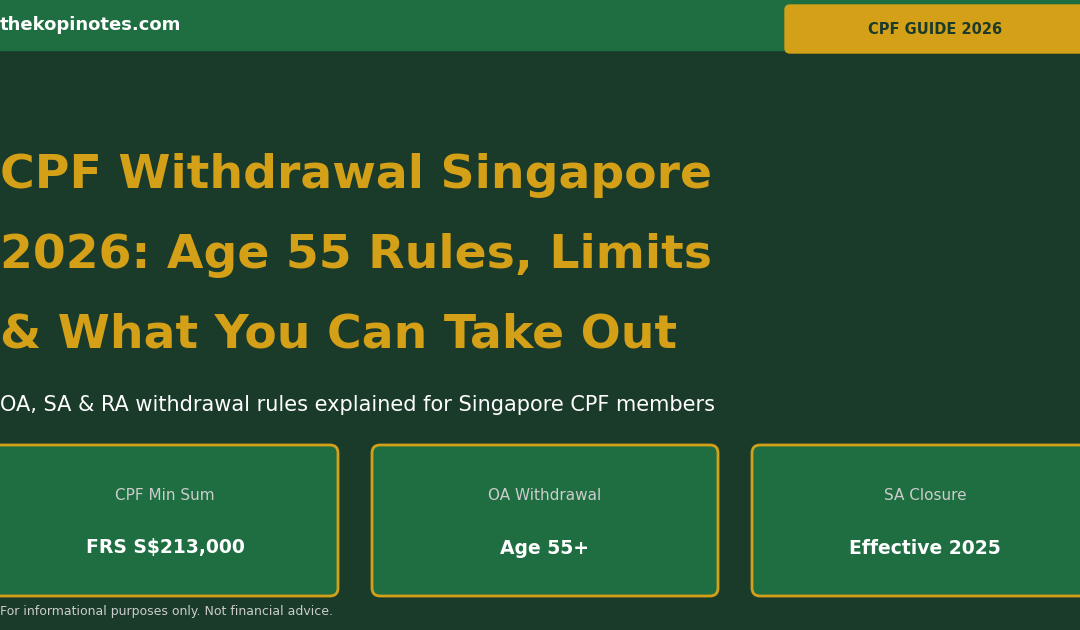
CPF Withdrawal Singapore 2026: Age 55 Rules, Limits & What You Can Actually Take Out
Turning 55 is a major CPF milestone. For the first time, you can access money you have been locked out of since your first pay cheque. But the rules around CPF withdrawal are more nuanced than most people expect — and getting them wrong can delay your plans or leave you short. This guide covers exactly what you can withdraw, when, and how much, based on CPF Board rules as at April 2026.
Not financial advice. Always verify figures with CPF Board directly before making withdrawal decisions.
Table of Contents
Contents — Click to expand
- What Happens to Your CPF at Age 55?
- CPF Retirement Sums 2026: BRS, FRS & ERS
- How Much Can You Withdraw at 55?
- CPF Withdrawal Age: The Key Milestones
- SA Closure From 2025: What Changes
- Can You Still Use Your OA After 55?
- CPF LIFE Payouts From Age 65
- Step-by-Step: How to Make a CPF Withdrawal
- Frequently Asked Questions
What Happens to Your CPF at Age 55?
On your 55th birthday, CPF Board automatically creates a Retirement Account (RA) for you. Savings from your Special Account (SA) — and if insufficient, your Ordinary Account (OA) — are transferred into the RA up to the prevailing Full Retirement Sum (FRS).
In 2026, the FRS is S$213,000. This sum is ring-fenced to fund your CPF LIFE monthly payouts from age 65. The logic is simple: CPF ensures you have a minimum retirement income floor before letting you withdraw freely.
Key things that happen automatically at 55:
- RA is created and funded with your SA (and OA top-up if needed)
- Any SA savings above the FRS transferred to RA can remain in the SA briefly before the account is closed under 2025 changes (see Section 4)
- Your OA balance remains in the OA — accessible for approved uses
- You can apply to withdraw cash above the FRS/BRS you have set aside
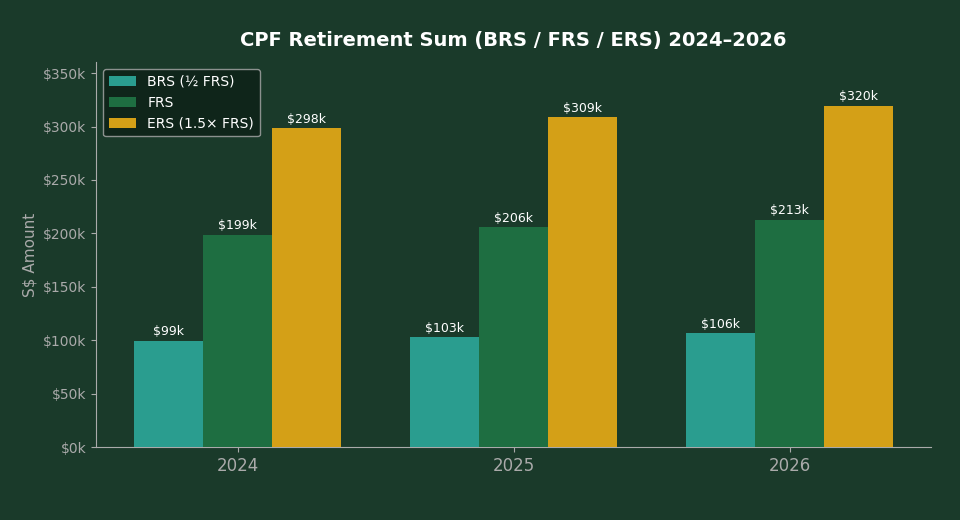
CPF Retirement Sums 2026: BRS, FRS & ERS
There are three retirement sum tiers, each determining a different monthly payout level under CPF LIFE:
| Retirement Sum | 2024 | 2025 | 2026 |
|---|---|---|---|
| Basic Retirement Sum (BRS) | S$99,400 | S$102,900 | S$106,500 |
| Full Retirement Sum (FRS) | S$198,800 | S$205,800 | S$213,000 |
| Enhanced Retirement Sum (ERS) | S$298,200 | S$308,700 | S$319,500 |
Source: CPF Board, 2026. ERS = 1.5× FRS. All figures are for CPF members turning 55 in that respective year.
Choosing BRS means you pledge your property to make up the remaining FRS equivalent, and you get a lower monthly payout. Choosing ERS means you voluntarily top up beyond the FRS to secure a higher payout. Most Singaporeans default to the FRS.
Want to estimate your monthly payout? Use our free CPF LIFE Payout Calculator.
How Much Can You Withdraw at 55?
The short answer: everything above your chosen retirement sum. Here is the formula:
Cash Withdrawal = (OA + SA + RA balance) − Retirement Sum set aside
For example, if your combined OA + SA = S$350,000 and you set aside the FRS of S$213,000:
- S$213,000 goes into your RA (funded from SA first, then OA top-up)
- S$350,000 − S$213,000 = S$137,000 is available for cash withdrawal
If you own property and are willing to pledge it, you only need to set aside the BRS (S$106,500 in 2026), freeing up even more for withdrawal.
Important caveats:
- Money used for CPFIS investments is included in the calculation
- Shields (e.g. CPF OA used for property) are not part of freely withdrawable balance until the property is sold
- You cannot withdraw below your chosen retirement sum — once set aside, that money stays in the RA for CPF LIFE
Use our CPF Withdrawal at 55 Calculator to model your exact numbers.
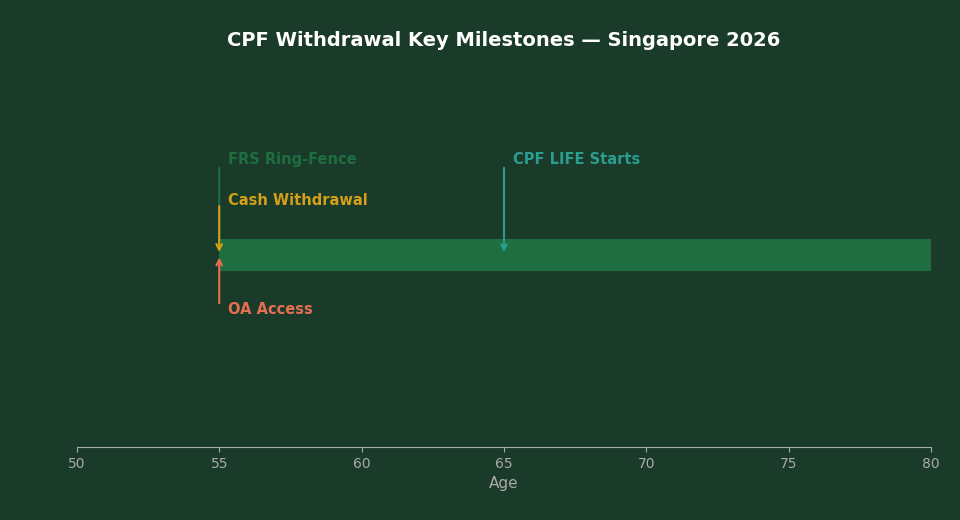
CPF Withdrawal Age: The Key Milestones
CPF withdrawal is not a single event. It unfolds across several age thresholds:
| Age | What You Can Do |
|---|---|
| 55 | RA created. Withdraw cash above FRS/BRS. Access OA for housing, education, investment. |
| 55–65 | OA remains accessible for approved purposes. RA continues to earn 4% p.a. interest. |
| 65 | CPF LIFE monthly payouts commence. Payout amount depends on RA balance at 65. |
| Any age | S$5,000 special withdrawal available regardless of retirement sum (introduced from 2023). |
Note: The S$5,000 unconditional withdrawal at 55 is separate from, and in addition to, any excess above your retirement sum.
The key insight: the CPF withdrawal age for the big lump sum is 55, but the monthly income stream only starts at 65. The decade in between is a critical window where your RA is still compounding at 4% p.a. — making voluntary top-ups during this period highly effective for boosting your eventual CPF LIFE payout.
SA Closure From 2025: What Changes
From January 2025, the CPF Special Account (SA) is closed for members aged 55 and above. This was announced by PM Lawrence Wong in Budget 2024 and officially took effect on 19 January 2025.
What this means in practice:
- At age 55, SA savings transfer to your RA first (up to the FRS)
- Any remaining SA balance above the FRS previously would have stayed in SA earning 4% — this is no longer the case
- From 2025, excess SA savings above the FRS are transferred to your OA instead (earning 2.5% p.a.)
- You can then choose to top up your RA voluntarily up to the ERS (S$319,500 in 2026) to restore higher returns
The practical implication: members who were relying on large SA balances to compound at 4% indefinitely post-55 lose that benefit. The workaround is a voluntary RA top-up to ERS — but that money is then committed to CPF LIFE and cannot be withdrawn as cash.
For context on optimising CPF before 55, see our CPF Investment Strategy Guide.
Can You Still Use Your OA After 55?
Yes. Your OA remains fully functional after age 55. You can use it for:
- Housing: Continued mortgage repayments or downpayment on new property
- CPF Investment Scheme (CPFIS): Invest OA funds in approved unit trusts, ETFs, shares — see our CPF investment guide
- Education: Approved tertiary education fees
- Insurance premiums: MediShield Life, ElderShield/CareShield Life
- Cash withdrawal: You can also simply withdraw OA balance in cash at any time from age 55 (subject to the overall minimum retirement sum rule)
The OA earns a base interest rate of 2.5% p.a., with an extra 1% on the first S$20,000 (with SA closed post-55, the first S$30,000 in OA+RA counts for the bonus interest). This makes OA a reasonable emergency fund alternative in retirement if you have surplus balance above housing needs.
Considering using OA savings to invest in S-REITs or ETFs? Read our Best S-REITs Singapore 2026 guide or the Singapore REIT ETF Guide for ideas.
CPF LIFE Payouts From Age 65
CPF LIFE (Lifelong Income For the Elderly) is Singapore’s national longevity annuity. It is not a withdrawal — it is a monthly income stream funded by your RA balance at age 65.
Estimated monthly payouts (FRS S$213,000, under CPF LIFE Standard Plan at age 65 in 2026):
| RA Balance at 65 | Approx Monthly Payout |
|---|---|
| BRS (~S$106,500 × 1.04^10 ≈ S$157,000) | ~S$880–S$940/mo |
| FRS (~S$213,000 × 1.04^10 ≈ S$315,000) | ~S$1,650–S$1,800/mo |
| ERS (~S$319,500 × 1.04^10 ≈ S$472,000) | ~S$2,430–S$2,590/mo |
Indicative only. Actual payouts depend on CPF LIFE plan chosen (Standard vs Basic), gender, and cohort interest crediting rate. Use the official CPF LIFE Estimator for personalised projections.
Want to model different scenarios? Our CPF LIFE Payout Calculator lets you toggle plan type and top-up amounts.
Step-by-Step: How to Make a CPF Withdrawal
Once you turn 55, here is how to actually withdraw your CPF cash:
- Log in to my cpf Online Services at cpf.gov.sg using Singpass
- Navigate to My Requests → Retirement → Withdraw CPF Savings
- Confirm your retirement sum preference (BRS with property pledge, or FRS)
- Enter the amount you wish to withdraw (up to your eligible excess)
- Select your bank account for the credit (PayNow-linked NRIC or nominated bank account)
- Authenticate with Singpass and submit
- Funds are typically credited within 5 working days
Things to note:
- No physical queuing needed — the entire process is online or via the CPF app
- You can make partial withdrawals and leave the remainder to continue earning CPF interest
- There is no withdrawal fee charged by CPF Board
- Tax: CPF withdrawals are not taxable income in Singapore
Boost Your Retirement Income Beyond CPF
CPF LIFE provides a foundation but most Singaporeans need additional income streams in retirement. Consider pairing your CPF with:
- S-REITs: Dividend yields of 5–7% from Singapore-listed REITs — see Best S-REITs Singapore 2026
- SRS Account: Tax deductions now, tax savings in retirement — compare platforms with our SRS Tax Savings Calculator
- ETF income portfolios: Low-cost dividend ETFs via Endowus or Syfe Income+
Frequently Asked Questions
Can I withdraw all my CPF savings at 55?
What is the minimum CPF withdrawal amount?
Is CPF withdrawal taxable in Singapore?
Can I withdraw CPF before 55 due to illness?
What happens to my CPF if I leave Singapore permanently?
How does property affect CPF withdrawal at 55?
Can I top up my CPF after withdrawing at 55?
This article was researched with the help of AI. While we strive to keep all information accurate and up to date, there may be errors. If you notice any discrepancies, please contact us.