
CPF FI Ratio Calculator Singapore 2026
Instantly see what percentage of your retirement expenses are already covered by your CPF LIFE payout and investment portfolio income — free calculator with real-time results in SGD.
📊 Your Retirement Income
💼 Your Investment Portfolio
Understanding the CPF FI Ratio for Singapore Investors
The CPF Financial Independence (FI) Ratio is one of the most practical metrics a Singapore investor can track. It answers a simple but powerful question: what fraction of your monthly retirement expenses is already covered by guaranteed and passive income? Unlike the abstract “FIRE number”, the FI Ratio gives you a live readiness score you can update every year as your CPF balance grows and your investment portfolio compounds.
Singapore’s retirement ecosystem is uniquely structured. CPF LIFE — the national annuity scheme administered by the CPF Board — provides a lifelong monthly payout starting at age 65, anchored to the amount in your Retirement Account (RA) at age 55. As at Q2 2026, members who set aside the Full Retirement Sum (FRS of S$213,000) can expect payouts of approximately S$1,490–S$1,630 per month on the CPF LIFE Standard Plan, depending on gender. The Enhanced Retirement Sum (ERS of S$426,000) delivers around S$2,170–S$2,430 per month. These guaranteed payouts form the bedrock of your FI Ratio.
Not financial advice. All figures are for educational reference only. CPF LIFE payout estimates are illustrative based on CPF Board projections as at Q2 2026 — actual payouts depend on your RA balance at 55 and the prevailing CPF LIFE interest crediting rate. Data accurate as at September 2026 unless noted.
What Counts as “Passive Income” in the FI Ratio?
For this calculator, passive income is the sum of two streams: (1) your expected monthly CPF LIFE payout, and (2) the monthly income generated by your investment portfolio. Portfolio income is calculated as your total portfolio value multiplied by your expected annual yield, divided by 12. For Singapore retail investors, a typical blended yield for a diversified S-REIT and dividend-stock portfolio ranges from 4–6% per annum. If you hold broad market ETFs like VWRA or CSPX, use a lower yield of 2–3% and note that accumulating ETFs do not distribute income directly — you would need to fund expenses through periodic withdrawal instead.
How to Interpret Your FI Ratio Score
The calculator uses four readiness bands. A ratio below 25% means you are in early accumulation — the focus should be on growing CPF and investment balances aggressively. Between 25–50%, you are building solid foundations. Between 50–80%, you are in the home stretch and could fine-tune your CPF LIFE plan or top up your RA for a higher payout. Above 80%, you are close to FI; review your expenses and consider whether retiring slightly earlier makes sense. At 100% or above, your passive income fully covers your projected retirement expenses — congratulations, you have achieved financial independence in Singapore’s terms.
How to Use This CPF FI Ratio Calculator
- Set Monthly Retirement Expenses: Use the first slider to enter your estimated monthly spending in retirement. Include housing (if any), food, transport, healthcare, and lifestyle expenses. A common benchmark for Singapore couples is S$3,000–S$5,000 per month, though your personal figure will vary.
- Enter CPF LIFE Monthly Payout: Use the CPF LIFE payout estimator on the CPF Board website, or check your latest CPF statement. If unsure, use our CPF LIFE Payout Calculator first, then copy the result here.
- Enter Your Investment Portfolio Value: Type in the total current market value of your investment portfolio — this includes S-REITs, stocks, ETFs, bonds, and robo-advisor accounts. Exclude CPF savings (CPF LIFE already captures that income stream), emergency funds, and illiquid assets like property.
- Set Expected Portfolio Yield: Use the yield slider to set your expected annual income yield from investments. For dividend-focused portfolios with S-REITs, 5–6% is typical. For growth-oriented ETF portfolios, use 2–3%.
The calculator instantly shows your CPF FI Ratio, the breakdown of your passive income, and — if you have a gap — how much additional investment capital you would need to close it.
Pro tip: Combine this calculator with our CPF FIRE Number Calculator to see both your current FI Ratio and the total nest egg target you are building toward.
Contents — Click to Expand
What Is the CPF FI Ratio?
The CPF FI Ratio (Financial Independence Ratio) is a personal finance metric that expresses how much of your projected monthly retirement expenses are covered by your combined passive income — primarily your CPF LIFE annuity payout and the income generated by your investment portfolio. It is calculated as:
CPF FI Ratio = (CPF LIFE Monthly Payout + Monthly Portfolio Income) ÷ Monthly Retirement Expenses × 100%
A ratio of 100% means your passive income equals your expenses — you have achieved financial independence. A ratio of 70% means 70 cents of every retirement dollar is already covered; you need to close the remaining 30-cent gap either by reducing expenses, growing your portfolio, or increasing CPF contributions. The beauty of this metric is that it is actionable: each lever — CPF top-ups, investment contributions, expense reduction — moves the ratio in a measurable direction.
The CPF FI Ratio differs from other FI measures in one important respect: it treats CPF LIFE as a guaranteed income stream rather than an asset. CPF LIFE payouts are backed by the Singapore government, inflation-adjustable (the CPF interest rate is reviewed annually), and lifelong — meaning you cannot outlive them. This makes the FI Ratio a more reliable and conservative measure of retirement readiness than pure portfolio-based approaches used in markets without national annuity schemes.
How the CPF FI Ratio Is Calculated: The Maths
Let us walk through a worked example for a 45-year-old Singapore professional targeting retirement at 65.
| Item | Value |
|---|---|
| Monthly Retirement Expenses | S$3,500 |
| CPF LIFE Monthly Payout (at 65) | S$1,490 (FRS plan) |
| Investment Portfolio Value | S$250,000 |
| Portfolio Annual Yield | 5.0% |
Calculation:
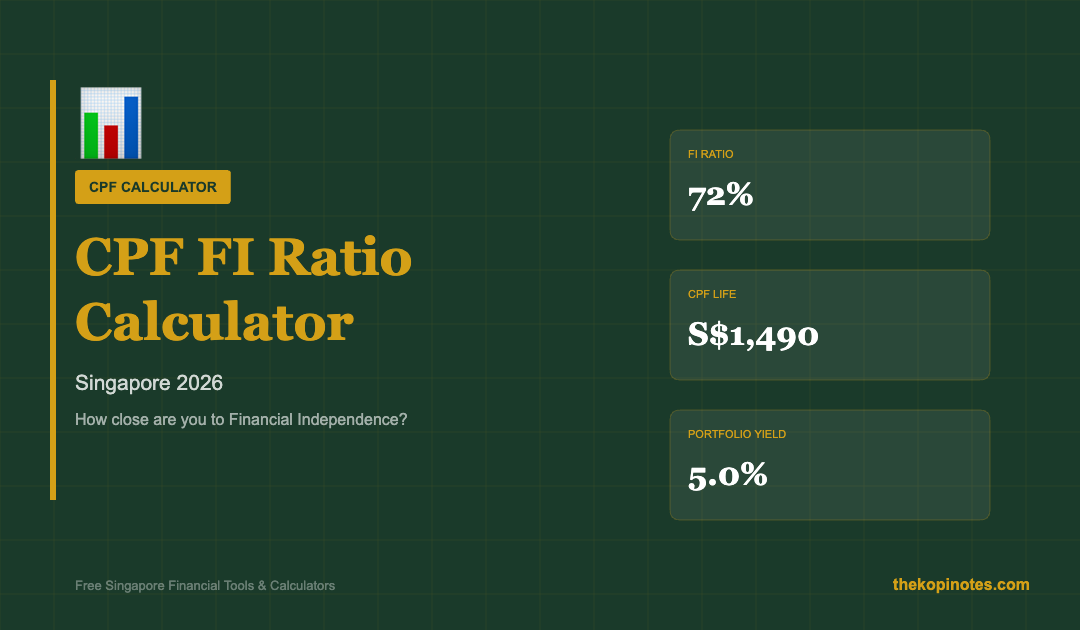
Monthly Portfolio Income = S$250,000 × 5% ÷ 12 = S$1,042
Total Passive Income = S$1,490 + S$1,042 = S$2,532
CPF FI Ratio = S$2,532 ÷ S$3,500 × 100 = 72.3%
Monthly FI Gap = S$3,500 − S$2,532 = S$968
Additional portfolio needed = S$968 × 12 ÷ 5% = S$232,320
This investor is solidly in the “Building” zone. To reach 100% FI, they would need an additional S$232,320 in investable assets (at a 5% yield), or they could reduce their target monthly expenses, increase their CPF RA top-ups to push toward the ERS, or pursue a slightly higher-yielding portfolio allocation.
CPF LIFE vs Investment Portfolio: Role in Your FI Ratio
Both income streams contribute to your FI Ratio, but they behave very differently and should be managed accordingly.
CPF LIFE is a government-backed annuity — the payout is guaranteed for life regardless of market conditions. The trade-off is that CPF funds are relatively illiquid before age 55 and cannot be freely invested outside the CPF Investment Scheme (CPFIS). The best way to maximise CPF LIFE payouts is to top up your Retirement Account to the Enhanced Retirement Sum (ERS), currently S$426,000 in 2026. Members who do this can expect monthly payouts of S$2,170–S$2,430 — enough on its own to cover basic living expenses for many Singaporeans.
Investment Portfolio income — from S-REITs, dividend stocks, or ETFs — provides flexibility. Unlike CPF LIFE, you can adjust your portfolio allocation, access the capital if needed, and benefit from growth over time. S-REITs in particular are Singapore’s most popular dividend vehicle, offering distribution yields of 5–7% and monthly or quarterly payouts that can be directly reinvested or used for living expenses. Use our Dividend Portfolio Yield Calculator to size your portfolio for your target monthly income.
The ideal FI structure for a Singapore investor typically combines both: a robust CPF LIFE payout covering basic necessities, and a dividend/REIT portfolio covering discretionary expenses. This two-layer approach mirrors how many FI-focused Singaporeans structure their retirement income. Explore the best S-REITs in Singapore for 2026 if you are building the investment income leg of this strategy.
How to Boost Your CPF FI Ratio in Singapore
There are four practical levers for improving your FI Ratio:
1. CPF RA Top-Ups (Retirement Sum Topping-Up Scheme): Top up your own or a family member’s Retirement Account to increase CPF LIFE payouts. Each S$10,000 top-up to the RA at age 45 increases eventual monthly payouts by roughly S$60–S$80 at age 65. Cash top-ups to your MA, SA, or RA are also eligible for up to S$8,000 in personal income tax relief per year under the RSTU scheme — effectively a double benefit. Use our CPF Cash Top-Up Tax Relief Calculator to quantify this.
2. SRS Contributions: The Supplementary Retirement Scheme (SRS) allows Singapore citizens to contribute up to S$15,300 per year (S$35,700 for foreigners) in tax-deductible contributions. SRS funds can be invested in unit trusts, ETFs, and insurance products. At retirement, only 50% of SRS withdrawals are taxable, making it a powerful tax-efficiency tool that indirectly improves your FI Ratio by growing investable assets faster. See our SRS Tax Savings Calculator to model the benefit.
3. Portfolio Growth: Increasing your investment portfolio through regular contributions is the most direct way to move the FI Ratio needle. Dollar-cost averaging into diversified holdings — especially S-REITs and broad-market ETFs — has historically delivered 5–8% total returns for Singapore investors over decade-long periods. Model your contributions with our DCA Investment Calculator.
4. Expense Optimisation: The FI Ratio is a fraction — reducing the denominator (monthly expenses) is as powerful as increasing the numerator (passive income). A S$500 reduction in monthly retirement expenses has the same effect as adding S$120,000 to a portfolio at a 5% yield.
CPF, SRS and the Singapore FI Landscape
Singapore investors have access to a uniquely comprehensive set of government-backed tools that do not exist in most Western FI frameworks. The CPF system functions as a mandatory savings and insurance mechanism, with ordinary wages contributing 20% employee + 17% employer (for workers under 55 in 2026) to a member’s CPF accounts. These contributions flow through OA, SA, and MA accounts with interest rates of 2.5%, 4.0%, and 4.0% respectively — all significantly above Singapore’s prevailing bank deposit rates. The SA and RA also benefit from an extra 1% on the first S$60,000 of combined balances.
Beyond CPF, the SRS scheme effectively creates a second tax-advantaged retirement pot, while Singaporeans also benefit from the absence of capital gains tax, relatively low income tax rates (maximum 24% for incomes above S$1 million), and no dividend withholding tax on Singapore-listed stocks and REITs. This tax efficiency means that the “effective” FI Ratio for Singaporeans is often better than a nominal comparison with other countries would suggest.
For Singaporeans building toward FI, the recommended order of operations is: (1) fully fund emergency reserve → (2) maximise CPF SA/RA top-ups for tax relief → (3) contribute to SRS up to annual limit → (4) invest surplus in a diversified dividend/REIT portfolio via a low-cost brokerage. This sequencing optimises both the FI Ratio and after-tax wealth accumulation simultaneously.
Using the FI Ratio as a Retirement Planning Framework
The CPF FI Ratio is most powerful when tracked annually alongside your net worth. Unlike a one-time calculation, monitoring the ratio over time shows you whether you are accelerating toward FI or stagnating. A healthy progression might look like: age 35 at 15% → age 40 at 30% → age 45 at 50% → age 50 at 70% → age 55 at 90% → retire comfortably at 60–65 at 100%+.
For comprehensive retirement planning, use the FI Ratio in conjunction with our Retirement Planning Calculator, which models your total nest egg and drawdown over time. The two tools together answer both “am I earning enough passively?” (FI Ratio) and “will my capital last?” (drawdown projection).
Singapore’s retirement ecosystem — CPF LIFE as the guaranteed floor, SRS as the tax-efficient accelerant, and a dividend portfolio as the flexible topper — means that a well-structured Singaporean approaching 65 with FRS set aside and a S$300,000 investment portfolio could realistically achieve a FI Ratio of 75–90% without ever having earned an extraordinary income. This is the quiet power of starting early, topping up consistently, and letting compounding and CPF interest work over 20–30 years. For more on building passive income streams, see our passive income guide for Singapore 2026.
Frequently Asked Questions
What is a good CPF FI Ratio for Singapore?
A CPF FI Ratio of 100% or above means your passive income (CPF LIFE + investment portfolio income) fully covers your projected monthly retirement expenses — this is the gold standard for financial independence in Singapore. A ratio of 80% or more is considered “almost there” and is a strong position for most retirees, as expenses often decrease in later retirement years. For those still in the accumulation phase, targeting a 50%+ ratio by age 50 and 80%+ by age 60 are practical interim milestones.
How is the CPF FI Ratio different from the FIRE number?
The FIRE number is a target total portfolio size (typically 25x annual expenses under the 4% rule), whereas the CPF FI Ratio is a percentage expressing how much of your expenses are currently covered by passive income. The ratio is more useful for Singaporeans because it accounts for CPF LIFE — a guaranteed lifelong annuity that dramatically reduces the portfolio you need to accumulate compared to a pure self-funded retirement. Use our CPF FIRE Number Calculator to find your Singapore-adjusted FIRE number.
Should I include CPF OA and SA balances in the investment portfolio field?
No. Your CPF OA, SA, and RA balances are already captured through the CPF LIFE payout figure — the LIFE payout is essentially a function of how much accumulates in your RA by age 55. To avoid double-counting, enter only your external investment portfolio (stocks, S-REITs, ETFs, unit trusts, robo-advisor balances, bonds, and cash in brokerage accounts) in the portfolio value field.
What portfolio yield should I use in the calculator for Singapore?
Use 4–6% for a dividend-focused portfolio of Singapore S-REITs and blue-chip dividend stocks. Use 2–3% for broad-market accumulating ETFs like VWRA or CSPX, where income is reinvested rather than distributed. Use 5–6% if your portfolio primarily consists of S-REITs, which distributed yields averaging around 5.5–6.5% in 2025–2026 across the SGX-listed sector. If you hold a mix, a blended 4–5% yield is a reasonable starting assumption.
How much CPF LIFE payout can I expect in Singapore?
CPF LIFE payouts depend on the amount in your Retirement Account at age 55 and the plan you choose (Standard, Basic, or Escalating). As at 2026, the indicative monthly payouts are: Basic Retirement Sum (BRS, S$106,500) → S$790–S$870/month; Full Retirement Sum (FRS, S$213,000) → S$1,490–S$1,630/month; Enhanced Retirement Sum (ERS, S$426,000) → S$2,170–S$2,430/month. Use our dedicated CPF LIFE Payout Calculator for more precise projections based on your age and RA balance.
Can I use the CPF FI Ratio to plan for early retirement in Singapore?
Yes, with one important caveat: CPF LIFE payouts only begin at age 65 (or 70 if you defer). If you plan to retire at 50 or 55, your FI Ratio during the bridge years (age 50–65) will rely entirely on your investment portfolio income, with CPF LIFE contributing zero. For early retirement planning, we recommend running this calculator twice — once for the “bridge” phase (using only portfolio income as passive income) and once for post-65 retirement (including CPF LIFE). The CPF FIRE Number Calculator also models this two-phase approach.
Which Singapore platforms are best for building the investment income leg?
For S-REITs and dividend stocks, FSMOne and IBKR offer low brokerage fees for SGX-listed securities. For diversified ETF portfolios, robo-advisors like Endowus (which also invests CPF OA funds) and Syfe provide automated, low-cost exposure to global markets. Endowus is particularly powerful for Singapore investors as it can channel CPF OA funds into institutional-class funds, effectively boosting your investment returns beyond the standard OA interest rate.
How does SRS affect my CPF FI Ratio?
SRS contributions do not directly affect your CPF LIFE payout, but they significantly accelerate the growth of your investment portfolio — the second leg of the FI Ratio. By investing SRS funds in dividend-paying assets or ETFs, you build investable capital faster (thanks to the upfront tax relief), which translates to higher portfolio income at retirement. For a Singapore individual earning S$100,000 per year, the annual SRS contribution of S$15,300 at the 11.5% marginal tax rate saves S$1,759 in tax — that is additional capital compounding in your favour. Use our SRS Tax Savings Calculator to model this.
How often should I recalculate my CPF FI Ratio?
Recalculate once a year — ideally after receiving your annual CPF Statement (issued by CPF Board in January) and after your year-end portfolio valuation. This gives you a clean snapshot of your progress. You should also recalculate after major life events: a significant pay rise (which accelerates CPF contributions), a large CPF RA top-up, a major portfolio rebalancing, or a significant lifestyle change that affects your projected retirement expenses.
Ready to Improve Your CPF FI Ratio?
Track your progress, top up your CPF, and grow your investment portfolio. Use our free tools and referral bonuses to put your knowledge into action.