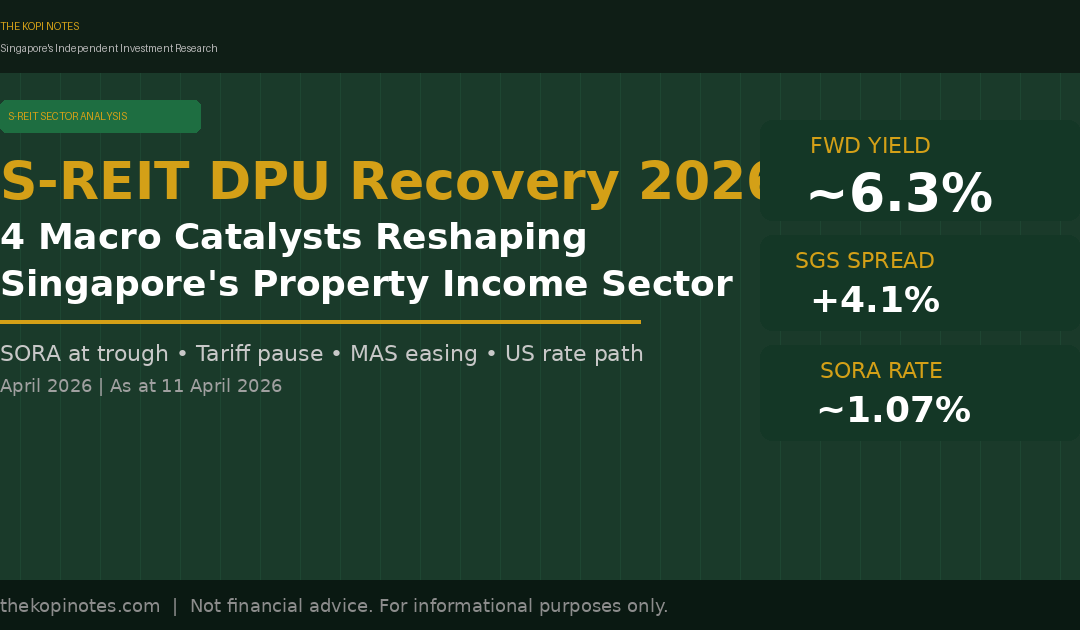
S-REIT DPU Recovery 2026: 4 Macro Catalysts Reshaping Singapore’s Property Income Sector
SORA near trough. MAS easing. Tariff pause. US Fed holding. Four macro forces are converging to make 2026 one of the most compelling entry windows for Singapore REIT investors since 2020.
Not financial advice. This article is for informational and educational purposes only. It does not constitute financial, investment, or tax advice. All figures cited are as at April 2026 unless stated otherwise. Always do your own due diligence before investing.
The Singapore REIT sector has been through a bruising two years. Rising interest rates from 2022 to 2023 pushed SORA to a peak of 3.03% and compressed distribution per unit (DPU) across virtually every S-REIT. Many unitholders watched their quarterly income dip, and the iEdge S-REIT Index underperformed broader equities.
But the macro backdrop is shifting rapidly. In the week of 7–11 April 2026 alone, Singapore investors absorbed the Trump 90-day tariff pause, an anticipated MAS monetary policy easing, and fresh US inflation data that supports a “higher for longer” pause rather than a re-acceleration of rate hikes. The four macro catalysts we examine below are converging in a way that has not been seen since the post-COVID rate normalisation period. With S-REIT forward yields now trading at roughly 6.3% and yield spreads over Singapore Government Securities (SGS) widened to ~4.1 percentage points, the fundamental case for Singapore REIT income investors is strong.
Table of Contents
Contents — Click to expand
- The Macro Context: Why April 2026 Matters
- Catalyst 1 — SORA at 1.07%: The DPU Windfall
- Catalyst 2 — MAS April 2026 Easing
- Catalyst 3 — Trump Tariff Pause: 90-Day Window
- Catalyst 4 — US Fed: Rate Path and Singapore Impact
- S-REIT Sector Breakdown: Yield & DPU Outlook
- What This Means for S-REIT Investors
- Risks and What to Watch
- Frequently Asked Questions
- Conclusion
The Macro Context: Why April 2026 Matters
Singapore REIT investors rarely get a confluence of positive macro signals at the same time. The 2018–2019 period, when the US Federal Reserve pivoted from hikes to cuts, was one such window. The post-COVID yield compression of 2020–2021 was another. April 2026 has the hallmarks of a third.
Consider the snapshot as at 11 April 2026:
| Metric | Value | Direction |
|---|---|---|
| SORA (overnight) | ~1.07% | ▼ Trough |
| SGS 10-Year Yield | ~2.29% | ▼ Declining |
| iEdge S-REIT Fwd Yield | ~6.3% | ▲ Attractive |
| Yield Spread (S-REIT vs SGS 10Y) | ~4.1 pp | ▲ Wide |
| S-REIT Index P/Book | ~0.90× | Below NAV |
| US Federal Funds Rate (effective) | 3.64% | Hold |
| FY2026 S-REIT DPU Growth Forecast | +3% YoY | ▲ Recovery |
Sources: MAS, SGX, Federal Reserve H.15 (April 10, 2026), The Kopi Notes analysis. Not financial advice.
Catalyst 1 — SORA at 1.07%: The DPU Windfall
The Singapore Overnight Rate Average (SORA) peaked at approximately 3.03% in late 2023 and has since fallen to roughly 1.07% — close to what many analysts consider the cyclical trough for this rate cycle. This 196 basis point decline from peak to trough is the single biggest driver of S-REIT DPU recovery in 2026.
Why does SORA matter so much? The vast majority of S-REIT debt is either directly floating rate (tied to SORA or its predecessors SOR and SIBOR) or has been refinanced in recent quarters with SORA-linked facilities. Every 25bps move in SORA translates, across the S-REIT sector, to an estimated S$60–100 million change in annual interest costs.
The practical effect: for a REIT with S$1 billion of floating-rate debt, the move from 3.03% SORA to 1.07% SORA saves approximately S$19.6 million in annual interest — money that flows directly to distributable income and, ultimately, DPU for unitholders.
High-floating-rate REITs that benefit most include Keppel DC REIT, Mapletree Logistics Trust, and CapitaLand Ascendas REIT. Defensively structured REITs with mostly fixed-rate debt, such as Parkway Life REIT, benefit less in the short term but gain from lower refinancing costs at their next debt maturity.
Catalyst 2 — MAS April 2026 Easing
The Monetary Authority of Singapore (MAS) is expected to release its April 2026 Monetary Policy Statement on Tuesday, 14 April 2026. Market consensus, as at 11 April 2026, strongly anticipates a further slight easing of the Singapore dollar nominal effective exchange rate (SGD NEER) policy band — either a reduction in the slope, a downward shift in the midpoint, or both.
Unlike most central banks, MAS uses the exchange rate (not interest rates) as its primary policy tool. An easing of the NEER band is designed to allow the SGD to depreciate slightly at the margin, supporting Singapore exporters and counteracting the deflationary impulse from weaker global trade caused by tariff uncertainty.
Why does this matter for S-REITs? Several transmission mechanisms:
- SORA may stay lower for longer: MAS easing signals that domestic monetary conditions will remain accommodative, keeping SORA near its current trough into late 2026.
- SGD commercial property values are supported: Lower interest rates keep capitalisation rates stable, protecting NAV per unit for S-REITs. A P/B of 0.90× becomes less concerning if NAV is stable or rising.
- DPU recovery window stays open: With borrowing costs not rising, S-REITs can continue the debt refinancing tailwind that started in 2025.
The MAS April 2026 decision will be a key catalyst for the S-REIT sector in the near term. This article will be updated if MAS delivers a surprise outcome on 14 April.
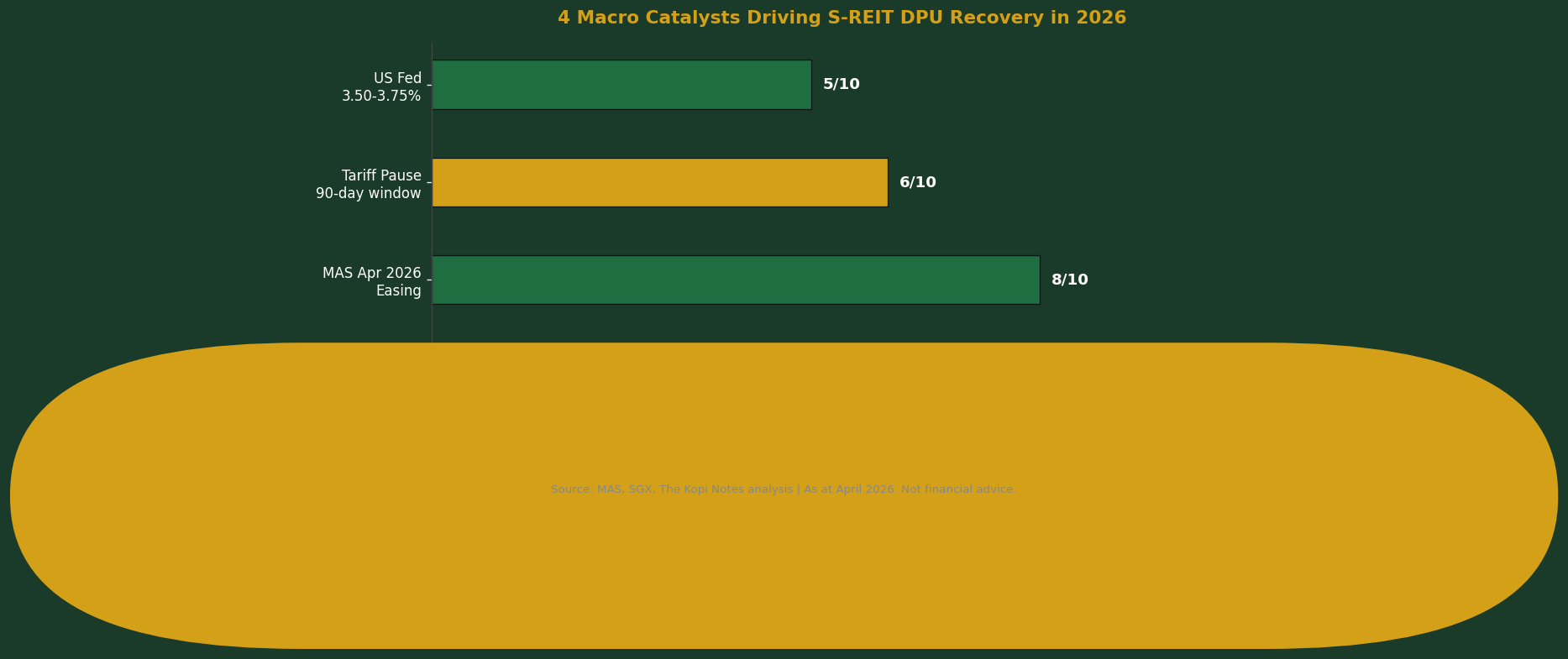
Catalyst 3 — Trump Tariff Pause: 90-Day Window for S-REITs
On 9 April 2026, the Trump administration announced a 90-day pause on the “reciprocal” tariff regime that had been announced on 2 April (“Liberation Day”). The S&P 500 surged 9.52% on the day. Singapore’s S-REIT index, while not rising as dramatically, reacted positively given the relief from near-term global trade disruption risk.
Singapore benefits from an exceptionally favourable position: its baseline tariff rate is just 10% (the lowest tier applied universally to all countries), versus the 20–34% rates that had been threatened for regional peers. This means Singapore-focused S-REITs, particularly retail, industrial, and data centre REITs serving the domestic economy, face very limited direct tariff exposure.
The 90-day window extends until approximately 8 July 2026, giving markets a period of reduced uncertainty. During this window:
- Retail REITs (FCT, CICT, Lendlease) benefit as consumer sentiment recovers and footfall stays robust
- Industrial and logistics REITs (CLAR, ESR-LOGOS, MLT) see reduced immediate pressure on supply chain tenant demand
- Data centre REITs (Keppel DC REIT) are largely insulated — AI infrastructure demand is structural and unrelated to tariff cycles
Important caveat: while there is a pause on “reciprocal” tariffs, US-China tariffs remain elevated at 125%. S-REITs with significant China exposure (Mapletree Pan Asia Commercial Trust at ~40% AUM from China/HK, Mapletree Logistics Trust at ~20% from China) remain at higher macro risk.
Catalyst 4 — US Fed Rate Path: Holding Means No New Headwinds
The US Federal Reserve’s Federal Funds Rate stands at 3.50–3.75% (effective rate: 3.64% as at 10 April 2026, per the Federal Reserve H.15 release). The Fed is in a holding pattern — neither hiking nor cutting aggressively. The market is pricing roughly 1–2 cuts in 2026, likely in H2.
For Singapore REIT investors, the key insight here is “no new headwinds from the Fed.” The 2022–2023 rate hiking cycle that caused SORA to spike from near-zero to 3.03% was directly imported from the Fed’s 525bps of cumulative hikes. With the Fed on hold, that import mechanism is dormant.
Additionally, US long-term rates matter for Singapore through the global bond market. The US 10-year Treasury stands at 4.29% as at 10 April 2026. SGS 10-year yields of ~2.29% reflect Singapore’s lower inflation environment and AAA sovereign credit. The SGS-US Treasury spread of roughly 200bps is normal for Singapore and does not signal stress.
The key watch points on the Fed side:
- May 6–7, 2026 FOMC meeting: Market expects a hold. If Fed signals 2 cuts in 2026, S-REIT yields become even more compelling relative to risk-free alternatives
- US PCE inflation: The Fed’s preferred inflation gauge was at 2.7% as at the March 2026 meeting. Moderation toward 2.0–2.5% would clear the path for cuts
- US recession risk: Tariff uncertainty raises recession probability estimates (Oxford Economics: global growth at 1.4%). A US recession would likely accelerate Fed cuts, further supporting Singapore REIT yields
S-REIT Sector Breakdown: Yield & DPU Outlook by Sub-Sector
Not all S-REITs benefit equally from the four catalysts above. Here is how the major sub-sectors look as at April 2026:
| Sub-Sector | Example REITs | Fwd Yield | Tariff Risk | DPU Outlook |
|---|---|---|---|---|
| Retail | FCT, CICT, Lendlease | 5.5–7.0% | Low | Positive |
| Industrial / Logistics | CLAR, MLT, ESR-LOGOS | 5.5–9.5% | Medium | Positive |
| Data Centre | Keppel DC REIT | 4.0–4.5% | Very Low | Positive (AI) |
| Healthcare | Parkway Life REIT | 3.5–4.0% | Negligible | Stable (18yr streak) |
| Hospitality | Suntec REIT, CDL HT | 4.5–6.5% | Medium | Moderate |
| Office | Keppel REIT, OUE REIT | 5.5–7.0% | Low | Stable |
Forward yields are approximate, based on consensus FY2026 DPU estimates and market prices as at early April 2026. Not financial advice.
For a comprehensive ranked view of the best-value S-REITs, see our Best S-REITs Singapore 2026 Guide and the Singapore REIT ETF Guide for those who prefer diversified exposure.
What This Means for S-REIT Investors: Practical Takeaways
Four macro catalysts pointing in the same direction does not eliminate risk — but it does create a constructive backdrop for S-REIT income investors. Here is how to interpret this environment:
1. DPU recovery is real, not just hoped for. With SORA declining 196bps from its peak and now near trough, the interest cost relief is already flowing through to reported DPU. FY2025 results across the sector showed this, and the FY2026 consensus forecasts of +3% DPU growth are grounded in actual refinancing activity, not assumption.
2. Yield spread is at historically attractive levels. A 4.1 percentage point spread between S-REIT forward yields (~6.3%) and SGS 10-year bonds (~2.29%) is wider than the 10-year historical average of roughly 3.0–3.5 percentage points. The market is still pricing in considerable risk premium — which means there is room for re-rating as macro uncertainty fades.
3. P/B below 1.0× means unitholders are buying assets at a discount to appraised value. At ~0.90× P/B, an investor buying the sector today is effectively acquiring S$100 worth of investment property for S$90. This is not risk-free — appraised values can decline — but it does represent a fundamental margin of safety.
4. Consider dollar-cost averaging rather than a lump sum. The 90-day tariff pause expires around 8 July 2026. If US-China trade tensions re-escalate after that, S-REIT prices may face another bout of volatility. Spreading purchases across April–June 2026 is a reasonable strategy for risk-managed entry.
5. Use the free tools to model your portfolio. Try the Retirement Planning Calculator to model how S-REIT yield income compounds toward a retirement target, and the CPF Investment Strategy Guide if you want to explore using CPF OA for eligible S-REITs via CPFIS-approved brokers.
If you prefer robo-advisor-based exposure to S-REITs without stock selection, Endowus and Syfe REIT+ both offer curated S-REIT portfolios with low minimums.
Risks and What to Watch
With four bullish macro catalysts on the table, it is easy to overlook the downside risks. Singapore REIT investors should monitor the following:
1. US-China trade war re-escalation after the 90-day pause. The tariff pause expires ~8 July 2026. If negotiations fail and tariffs are reimposed at Liberation Day levels (20–34% on most countries), global trade disruption would return. S-REITs with China-facing tenants (MLT ~20% China AUM, MPACT ~40% China/HK AUM) are most exposed. Watch for USTR announcements in June 2026.
2. SORA re-acceleration if Singapore inflation picks up. MAS uses the exchange rate to manage inflation. If Singapore CPI re-accelerates (e.g., from tariff-driven import cost inflation or a surge in energy prices), MAS could tighten the NEER band, which would push SORA higher and reverse some of the DPU recovery tailwind. As at February 2026, core CPI was 1.4% — well within MAS’ comfort zone of 1.0–2.0%.
3. S-REIT gearing levels remain elevated. The sector average gearing is approximately 38–40%, which is below the 50% regulatory cap but leaves limited room for acquisitions. REITs that need to recapitalise via equity fundraising (private placements or rights issues) will dilute unitholders. Check gearing levels before entering any individual S-REIT.
4. Global commercial real estate correction risk. S-REITs with overseas exposure (office in Europe, logistics in Australia, hotels globally) face mark-to-market risk if global property values decline. The high US interest rate environment (Fed Funds at 3.64%) is still compressing cap rates for US and European properties.
5. Earnings season concentration risk — April–May 2026. Many S-REITs will report their FY2025 full-year or H2 FY2026 results in April–May. Negative DPU surprises — particularly from REITs with high China, Australia, or European exposure — could trigger sharp price drops in individual names. Diversify across sub-sectors if you are building a new position.
Frequently Asked Questions
What is DPU in Singapore REITs and how is it calculated?
DPU stands for Distribution Per Unit — the per-unit income paid out by an S-REIT to its unitholders, similar to a dividend for a stock. S-REITs are required by Singapore law to distribute at least 90% of their taxable income to qualify for tax-transparency status (no corporate-level tax on income). DPU is calculated as total distributable income divided by the number of units in issue. It is typically paid quarterly or semi-annually. When SORA rises, interest costs increase and distributable income falls, reducing DPU. Conversely, when SORA falls, interest savings boost distributable income and support DPU growth.
How does SORA affect Singapore REIT distributions?
SORA (Singapore Overnight Rate Average) is the benchmark rate for most S-REIT floating-rate debt. When SORA rises, S-REITs with floating-rate borrowings see their interest costs increase directly, reducing the income available for distribution. When SORA falls, the reverse occurs. As at April 2026, SORA has declined from a peak of ~3.03% to ~1.07% — a 196bps reduction that is flowing through to meaningfully higher distributable income for floating-rate-heavy S-REITs. REITs with predominantly fixed-rate debt are less immediately impacted but benefit when they refinance at lower rates.
Is it a good time to buy Singapore REITs in April 2026?
This is not financial advice. As at April 2026, the macro backdrop for S-REITs is genuinely supportive: SORA near trough, MAS expected to ease, a 90-day tariff pause reducing immediate trade disruption risk, and the US Fed on hold with no new rate hikes expected. S-REIT forward yields of ~6.3% with a 4.1pp spread over SGS bonds and P/B of ~0.90× represent historically attractive valuations. However, risks remain — particularly from US-China trade war re-escalation after July 2026, REIT-specific gearing levels, and overseas property market exposure. Investors should assess their own risk tolerance, diversify across sub-sectors, and consider a phased entry strategy.
What is the difference between S-REIT yield and SGS bond yield?
The SGS (Singapore Government Securities) 10-year yield is the risk-free rate for Singapore-dollar assets. As at April 2026, it is approximately 2.29%. S-REIT forward yields are approximately 6.3%. The difference — roughly 4.1 percentage points — is the “yield spread” or risk premium that investors demand for taking on S-REIT-specific risks (leverage, property market cycles, management execution, tenant risk). Historically, this spread has averaged around 3.0–3.5 percentage points. A spread of 4.1pp suggests the market is pricing in above-average risk, which can represent an opportunity for investors willing to accept that risk.
Which S-REIT ETF should I consider for diversified exposure?
Singapore investors have several S-REIT ETF options for diversified exposure without individual stock selection risk. The Lion-Phillip S-REIT ETF (SGX: CLR) tracks the iEdge S-REIT Leaders Index and holds the largest S-REITs by market cap. The CSOP iEdge S-REIT Leaders Index ETF (SGX: SRT) offers a similar exposure. For more details on ETF construction, fees, and tax treatment, see our Singapore REIT ETF Guide. Robo-advisor options include Syfe REIT+ and Endowus’ REIT-focused portfolios for those who prefer a managed approach.
How does the US tariff situation affect Singapore REITs?
Singapore has been assigned a 10% baseline tariff rate — the lowest tier in the Trump tariff regime. This means most Singapore-focused S-REITs (retail malls, data centres, healthcare facilities) have minimal direct tariff exposure. However, S-REITs with significant China or Asia-Pacific logistics exposure are at higher risk because US-China tariffs remain elevated at 125% as at April 2026, potentially slowing supply chain volumes that support logistics and industrial REIT rental demand. The 90-day pause on most “reciprocal” tariffs (until ~July 8, 2026) provides near-term relief. Watch Mapletree Logistics Trust (China ~20% AUM) and Mapletree Pan Asia Commercial Trust (China/HK ~40% AUM) closely.
Can I invest in S-REITs using my CPF or SRS?
Yes, with specific conditions. For CPF OA (CPFIS-OA), you can invest in eligible S-REITs listed on SGX through a CPFIS-approved broker such as FSMOne or DBS Vickers. Not all S-REITs qualify — check the CPF website for the current approved list. For SRS (Supplementary Retirement Scheme), you can invest in any SGX-listed S-REIT through an SRS-compatible brokerage. Using SRS for S-REIT investments gives you upfront income tax relief on your contributions (up to S$15,300 per year for Singapore Citizens and PRs), making the effective return higher than the headline yield. For more, see our CPF Investment Strategy Guide and SRS Account Guide.
Conclusion: Four Tailwinds, One Window
SORA at a cyclical trough. MAS easing further. A 90-day tariff pause reducing immediate trade disruption risk. The US Fed on hold with no new rate hikes in sight. These four macro catalysts are converging in April 2026 to create the most supportive environment for S-REIT income recovery that Singapore investors have seen in several years.
That does not mean risks have disappeared. The tariff pause expires around July 8. US-China tensions remain high. And individual REITs with elevated gearing or China exposure carry specific risks that broad macro tailwinds cannot fully offset.
But for long-term income investors — those who care about the 6.3% forward yield, the 4.1pp spread over risk-free bonds, and the fact that they are buying at 0.90× book value — the current setup is compelling. The four catalysts are all pointing in the direction of DPU recovery. The window is open. Position thoughtfully.
Not financial advice. All data as at April 2026. Do your own due diligence before investing.
This article was researched with the help of AI. While we strive to keep all information accurate and up to date, there may be errors. If you notice any discrepancies, please contact us.