MAS April 2026 Monetary Policy Statement: What Singapore REIT Investors Must Know Before Tuesday
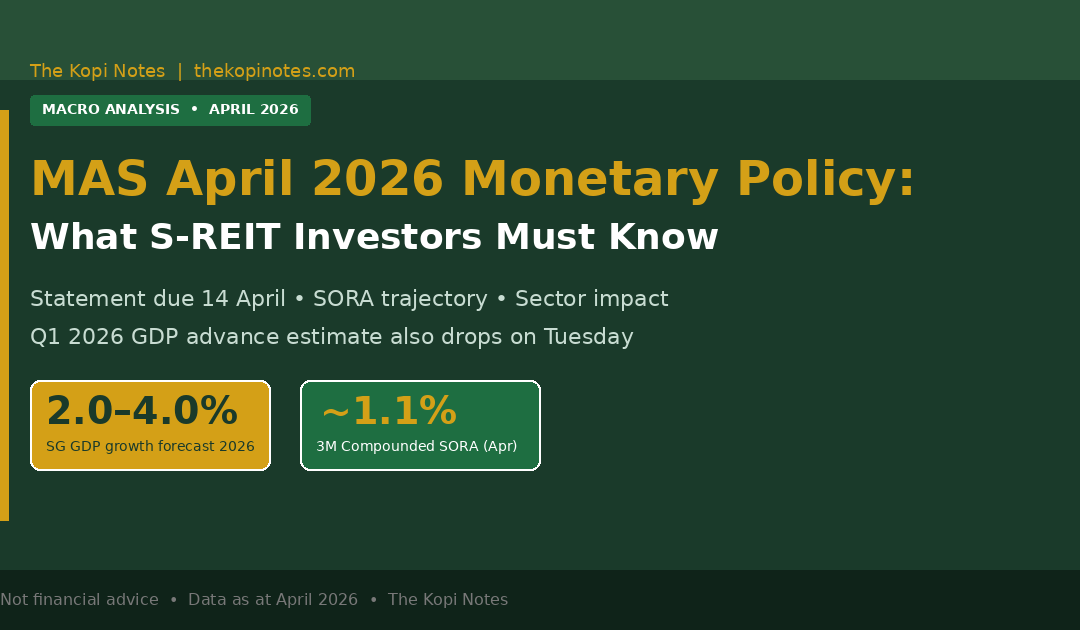
On Tuesday, 14 April 2026, the Monetary Authority of Singapore (MAS) releases its April Monetary Policy Statement — and the Ministry of Trade and Industry (MTI) drops the Q1 2026 GDP advance estimate on the same day. For Singapore REIT investors, this is the most important macro date of the quarter.
Not financial advice. This article is for informational purposes only. Always do your own due diligence before investing.
MAS uses Singapore’s exchange rate — not interest rates — as its primary monetary policy tool. Every April and October, it reviews whether to adjust the S$NEER policy band’s rate of appreciation, width, or centre-point. Meanwhile, the 3-month compounded SORA has been hovering near its trough, and S-REIT unitholders are watching closely for signals that cheaper refinancing costs will feed into Distribution Per Unit (DPU) recovery. Here’s the full picture before Tuesday’s announcements.
Table of Contents
Contents — Click to expand
- How MAS Monetary Policy Works — The S$NEER Framework
- What Happened in January 2026: The Last MAS Statement
- April 14, 2026 Preview: Watchful Hold Expected
- SORA Trajectory & What It Means for S-REIT Borrowing Costs
- Sector-by-Sector Impact: Which S-REITs Benefit Most?
- What This Means for Singapore REIT Investors
- Risks & What to Watch After Tuesday
- FAQ: MAS Policy & S-REITs
How MAS Monetary Policy Works — The S$NEER Framework
Unlike the US Federal Reserve, which targets interest rates, MAS manages monetary policy through the Singapore Dollar Nominal Effective Exchange Rate (S$NEER) — a trade-weighted basket of currencies. MAS sets three levers: the rate of appreciation of the policy band, the width of that band, and the centre-point at which the band is anchored.
A stronger S$NEER makes imports cheaper, dampening imported inflation. A shallower appreciation slope gives the economy more breathing room. For S-REIT investors, this matters indirectly — MAS policy shapes inflation expectations, affects the SGD/USD cross (which drives offshore asset valuations), and influences the trajectory of SORA, the domestic benchmark rate used to price floating-rate debt.
MAS reviews monetary policy formally twice a year — in April and October. The January 2026 statement was an additional off-cycle review triggered by global trade-policy uncertainty from US tariffs.
What Happened in January 2026: The Last MAS Statement
On 29 January 2026, MAS issued an off-cycle Monetary Policy Statement — only the second such mid-cycle review in recent years. The decision: hold the prevailing rate of appreciation of the S$NEER policy band with no change to its width or centre.
Key takeaways from January:
- MAS Core Inflation forecast raised to 1.0–2.0% for 2026 (up from 0.5–1.5% in October 2025), reflecting normalising price pressures and resilient domestic demand.
- Global growth expected to ease modestly in 2026 as lagged tariff effects weigh on trade — but the AI capex boom provides a significant offset for electronics supply-chain economies like Singapore.
- S$NEER trading in the upper half of the policy band — effectively delivering incremental tightening through the exchange rate level, not just the slope.
- 3-month compounded SORA near its trough — MAS signalled the rate may be close to bottom, with a “potential gentle upward drift in H2 2026” as excess liquidity gradually recedes.
For S-REIT unitholders, the January statement was net-neutral. SORA at historically low levels (~1.07% at trough) supported DPU recovery projections, but the gentle upward drift guidance in H2 tempered enthusiasm for the most rate-sensitive sub-sectors (office, diversified commercial).
April 14, 2026 Preview: Watchful Hold Expected
Based on analyst previews from MUFG (8 April 2026) and IndexBox, the April 2026 Monetary Policy Statement is widely expected to deliver a “watchful hold” — no change to the S$NEER policy band’s rate of appreciation, width, or centre-point.
Why hold? Several factors argue against any adjustment at this meeting:
- Inflation within target: MAS Core Inflation is tracking within the 1.0–2.0% forecast band. There is no urgency to tighten further.
- Tariff uncertainty: With US tariffs still generating global trade disruptions (Singapore’s 10% baseline US tariff remains in effect), MAS is unlikely to shock markets with a surprise easing that could weaken the SGD.
- GDP resilience: MTI upgraded the 2026 GDP growth forecast to 2.0–4.0% — not the environment that typically triggers emergency policy shifts.
- Q1 GDP data drops simultaneously: MAS will have advance Q1 GDP data in hand on the 14th. If Q1 surprised strongly to the upside, the case for any preemptive easing is even weaker.
Our view: A hold is the base case. The more interesting signal will be MAS’s updated inflation and growth forecasts in the accompanying Macroeconomic Review, and any language about the H2 2026 SORA trajectory. Watch for rhetoric around “calibrated easing” vs “watchful pause” — the former would be a bullish signal for S-REITs.
SORA Trajectory & What It Means for S-REIT Borrowing Costs
While MAS manages the S$NEER, the 3-month compounded SORA is the benchmark rate that directly affects S-REIT borrowing costs — roughly 60–70% of S-REIT debt is floating-rate or refinanced on 2–5 year cycles tied to SORA.
| Period | 3M SORA | Change | Implication for S-REITs |
|---|---|---|---|
| Peak (H2 2023) | ~3.80% | High | Maximum DPU compression |
| Oct 2025 | ~1.60% | ↓ Falling | Refinancing relief beginning |
| Jan 2026 (trough) | ~1.07% | ↓ Near bottom | DPU recovery window open |
| Apr 2026 (current) | ~1.10% | → Stabilising | Gradual recovery underway |
| H2 2026 (MAS guidance) | ~1.2–1.3% | ↑ Gentle drift | Manageable — already priced in |
The math is compelling: a S-REIT that financed debt at a blended cost of 3.5–4.0% in 2023–24 and is now refinancing at 2.0–2.5% SORA-linked rates (all-in) is adding 1.5–2.0% back to its distribution yield on the refinanced portion. For a REIT with 30% of its debt maturing in 2026, that translates to a 0.5–0.8 percentage point improvement in distribution yield — materially meaningful for unitholders.
Explore our Best S-REITs for 2026 guide for a detailed breakdown of gearing ratios and refinancing schedules across the S-REIT universe.
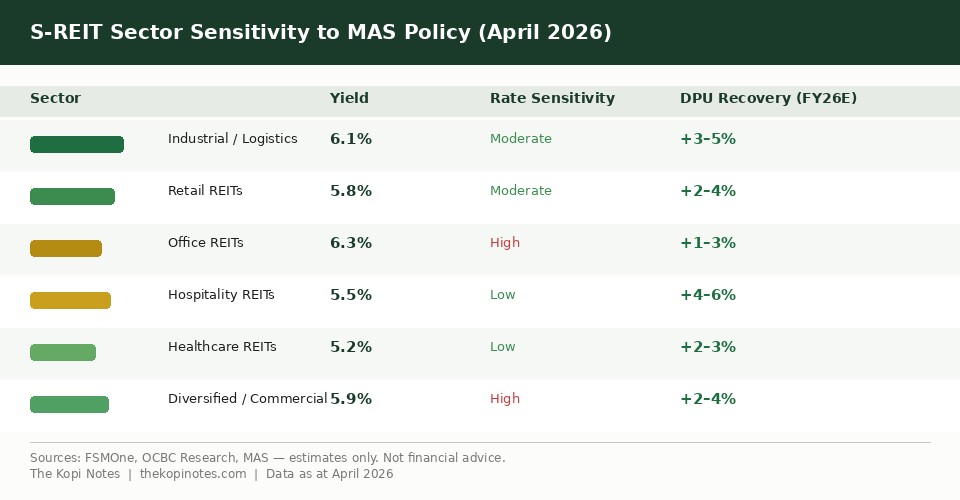
Sector-by-Sector Impact: Which S-REITs Benefit Most?
Not all S-REITs respond equally to monetary policy signals. Here’s how each sub-sector stacks up heading into the April 14 announcement:
🏭 Industrial & Logistics REITs — Best Positioned
Industrial REITs (Mapletree Industrial, CapitaLand Ascendas, Frasers Logistics) offer yields in the 5.8–6.5% range with moderate rate sensitivity. Their shorter WALE (weighted average lease expiry) allows faster rental reversion, and data-centre assets within industrial portfolios benefit from the AI-infrastructure investment tailwind. DPU recovery of 3–5% is achievable in FY2026.
🏬 Retail REITs — Defensive Income
Retail REITs (Frasers Centrepoint Trust, Mapletree Pan-Asia Commercial) benefit from Singapore’s resilient domestic consumption and low unemployment. Occupancy rates remain elevated above 98% for suburban malls. With SORA stabilising, retail REIT distributions are expected to recover 2–4% in FY2026.
🏢 Office REITs — Watch the US Rate Overhang
Office REITs (Keppel REIT, Suntec REIT, CICT commercial exposure) are more sensitive to global rate movements. With the US 10-year Treasury yield rising to ~4.38% in April 2026, the spread compression for Singapore office assets remains a headwind. That said, Grade-A office vacancy in the CBD remains tight at under 4%, supporting rental reversion above inflation.
🏨 Hospitality REITs — Post-Tariff Bounce
Hospitality REITs (CDL Hospitality, Far East Hospitality) have lower floating-rate debt exposure and benefit directly from Singapore tourism recovery. MICE (Meetings, Incentives, Conferences, Exhibitions) demand remains robust. DPU recovery of 4–6% is achievable in FY2026, with RevPAR (Revenue Per Available Room) tracking above 2025 levels.
For a deeper yield comparison, see our Singapore REIT ETF guide for exposure via diversified REIT ETFs like Lion-Phillip S-REIT ETF and NikkoAM-STC Asia REIT.
What This Means for Singapore REIT Investors
Here’s the practical playbook for unitholder heading into Tuesday:
1. A Hold Is the Bull Case (Counterintuitive, but True)
A “watchful hold” by MAS confirms that Singapore’s monetary conditions remain accommodative — SORA stays low, refinancing costs stay manageable, and the DPU recovery narrative remains intact. No surprise tightening = green light for S-REITs.
2. Watch the Q1 GDP Number for Sentiment
MTI’s Q1 2026 advance GDP estimate dropping simultaneously is a significant bonus. Singapore posted 5.7% Q4 2025 growth (manufacturing-led). If Q1 2026 comes in at 3%+, it validates the growth-with-low-rates environment that is ideal for S-REITs. A sub-2% reading could briefly unsettle sentiment but would reinforce the case for MAS easing later in the year.
3. Refinancing Yield Math Still Compelling
With SORA near 1.1% and all-in debt costs for new borrowings around 2.2–2.8%, any S-REIT with significant 2026 debt maturities is locking in 1.0–1.5% lower cost of debt vs 2024. That’s pure DPU accretion — no occupancy improvement or rent hike needed.
4. Use Robo-Advisors for Passive Exposure
If you want S-REIT exposure without stock-picking, platforms like Endowus and Syfe offer curated income portfolios with S-REIT allocations. Use our referral codes for bonus cash credits. You can also model your projected income with our Singapore Retirement Planning Calculator.
5. CPF OA as Your Base Rate Benchmark
CPF OA earns 2.5% with zero risk. S-REITs currently yield 5.5–6.5%. The spread of 3.0–4.0% percentage points remains one of the widest since 2020 — historically, that level of risk premium has been a compelling entry signal. For CPF-OA optimisation strategies, read our CPF investment guide.
Risks & What to Watch After Tuesday
- Surprise MAS tightening: If MAS re-centres the S$NEER band higher than expected (hawkish surprise), it could strengthen the SGD sharply, compressing overseas asset valuations for REITs with significant offshore exposure (e.g. Mapletree Pan-Asia, Frasers Logistics).
- US 10Y Treasury above 4.5%: The global “higher-for-longer” narrative reasserted itself in April 2026, with the 10-year at ~4.38%. If it breaches 4.5%, Singapore office and commercial REIT valuations face further pressure regardless of what MAS does.
- Tariff escalation: A further ratchet-up of US tariffs targeting electronics or logistics could weigh on industrial REIT demand from MNCs rightsizing their regional supply chains.
- SGD strength headwind: A strongly appreciating SGD reduces the SGD-translated income of REITs with AUD, JPY, EUR, or HKD denominated assets. REITs like Mapletree Pan-Asia Commercial Trust and Frasers Logistics & Commercial Trust are most exposed.
- SORA drift faster than expected: If MAS’s “gentle H2 drift” in SORA materialises more sharply (e.g. 3M SORA above 1.5% by Q3), floating-rate debt costs rise and the refinancing tailwind partially reverses.
FAQ: MAS Policy & Singapore REITs
What is the MAS S$NEER policy band and why does it matter for REITs?
The S$NEER (Singapore Dollar Nominal Effective Exchange Rate) is a trade-weighted basket of currencies that MAS manages to target inflation. A stronger SGD makes imports cheaper, easing price pressures. For S-REITs, a steadily appreciating SGD matters when their overseas assets generate non-SGD income — those foreign currency distributions get reduced when converted back to SGD. It also indirectly shapes SORA, the domestic benchmark rate most closely watched by REIT investors.
What is SORA and how does it affect S-REIT distributions?
SORA (Singapore Overnight Rate Average) is the interest rate benchmark used for most floating-rate SGD loans in Singapore, having replaced SIBOR/SOR in 2024. Most S-REIT debt is either SORA-linked floating rate or fixed-rate bonds. When SORA falls (as it did from ~3.8% in 2023 to ~1.07% in early 2026), REITs refinancing maturing debt at lower rates see their finance costs drop — which flows directly into higher Distribution Per Unit (DPU). As at April 2026, 3M compounded SORA is around 1.10%, near its post-tightening trough.
Will MAS cut policy in April 2026?
Unlike the US Fed, MAS doesn’t “cut rates” — it adjusts the slope, width, or centre of the S$NEER policy band. In April 2026, the consensus view (including MUFG’s April 8 preview) is that MAS will hold all three parameters unchanged — a “watchful hold.” The base case is no adjustment to the rate of appreciation, no change to width, and no re-centring. Any surprise deviation (especially an easing re-centring) would be a bullish signal for S-REITs.
How does the Q1 2026 Singapore GDP reading affect S-REITs?
The MTI Q1 2026 advance GDP estimate is released on the same day as the MAS Monetary Policy Statement — 14 April 2026. A strong GDP reading (3%+) would confirm Singapore’s economic resilience and reduce the likelihood of MAS moving to ease policy, but it also validates the earnings environment for Singapore-centric retail and hospitality REITs. A weak GDP reading (below 2%) might briefly unsettle REIT share prices but could strengthen the case for monetary easing later in 2026, which is ultimately positive for REITs over the medium term.
Which S-REITs are most sensitive to MAS and SORA changes?
REITs with the highest proportion of floating-rate debt (typically 30–50% of total borrowings) are most sensitive to SORA movements — this includes larger REITs like CapitaLand Integrated Commercial Trust (CICT) and Mapletree Industrial Trust. Hospitality REITs tend to have lower debt ratios overall. REITs with significant offshore assets in JPY, AUD, or EUR are additionally sensitive to S$NEER movements via the SGD/FX conversion effect on distributions.
Is 2026 a good year to invest in Singapore REITs?
Many Singapore REIT analysts are constructive on 2026, given the combination of falling refinancing costs (SORA near trough), valuations still below historical averages (many REITs trade below book NAV), and forward DPU recovery of 2–5% across sectors. The FTSE ST All-Share REIT Index has been ~7–8% below recent peaks as at early April 2026, which historically has represented a reasonable entry point for long-term income investors. That said, risks remain: US rate volatility, tariff escalation, and SGD strength could weigh on overseas-asset REITs. Not financial advice — always invest based on your own financial situation.
How can I track MAS policy decisions as an investor?
MAS publishes all Monetary Policy Statements, the accompanying Macroeconomic Review, and occasional market commentary directly on mas.gov.sg/monetary-policy. The next scheduled statement after April 2026 will be in October 2026. SGX and broker research teams (OCBC, DBS, Maybank) typically publish same-day REIT impact assessments. You can also follow the 3-month compounded SORA daily on MAS eServices at eservices.mas.gov.sg.
The Bottom Line: Hold Your S-REIT Positions Through Tuesday
The April 14 MAS statement is unlikely to be a market-moving shock — a “watchful hold” is the consensus, and that’s a net-positive backdrop for Singapore REIT investors. The real DPU recovery story remains intact: SORA near its trough, cheap refinancing rolling through balance sheets in 2026, and Singapore’s GDP growth holding up at 2–4%.
What matters most for unitholders is not Tuesday’s statement itself, but the language around the H2 2026 SORA trajectory and whether MAS signals any willingness to ease if global growth disappoints. Any dovish language is a tactical tailwind. Watch for the full Macroeconomic Review release alongside the statement.
This article is for informational purposes only and does not constitute financial advice. Always consult a licensed financial adviser before making investment decisions.
This article was researched with the help of AI. While we strive to keep all information accurate and up to date, there may be errors. If you notice any discrepancies, please contact us.