Trump 90-Day Tariff Pause: What Singapore REIT Investors Must Do Now
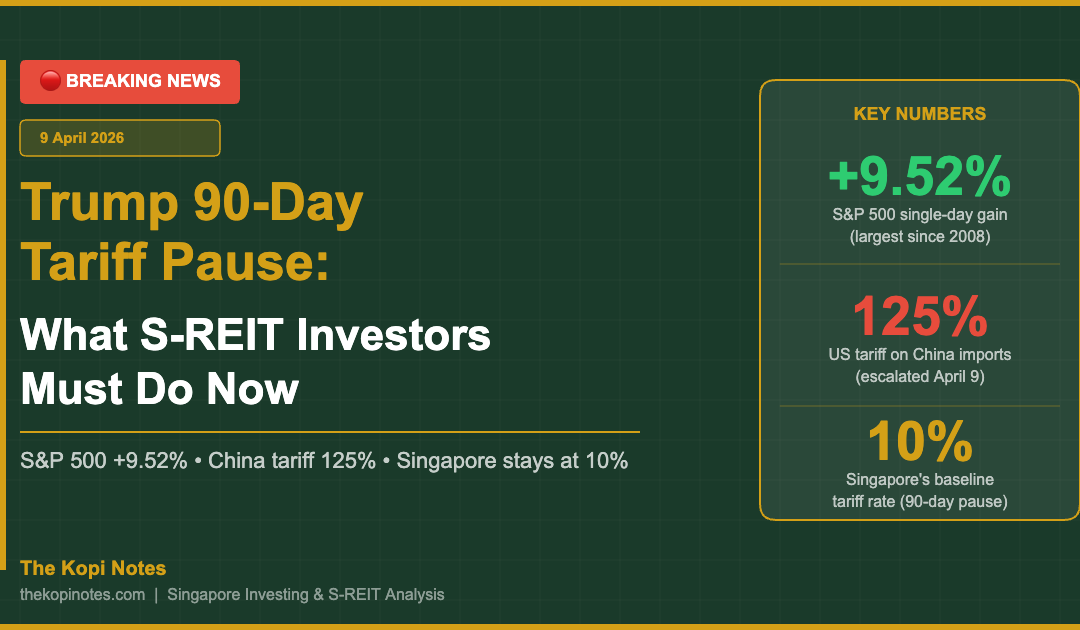
On 9 April 2026, President Trump announced a 90-day pause on reciprocal tariffs for all trading partners — except China, which now faces a punishing 125% tariff rate. The S&P 500 surged 9.52% in its largest single-day gain since 2008. Here is what this means for your S-REIT portfolio.
⚠️ This article is for informational purposes only and does not constitute financial advice. Always do your own research before making investment decisions.
The tariff landscape shifted dramatically on 9 April 2026. What began as a broad “Liberation Day” tariff shock on 2 April has now bifurcated into two very different worlds: a 90-day window of relative calm for most of Singapore’s trading partners, and an escalating trade war between the US and China that has pushed bilateral tariffs to historic highs.
For Singapore investors — especially those holding S-REITs, dividend stocks, and ETFs — this is a fast-moving situation with both risks and genuine opportunities. This analysis breaks down exactly what happened, which S-REIT sectors benefit or suffer, and what actionable steps you should consider.
What Happened on 9 April 2026
The sequence of events unfolded rapidly. After Liberation Day on 2 April — when Trump announced sweeping “reciprocal” tariffs ranging from 10% to over 50% on most trading partners — global markets sold off sharply. The STI fell roughly 7–8% over the following week, with the S-REIT index tracking broader equity sentiment lower.
Then, on the morning of 9 April 2026, Trump posted on Truth Social announcing a 90-day pause on all reciprocal tariffs above the baseline 10% rate — for every country except China. Markets responded explosively. The S&P 500 surged 9.52% on the day, its single largest gain since October 2008 during the Global Financial Crisis. The Nasdaq rose over 12%.
At the same time, the White House escalated tariffs on China from 104% to 125%, citing China’s decision to raise its own tariffs on US goods to 84%. What was already a trade war has now become an outright economic standoff between the world’s two largest economies.
The key facts as at 9 April 2026:
- All countries except China: 10% baseline tariff (90-day pause on higher rates)
- China: 125% US tariff (escalated from 104%); China’s counter-tariff: 84% on US goods
- Singapore: Faces the 10% baseline — unchanged from the initial Liberation Day announcement
- 90-day pause window: Runs until approximately 8 July 2026
- S&P 500: +9.52% on 9 April 2026 (largest single-day gain since 2008)
Singapore’s Position: The 10% Baseline Tariff Explained
Singapore sits in a structurally advantageous position within this tariff environment. As a small, open trading economy with no significant bilateral trade surplus against the US (Singapore exports primarily financial services, electronics, and pharmaceutical products), it was never in the crosshairs of punitive reciprocal tariffs.
The 10% baseline tariff — which applies to Singapore — is the lowest possible rate under the current US tariff framework. While not ideal, it is far less damaging than the 25–50% rates that other Asian economies face even after the pause, or the crushing 125% that China now bears.
There is a strategic silver lining here: as US companies accelerate their decoupling from Chinese supply chains, Singapore — already established as a trusted neutral hub for manufacturing, logistics, and financial services — stands to benefit from significant trade and business diversion. This dynamic directly supports demand for Singapore’s industrial parks, logistics facilities, business parks, and Grade A office space — core assets held by S-REITs.
MAS has also demonstrated its willingness to adjust monetary policy to support the domestic economy. Following its April 2026 policy meeting, MAS eased the S$NEER slope, providing a tailwind for SORA-sensitive S-REITs as interest costs trend lower. SORA currently sits at approximately 1.1% — near its cyclical trough — providing a constructive backdrop for S-REIT DPU recovery in FY2026 and FY2027.
S-REIT Sector Impact Analysis
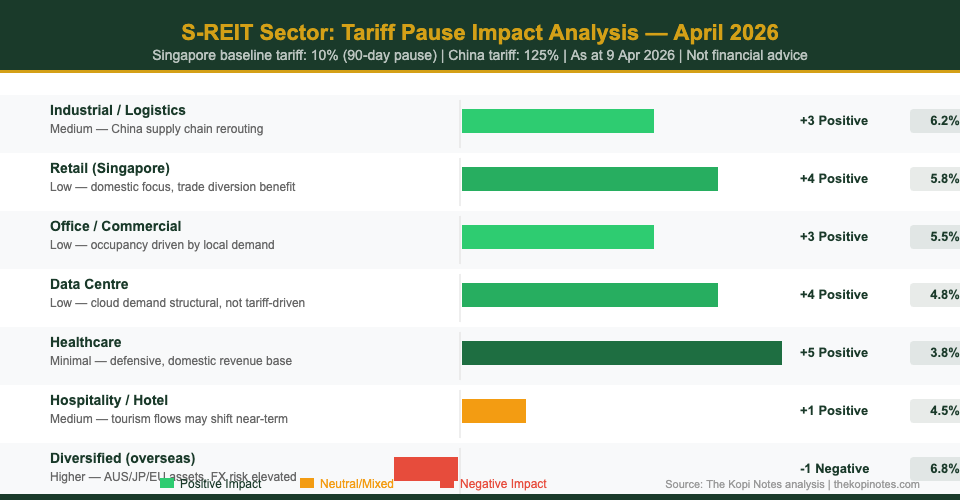
Not all S-REIT sectors are equally exposed to tariff dynamics. Here is a sector-by-sector breakdown of how the 90-day pause and US-China escalation affects each segment of the Singapore REIT market as at 9 April 2026.
✅ Industrial & Logistics REITs — Net Positive
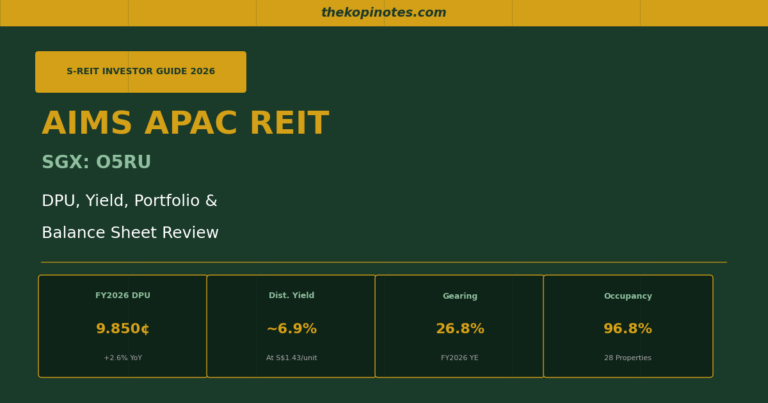
Industrial and logistics REITs (Mapletree Industrial Trust, Mapletree Logistics Trust, AIMS APAC REIT, ESR-LOGOS REIT) are the most directly exposed to global supply chain dynamics — and they stand to benefit from the US-China decoupling narrative. As multinationals reroute supply chains away from China, Singapore’s industrial parks and logistics hubs see elevated leasing interest. The 90-day pause provides breathing room for tenants to plan relocation or manufacturing diversification strategies without the immediate shock of high tariff costs.
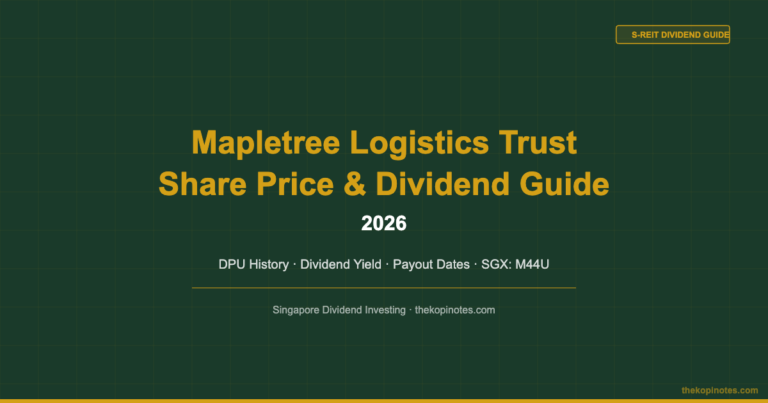
Key risk: Industrial REITs with direct China exposure (Mapletree Logistics Trust’s China portfolio represents ~20% of AUM) face NPI pressure as Chinese logistics demand softens. Watch the next quarterly update carefully.
✅ Retail REITs — Beneficiary of Domestic Demand
Singapore’s retail REITs (Frasers Centrepoint Trust, CapitaLand Integrated Commercial Trust, Lendlease REIT) are largely insulated from tariff dynamics given their overwhelmingly domestic revenue base. Singapore retail sales remain supported by low unemployment, stable wage growth, and resilient consumer spending. The tariff pause reduces near-term macro uncertainty, which is broadly supportive of consumer sentiment.
As tourism potentially shifts away from US-China tension flashpoints, Singapore may see incremental international visitor growth — a tailwind for retail REITs with tourism-linked mall exposure.
✅ Data Centre REITs — Structurally Insulated
Data centre REITs (Keppel DC REIT, Digital Core REIT) operate on long-term leases (WALE 5–8 years) with mission-critical tenants whose demand is structural, not cyclical or tariff-driven. Cloud adoption and AI infrastructure buildout are secular trends that tariffs do not meaningfully disrupt. These REITs continue to offer defensive yield with strong rental reversion prospects.
⚠️ Hospitality REITs — Mixed
Hospitality REITs (CDL Hospitality Trusts, Far East Hospitality Trust) face a nuanced picture. While the tariff pause reduces macro uncertainty, US-China tensions may dampen some inbound Chinese tourism to Singapore as Chinese consumers face economic pressure. However, Singapore’s position as a safe, neutral meeting ground for international business could see corporate travel hold up better than leisure.
⚠️ Diversified REITs with Overseas Assets — Watch FX
REITs with significant overseas exposure (Mapletree Pan Asia Commercial Trust with Japan/China/HK/Korea assets; Starhill Global REIT with AU/MY/JP assets) face elevated FX risk as trade war uncertainty drives currency volatility. The USD may weaken if the US economy slows, which could affect SGD-denominated DPU from USD-denominated assets. Monitor FX hedge ratios carefully.
S-REIT Yield & Tariff Exposure Table
The table below summarises key S-REITs, their current estimated trailing yield, gearing, and relative tariff exposure as at 9 April 2026. All yield figures are approximate and based on most recent reported DPU. Not financial advice.
| S-REIT | SGX | Sector | Est. Yield | Gearing | Tariff Exposure |
|---|---|---|---|---|---|
| Mapletree Logistics Trust | M44U | Logistics | 7.2% | 39.8% | Medium-High (China ~20%) |
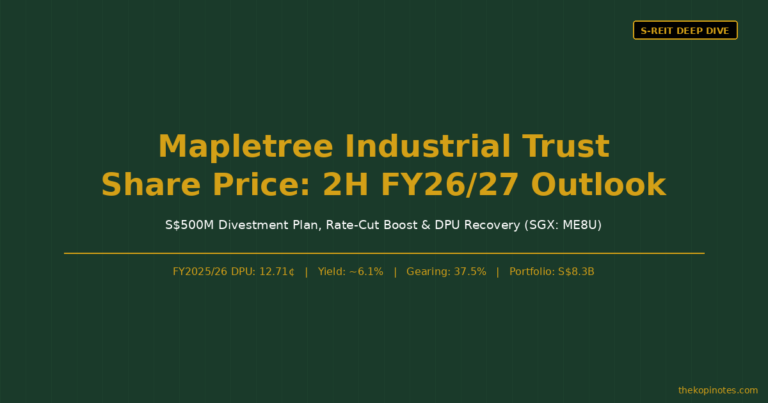
| Mapletree Industrial Trust | ME8U | Industrial | 6.1% | 39.5% | Low (SG/US focus) |
| Keppel DC REIT | AJBU | Data Centre | 4.9% | 36.5% | Very Low (structural demand) |
| Frasers Centrepoint Trust | J69U | Retail | 5.9% | 39.1% | Very Low (SG suburban retail) |
| CapitaLand Integrated CT | C38U | Retail/Office | 5.5% | 40.4% | Very Low (SG domestic) |
| Lendlease REIT | JYEU | Retail/Office | 6.7% | 38.4% | Medium (Sky Complex Milan) |
| Parkway Life REIT | C2PU | Healthcare | 3.8% | 33.4% | Minimal (defensive sector) |
| Mapletree Pan Asia CT | N2IU | Commercial | 7.5% | 40.5% | High (China/HK ~40% AUM) |
Yields are approximate trailing estimates as at 9 April 2026. Source: SGX disclosures, company presentations. Not financial advice.
The key takeaway from the yield table: S-REITs with minimal China or overseas exposure (FCT, CICT, Keppel DC REIT, Parkway Life) offer the most defensible yield profile. Those with elevated China exposure (MPACT, MLT) offer higher headline yields but come with greater uncertainty around near-term DPU delivery.
At the index level, the S-REIT index trades at approximately 0.9× P/B with a forward yield of ~6.3% — a 4.1% spread over the SGS 10-year bond at 2.22%. Historically, this spread signals that the S-REIT sector is attractively priced.
The S-REIT Investor Playbook for the 90-Day Window
The 90-day pause is not a resolution — it is a ceasefire. Negotiations will proceed through July 2026, and there is no guarantee that tariffs will not be re-imposed or escalated. Here is how to think about positioning your S-REIT portfolio during this window.
1. Use the Sentiment Rally to Review Your Exposure
The massive US market rally on 9 April will likely filter into Asian markets — including Singapore — in the coming days. Use any rally in S-REIT prices to honestly assess your portfolio’s China exposure. If you hold significant MPACT or MLT, consider whether their yield adequately compensates you for the added uncertainty. Use tools like our S-REIT Yield vs Bond Spread Calculator to check whether your holdings are fairly priced relative to the risk-free rate.
2. Favour Domestically-Focused S-REITs
In an environment of elevated trade uncertainty, Singapore’s domestic economy remains the most predictable revenue driver. REITs like Frasers Centrepoint Trust (suburban retail), CapitaLand Integrated Commercial Trust, and Keppel DC REIT (data centres) derive the vast majority of their income from Singapore-based tenants with long-term leases. Their DPU profiles are the least likely to be disrupted by tariff volatility.
3. Consider Deploying CPF OA / SRS Systematically
For long-term investors, periods of elevated macro uncertainty followed by sentiment recovery — exactly what we are seeing now — have historically offered attractive entry points for S-REIT accumulation. If you hold CPF OA funds or SRS balances, consider whether this 90-day window represents an opportunity to deploy capital into quality S-REITs systematically via platforms like Endowus or Syfe — both of which offer CPF OA and SRS-eligible S-REIT portfolios. See also our CPF investment strategy guide for how to approach CPF OA investing in S-REITs.
4. Watch the ETF Channel for Broader Exposure
Rather than picking individual S-REITs in a volatile tariff environment, the Singapore REIT ETF route offers diversified exposure across the sector with lower single-name risk. The NikkoAM-StraitsTrading Asia Ex Japan REIT ETF (CFA) and the Lion-Phillip S-REIT ETF (CLR) are two SGX-listed options that automatically balance across sectors.
Risks & What to Watch
The 90-day pause is a positive development — but it is not a resolution. Here are the key risks S-REIT investors should monitor over the coming weeks.
1. Tariff Pause Breakdown — The 90-day window depends on productive negotiations. If talks collapse, or if additional countries retaliate against US goods, tariff rates could snap back higher than their post-Liberation Day levels. Any breakdown would likely trigger a sharp risk-off move in Asian equities and S-REITs.
2. US-China Escalation Contagion — A 125% US tariff on China combined with 84% Chinese counter-tariffs represents a near-complete severing of bilateral trade in affected categories. The secondary effects — slower Chinese economic growth, reduced Chinese consumer demand, supply chain disruption for non-Chinese manufacturers dependent on Chinese inputs — could affect Singapore’s broader economy and, by extension, retail sales and office occupancy.
3. Singapore’s Q1 2026 GDP Data (14 April 2026) — MTI releases Singapore’s advance Q1 2026 GDP estimates on 14 April. The consensus is for continued growth supported by strong 2025 momentum (4.8% full-year 2025 growth), but any negative surprise in the manufacturing or trade data could weigh on Singapore REIT sentiment. Watch this date carefully.
4. S-REIT Gearing Levels Approaching Regulatory Limits — Several S-REITs are operating with gearing ratios above 40% (approaching the 50% regulatory ceiling). In an environment of rising asset price uncertainty, there is a risk that falling property valuations push effective gearing higher. REITs in this situation may need to issue equity or divest assets, which is dilutive to unitholders.
5. SGD/USD Currency Risk — A prolonged US-China trade war is USD-negative in the medium term as the US economy weakens. For Singapore investors, a stronger SGD relative to USD erodes the SGD value of DPU from US-denominated assets (e.g., Keppel DC REIT’s US data centres). Conversely, a weaker USD helps REITs with USD-denominated debt refinancing costs.
Frequently Asked Questions
What does the 90-day tariff pause mean for Singapore?
The 90-day tariff pause means that the US has suspended the higher reciprocal tariff rates (above 10%) for all countries except China. Singapore faces a 10% baseline tariff on its exports to the US — which is the lowest rate possible under the current framework. This gives Singapore-based businesses, exporters, and tenants of Singapore REITs a 90-day window of relative stability to plan and adapt. The pause runs until approximately 8 July 2026, after which tariffs could be re-imposed if negotiations fail.
How does the US-China 125% tariff affect S-REITs?
The US-China tariff escalation to 125% primarily affects S-REITs through two channels: (1) S-REITs with direct China property exposure (notably Mapletree Logistics Trust with ~20% China AUM and Mapletree Pan Asia Commercial Trust with ~40% China/HK exposure) face slower leasing demand and potential NPI pressure as Chinese economic growth softens. (2) Industrial and logistics REITs in Singapore may benefit as multinationals accelerate supply chain diversification away from China into Singapore and Southeast Asia. The net impact is sector-dependent.
Should I buy S-REITs after the tariff pause announcement?
This article does not constitute financial advice. However, from a fundamental perspective, S-REITs continue to offer a ~6.3% forward yield at approximately 0.9× P/B — a historically attractive entry point. The 90-day pause reduces near-term macro uncertainty, and Singapore’s domestic-focused REITs (retail, healthcare, data centres) offer relatively defensible DPU profiles. Investors with a long-term horizon may find the current environment constructive for systematic accumulation. Always assess your own financial situation, risk tolerance, and investment horizon before making decisions. Consider using our retirement planning calculator to check how S-REIT income might fit into your long-term income goals.
Which S-REITs are safest in the current tariff environment?
S-REITs with the lowest tariff exposure are those with predominantly Singapore-based, domestically-focused revenue streams. This generally points to: suburban retail REITs like Frasers Centrepoint Trust; integrated commercial REITs like CICT; healthcare REITs like Parkway Life REIT; and data centre REITs like Keppel DC REIT whose tenants have long-term, mission-critical contracts. These REITs offer more predictable DPU in volatile macro environments, though they typically trade at lower headline yields than their more geographically diversified peers. Not financial advice.
What is the CPF OA investing angle for S-REITs right now?
CPF OA funds earn a guaranteed 2.5% p.a. from CPF. Investing CPF OA into quality S-REITs via platforms like Endowus (which allows CPF OA investing in S-REIT funds) potentially allows investors to earn yields of 5–7% — a meaningful spread over the 2.5% CPF rate. The trade-off is market risk and unit price volatility. Given the current tariff-driven volatility, CPF OA investors should consider whether the current entry prices represent value and whether they can tolerate potential short-term unit price fluctuations. See our CPF investment strategy guide for a full breakdown of how CPF OA investing in S-REITs works.
When will we know if the tariff pause becomes permanent?
The 90-day pause window runs until approximately 8 July 2026. During this period, the US will negotiate bilateral trade agreements with the affected countries. For Singapore, given its small bilateral trade surplus with the US and its strategic importance as a financial and logistics hub, there is a reasonable probability that any final agreement will be favourable. However, investors should not assume a positive outcome and should monitor trade negotiation headlines closely, particularly in May and June 2026 as the July deadline approaches.
How does SORA rate affect S-REIT DPU in this environment?
SORA (Singapore Overnight Rate Average) directly affects S-REIT financing costs, as most Singapore REITs use SORA-linked floating-rate debt. At approximately 1.1% currently — near its cyclical trough — SORA provides a supportive interest cost environment for S-REITs. Lower SORA means lower interest expenses, which flows through to higher distributable income (DPU). MAS’s April 2026 policy easing further signals that SORA is likely to remain low or trend lower in the near term. This is one of the most constructive factors for S-REIT DPU recovery in FY2026–FY2027.
Bottom Line for Singapore REIT Investors
The Trump 90-day tariff pause is a meaningful positive development — but it is not a full resolution. Singapore, with its 10% baseline tariff and neutral geopolitical positioning, is in the best possible position among Asian economies to navigate the current trade war environment. The real risk is the US-China escalation to 125%, which creates economic drag globally and could slow Singapore’s trading economy more broadly.
For S-REIT investors, the key takeaway is sector differentiation: prioritise domestically-focused, low-gearing REITs with defensible DPU profiles. The current forward yield of ~6.3% and 0.9× P/B continue to represent compelling value on a 12–24 month view. The 90-day window is an opportunity to review your portfolio construction, not a signal to chase a rally.
For more S-REIT analysis and the latest updates, explore our Best S-REITs Singapore 2026 guide, or use our Retirement Planning Calculator to model how S-REIT income fits into your long-term financial goals.
This article was researched with the help of AI. While we strive to keep all information accurate and up to date, there may be errors. If you notice any discrepancies, please contact us.