SRS Account Singapore 2026: Complete Guide to the Supplementary Retirement Scheme
Save up to S$3,672 in income tax every year — and grow your retirement nest egg at the same time.
The Supplementary Retirement Scheme (SRS) is one of Singapore’s best-kept tax optimisation secrets. While most investors focus on CPF, a well-managed SRS account can slash your annual tax bill by thousands of dollars — while simultaneously compounding your retirement wealth in stocks, REITs, ETFs or robo-advisory portfolios.
In this guide, we break down exactly how the SRS works in 2026, how much you can save, where to invest your SRS funds for maximum returns, and the key rule change taking effect from 1 July 2026 that every investor needs to know about.
Not financial advice. This article is for educational purposes only. Please consult a licensed financial adviser before making investment decisions. All figures are as at April 2026.
Table of Contents
What Is the SRS Account?
The Supplementary Retirement Scheme (SRS) is a voluntary savings scheme introduced by the Singapore government in 2001 to complement CPF. Unlike CPF, which is mandatory, SRS contributions are entirely at your discretion — you choose how much to put in (up to the annual cap) and where to invest it.
SRS sits alongside — not instead of — your CPF. The two core benefits are simple:
- Immediate tax relief: Every dollar you contribute to SRS is deducted from your chargeable income for that Year of Assessment, reducing your income tax bill in the following year.
- Tax-efficient withdrawals: When you withdraw at or after the statutory retirement age, only 50% of the withdrawal is taxable. If you stagger withdrawals smartly over 10 years, a large portion of your SRS balance can be withdrawn tax-free.
SRS accounts are operated by three agent banks: DBS (POSB), OCBC, and UOB. Each person may hold only one SRS account in Singapore.
SRS Contribution Limits 2026
The annual SRS contribution cap differs depending on your residency status. As at April 2026, the limits are:
| Resident Status | Annual SRS Cap | Notes |
|---|---|---|
| Singapore Citizen / PR | S$15,300 | Unchanged from 2025 |
| Foreigner (non-PR) | S$35,700 | Higher cap (no CPF access) |
| Overall personal relief cap | S$80,000 | Total across all tax reliefs |
The contribution deadline is 31 December each year to qualify for that Year of Assessment. From YA 2026, IRAS automatically applies SRS relief based on data from your SRS operator — no manual claim needed.
Note: The S$80,000 overall personal tax relief cap applies across all reliefs including CPF Cash Top-Up, NSman relief, course fee relief, and others. If you are already near this cap, additional SRS contributions above it will not provide further tax savings.
How Much Tax Can You Save?
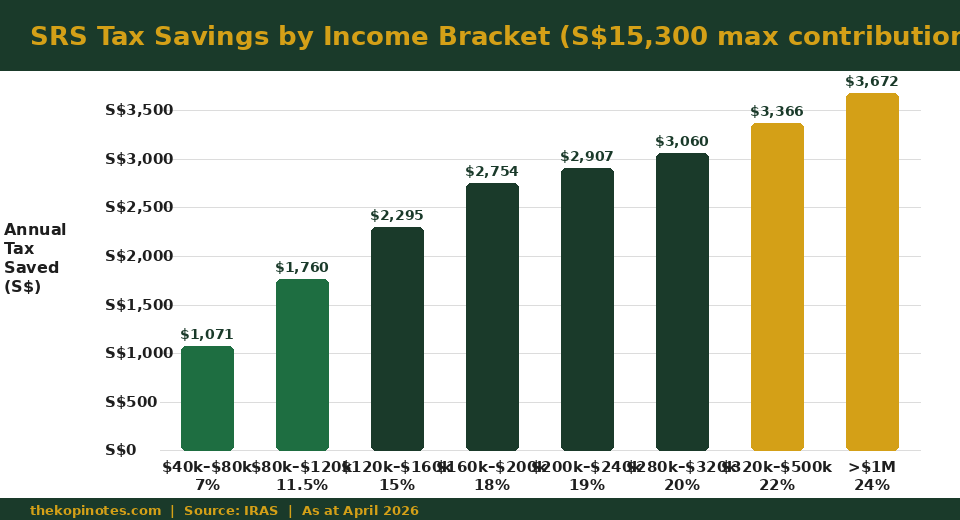
The tax savings from maxing out your SRS contribution depend entirely on your marginal income tax rate. The higher your income, the more valuable each SRS dollar becomes. Here’s the full breakdown for the maximum S$15,300 contribution (Singapore citizens/PRs) as at YA 2026:
| Chargeable Income | Tax Rate | Tax Saved (S$15,300 contribution) |
|---|---|---|
| S$40,001 – S$80,000 | 7% | S$1,071 |
| S$80,001 – S$120,000 | 11.5% | S$1,760 |
| S$120,001 – S$160,000 | 15% | S$2,295 |
| S$160,001 – S$200,000 | 18% | S$2,754 |
| S$200,001 – S$240,000 | 19% | S$2,907 |
| S$280,001 – S$320,000 | 20% | S$3,060 |
| S$320,001 – S$500,000 | 22% | S$3,366 |
| Above S$1,000,000 | 24% | S$3,672 |
Example: A Singapore professional earning S$150,000 per year who contributes the maximum S$15,300 to SRS saves S$2,295 in income tax the following year. Over 20 years of contributions, that’s over S$45,000 in cumulative tax savings — not counting the investment returns inside the account.
Source: IRAS — SRS Contributions
Best SRS Investment Options in 2026
The biggest mistake SRS account holders make is leaving their money sitting in cash at 0.05% p.a. — which is essentially losing value against inflation. Your SRS funds should always be invested. Here are the best options available:
1. S-REITs (Real Estate Investment Trusts)
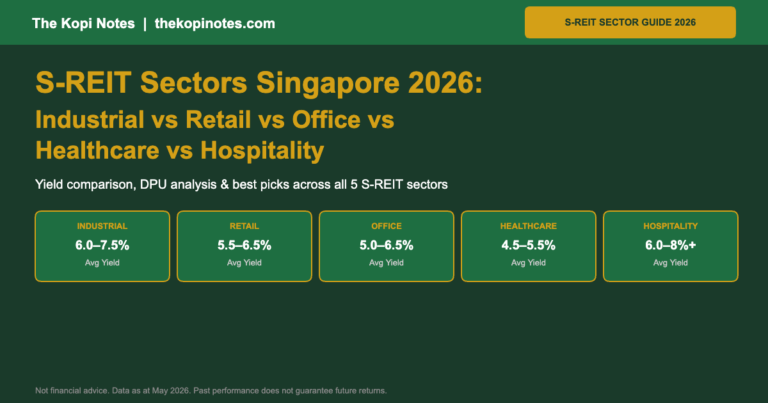
S-REITs listed on SGX are fully SRS-eligible and offer compelling 5–7% dividend yields as at April 2026. Because distributions inside SRS are not immediately taxed, you benefit from tax-deferred compounding. See our Best S-REITs Singapore 2026 guide for our top picks.
2. ETFs (Exchange-Traded Funds)
SGX ETF holdings inside SRS accounts grew 380% between December 2019 and October 2025 — a sign that Singapore investors are increasingly using SRS for low-cost passive investing. UCITS ETFs (CSPX, VWRA, IWDA) listed on the London Stock Exchange are also accessible via SRS through brokers like IBKR and FSMOne. See our Singapore REIT ETF guide for details.
3. Robo-Advisors (Endowus / Syfe / StashAway)
For hands-off investors, robo-advisors are arguably the best SRS option. All three major platforms accept SRS funds:
| Platform | SRS Support | CPF Support | Annual Fee | Best For |
|---|---|---|---|---|
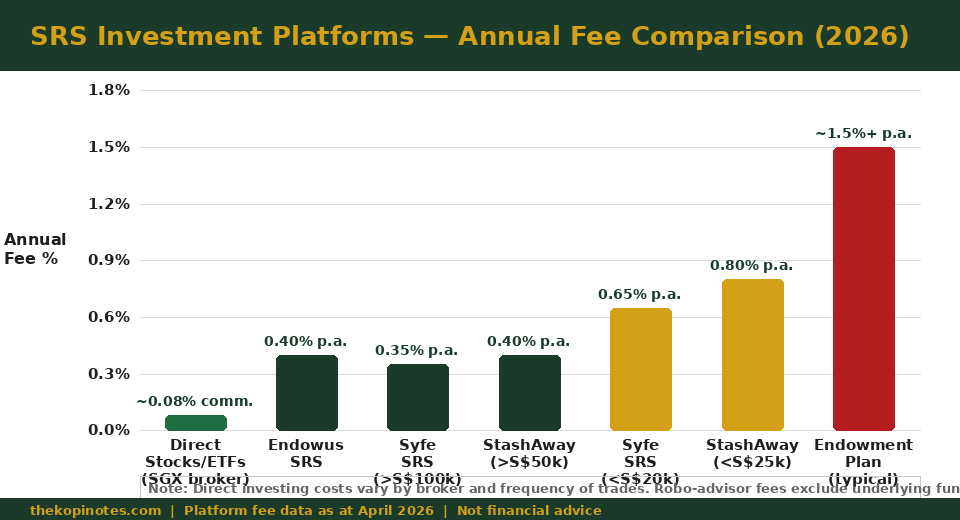
| Endowus | ✅ Yes | ✅ Yes | 0.40% (SRS/CPF) | CPF + SRS one-stop |
| Syfe | ✅ Yes | ❌ No | 0.65%–0.25% | REIT+/Income+ portfolios |
| StashAway | ✅ Yes | ❌ No | 0.20%–0.80% | ERAA® risk-managed |
Our pick: Endowus is the only platform that manages CPF, SRS and cash under one roof — and its 0.40% SRS/CPF fee is the lowest among robo-advisors. See our Best Robo Advisor Singapore 2026 comparison for the full breakdown.
4. Singapore Savings Bonds & T-Bills via SRS
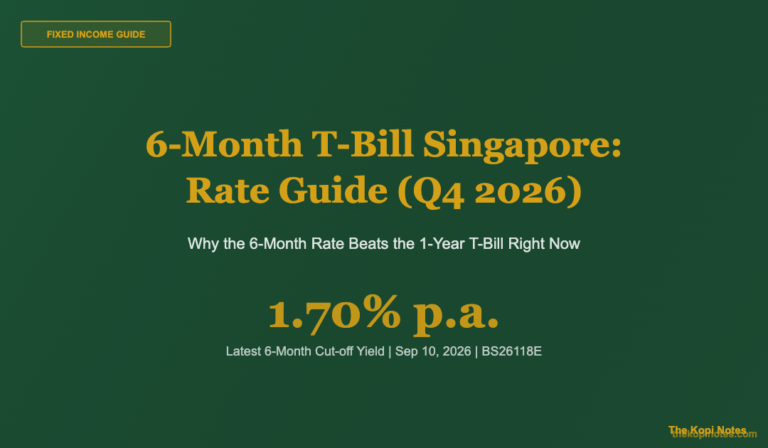
For capital preservation inside SRS, SSBs and Treasury Bills are available through your SRS operator bank. With T-bill yields around 1.46% (as at April 2026) and SSB 10-year averages near 2.14%, these are conservative but inflation-trailing options — better than the 0.05% cash rate but inferior to equities over the long run.
5. Dividend Stocks
SGX-listed stocks including Singapore dividend stocks like DBS, OCBC, UOB, NetLink NBN Trust, and Sembcorp are all eligible within SRS. Dividends accumulate tax-deferred inside the account, making SRS especially attractive for high-yield equity investors.
SRS vs CPF Top-Up: Which Is Better?
Both SRS contributions and CPF Cash Top-Ups (to SA/RA) offer tax relief. Many investors ask which one to prioritise. The answer is: they serve different purposes.
| Feature | SRS | CPF SA/RA Cash Top-Up |
|---|---|---|
| Type | Voluntary | Voluntary |
| Interest Rate (uninvested) | 0.05% p.a. | 4% p.a. (guaranteed to Dec 2026) |
| Investment Flexibility | High — stocks, ETFs, REITs, robo | Limited — CPFIS approved list |
| Tax on Withdrawal | 50% taxable at retirement | Not taxed |
| Withdrawal Flexibility | Flexible (10-year window) | Fixed CPF LIFE payout rules |
| Best For | Growth investing, flexibility, higher-income earners | Guaranteed income, conservative savers |
The smart approach: Use CPF top-ups for stable, guaranteed retirement income (CPF LIFE) and use SRS for equity/REIT/ETF growth investing. See our CPF investment strategy guide for how to optimise both. You can also use our Retirement Planning Calculator to model different contribution scenarios.
SRS Withdrawal Rules & Strategy
Statutory Retirement Age — Critical 2026 Change
The statutory retirement age for SRS is currently 63 years old. However, from 1 July 2026, it rises to 64. This means:
- If you made your first SRS contribution before 1 July 2026, your penalty-free withdrawal age is locked in at 63.
- If your first SRS contribution is on or after 1 July 2026, you must wait until 64 to withdraw penalty-free.
Action item: If you haven’t opened an SRS account yet and you want to lock in age 63, open and make a nominal contribution (e.g. S$10) before 30 June 2026.
The 10-Year Withdrawal Window
Once you reach statutory retirement age and take your first penalty-free withdrawal, a 10-year window opens. This window is your opportunity to spread out withdrawals to minimise tax. Here’s the maths:
- Only 50% of any SRS withdrawal is taxable.
- An individual with no other taxable income pays zero tax on withdrawals up to S$40,000 per year (since the first S$20,000 of chargeable income is taxed at 0%).
- Over 10 years: up to S$400,000 in SRS withdrawals can be made completely tax-free.
Example: You retire at 63 with S$250,000 in SRS. Withdraw S$25,000/year. Only S$12,500 is taxable each year — well under the S$20,000 zero-tax threshold. Result: zero tax on all withdrawals.
Early Withdrawal Penalty
Withdrawing before the statutory retirement age incurs a 5% penalty (non-refundable) on the withdrawal amount, and 100% of the withdrawal is taxable (no 50% concession). This can be very costly — think carefully before touching SRS funds early.
Penalty-free exceptions apply in cases of terminal illness, death, or bankruptcy.
How to Open an SRS Account
Opening an SRS account takes minutes via digital banking. The three SRS operators are DBS (POSB), OCBC, and UOB.
| Bank | How to Open | Processing |
|---|---|---|
| DBS / POSB | digibank mobile app or online banking | Instant (Mon–Fri 7am–10pm) |
| OCBC | OCBC digital banking or branch | Same-day processing |
| UOB | UOB TMRW app or internet banking | Same-day processing |
Eligibility: Singapore citizen, PR, or foreigner with valid work pass. Must be at least 18 years old, not an undischarged bankrupt, and not currently holding another SRS account. Only one SRS account is allowed per person in Singapore.
For foreigners: A completed SRS Declaration Form is required. The higher contribution cap of S$35,700 applies.
Once open, you can fund the account via online bank transfer and immediately invest the balance. Remember: uninvested SRS cash earns only 0.05% p.a. — set up an investment portfolio right away.
Common SRS Mistakes to Avoid
- Leaving money in cash (0.05% p.a.). The most damaging mistake. SRS cash depreciates in real terms against Singapore’s average inflation of 2–3%. Invest immediately after contributing.
- Not contributing before December 31. SRS tax relief is only granted for the Year of Assessment in which you contribute. Miss the December 31 deadline and you lose an entire year of relief.
- Opening your first SRS account after 1 July 2026. Your statutory retirement age is locked in at the time of first contribution. Open before the deadline to secure age 63 rather than 64.
- Withdrawing early without understanding the penalty. A 5% penalty plus full income tax on early withdrawals can wipe out years of tax savings. Plan your withdrawal window carefully.
- Exceeding the S$80,000 overall personal tax relief cap. If your total reliefs (CPF top-up + SRS + others) already exceed S$80,000, additional SRS contributions will not reduce your tax. Check your position before topping up.
- Investing in high-fee products. Some endowment plans inside SRS carry high charges. As at December 2024, around 25% of SRS funds sit in endowment plans — often with inferior long-term returns. ETFs and robo-advisors are typically lower cost and better for growth.
Frequently Asked Questions
What is the SRS contribution limit for Singapore citizens in 2026?
The annual SRS contribution limit for Singapore citizens and PRs is S$15,300 for YA 2026. The limit for foreigners (non-PRs) is S$35,700. Contributions must be made by 31 December of each year to count for that Year of Assessment.
Is SRS worth it if I'm in a low income tax bracket?
If your chargeable income is below S$20,000, you pay 0% income tax and SRS contributions provide no immediate tax benefit. At S$40,000–S$80,000 income (7% bracket), you save S$1,071/year on a full S$15,300 contribution. The higher your income, the greater the SRS benefit. For low-income earners, CPF SA top-ups (earning 4% guaranteed) are often a better priority.
Can I invest SRS in S-REITs and ETFs?
Yes. All SGX-listed stocks including S-REITs, ETFs (such as the Nikko AM STI ETF or LION-Phillip S-REIT ETF), and dividend stocks are eligible investments within your SRS account. You can also invest in Ireland-domiciled ETFs (CSPX, VWRA) through brokers like IBKR and FSMOne via your SRS account.
What happens to my SRS if I leave Singapore permanently?
If you are a foreigner or PR who renounces your PR status and leaves Singapore permanently, you can withdraw your full SRS balance penalty-free (the 5% penalty is waived). However, 50% of the withdrawal amount remains taxable. You must notify your SRS operator and IRAS of your departure.
What is the SRS withdrawal age in 2026?
The statutory retirement age for SRS is currently 63 years old. This rises to 64 for individuals whose first SRS contribution is made on or after 1 July 2026. If you already have an SRS account (or open one before 30 June 2026), your withdrawal age remains 63. The retirement age is expected to rise again to 65 in the future as Singapore’s official retirement age increases.
Can I use Endowus or Syfe with my SRS account?
Yes. Both Endowus and Syfe accept SRS funds. Endowus charges 0.40% p.a. for SRS portfolios and is the only robo-advisor that also supports CPF investing. Syfe charges 0.65%–0.25% based on AUM and offers REIT+ and Income+ portfolios well-suited for SRS. StashAway also accepts SRS. See our Endowus referral page and Syfe referral page for current promotions.
How do I claim SRS tax relief?
From YA 2026, SRS tax relief is granted automatically by IRAS — your SRS operator transmits your contribution data directly. You no longer need to manually declare SRS contributions in your tax return. No action is needed beyond making the contribution itself by 31 December.
What is the interest rate on SRS cash?
Uninvested SRS cash earns a nominal 0.05% per annum — the same across all three SRS operators (DBS, OCBC, UOB). This is far below inflation and well below the CPF SA rate of 4%. Never leave large amounts in SRS cash; invest in stocks, ETFs, REITs, T-bills, SSBs, or a robo-advisor as soon as possible.
Start Maximising Your SRS Today
The SRS is one of the most powerful (and underused) tax-saving tools available to Singapore investors. Whether you’re earning S$80,000 or S$300,000 a year, maxing out your annual SRS contribution and investing those funds wisely can save you thousands in tax while building a substantial retirement nest egg.
The key message: open your account, invest your funds immediately (not in cash at 0.05%), and plan your withdrawal window to minimise tax at retirement. For most investors, a low-cost robo-advisor like Endowus or Syfe is the simplest and most effective way to deploy SRS funds.
This article was researched with the help of AI. While we strive to keep all information accurate and up to date, there may be errors. If you notice any discrepancies, please contact us.