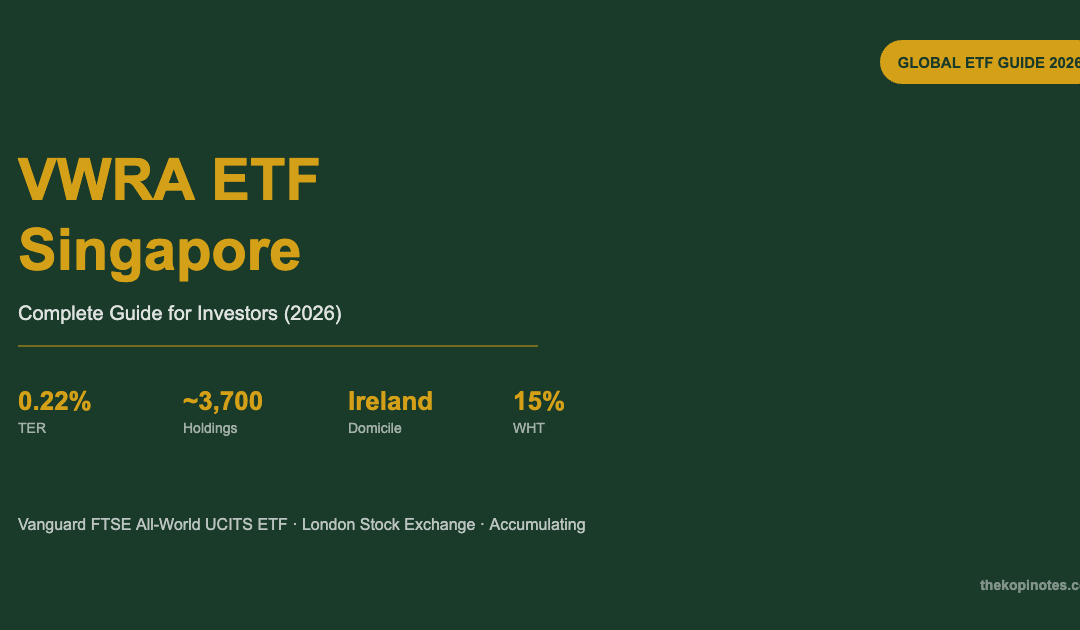
VWRA ETF Singapore: Complete Guide for Investors (2026)
The Vanguard FTSE All-World Accumulating ETF — expense ratio, tax advantages, how to buy on the LSE, and VWRA vs IWDA comparison for Singapore investors.
VWRA is the Vanguard FTSE All-World UCITS ETF (Accumulating), listed on the London Stock Exchange. It gives Singapore investors instant exposure to approximately 3,700 stocks across developed and emerging markets in a single, Ireland-domiciled fund. The key advantages over US equivalents like VT: 15% withholding tax on US dividends (vs 30%), zero US estate tax exposure, and automatic dividend reinvestment — making it a core holding for Singapore’s long-term passive investors.
Not financial advice. All figures are for educational reference only. Data as at Q1 2026 unless noted.
What Is VWRA?
VWRA stands for the Vanguard FTSE All-World UCITS ETF USD Accumulating, listed on the London Stock Exchange under the ticker VWRA. It is managed by Vanguard, one of the world’s largest asset managers, and tracks the FTSE All-World Index — a benchmark that covers approximately 3,700 large- and mid-cap stocks across 49 countries, spanning both developed and emerging markets.
The fund was launched in July 2019 specifically as an accumulating share class — meaning all dividends generated by the underlying holdings are automatically reinvested back into the fund rather than paid out to investors. This makes VWRA a highly efficient vehicle for Singapore investors pursuing long-term wealth accumulation, as there is no dividend payout to handle or reinvest manually.
VWRA is domiciled in Ireland, which is critical for tax efficiency. Ireland has a favourable tax treaty with the United States, capping the withholding tax on US dividends at 15% (versus 30% for US-domiciled ETFs). Since the US market accounts for roughly 60–65% of the FTSE All-World Index, this treaty benefit translates into meaningful cost savings over decades of investing. As at Q1 2026, VWRA has an AUM of approximately USD 22 billion and trades in USD on the LSE, with a secondary listing on Euronext Amsterdam and Euronext Dublin.
Singapore investors access VWRA through international brokers — primarily Interactive Brokers (IBKR), Saxo Markets, MooMoo Singapore, and Syfe Brokerage — by selecting the London Stock Exchange as the exchange when placing an order. It cannot be purchased through the SGX or via CPF investment funds, but is eligible for SRS (Supplementary Retirement Scheme) investment through qualifying brokers.
Key Facts at a Glance
| Metric | Detail |
|---|---|
| Full Name | Vanguard FTSE All-World UCITS ETF USD Accumulating |
| Ticker (LSE) | VWRA |
| Index Tracked | FTSE All-World Index (~3,700 stocks, 49 countries) |
| Domicile | Ireland (UCITS) |
| Structure | Accumulating (dividends reinvested automatically) |
| TER (Expense Ratio) | 0.22% p.a. |
| AUM | ~USD 22 billion (as at Q1 2026) |
| Number of Holdings | ~3,700 stocks across 49 countries |
| Currency | USD (trades in USD on LSE) |
| Exchange | London Stock Exchange (primary) |
| Launch Date | July 2019 (accumulating share class) |
| US WHT Rate | 15% (Ireland-US tax treaty) |
Source: Vanguard VWRA fund factsheet, Q1 2026
Why Singapore Investors Buy ETFs on the London Stock Exchange
The London Stock Exchange is the preferred exchange for Singapore investors buying global ETFs — and for good reason. ETFs listed on the LSE are predominantly UCITS funds domiciled in Ireland or Luxembourg, which enjoy two structural advantages over their US-listed equivalents.
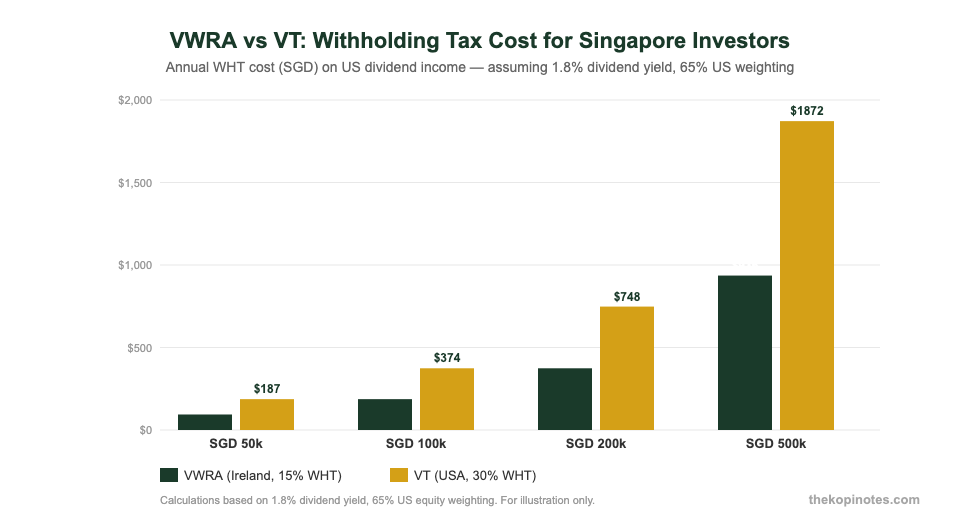
1. Lower withholding tax (WHT) on US dividends. Under the Ireland-US tax treaty, Irish-domiciled ETFs like VWRA pay only 15% withholding tax on dividends received from US companies. By contrast, if you held a US-domiciled ETF like VT (Vanguard Total World Stock ETF listed on NYSE), the withholding tax would be 30%. Since US stocks typically represent 60–65% of VWRA’s portfolio, this 15-percentage-point difference compounds significantly. On a SGD 100,000 portfolio with a 1.8% dividend yield, the difference in WHT alone is approximately SGD 180 per year — which over 20 years of compounding adds up to thousands of dollars.
2. No US estate tax exposure. This is perhaps the most underappreciated risk for Singapore investors holding US-domiciled ETFs. Under US tax law, non-US residents are subject to a 40% estate tax on US-situs assets above USD 60,000 at the time of death. For US-domiciled ETFs (VOO, VT, SPY, QQQ), this threshold is easily breached. Irish-domiciled ETFs like VWRA are not considered US-situs assets, so there is no estate tax liability regardless of portfolio size. This is a critical long-term consideration for estate planning, and an important reason to favour CSPX ETF Singapore guide or VWRA over their US equivalents.
| ETF Type | Domicile | US Dividend WHT | US Estate Tax Risk |
|---|---|---|---|
| VWRA (LSE) | Ireland | 15% | None |
| VT (NYSE) | USA | 30% | Yes (above USD 60,000) |
| IWDA (LSE) | Ireland | 15% | None |
Source: IRS Publication 515, Ireland-US Tax Treaty, Vanguard fund documentation
Additionally, Singapore investors benefit from the absence of capital gains tax and dividend tax at the personal level. Since Singapore does not tax capital gains and VWRA’s accumulating structure means no dividends are distributed to you directly, the investment grows entirely tax-free from a Singapore tax perspective. This makes VWRA an exceptionally clean structure for long-term passive income Singapore seekers who prefer growth over immediate income.
Expense Ratio and Total Costs
VWRA’s Total Expense Ratio (TER) is 0.22% per annum. This covers Vanguard’s fund management fee, administration, custody, and regulatory costs. There are no entry or exit fees charged by the fund itself.
To put this in practical SGD terms: on a SGD 50,000 VWRA portfolio, you pay approximately SGD 110 per year in management fees — deducted automatically from the fund’s NAV rather than billed separately. On a SGD 200,000 portfolio, that rises to SGD 440 per year. These costs are already reflected in the daily unit price you see on your broker’s platform.
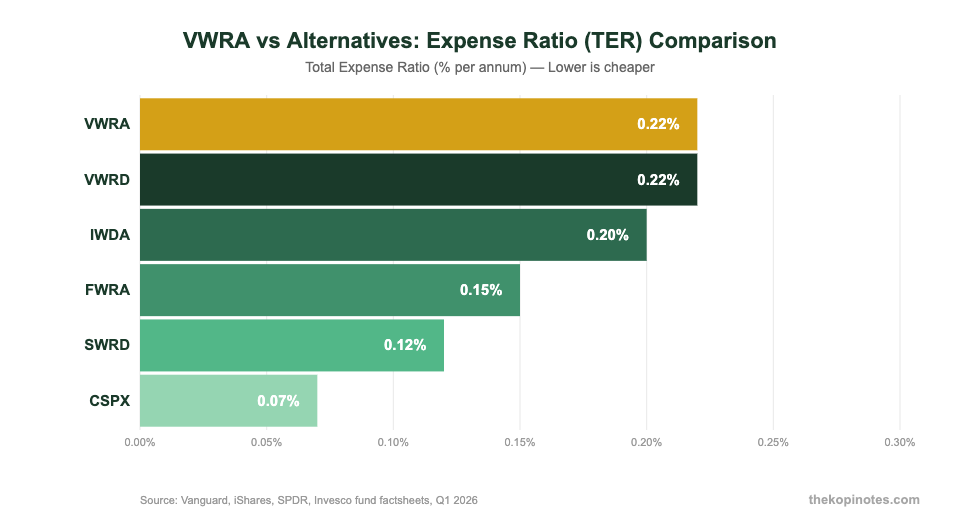
Compared to VWRD (the distributing share class of the same fund), the TER is identical at 0.22%. VWRA is slightly more cost-efficient in practice because the accumulating structure avoids transaction costs of manually reinvesting dividends. For comparison, IWDA (iShares MSCI World) costs 0.20% — marginally cheaper, but it covers only developed markets. SWRD (SPDR MSCI World) comes in at 0.12%, though again, no emerging market exposure. The cheapest true global option after VWRA is FWRA (Invesco FTSE All-World) at 0.15%.
Beyond the TER, Singapore investors face broker transaction commissions (typically USD 1–5 per trade on IBKR, or a percentage on Saxo/MooMoo) and FX conversion costs if funding in SGD. At Interactive Brokers, the effective all-in annual cost for holding VWRA long-term is typically 0.25–0.35% (TER + amortised commissions). For investors contributing regularly via the Syfe referral code and using Syfe Brokerage, the simplicity of the platform may justify a slightly higher commission structure for smaller portfolios.
How to Buy VWRA in Singapore (Step-by-Step)
VWRA is not listed on SGX and cannot be bought through standard Singapore retail brokers like DBS Vickers or Poems for the LSE version. You need an international brokerage with LSE access. Here are the four most popular options for Singapore investors.
Option 1: Interactive Brokers (IBKR)
IBKR is the most cost-effective broker for most Singapore investors buying VWRA, particularly for portfolios above SGD 20,000. Steps: (1) Open and fund an IBKR account via interactivebrokers.com.sg. (2) In the trading platform (TWS or mobile app), search for “VWRA”. (3) Select the listing on LSE (London Stock Exchange) — confirm the exchange shows “LSE” or “London”. (4) Choose “Market” or “Limit” order, enter quantity, and submit. IBKR charges USD 1.70 minimum per LSE trade (or 0.05% of trade value, whichever is higher). For orders above USD 3,400, the percentage basis kicks in.
Option 2: Saxo Markets Singapore
Saxo is a user-friendly platform well-suited for Singapore investors new to international markets. Steps: (1) Open a Saxo account at home.saxo/en-sg. (2) Search for “VWRA” in the platform. (3) Select the London Stock Exchange listing. (4) Fund your account and place a buy order. Saxo’s commissions are higher than IBKR (typically 0.08–0.12% per trade, minimum GBP 8), so it works better for less frequent, larger lump-sum purchases.
Option 3: MooMoo Singapore
MooMoo offers competitive commissions for Singapore residents and has a clean mobile-first interface. Read the full moomoo Singapore review for a detailed breakdown of fees and features. To buy VWRA: (1) Open and fund a MooMoo account. (2) Search “VWRA” and select the LSE-listed version. (3) Place your order. MooMoo periodically offers commission-free trades for new account holders.
Option 4: Syfe Brokerage
Syfe’s brokerage platform (separate from its managed portfolios) allows direct ETF purchases on international exchanges. It is the simplest option for beginners — the app guides you through the process step by step. For most investors, Syfe is ideal for regular monthly contributions given its straightforward interface, though its commission rates are slightly higher than IBKR for larger lump sums. Use the Syfe referral code when signing up to receive a sign-up bonus.
SRS Eligibility: VWRA is eligible for SRS investment through IBKR and Saxo if you open an SRS-linked account. This allows you to invest up to SGD 15,300 per year (for Singapore Citizens and PRs) in VWRA from pre-tax income, reducing your taxable income for the year. Consider pairing VWRA with a long-term retirement strategy — use the Singapore retirement calculator to see how VWRA returns could affect your retirement timeline.
CPF Eligibility: VWRA is not eligible for CPF-OA or CPF-SA investment. Only SGX-listed ETFs and selected unit trusts are eligible under the CPF Investment Scheme (CPFIS). If you want to invest your CPF funds, refer to the Singapore REIT ETF guide for CPF-eligible alternatives.
VWRA vs Alternatives (IWDA, CSPX, SWRD, VWRD)
VWRA’s main competitors are other LSE-listed UCITS ETFs targeting broadly diversified global or developed-market exposure. Understanding the distinctions helps you pick the right core ETF for your portfolio goals.
The biggest choice for most investors is between VWRA (global, including emerging markets) and IWDA (developed markets only). VWRA includes approximately 10–12% emerging market exposure — China, India, Brazil, Taiwan, South Korea — while IWDA excludes all emerging markets. If you believe in the long-term growth of emerging markets, VWRA gives you that exposure automatically. If you prefer to avoid emerging market volatility, IWDA is the cleaner choice. The TER difference is negligible (0.22% vs 0.20%).
SWRD (SPDR MSCI World) is a developed-market-only alternative at just 0.12% TER — the cheapest on the LSE for broad developed market exposure. However, it excludes emerging markets and has a smaller AUM than IWDA, which can lead to slightly wider bid-ask spreads. FWRA (Invesco FTSE All-World Accumulating) mirrors VWRA’s index at 0.15% TER, making it the cheapest true global alternative — though VWRA’s vastly larger AUM of USD 22 billion versus FWRA’s smaller base provides greater liquidity and tighter spreads.
| ETF | TER | Index | Structure | Includes EM? | Best For |
|---|---|---|---|---|---|
| VWRA | 0.22% | FTSE All-World | Acc | Yes (~11%) | True global, set-and-forget |
| VWRD | 0.22% | FTSE All-World | Dist | Yes (~11%) | Global with quarterly dividends |
| IWDA | 0.20% | MSCI World | Acc | No | Developed markets, slightly cheaper |
| CSPX | 0.07% | S&P 500 | Acc | No | US-only, lowest TER |
| SWRD | 0.12% | MSCI World | Acc | No | Dev markets, lowest TER |
| FWRA | 0.15% | FTSE All-World | Acc | Yes (~11%) | Global, cheaper than VWRA |
Source: Vanguard, iShares, SPDR, Invesco fund factsheets, Q1 2026
Who Should Buy VWRA?
VWRA is ideal if you:
- Want maximum global diversification in a single ETF — 3,700 stocks across 49 countries including emerging markets like India, China, and Brazil
- Prefer an accumulating structure that automatically reinvests dividends, simplifying your tax position and removing the need to manually reinvest payouts
- Are building a long-term retirement portfolio and want to avoid US estate tax risk on a growing portfolio
- Prioritise a large, liquid fund with over USD 22 billion in AUM and tight bid-ask spreads
- Are comfortable with some emerging market exposure (approximately 11% of the portfolio) for potential additional growth
Consider alternatives if you:
- Want lower fees and are happy to exclude emerging markets — SWRD at 0.12% or IWDA at 0.20% are cheaper for developed-market-only exposure
- Need dividend income rather than reinvestment — consider VWRD (the distributing version, same index, same TER) which pays quarterly dividends
- Want maximum US market concentration and the lowest possible TER — CSPX tracks the S&P 500 at just 0.07%, though with US-only exposure
- Need CPF-investable options — VWRA is not eligible for CPFIS; explore SGX-listed ETFs or unit trusts for CPF funds
- Want to optimise for the very lowest cost on a global index — FWRA (Invesco) tracks the same FTSE All-World index at 0.15% TER
For most Singapore investors starting out with a long-term, passive investment approach, VWRA is the simplest “one ETF portfolio” solution. Combined with a CPF strategy and regular contributions, it forms the backbone of a robust retirement plan. Use the Singapore retirement calculator to model out how regular VWRA investments could grow over your working years, and pair it with an Endowus referral code if you prefer a managed approach using SRS funds.
Disclaimer: This article is for educational purposes only and does not constitute financial advice. Past performance is not indicative of future results. Please consult a licensed financial adviser before making investment decisions.
Frequently Asked Questions
What is VWRA ETF and why do Singapore investors buy it?
VWRA is the Vanguard FTSE All-World UCITS ETF (Accumulating), listed on the London Stock Exchange. It tracks approximately 3,700 stocks across 49 countries — covering both developed and emerging markets — in a single Ireland-domiciled fund. Singapore investors favour VWRA over US-listed equivalents like VT because it attracts only 15% withholding tax on US dividends (vs 30% for US-domiciled ETFs) and carries no US estate tax risk, which is significant for portfolios above USD 60,000.
Is VWRA the same as VT (Vanguard Total World)?
VWRA and VT both track global equity markets — VT tracks the FTSE Global All Cap Index while VWRA tracks the FTSE All-World Index — but they are fundamentally different for Singapore investors. VT is US-domiciled (listed on NYSE), meaning 30% withholding tax on US dividends and exposure to US estate tax above USD 60,000. VWRA is Ireland-domiciled (listed on LSE), with 15% WHT and no estate tax risk. VT’s TER is 0.07% vs VWRA’s 0.22%, but the WHT disadvantage more than offsets VT’s lower fee for most Singapore investors.
Can I buy VWRA using my CPF or SRS funds?
VWRA cannot be purchased using CPF funds — only SGX-listed securities and approved unit trusts are eligible under the CPF Investment Scheme (CPFIS). However, VWRA is eligible for SRS (Supplementary Retirement Scheme) investment through qualifying brokers such as Interactive Brokers and Saxo Markets. Contributing to SRS and investing in VWRA allows you to reduce your taxable income by up to SGD 15,300 per year (for Singapore Citizens and PRs) while building a globally diversified portfolio.
What is the difference between VWRA and VWRD?
VWRA and VWRD are two share classes of the same Vanguard fund tracking the FTSE All-World Index. The difference is distribution policy: VWRA is accumulating — dividends are automatically reinvested into the fund — while VWRD is distributing — dividends are paid out quarterly to investors. Both have the same TER of 0.22%. For Singapore investors focused on long-term growth, VWRA is generally preferred because it avoids the need to manually reinvest dividends and keeps the full portfolio compounding. VWRD suits investors who want regular quarterly cash income from their ETF holdings.
Which broker is best for buying VWRA in Singapore?
For most Singapore investors, Interactive Brokers (IBKR) offers the lowest commissions for buying VWRA — approximately USD 1.70 per trade minimum, making it cost-effective for both small regular investments and large lump sums. Saxo Markets is a good alternative with a more intuitive interface, though commissions are slightly higher. MooMoo Singapore is competitive for smaller portfolios and frequently offers commission-free promotions for new accounts. Syfe Brokerage is the simplest option for complete beginners, with a guided interface well-suited to regular monthly contributions.
Is VWRA better than IWDA for Singapore investors?
VWRA vs IWDA comes down to whether you want emerging market exposure. VWRA tracks the FTSE All-World Index, which includes approximately 11% in emerging markets (China, India, Brazil, Taiwan, South Korea). IWDA tracks the MSCI World Index, which covers only developed markets. IWDA’s TER is 0.20% vs VWRA’s 0.22% — a minimal difference. If you believe in long-term emerging market growth and want true global diversification, VWRA is the better choice. If you prefer to exclude the volatility associated with emerging markets, IWDA is the cleaner option. Many Singapore investors who want both simply buy VWRA alone as their single core holding.
Ready to Start Investing in ETFs?
Open a brokerage account and buy your first ETF today. Use our referral links for exclusive sign-up bonuses.
This article was researched with the help of AI. While we strive to keep all information accurate and up to date, there may be errors. If you notice any discrepancies, please contact us.