CSPX ETF: Complete Singapore Investor’s Guide (2026)
iShares Core S&P 500 UCITS ETF — tax advantages, broker guide, expense ratio & how to buy on the LSE.
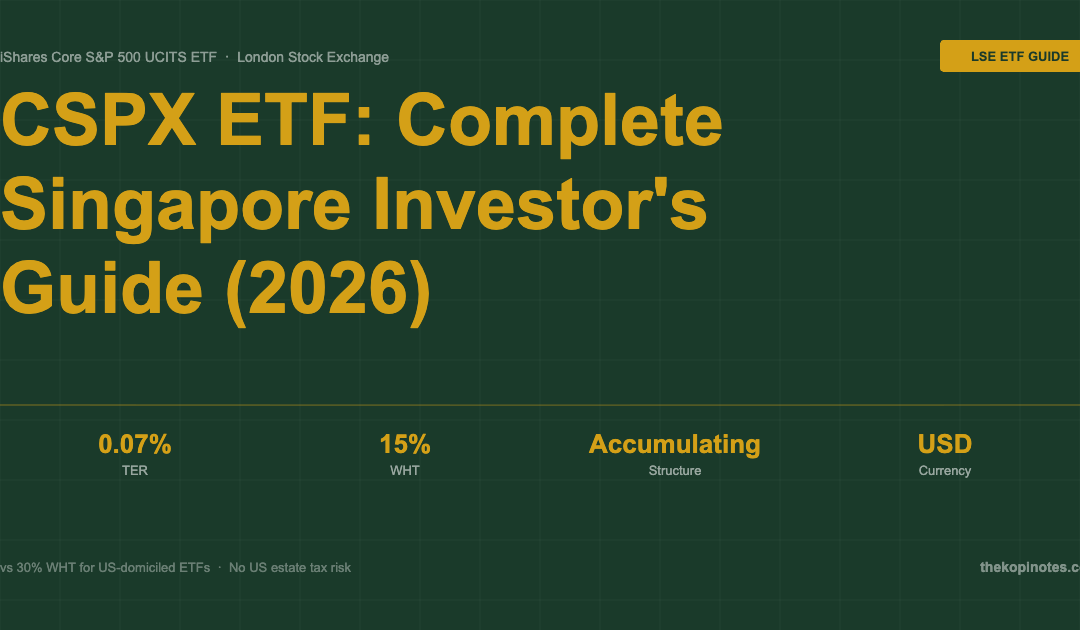
CSPX is the iShares Core S&P 500 UCITS ETF (Acc), listed on the London Stock Exchange (LSE) and domiciled in Ireland. It tracks 503 of the largest US companies and has a Total Expense Ratio (TER) of 0.07% p.a. Singapore investors favour CSPX over US-listed equivalents like VOO because it attracts only 15% US dividend withholding tax (vs 30% for US-domiciled ETFs) and carries no US estate tax risk — saving thousands of dollars over a long-term portfolio.
Not financial advice. All figures are for educational reference only. Data as at April 2026 unless noted.
Table of Contents
Contents — Click to expand
What Is CSPX?
CSPX stands for the iShares Core S&P 500 UCITS ETF (Acc), managed by BlackRock — the world’s largest asset manager with over USD 10 trillion in assets under management. Launched in 2010, CSPX tracks the S&P 500 Index, which represents approximately 503 of the largest publicly listed companies in the United States by market capitalisation, covering roughly 80% of the total US equity market.
A few key terms worth understanding:
- UCITS — Undertakings for Collective Investment in Transferable Securities. This is a European regulatory framework that governs how the fund is structured and managed. UCITS funds must meet strict investor protection standards, including diversification requirements and daily liquidity.
- Accumulating (Acc) — Dividends paid by the S&P 500 companies inside the fund are automatically reinvested back into the fund rather than paid out to investors. This maximises the power of compounding over time. If you prefer income payouts, the distributing version is CSPX’s sister fund VUSD (iShares Core S&P 500 UCITS ETF USD Dist).
- Ireland-domiciled — The fund is legally registered in Ireland. This is a critical detail for Singapore investors because it determines how much US withholding tax applies (more on this in the tax section).
CSPX trades in US dollars on the London Stock Exchange (LSE) and is accessible to Singapore investors through brokers offering international market access. As at Q1 2026, CSPX has an AUM of approximately USD 100 billion+, making it one of the largest and most liquid UCITS ETFs available anywhere in the world. The sheer size of CSPX means the bid-ask spread is typically very tight — reducing hidden transaction costs for investors.
Key Facts at a Glance
| Metric | Detail |
|---|---|
| Full Name | iShares Core S&P 500 UCITS ETF (Acc) |
| Ticker (LSE) | CSPX |
| ISIN | IE00B5BMR087 |
| Index Tracked | S&P 500 |
| Domicile | Ireland |
| Regulatory Framework | UCITS |
| Structure | Accumulating (dividends reinvested) |
| TER (Expense Ratio) | 0.07% per annum |
| AUM | ~USD 100 billion+ (Q1 2026) |
| Number of Holdings | ~503 |
| Trading Currency | USD (on LSE) |
| Exchange | London Stock Exchange (LSE) |
| Launch Date | May 2010 |
Source: iShares by BlackRock CSPX factsheet, April 2026
Why Singapore Investors Buy CSPX on the London Stock Exchange
The single most important reason Singapore investors choose CSPX over US-listed S&P 500 ETFs is tax efficiency. There are two taxes that matter here: US dividend withholding tax and US estate tax. CSPX’s Ireland domicile provides a material advantage on both.
1. US Dividend Withholding Tax (WHT)
When US companies pay dividends to shareholders, the US Internal Revenue Service (IRS) withholds a percentage at source. For investors holding US-domiciled ETFs like VOO or SPY, this rate is 30% for non-US residents (Singapore has no income tax treaty with the US that reduces this rate). However, because CSPX is domiciled in Ireland — and Ireland has a tax treaty with the US — the withholding tax is reduced to 15% at the fund level. As a Singapore investor, you never see this as a separate deduction; it is simply reflected in the net asset value of CSPX versus a gross S&P 500 benchmark.
Singapore does not levy any additional tax on dividends received by Singapore residents, so the 15% WHT inside CSPX is the only tax drag you experience.
2. US Estate Tax
The US imposes an estate tax of up to 40% on the US-situs assets of non-US residents who die holding more than USD 60,000 in US assets. This threshold is not adjusted for inflation and was set decades ago — it is easy for even a modest portfolio to exceed it. US-domiciled ETFs (VOO, SPY, IVV) are classified as US-situs assets. Ireland-domiciled ETFs like CSPX are not classified as US-situs assets, so your estate has no exposure to US estate tax through CSPX holdings, no matter how large your portfolio grows. This is increasingly relevant for Singapore investors building long-term retirement wealth — a point worth discussing with a financial planner if your global estate is significant.
| ETF | Domicile | US Dividend WHT | US Estate Tax Risk | SG Capital Gains Tax |
|---|---|---|---|---|
| CSPX (LSE) | Ireland | 15% | None | None |
| VOO / SPY (NYSE) | USA | 30% | Yes (above USD 60k) | None |
Source: IRS Publication 515 (Withholding of Tax on Nonresident Aliens); US-Ireland Tax Treaty Article 10
The SGD Cost Saving — A Worked Example
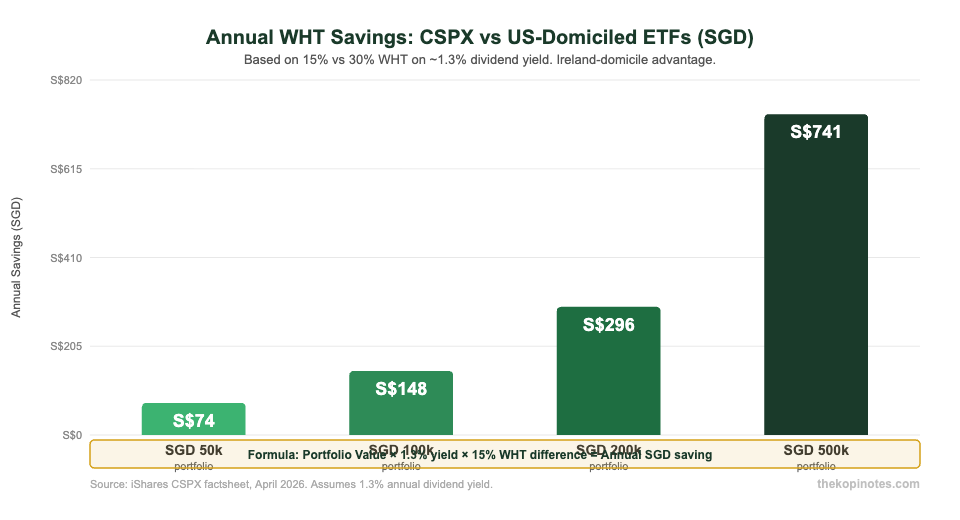
Consider a Singapore investor with a SGD 200,000 portfolio invested in an S&P 500 ETF. The S&P 500 historically yields approximately 1.3% in annual dividends (as at Q1 2026).
- Annual dividends generated: SGD 200,000 × 1.3% = SGD 2,600
- WHT at 30% (VOO/SPY): SGD 780 withheld annually
- WHT at 15% (CSPX): SGD 390 withheld annually
- Annual saving with CSPX: SGD 390 per year
Over a 25-year investment horizon, and assuming this saving is reinvested, this difference compounds into a material amount — before even considering the estate tax protection. For Singapore investors building a passive income portfolio in Singapore, choosing the right fund domicile is one of the highest-leverage decisions you can make.
CSPX Expense Ratio and True Cost of Ownership
The CSPX TER is 0.07% per annum. This means for every SGD 10,000 invested, you pay approximately SGD 7 per year in fund management costs — automatically deducted from the fund’s NAV, not charged as a separate fee. At this level, the management cost is negligible for long-term investors.
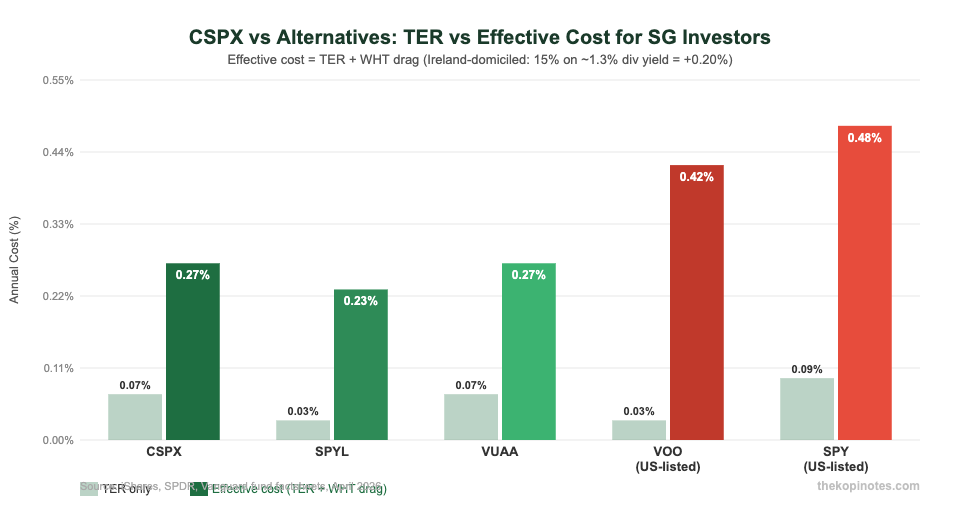
However, looking at TER alone can be misleading when comparing CSPX to US-listed alternatives. The true cost of ownership for a Singapore investor must account for withholding tax drag on dividends. Here is the full picture:
| ETF | TER | WHT on Dividends | WHT Drag (1.3% yield) | Effective Annual Cost |
|---|---|---|---|---|
| CSPX (LSE) | 0.07% | 15% | 0.20% | ~0.27% |
| SPYL (LSE) | 0.03% | 15% | 0.20% | ~0.23% |
| VUAA (LSE) | 0.07% | 15% | 0.20% | ~0.27% |
| VOO (NYSE) | 0.03% | 30% | 0.39% | ~0.42% |
| SPY (NYSE) | 0.09% | 30% | 0.39% | ~0.48% |
WHT drag calculated as: (dividend yield × WHT rate). S&P 500 dividend yield assumed at 1.3% p.a. (as at Q1 2026). Source: iShares, Vanguard, SSGA fund factsheets; IRS Publication 515.
The key insight: CSPX costs 0.27% effectively vs VOO at 0.42% for a Singapore investor — despite VOO having a lower headline TER. The lower withholding tax from Ireland domicile more than compensates for CSPX’s slightly higher management fee versus SPYL or VOO.
SPYL (SPDR S&P 500 UCITS ETF, also LSE-listed and Ireland-domiciled at 0.03% TER) is the cheapest option on a pure-cost basis, though CSPX’s significantly larger AUM (USD 100B+ vs SPYL’s USD 10B+) means tighter bid-ask spreads and higher daily trading liquidity — which matters for investors making larger trades or wanting to exit quickly.
How to Buy CSPX in Singapore (Step-by-Step)
CSPX is not listed on the Singapore Exchange (SGX) — it trades on the London Stock Exchange (LSE). You will need a broker that offers international market access. Below are the four most popular options for Singapore investors, with accurate fee data as at April 2026.
Interactive Brokers (IBKR) — Best for Cost-Conscious Investors
IBKR is widely considered the most cost-effective broker for buying LSE-listed ETFs from Singapore. The fixed commission is approximately USD 1.70 per trade (fixed rate) or USD 0.005 per share (min USD 1, max 1% of trade value). For a regular monthly investment of SGD 1,000–5,000 in CSPX, IBKR’s fees represent less than 0.2% of the transaction — well below most alternatives.
How to buy CSPX on IBKR:
- Open an IBKR Singapore account at interactivebrokers.com.sg
- Fund your account via bank transfer (SGD accepted; IBKR converts to USD/GBP)
- In the Trader Workstation or IBKR app, search for ticker “CSPX“
- Select the London Stock Exchange (LSE / IBIS) listing in USD
- Choose “Market” order for immediate execution or “Limit” order to set your price
- Confirm the number of units (CSPX trades at approximately USD 500–600 per unit as at April 2026, so 1 unit = ~SGD 670–800)
- Submit and confirm your order
Saxo Markets Singapore — Good for Beginners
Saxo offers a clean interface with Singapore-based customer support. Commission for LSE trades is approximately 0.10% per trade, minimum USD 4 on the Classic account (reduced to 0.08% for Platinum tier). Saxo also supports LSE trading in GBP if you prefer the GBP-denominated CSPX share class. A Saxo account can also be funded with Syfe referral code partners for comparison — though Syfe Brokerage is a separate platform.
MooMoo Singapore — Competitive and App-First
MooMoo (Futu Singapore) has grown rapidly among Singapore retail investors. Check the moomoo Singapore review for the latest 2026 fee structure — promotions change frequently and MooMoo often offers commission-free periods for new accounts. Search for CSPX under the “US/HK/SG/UK” markets tab and select the LSE listing.
Syfe Brokerage — Simplest for SGD-First DCA
Syfe Brokerage offers a flat-fee model with no FX conversion headaches — you fund in SGD and Syfe handles the rest. It is particularly well-suited for investors doing a monthly dollar-cost average (DCA) in amounts of SGD 500–2,000 where IBKR’s per-trade fee becomes proportionally larger. Sign up via our Syfe referral code and sign-up bonus for any current promotions.
CSPX vs Alternatives: SPYL, VUAA, VOO, VWRA
CSPX is the most popular Ireland-domiciled S&P 500 UCITS ETF but it is not the only option. Here is how it stacks up against the main alternatives for Singapore investors:
| ETF | TER | Exchange | Index | Structure | AUM (approx) | Best For |
|---|---|---|---|---|---|---|
| CSPX | 0.07% | LSE | S&P 500 | Acc | USD 100B+ | Largest AUM, most liquid UCITS S&P 500 |
| SPYL | 0.03% | LSE | S&P 500 | Acc | USD 10B+ | Lowest TER, cost-focused investors |
| VUAA | 0.07% | LSE | S&P 500 | Acc | USD 20B+ | Vanguard brand preference |
| VOO | 0.03% | NYSE | S&P 500 | Dist | USD 500B+ | Not recommended for SG investors — 30% WHT + estate tax risk |
| VWRA | 0.19% | LSE | FTSE All-World | Acc | USD 20B+ | Global diversification (90+ countries, not just US) |
Source: iShares, SPDR, Vanguard fund factsheets, April 2026. AUM figures approximate.
CSPX vs SPYL: Both are Ireland-domiciled, LSE-listed, accumulating S&P 500 UCITS ETFs. The key difference is TER (0.07% vs 0.03%) and AUM. SPYL is cheaper but CSPX’s far larger AUM means tighter spreads and higher daily trading volume. For most Singapore investors doing monthly DCA, either is fine — but for large lump sum investments, CSPX’s liquidity is a comfort.
CSPX vs VWRA: CSPX gives you pure US S&P 500 exposure; VWRA gives you the whole world including emerging markets. If you believe US equities will continue to outperform, CSPX is the sharper bet. If you want true global diversification in a single fund, VWRA is the better choice. Many Singapore investors hold both — using CSPX as the US core and VWRA for broader exposure.
Who Should Buy CSPX?
CSPX is ideal for Singapore investors who:
- Want long-term exposure to the US stock market through 503 large-cap US companies
- Prefer automatic dividend reinvestment (accumulating structure) for maximum compounding
- Want the largest, most liquid UCITS S&P 500 ETF available (AUM USD 100B+)
- Are building a buy-and-hold retirement portfolio and want estate tax peace of mind
- Already using a broker with LSE access (IBKR, Saxo, MooMoo, Syfe)
Consider alternatives if you:
- Want the lowest possible TER: SPYL at 0.03% saves 0.04% annually versus CSPX
- Want global diversification beyond the US: VWRA covers 90+ countries in one fund
- Need dividend income paid to your account: CSPX reinvests dividends — consider VUSD (distributing version)
- Want to invest via CPF OA: CSPX is not CPF-eligible. For CPF investing, see our CPF investment strategy Singapore guide for eligible options
- Prefer a robo-advisor to pick and manage the ETF for you: see our Syfe vs Endowus 2026 comparison
For Singapore investors building a diversified retirement portfolio beyond just equities, it is also worth exploring the best S-REITs in Singapore 2026 for local income exposure, and using our Singapore retirement calculator to model how CSPX fits into your long-term wealth plan.
Risks to Consider
CSPX, like all equity investments, carries risks that investors should understand before committing capital:
- US concentration risk: 100% of CSPX’s holdings are US companies. A significant US market downturn (as seen in 2022 with a ~20% correction, or 2008–09 with a ~50% drawdown) will directly impact CSPX’s value. Consider pairing with geographically diversified holdings.
- Currency risk: CSPX trades in USD. As a Singapore investor, your returns are affected by the SGD/USD exchange rate. If the USD weakens against SGD, your returns in SGD terms will be lower even if CSPX performs well in USD.
- Sector concentration: The S&P 500 is market-cap weighted, meaning the top 10 holdings (predominantly Apple, Microsoft, Nvidia, Alphabet, Amazon as at Q1 2026) represent approximately 30%+ of the index. Strong performance from these megacap tech stocks has driven returns — but also concentrates risk.
- Valuation risk: The S&P 500 has historically traded at elevated P/E multiples in recent years. Future returns may be lower than historical averages if valuations compress.
- No CPF eligibility: CSPX cannot be purchased using CPF funds. It is not listed on the SGX CPFIS approved list.
None of the above are reasons to avoid CSPX — they are reasons to understand what you own. A long-term Singapore investor with a 20+ year horizon has historically been well-rewarded by holding a low-cost S&P 500 UCITS ETF like CSPX through market cycles.
Not financial advice. All figures are for educational reference only. Data as at April 2026 unless noted.
Frequently Asked Questions
What is CSPX and why do Singapore investors buy it?
CSPX is the iShares Core S&P 500 UCITS ETF (Acc), an Ireland-domiciled, accumulating ETF listed on the London Stock Exchange that tracks the S&P 500 Index. Singapore investors prefer CSPX over US-listed equivalents like VOO primarily because it attracts only 15% US dividend withholding tax (vs 30% for US-domiciled ETFs) and carries no US estate tax risk. It is managed by BlackRock with an AUM exceeding USD 100 billion and a TER of just 0.07% p.a.
Is CSPX the same as VOO for Singapore investors?
Both CSPX and VOO track the S&P 500 Index, so their underlying exposure is very similar. However, they differ critically for Singapore investors: CSPX is Ireland-domiciled (15% US dividend withholding tax, no US estate tax risk), while VOO is US-domiciled (30% withholding tax, US estate tax applies to holdings above USD 60,000). CSPX also reinvests dividends automatically (accumulating), while VOO pays them out quarterly. For a Singapore investor, CSPX is almost always the better choice on a net-of-tax basis.
Can I buy CSPX using my CPF or SRS funds?
CSPX is not eligible for investment using CPF Ordinary Account (OA) funds under the CPF Investment Scheme (CPFIS) — it is not listed on the SGX and is not on the CPFIS approved list. However, CSPX may be purchased using your Supplementary Retirement Scheme (SRS) account through brokers that support SRS investing and offer LSE market access — check directly with your broker whether they support SRS-funded LSE trades. For CPF investing options, see our guide on CPF investment strategy.
What is the minimum investment to buy CSPX in Singapore?
CSPX trades in whole units on the LSE. As at April 2026, each CSPX unit is priced at approximately USD 500–600 (roughly SGD 670–800). This means the minimum investment is effectively one unit (~SGD 700–800). There is no way to buy fractional CSPX units on the LSE through standard brokers — if you want to invest smaller amounts regularly, a platform like Syfe Brokerage may allow fractional investing or managed CSPX-equivalent exposure at lower minimum amounts.
What is the CSPX expense ratio and is it competitive?
The CSPX Total Expense Ratio (TER) is 0.07% per annum — meaning SGD 7 per year for every SGD 10,000 invested. While this is higher than VOO (0.03%) or SPYL (0.03%), the net-of-tax cost for Singapore investors is lower with CSPX because of the reduced 15% withholding tax on dividends vs 30% for US-domiciled funds. The effective all-in cost for a Singapore investor in CSPX is approximately 0.27% annually, compared to 0.42% for VOO after accounting for the higher withholding tax drag.
Is CSPX safe? What are the main risks?
CSPX is one of the most liquid and well-regulated ETFs in the world, managed by BlackRock with over USD 100 billion AUM and subject to EU UCITS regulations. However, all equity investments carry market risk — CSPX’s value moves with the S&P 500, which can fall 20–50% in severe bear markets. Additional risks for Singapore investors include USD/SGD currency fluctuation and sector concentration in US mega-cap tech companies. CSPX does not protect against market downturns — it simply gives you broad exposure to 503 large US companies at very low cost.
Ready to Start Investing in CSPX?
Open a brokerage account with LSE access and buy your first CSPX unit today. Use our referral links for exclusive sign-up bonuses.
This article was researched with the help of AI. While we strive to keep all information accurate and up to date, there may be errors. If you notice any discrepancies, please contact us.