S-REIT 1Q 2026 DPU Results: Winners, Laggards & What Singapore Investors Should Watch
Data centre REITs surged. Healthcare held firm. Logistics faced headwinds. Here’s the full S-REIT 1Q 2026 earnings scorecard — with what it means for your income portfolio.
Not financial advice. Data as at May 2026. Past distributions are not a guarantee of future payouts.
The S-REIT 1Q 2026 earnings season has wrapped up, and the results paint a picture of a sector finding its footing after years of rate uncertainty. With the US Federal Reserve having cut rates in late 2025, lower financing costs are flowing through to REIT balance sheets — and unitholders are starting to feel it in their DPU.
In this roundup, we cover six major S-REITs that reported 1Q 2026 results: ParkwayLife REIT, Keppel DC REIT, Suntec REIT, CapitaLand Integrated Commercial Trust (CICT), Mapletree Industrial Trust (MIT), and First REIT. We also look at what the broader results mean for income investors heading into the second half of 2026.
Table of Contents
Contents — Click to expand
- 1Q 2026 S-REIT DPU Scorecard at a Glance
- ParkwayLife REIT: DPU +15.1% — Healthcare Shines
- Keppel DC REIT: DPU +13.2% — Data Centres on Fire
- Suntec REIT: DPU +23.9% — Singapore Core Delivers
- CICT: Revenue +8% — Paragon Acquisition Headlines
- Mapletree Industrial Trust: Navigating Portfolio Transition
- First REIT: DPU -13.8% — Currency Headwinds Bite
- Key Themes for the Rest of 2026
- Frequently Asked Questions
1Q 2026 S-REIT DPU Scorecard at a Glance
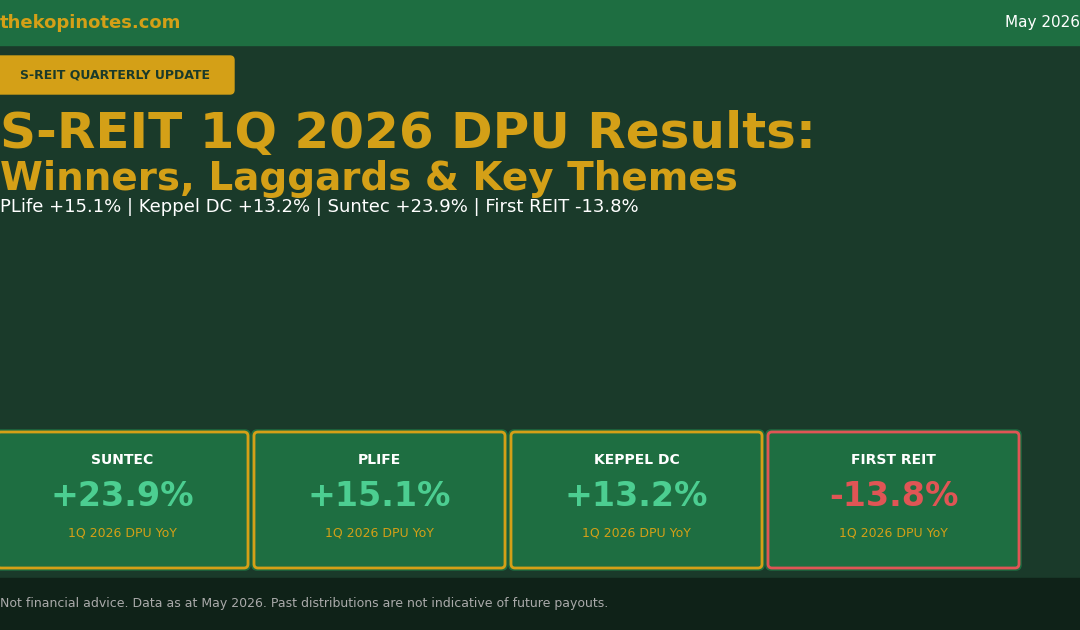
Here’s how the six S-REITs stacked up in the first quarter of 2026:
| REIT | Ticker | 1Q 2026 DPU | YoY Change | Sector |
|---|---|---|---|---|
| ParkwayLife REIT | C2PU | 4.42¢ | +15.1% | Healthcare |
| Keppel DC REIT | AJBU | 2.833¢ | +13.2% | Data Centre |
| Suntec REIT | T82U | 1.936¢ | +23.9% | Office/Retail |
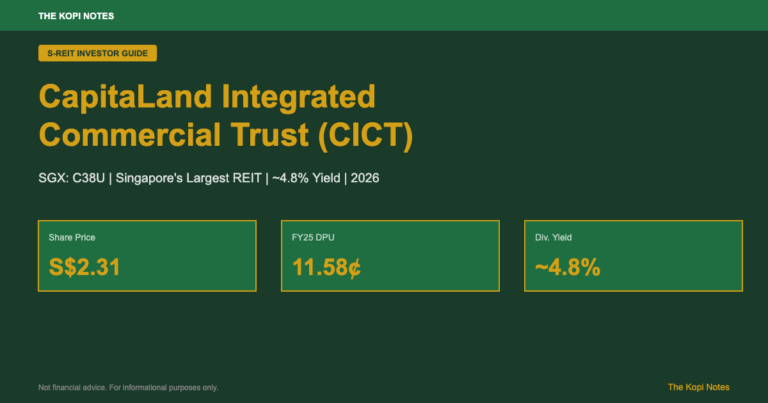
| CICT | C38U | 0.0398 (adv.) | N/A* | Commercial |
| Mapletree Industrial Trust | ME8U | Transitioning | -7% | Industrial/DC |
| First REIT | AW9U | 0.50¢ | -13.8% | Healthcare |
*CICT declared advance distribution of S$0.0398/unit for 1 Jan–28 Apr 2026, to be paid 8 June 2026.
ParkwayLife REIT (C2PU): DPU +15.1% — Healthcare Shines
1Q 2026 DPU: 4.42 Singapore cents (+15.1% YoY)
ParkwayLife REIT delivered one of the strongest DPU growth numbers in the S-REIT space for 1Q 2026. The 15.1% jump was driven by a key structural shift: the expiry of a three-year rent rebate arrangement with its Singapore master lessee, Parkway Hospitals Singapore, and the simultaneous activation of a new annual rent review formula from FY2026 onwards.
Distributable income for 1Q 2026 rose 15.1% to S$28.8 million. The REIT’s balance sheet remains one of the most defensive in the sector, with gearing at 34.2%, interest coverage of 8.4x, and an average debt cost of just 1.66%. There are no refinancing needs until March 2027.
The Singapore hospital portfolio — which accounts for the bulk of income — performed well, while Japan assets faced some currency headwinds (JPY weakness). However, the income structure of Japan assets incorporates CPI-linked rent adjustments, which partially offset currency drag over time.
What this means for investors: PLife’s 15% DPU jump is partly a one-off re-basing from the rent rebate expiry, not purely organic growth. Expect DPU growth to moderate in subsequent quarters. That said, the long-dated master lease structure and Singapore hospital exposure makes PLife one of the most defensive income REITs available on SGX. At current prices, PLife offers a forward yield of approximately 3.8–4.2%, which is lower than most S-REITs but reflects its quality premium.
Keppel DC REIT (AJBU): DPU +13.2% — Data Centres on Fire
1Q 2026 DPU: 2.833 Singapore cents (+13.2% YoY)
Keppel DC REIT continues to be the standout performer in the data centre space. The 13.2% DPU increase to 2.833 cents was driven by contributions from acquisitions completed in late 2025 — Tokyo Data Centre 3 and remaining interests in Keppel DC Singapore 3 and 4 — combined with stellar rental reversions of +50.3% on leases renewed in 1Q 2026.
Distributable income posted a 20% jump year-on-year, reflecting both organic rental growth and the inorganic uplift from new assets. At an annualised DPU yield of approximately 4.86%, Keppel DC REIT offers an attractive blend of growth and income — rare in the REIT world.
The AI-driven demand for data centre capacity remains the key structural tailwind. Singapore’s land constraints and Keppel DC’s first-mover advantage in quality data centre infrastructure across Asia Pacific position it well for further rental reversions as legacy leases roll over at market rates.
What this means for investors: The +50.3% rental reversion is extraordinary and reflects just how severely underpriced legacy data centre leases were. As more leases roll to market, DPU growth should remain above-average. Key risk: any slowdown in AI capex globally could dampen demand at the margin, though current hyperscaler demand pipelines remain robust.
Suntec REIT (T82U): DPU +23.9% — Singapore Core Delivers
1Q 2026 DPU: 1.936 Singapore cents (+23.9% YoY)
Suntec REIT posted the largest percentage DPU jump among the REITs in this roundup, with distributable income surging 24.8% to S$57.3 million and DPU rising 23.9% to 1.936 cents. The results were underpinned by strong operational performance from its Singapore office and retail portfolios, reduced financing costs, and a lower provision for Australian withholding tax.
The Singapore office portfolio achieved occupancy of 98.8% with rental reversions of +9.5%. The retail (Suntec City Mall) showed occupancy of 99% with rental reversions of +15% — reflecting robust demand for prime retail space in the Suntec micromarket as tourist footfall recovers.
The overseas portfolio (Australia, UK) has been a drag historically due to weak AUD/GBP and higher cap rates. However, reduced withholding tax provisions suggest Suntec is cleaning up the Australian structure, which could be a positive for future DPU stability.
What this means for investors: Suntec’s Singapore-centric turnaround is playing out well. With gearing manageable and Singapore assets at near-full occupancy, the distribution should be sustainable. The 1.936¢ quarterly DPU equates to roughly 7.74¢ annualised — a forward yield of approximately 5.5–6% depending on current price. Suntec remains a value play in the office/retail REIT space for those comfortable with its overseas exposure.
CICT (C38U): Revenue +8% — Paragon Acquisition Headlines
1Q 2026: Gross Revenue +8.0% YoY to S$426.7M | NPI +7.9% to S$314.4M
CapitaLand Integrated Commercial Trust (CICT) delivered solid top-line growth with gross revenue rising 8.0% year-on-year to S$426.7 million, and net property income (NPI) up 7.9% to S$314.4 million. Full-quarter contribution from its 100% stake in CapitaSpring and the Germany handover of Gallileo drove the improvement.
The big headline from 1Q 2026 for CICT was the announcement of the S$3.9 billion acquisition of Paragon — the prime mixed-use retail and medical/office asset on Orchard Road. This was paired with the strategic divestment of Asia Square Tower 2 (AST2) for approximately S$2.5 billion, recycling capital into higher-yielding assets. Paragon is a trophy asset, and the deal signals CICT’s intent to anchor itself in Singapore’s most resilient retail corridors.
Portfolio occupancy stood at 95.2% as at 31 March 2026, slightly lower due to transitional vacancy at CQ @ Clarke Quay, Funan (office), and Main Airport Center. These are expected to stabilise by mid-2026. CICT declared an advance distribution of S$0.0398 per unit for the period 1 January to 28 April 2026, payable on 8 June 2026.
What this means for investors: The Paragon acquisition is transformative — it adds a marquee Singapore asset with long-term structural demand from medical and retail tenants. The counter-balancing AST2 divestment reduces overseas risk. Watch for DPU accretion from Paragon in 2H 2026 and beyond. CICT remains one of the largest and most liquid S-REITs, suitable for core income allocations. Current yield of ~5–5.5% looks reasonable given the quality of the portfolio.
Mapletree Industrial Trust (ME8U): Navigating Portfolio Transition
1Q 2026 (3QFY2026): DPU approximately -7% YoY | Revenue -8% YoY
Mapletree Industrial Trust (MIT) had a mixed quarter. Revenue fell roughly 8% year-on-year and DPU declined approximately 7%, dragged by three factors: the absence of income from three Singapore properties divested in August 2025, lease non-renewals at North American properties, and a weaker US dollar reducing the SGD value of USD-denominated distributions.
MIT is in active portfolio transition, targeting S$500–600 million of further divestments in North America while pivoting toward data centre markets across Asia Pacific and Europe. This strategy makes sense given the premium valuations data centres command versus generic industrial assets, but it creates a transitional period of lower income until replacement assets are acquired and yield accretion materialises.
The Singapore industrial portfolio remains healthy with high occupancy, and the data centre assets (US and Singapore) continue to perform well. MIT’s gearing remains manageable, giving it firepower for acquisitions without equity fundraising at distressed prices.
What this means for investors: MIT is a “show me” story right now — the pivot to data centres is the right long-term direction, but near-term DPU will be pressured as North American assets are sold. Patient investors comfortable with a 6–12 month transition period may find MIT at current prices interesting, particularly if you believe in the data centre structural tailwind. Check out our Best S-REITs 2026 comparison for how MIT stacks up versus peers.
First REIT (AW9U): DPU -13.8% — Currency Headwinds Bite
1Q 2026 DPU: 0.50 Singapore cents (-13.8% YoY from 0.58¢)
First REIT was the notable laggard in the 1Q 2026 results season. DPU fell 13.8% year-on-year to 0.50 cents, while rental and other income dropped 8.4% to S$23.2 million and NPI declined 8.3% to S$22.5 million. The primary culprit was currency volatility — First REIT has significant exposure to Indonesian and South Korean hospital assets, and both the Indonesian Rupiah and Korean Won weakened against the Singapore dollar during the quarter.
Additionally, First REIT is undergoing strategic divestments to reshape its portfolio away from lower-quality assets in Southeast Asia, which creates a transitional income gap similar to MIT’s situation. The REIT’s ongoing refurbishment and repositioning of hospital assets takes time to yield returns.
What this means for investors: First REIT’s DPU trajectory is challenging in the near term. Currency exposure is structural and hard to hedge cost-effectively for this REIT’s size. The 13.8% DPU cut is significant for income investors. That said, at the lower DPU run rate, the REIT may offer a high single-digit yield at current prices — compensating partially for the risk. This is a higher-risk, potentially higher-yield position, not a core income holding.
Key Themes for the Rest of 2026
1. Lower rates = better distributions ahead. With the US Fed having cut rates and the Singapore 3-month SORA gradually declining, REIT refinancing costs are falling. REITs that locked in high-cost debt in 2022–2023 will see meaningful interest savings as those facilities mature and are refinanced at lower rates. This is a DPU tailwind for much of 2H 2026 and 2027.
2. Data centres remain the structural winner. Keppel DC REIT’s +50.3% rental reversion is extraordinary but not a fluke — it reflects years of undersupply meeting AI-driven hyperscaler demand. Singapore’s zero-tolerance for new greenfield data centres (due to power constraints) means existing assets command premium rents. This structural supply constraint benefits Keppel DC REIT and MIT’s DC assets for years to come.
3. Singapore core assets outperform. REITs with dominant Singapore exposure (CICT, PLife Singapore hospitals, Suntec Singapore) delivered the strongest results. Overseas-heavy portfolios (First REIT, MIT North America) faced currency and macro headwinds. The “Singapore core” premium looks likely to persist as long as the city-state’s economy remains resilient.
4. Portfolio reshaping is ongoing. CICT’s Paragon acquisition, MIT’s North America divestments, and First REIT’s strategic exits all signal active portfolio management. Investors should watch for DPU-accretive acquisitions that could be announced at the 2Q 2026 results stage.
For a broader view, see our Singapore REIT ETF guide if you prefer diversified S-REIT exposure, or our Best S-REITs 2026 article for individual stock analysis. You can also use our S-REIT Yield vs Bond Spread Calculator to assess current valuations.
Tools to Help You Analyse S-REITs
Use these free tools from The Kopi Notes to build your own S-REIT analysis:
- S-REIT Dividend Yield Calculator — compute DPU yield based on entry price
- S-REIT vs SGS Bond Spread Calculator — see if current valuations offer adequate spread
- S-REIT Total Return Calculator — model total return including DPU and capital appreciation
- Gearing Ratio & ICR Calculator — assess REIT balance sheet health
Also consider these investment platforms for buying S-REITs cost-effectively:
Frequently Asked Questions
Which S-REIT had the best DPU growth in 1Q 2026?
Suntec REIT posted the highest DPU growth in 1Q 2026 at +23.9% year-on-year, with DPU rising to 1.936 Singapore cents. This was driven by improved Singapore office and retail performance, reduced financing costs, and lower Australian withholding tax provisions. ParkwayLife REIT (+15.1%) and Keppel DC REIT (+13.2%) were close behind.
Why did First REIT's DPU fall in 1Q 2026?
First REIT’s DPU fell 13.8% year-on-year to 0.50 Singapore cents in 1Q 2026, primarily due to currency headwinds. First REIT has significant exposure to Indonesian and South Korean healthcare assets, and both the Indonesian Rupiah and Korean Won weakened against the Singapore dollar during the quarter. Strategic divestments also caused a transitional income gap.
What was Keppel DC REIT's rental reversion in 1Q 2026?
Keppel DC REIT achieved a remarkable +50.3% positive rental reversion on leases renewed in 1Q 2026. This reflects the significant gap between legacy data centre lease rates (signed years ago) and current market rates, which have surged due to AI-driven demand for data centre capacity. DPU rose 13.2% to 2.833 cents for the quarter.
What is CICT's Paragon acquisition and why does it matter?
In 1Q 2026, CapitaLand Integrated Commercial Trust (CICT) announced the acquisition of Paragon, a prime mixed-use retail and medical/office asset on Orchard Road, for approximately S$3.9 billion. This was paired with the divestment of Asia Square Tower 2 (AST2) for S$2.5 billion. The deal upgrades CICT’s portfolio quality by adding a trophy Singapore asset with long-term structural demand from premium retail and medical tenants, while reducing overseas exposure.
Are S-REIT distributions likely to improve in 2H 2026?
The outlook for S-REIT distributions in 2H 2026 is cautiously positive. As the US Federal Reserve rate cuts flow through to lower SORA rates in Singapore, REIT financing costs are declining. REITs refinancing high-cost debt from 2022–2023 at current lower rates will see interest savings that flow directly to DPU. Data centre REITs like Keppel DC also have strong rental reversion pipelines. The key risks remain currency volatility for REITs with overseas assets, and any global recession that could soften occupancy and rent growth.
How can I invest in S-REITs in Singapore?
You can invest in individual S-REITs through a brokerage account on SGX. Alternatively, platforms like Endowus allow you to invest in S-REIT funds using CPF OA funds or cash, which can be tax-efficient for CPF savings. Syfe offers an S-REIT Income+ portfolio for those who prefer a managed, diversified approach. You can also buy S-REIT ETFs like the Lion-Phillip S-REIT ETF (CLR) or NikkoAM-StraitsTrading Asia Ex Japan REIT ETF (CFA) for broad sector exposure — see our Singapore REIT ETF guide for details.
This article was researched with the help of AI. While we strive to keep all information accurate and up to date, there may be errors. If you notice any discrepancies, please contact us.