CSPX Price Today: Live Chart, Historical Data & Singapore Buying Guide (2026)
Track the current CSPX ETF price, understand its historical performance, and learn how Singapore investors buy it tax-efficiently on the London Stock Exchange.
CSPX (iShares Core S&P 500 UCITS ETF) is an Ireland-domiciled ETF listed on the London Stock Exchange (LSE) that tracks the S&P 500 index. Its share price trades in USD and reflects the combined value of 500 of America’s largest companies. Singapore investors favour CSPX over US-listed equivalents like VOO because it carries only 15% withholding tax on dividends (vs 30%) and carries no US estate tax risk — making it the go-to S&P 500 exposure for tax-efficient long-term investing from Singapore.
Not financial advice. All figures are for educational reference only. Data as at May 2026 unless noted.
Table of Contents
Contents — Click to expand
What Is CSPX and What Does Its Price Represent?
CSPX is the ticker symbol for the iShares Core S&P 500 UCITS ETF (Acc), managed by BlackRock and listed on the London Stock Exchange. The “price” of CSPX refers to the market price per share, which moves in line with the Net Asset Value (NAV) of its underlying holdings — 500 of the largest publicly listed US companies by market capitalisation.
Unlike a single stock, CSPX’s price reflects the aggregate weighted performance of the entire S&P 500 index. When Apple, Microsoft, Nvidia, Amazon and Google go up, CSPX goes up. When the broader US market falls, CSPX falls with it — but you are never exposed to any single company’s collapse wiping out your investment.
The ETF is accumulating, meaning it does not pay out dividends. Instead, all dividend income received from its 500 underlying companies is automatically reinvested back into the fund, which causes the share price to rise gradually over time beyond pure index gains. For Singapore investors, this is tax-advantageous: since there is no cash dividend distributed to your brokerage account, there is no Singapore income tax event on distributions.
CSPX is denominated in USD, so its share price quoted in your brokerage will be in US dollars. As at Q1 2026, CSPX was trading above USD 500 per share, reflecting years of cumulative S&P 500 growth and reinvested dividends since the fund’s inception in 2010.
CSPX Current Price and Key Facts (2026)
For the most up-to-date CSPX live price, check your brokerage platform (IBKR, Saxo, or MooMoo) under the LSE exchange. The table below shows the key static facts about CSPX as at May 2026:
| Metric | Detail |
|---|---|
| Full Name | iShares Core S&P 500 UCITS ETF (Acc) |
| Ticker (LSE) | CSPX |
| Index Tracked | S&P 500 |
| Domicile | Ireland |
| Structure | Accumulating (dividends reinvested) |
| TER (Expense Ratio) | 0.07% p.a. |
| AUM | ~USD 60 billion (as at Q1 2026) |
| Number of Holdings | ~500 |
| Currency | USD |
| Exchange | London Stock Exchange (LSE) |
| Launch Date | May 2010 |
Source: iShares CSPX factsheet, May 2026
CSPX Historical Price Performance
CSPX has delivered strong long-term returns that mirror the S&P 500’s performance. Since the fund’s 2010 inception at approximately USD 10 per share, the price has grown more than 50-fold in USD terms, powered by both capital appreciation and accumulated dividend reinvestment. Below is a simplified overview of CSPX’s approximate price milestones:
| Year | Approx. CSPX Price (USD) | Key Market Event |
|---|---|---|
| 2010 | ~10 | Fund inception |
| 2015 | ~160 | Mid-bull market rally |
| 2020 | ~280 (pre-COVID ~320, COVID low ~210) | COVID-19 sell-off & recovery |
| 2022 | ~330 (peak ~420, year-end ~330) | Rate hike drawdown (−19%) |
| 2023 | ~430 | AI-led recovery rally |
| 2024 | ~530 | Tech mega-cap surge |
| 2026 (May) | ~510–530 | Consolidation post-tariff volatility |
Source: iShares historical NAV data, Bloomberg. Figures are approximate and rounded. Past performance is not indicative of future results.
A Singapore investor who invested SGD 10,000 in CSPX in January 2015 would have seen their position grow to approximately SGD 45,000–50,000 by May 2026 in USD terms (before FX movements between SGD and USD). This illustrates the compounding power of accumulating ETF structures over a decade — no dividends to manage, no dividend tax events, and the full reinvestment effect built into the share price.
Why Singapore Investors Buy CSPX on the London Stock Exchange
Many Singapore investors discover CSPX while searching for S&P 500 exposure and wonder why not simply buy the more famous VOO from Vanguard or SPY from State Street on the US exchanges. The answer comes down to two critical financial risks that apply specifically to non-US residents:
| Risk Factor | CSPX (LSE, Ireland) | VOO / SPY (NYSE, USA) |
|---|---|---|
| Dividend Withholding Tax | 15% (Ireland-US tax treaty) | 30% (no treaty benefit for SG investors) |
| US Estate Tax Risk | None (Irish-domiciled, not US “situs” asset) | Yes — above USD 60,000 for non-US persons |
| Singapore Income Tax on Distributions | None (accumulating — no cash dividend) | N/A (distributing — distributions received) |
| Capital Gains Tax (Singapore) | None (Singapore has no CGT) | None (Singapore has no CGT) |
Source: IRS Publication 515, Ireland-US Tax Treaty, MAS guidelines — May 2026
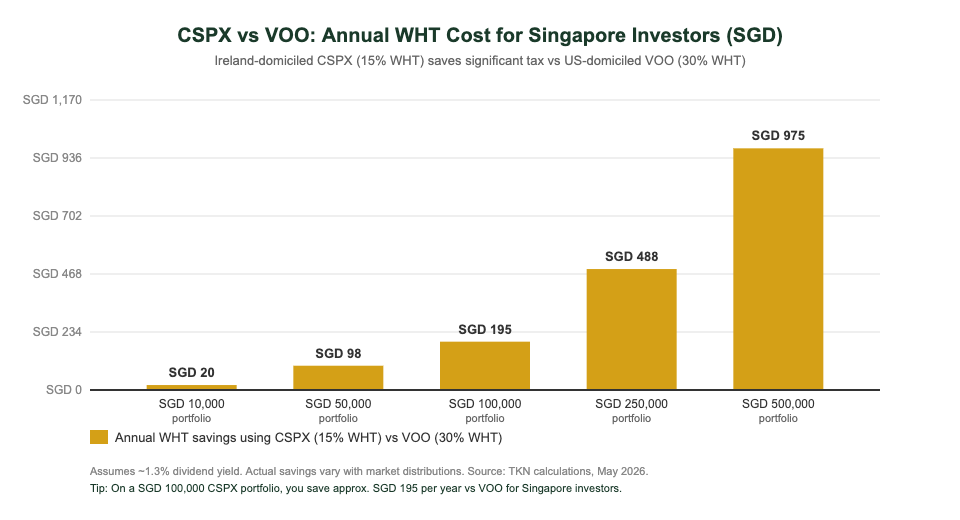
To put the withholding tax difference in concrete SGD terms: on a SGD 100,000 CSPX portfolio with a ~1.3% annual dividend yield, CSPX saves you approximately SGD 195 per year in withholding tax compared to VOO. Over 20 years, that compounding difference adds up to thousands of dollars in additional portfolio value — all from simply choosing the right exchange and domicile. You can explore these numbers further with the Singapore retirement calculator on this site.
CSPX Expense Ratio vs Alternatives
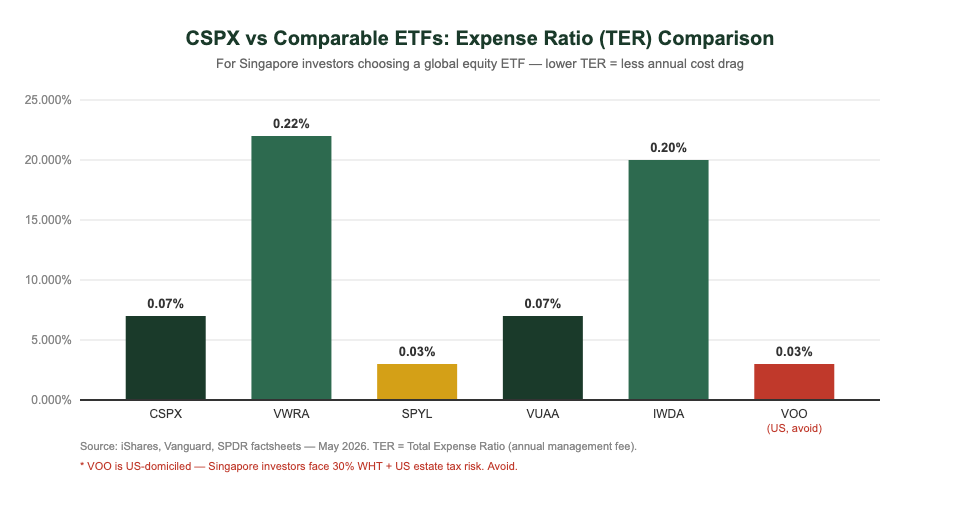
CSPX’s TER is 0.07% per annum — meaning for every SGD 10,000 you invest, you pay SGD 7 per year in management fees. This is deducted daily from the fund’s NAV and reflected in the share price, so you never pay it separately. While SPYL and VOO have lower stated TERs (0.03%), the 15% withholding tax advantage of CSPX means the effective net return for a Singapore investor is typically higher from CSPX than from a US-domiciled ETF with a lower TER.
Original cost comparison: for a Singapore investor holding SGD 100,000 across 10 years, assuming 1.3% dividend yield and 8% annual growth:
- CSPX total cost drag: ~0.07% TER + 15% WHT on dividends ≈ 0.27% effective annual cost
- VOO effective cost drag for SG investor: ~0.03% TER + 30% WHT on dividends ≈ 0.42% effective annual cost
CSPX wins on total cost for Singapore investors despite its higher TER. The Singapore REIT ETF guide covers similar cost considerations for investors interested in local dividend ETFs alongside global equity exposure.
How to Buy CSPX in Singapore (Step-by-Step)
CSPX is available through several brokers accessible to Singapore residents. Here is how to buy it on each major platform:
Interactive Brokers (IBKR) — Best for Cost Efficiency
IBKR offers the lowest commissions for LSE-listed ETFs. Commission is USD 1.70 per trade minimum (or 0.05% of trade value). Steps: Open an IBKR account → Fund in SGD or USD → Search “CSPX” → Select exchange “LSE” → Place a limit or market order in GBP (CSPX also trades in USD on LSE). Best for portfolios above SGD 30,000 where commission is a smaller percentage of trade size. The passive income Singapore guide has a broader overview of investment platforms available locally.
Saxo Markets — Good for Mid-Size Portfolios
Saxo offers competitive fees and a clean interface. Minimum commission applies per trade on LSE stocks. Steps: Open Saxo account → Fund in SGD → Search “CSPX” under UK/LSE market → Buy in GBP or USD denomination. Saxo also allows SRS (Supplementary Retirement Scheme) account investing, making CSPX SRS-eligible through this platform.
MooMoo Singapore — Good for Beginners
MooMoo Singapore has a user-friendly app and competitive commissions for Hong Kong and US markets. LSE trading is available though commission structures vary. Steps: Open MooMoo account → Navigate to “Markets” → Search CSPX → Select LSE → Place order. Use our moomoo Singapore review to check the current fee schedule and any sign-up promotions. For a SRS-compatible option with a simpler UX, consider Syfe referral code to access Syfe’s brokerage with a sign-up bonus.
FSMOne — Good for Regular Savings Plans
FSMOne allows Regular Savings Plans (RSP) on selected ETFs. Check their current ETF RSP list — CSPX availability may vary. Steps: Log into FSMOne → ETFs → Search CSPX → Set up RSP or lump sum. Use the FSMOne referral code for any available referral bonus on account opening.
Note: CSPX is not eligible for CPF Investment Scheme (CPFIS) as it is listed on the LSE, not SGX. However, it is compatible with SRS accounts through eligible brokers. For CPF-eligible ETFs, see the CPF investment strategy Singapore guide.
Who Should Buy CSPX?
CSPX is ideal for you if:
- You want broad exposure to 500 of the world’s largest US companies through a single, low-cost fund
- You prefer a set-and-forget, accumulating ETF where dividends are automatically reinvested
- You are investing outside CPF (e.g. cash or SRS account) and want to minimise withholding tax vs US-domiciled alternatives
- You have a long investment horizon of 10+ years and can tolerate short-term price volatility
- You want to avoid US estate tax exposure (CSPX, being Irish-domiciled, is not a US “situs” asset)
Consider alternatives if:
- You want dividend income paid out regularly — consider VWRD (distributing equivalent) or best S-REITs in Singapore 2026 for higher-yield Singapore REITs
- You want total global market exposure (not just US) — VWRA tracks the entire global market, not just S&P 500
- You are investing via CPF — look at CPFIS-approved ETFs on SGX instead
- You want a lower share price entry point (CSPX at ~USD 520/share requires meaningful initial capital)
Disclaimer: This article is for educational purposes only and does not constitute financial advice. Always conduct your own research or consult a licensed financial advisor before investing. Past performance of CSPX is not a guarantee of future results.
Frequently Asked Questions
What is the current CSPX price for Singapore investors?
CSPX trades on the London Stock Exchange (LSE) in USD. As at May 2026, CSPX was trading in the range of USD 510–530 per share. For the exact live price, check your brokerage platform (IBKR, Saxo, MooMoo) under the LSE market. Note that CSPX’s NAV-based price differs slightly from the real-time market price due to intraday trading spreads.
Why is CSPX price different from VOO price if they track the same index?
CSPX and VOO both track the S&P 500 but they are priced differently because they launched at different times and have different share structures. CSPX launched in 2010 at approximately USD 10/share while VOO launched in 2010 at approximately USD 100/share. Additionally, CSPX is accumulating (dividends reinvested, raising NAV) while VOO is distributing (dividends paid out as cash). Both reflect the same underlying index returns, just at different price levels per share.
Is CSPX better than VOO for Singapore investors?
For most Singapore residents, CSPX is the better choice over VOO. The key reasons: (1) CSPX is Irish-domiciled so it benefits from Ireland’s 15% dividend withholding tax rate vs VOO’s 30% for non-US investors; (2) CSPX is not a US “situs” asset, so your estate is not exposed to US estate tax above USD 60,000; (3) CSPX is accumulating, meaning no dividend cash flows that could create Singapore income tax events. VOO’s lower TER of 0.03% (vs CSPX’s 0.07%) does not compensate for the additional 15% WHT cost for Singapore investors.
Can I buy CSPX using my CPF or SRS funds?
CSPX is not eligible for the CPF Investment Scheme (CPFIS) as it is listed on the London Stock Exchange, not the Singapore Exchange (SGX). However, CSPX is SRS (Supplementary Retirement Scheme) compatible through eligible brokers such as Saxo Markets. If you want to invest CPF funds in an S&P 500-linked product, you would need to look at CPF-eligible instruments on SGX or unit trusts approved for CPFIS.
What is the minimum investment to buy CSPX in Singapore?
Since CSPX trades at approximately USD 510–530 per share (as at May 2026), the minimum investment is effectively one share plus brokerage commission. At SGD 1.35/USD exchange rate, one CSPX share costs approximately SGD 690–715. Most brokers require a minimum transaction value, so practically you would buy 1–5 shares per trade to make commissions cost-efficient. IBKR’s minimum commission of USD 1.70 per trade means you need at least USD 3,400 invested for commission to be below 0.05%.
What are the risks of investing in CSPX?
CSPX carries the following key risks: (1) Market risk — the S&P 500 can fall significantly in bear markets (e.g. −34% in March 2020, −19% in 2022); (2) Currency risk — CSPX is priced in USD, so SGD/USD exchange rate movements affect your returns in Singapore dollar terms; (3) Concentration risk — the S&P 500 is heavily weighted towards US technology mega-caps (Apple, Microsoft, Nvidia, Amazon, Google account for ~25%+ of the index); (4) Tracking error — minor differences between CSPX’s performance and the S&P 500 index can occur. Despite these risks, CSPX has historically delivered strong long-term returns for buy-and-hold investors.
Ready to Buy CSPX in Singapore?
Open a brokerage account and start investing in CSPX tax-efficiently. Use our referral links for sign-up bonuses.
This article was researched with the help of AI. While we strive to keep all information accurate and up to date, there may be errors. If you notice any discrepancies, please contact us.