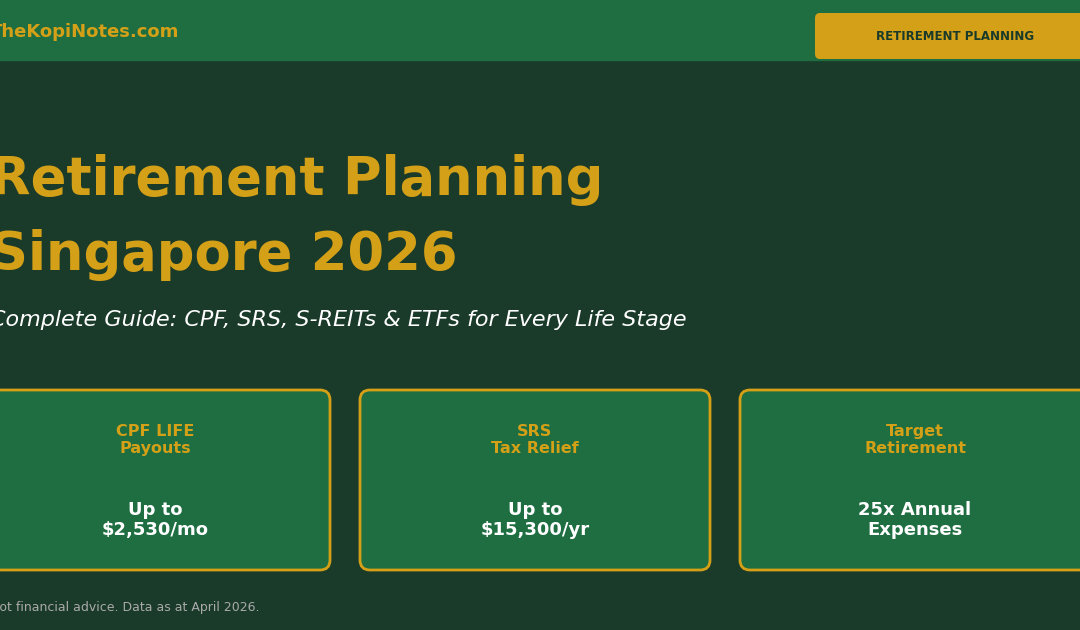
Retirement Planning Singapore 2026: Your Complete CPF, SRS & Investment Roadmap
Whether you are 25 and just started working, or 55 and eyeing the retirement finish line, Singapore offers one of the world’s most structured retirement systems — if you know how to use it. This guide breaks down every pillar of retirement planning in Singapore for 2026: CPF LIFE, the Supplementary Retirement Scheme (SRS), S-REITs, ETFs, and the numbers you need to hit at each life stage. Not financial advice — please consult a licensed adviser for your personal situation.
Table of Contents
Contents — Click to expand
- Why Retirement Planning Matters in Singapore 2026
- The Three Pillars of Singapore Retirement
- CPF LIFE: Your Lifelong Annuity
- CPF Milestones by Age
- Supplementary Retirement Scheme (SRS): Tax-Efficient Savings
- Investing for Retirement: S-REITs & ETFs
- Retirement Planning by Life Stage
- How Much Do You Need to Retire in Singapore?
- 5 Common Retirement Planning Mistakes
- Frequently Asked Questions
Why Retirement Planning Matters More Than Ever in Singapore 2026
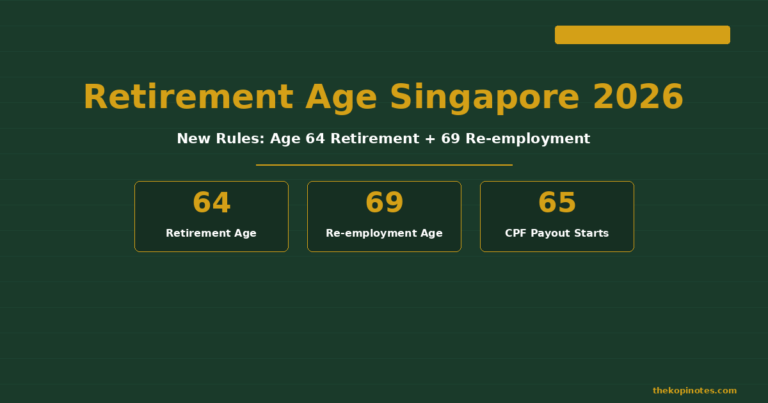
Singapore’s retirement landscape is shifting rapidly. The official retirement age rose to 64 in 2026 and the re-employment age to 69, giving workers more earning years — but also more complexity in planning. Meanwhile, CPF LIFE payouts have been enhanced, SRS contribution caps remain among the most tax-efficient tools available, and S-REITs continue delivering 5–7% dividend yields that can supplement CPF income.
The challenge is that most Singaporeans leave money on the table by not integrating all three pillars — CPF, SRS, and private investments — into a coherent plan. A 40-year-old with $200,000 in CPF OA earning 2.5% versus one who tops up the SA and invests via SRS can end up with a $300,000–$500,000 difference at retirement, purely from compounding and tax savings.
This guide will help you map out a personalised path using data current as at April 2026.
The Three Pillars of Singapore Retirement Planning
Singapore’s retirement architecture is built on three interlocking pillars. Understanding how they complement each other is the foundation of any solid plan.
| Pillar | Key Vehicle | 2026 Highlight | Best For |
|---|---|---|---|
| 1. CPF | OA / SA / RA / MA | FRS $213,000; ERS $426,000 | Guaranteed lifelong income via CPF LIFE |
| 2. SRS | SRS Account (bank) | Max $15,300/yr (citizens/PRs) | Tax deferral, flexible investment |
| 3. Private Investments | S-REITs, ETFs, stocks | S-REIT avg yield ~5.5–7% | Growth & passive dividend income |
The most effective strategy uses all three in concert: CPF provides the guaranteed floor, SRS provides tax savings plus flexible invested growth, and private investments in S-REITs and ETFs provide the upside and income layer on top.
CPF LIFE: Singapore’s Lifelong Annuity Explained (2026)
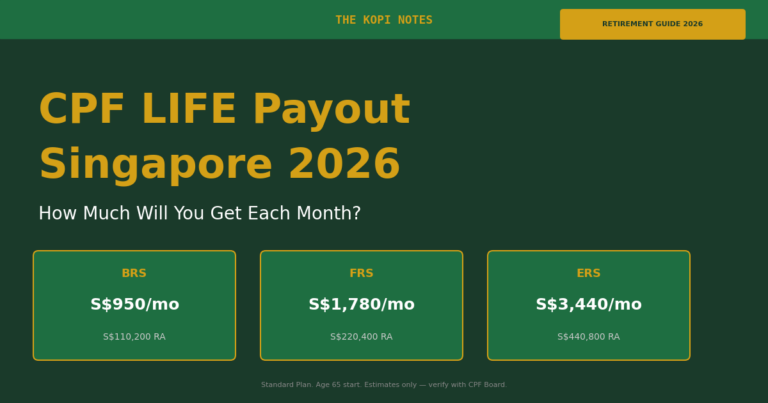
CPF LIFE (Lifelong Income For the Elderly) is the mandatory annuity scheme that pays you a monthly income from age 65 until death. As at 2026, the CPF LIFE monthly payouts for members who turn 65 are:
| CPF LIFE Plan | BRS (~$106,500) | FRS (~$213,000) | ERS (~$426,000) |
|---|---|---|---|
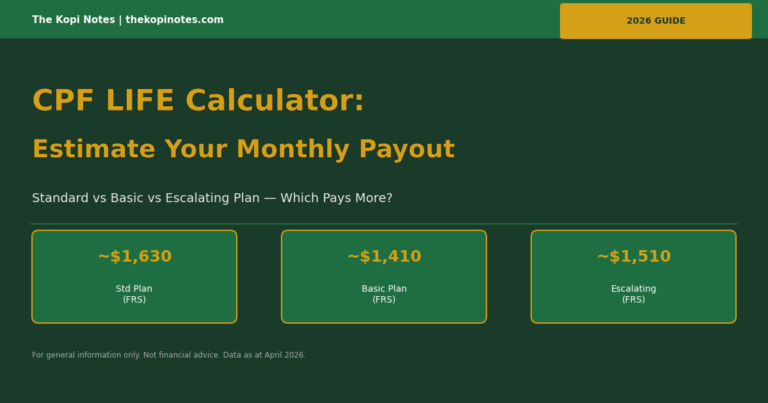
| Standard Plan | ~$800–$870/mo | ~$1,480–$1,600/mo | ~$2,380–$2,530/mo |
| Escalating Plan | ~$640–$700/mo | ~$1,180–$1,280/mo | ~$1,900–$2,020/mo |
| Basic Plan | ~$810–$880/mo | ~$1,510–$1,630/mo | ~$2,420–$2,570/mo |
Figures are estimates from CPF Board for members who join CPF LIFE at age 65 in 2026. Actual payouts depend on exact RA balance at 65 and prevailing CPF interest rates.
The Standard Plan is CPF Board’s default recommendation — it provides the highest monthly payout and leaves a smaller bequest. The Escalating Plan starts lower but increases by 2% each year, offering inflation protection over a long retirement. The Basic Plan preserves your whole RA balance as a bequest but offers no longevity protection beyond age 90.
For most Singaporeans, hitting the FRS ($213,000) or ERS ($426,000) in your RA should be the primary CPF retirement goal. Use the CPF LIFE Payout Calculator to model your specific scenario.
How to Boost Your CPF LIFE Payout
There are three main levers:
- Cash top-up to RA — top up to the ERS ($426,000) for maximum payout. You also get tax relief of up to $8,000/yr for personal top-ups.
- Delay payout start age — deferring CPF LIFE from 65 to 70 increases monthly payouts by approximately 6–7% per year of deferral.
- Top up SA before 55 — SA earns 4% p.a. (vs OA’s 2.5%), compounding into a larger RA at 55. This is the single most impactful CPF move for workers under 45.
CPF Milestones by Age (2026 Numbers)
Hit these milestones and your CPF is on track:
| Age | Key CPF Event | 2026 Benchmark | Action |
|---|---|---|---|
| 35 | Mid-career | SA ≥ $80,000 | Maximise SA top-up to BRS |
| 45 | Peak earning years | SA ≥ $150,000 | Consider CPFIS for OA balance > $20k |
| 55 | RA created from SA + OA | RA = FRS ($213,000) | Decide on BRS/FRS/ERS pledge |
| 63–64 | Retirement age (2026) | Plan income bridge 63→65 | Use SRS drawdown or dividends |
| 65 | CPF LIFE starts | RA ≥ FRS for $1,480+/mo | Start SRS withdrawal (10-yr spread) |
Use the Retirement Planning Calculator and CPF Retirement Sum Calculator to project exactly where you will land based on your current balances and contribution rate.
SRS: Singapore’s Most Under-Used Retirement Tax Tool
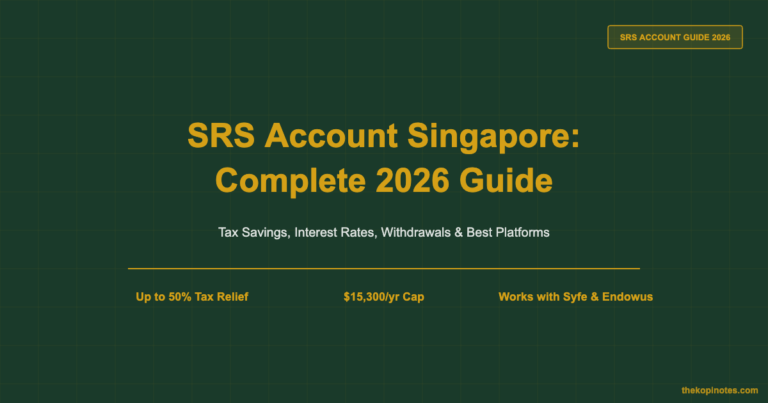
The Supplementary Retirement Scheme (SRS) is voluntary — and that is precisely why most Singaporeans miss it. Every dollar you contribute to SRS is deducted from your taxable income in that year, effectively reducing your income tax bill immediately. You only pay tax on withdrawals at retirement, and only on 50% of the amount withdrawn.
SRS 2026 Key Numbers
- Annual contribution cap: $15,300 (Singapore citizens & PRs); $35,700 (foreigners)
- Tax relief: Up to $15,300 deducted from chargeable income
- Effective tax saving: For someone in the 11.5% bracket, that is ~$1,760/yr saved
- Withdrawal age: SRS statutory retirement age is 63 (for accounts opened before 2021) or 63 (2026 effective date)
- Optimal drawdown: Spread withdrawals over 10 years from age 63 to minimise tax per year
What to Invest SRS Funds In?
SRS funds must be invested — they earn only 0.05% p.a. sitting idle in the bank. The most popular SRS investment options for Singapore investors in 2026 are:
- S-REIT ETFs — e.g. Lion-Phillip S-REIT ETF (CLR) for broad S-REIT exposure with ~5.5% yield
- Global ETFs — VWRA or IWDA for long-term equity growth via SRS (Endowus or FSMOne accept SRS funds)
- SGS Bonds / SSBs — capital-safe for near-retirees
- Robo-advisors — Endowus and Syfe both accept SRS for fee-efficient investing
Use the SRS Tax Savings Calculator to see exactly how much you save based on your income tax bracket.
Investing for Retirement: S-REITs & ETFs in 2026
CPF LIFE and SRS form the guaranteed and tax-sheltered layers. Your third pillar — private investments — provides the growth and passive income that supplements these. For Singapore investors, the two most practical retirement-oriented asset classes are S-REITs and broad market ETFs.
S-REITs: Dividend Income for Retirees
S-REITs distribute at least 90% of taxable income as dividends, and distributions to Singapore investors are tax-exempt at the individual level. In 2026, the average S-REIT yields roughly 5.5–7.0% depending on the sector, offering a reliable quarterly income stream that CPF LIFE can complement.
Top S-REIT picks for retirement income portfolios as at April 2026 (yields are approximate and not a recommendation):
| S-REIT | Sector | Approx. 2026 Yield | Gearing |
|---|---|---|---|
| Frasers Centrepoint Trust | Retail | ~5.8% | ~37% |
| Mapletree Industrial Trust | Industrial/Data Centre | ~6.4% | ~40% |
| Mapletree Logistics Trust | Logistics | ~7.2% | ~39% |
| CapitaLand Ascendas REIT | Industrial/Diversified | ~5.9% | ~38% |
Yields estimated from latest DPU data. Past yield is not a guarantee of future distribution. Data as at April 2026.
See the full Best S-REITs Singapore 2026 guide for a detailed comparison, or use the S-REIT Dividend Yield Calculator to compute returns on any holding.
ETFs: Long-Term Growth Layer
For the accumulation phase (20s to 50s), broad market ETFs provide diversified equity growth that S-REITs alone cannot. The two most popular options for Singapore investors in 2026:
- VWRA (Vanguard FTSE All-World) — 0.22% TER, ~3,500 stocks globally, available via SGX and IBKR. Ideal for accumulation-focused SRS portfolios.
- IWDA (iShares Core MSCI World) — 0.20% TER, developed markets only. Lower volatility than VWRA, but excludes emerging market upside.
These ETFs are best held for 15–30 years and gradually rebalanced toward income-generating S-REITs and bonds as retirement approaches — the classic “glide path” strategy.
Retirement Planning by Life Stage: What to Do at Every Age
In Your 20s: Build the Foundation
- Prioritise SA top-up: every dollar in SA earns 4% guaranteed and compounds aggressively over 35–40 years
- Open an SRS account immediately (no minimum contribution) to lock in the statutory retirement age at the current figure
- Start ETF investing (VWRA or IWDA via Syfe or FSMOne) with even $100/month — compounding rewards early starters most
- Build a 3–6 month emergency fund first before investing beyond CPF
In Your 30s: Accelerate
- Max out SA top-up ($8,000/yr personal top-up for tax relief, up to FRS)
- Contribute $5,000–$15,300/yr to SRS — the tax savings compound meaningfully at this income level
- Start building a core S-REIT position (2–3 S-REITs across sectors) for dividend income practice
- Review insurance coverage — a critical but overlooked retirement risk is a major illness in your 40s derailing savings. Use the Insurance Gap Calculator to quantify your exposure
In Your 40s: Consolidate and Protect
- Check if SA is near the FRS — if so, redirect top-up effort to RA top-up after 55 or increase SRS contributions
- Review CPF OA balance — if over $20,000, consider CPFIS (CPF Investment Scheme) to invest excess OA in SGX-listed blue chips or ETFs
- Shift ETF portfolio gradually: reduce pure equity exposure and add dividend ETFs or S-REITs
- Model your retirement number using the Retirement Planning Calculator
In Your 50s: Fine-Tune
- At 55, your SA + OA sweeps into a Retirement Account (RA). Decide at this point whether to set aside BRS (pledge property), FRS, or ERS for CPF LIFE
- Maximise RA top-up to ERS ($426,000) for the highest monthly payout — up to $2,530/mo on Standard Plan
- Begin systematic SRS withdrawal planning: drawdown over 10 years from age 63 to stay within lower tax brackets
- Reduce higher-risk equity exposure; build a “two-bucket” portfolio — liquid income assets for years 1–5, growth assets for years 6+
How Much Do You Need to Retire in Singapore?
The classic financial planning rule of thumb is the 25x annual expenses rule (also known as the 4% safe withdrawal rate). If you spend $4,000/month ($48,000/year) in retirement, your portfolio target is $48,000 × 25 = $1,200,000.
For Singapore, this calculation needs a few adjustments:
| Monthly Spending | CPF LIFE (FRS) | Gap to Fill | Portfolio Needed (25x) |
|---|---|---|---|
| $2,500/mo | $1,540/mo | $960/mo | $288,000 |
| $4,000/mo | $1,540/mo | $2,460/mo | $738,000 |
| $6,000/mo | $1,540/mo | $4,460/mo | $1,338,000 |
CPF LIFE FRS payout estimate ~$1,480–$1,600/mo used as $1,540 average. Portfolio calculation assumes 4% real withdrawal rate. Does not account for SRS income or rental income.
The good news: Singapore’s government subsidies (Medishield Life, GST vouchers, Pioneer/Merdeka packages) and the absence of capital gains tax or dividend withholding tax on S-REITs mean the effective cost of retirement is lower than these raw numbers suggest. Many Singaporeans find that CPF LIFE + $4,000–$8,000/mo from S-REIT dividends covers a comfortable retirement lifestyle entirely.
Use the CPF FIRE Number Calculator to find your exact retirement target accounting for CPF LIFE, SRS, and investment income.
5 Common Retirement Planning Mistakes Singapore Investors Make
- Leaving SA idle in the default OA — The OA earns only 2.5% vs SA’s 4%. Many employees never actively top up their SA, losing decades of 1.5% compounding. For a 30-year-old with $30,000 to top up, that gap is worth over $50,000 more at age 55 in SA versus OA.
- Not opening an SRS account early — Your SRS statutory retirement age is locked to the date you open the account. Open it early even with a $100 deposit. If you wait until 63 to open it, you cannot withdraw without penalty until 73 (10 years later). Opening at 30 lets you withdraw from 63 onwards.
- Over-concentrating in a single S-REIT — S-REITs are excellent income vehicles, but individual REITs carry sector and sponsor risk. Diversify across at least 3–4 REITs across retail, industrial, and logistics sectors to smooth distribution risk.
- Withdrawing SRS in a lump sum — Taking your entire SRS balance in one year means the full 50% taxable amount may push you into the 17–22% bracket. Spreading withdrawals over 10 years (e.g., $80,000/yr from a $800,000 SRS) keeps you in the 0–7% effective rate range.
- Treating CPF LIFE as the only retirement plan — CPF LIFE at FRS pays ~$1,540/mo. That is below the living wage for most Singaporeans. It is a guaranteed floor, not a ceiling. Build the second and third pillars (SRS + private investments) in parallel — do not wait until 50 to start.
Start Investing for Retirement Today
Open an Endowus or Syfe account to invest your SRS funds and CPF OA in low-cost, diversified funds. Both platforms are licensed by MAS and accept SRS and CPFIS investments.
Frequently Asked Questions: Retirement Planning Singapore 2026
How much CPF do I need to retire comfortably in Singapore?
When should I start retirement planning in Singapore?
Is SRS worth it for retirement planning in Singapore?
Can I use CPF for investing in S-REITs?
What is the retirement age in Singapore in 2026?
How do I invest SRS funds in Singapore?
What happens to my CPF if I retire before 65?
This article was researched with the help of AI. While we strive to keep all information accurate and up to date, there may be errors. If you notice any discrepancies, please contact us.